 Eurasia Press & News
The Gulf’s role as one of the world’s most important aviation crossroads is being tested as conflict with Iran disrupts airspace across the Middle East, forcing airlines to redraw the flight paths that connect Europe, Asia and Australasia.
Airspace restrictions have narrowed the corridors available to commercial aviation, pushing airlines onto alternative routes that bypass large parts of the Gulf.
It has also meant passengers transiting through the region have been stranded either in local airports or at the point of travel.
Ged Tod, an IT director from the UK, said he booked a trip to Thailand back in August 2025 flying with Gulf Air via Bahrain.
“We saw tensions rising in January and February, but I don’t think anyone in the world expected what happened,” he told AGBI.
His plane ride back to the UK was cancelled when hostilities began at the end of February and a subsequent Gulf Air flight was also scrapped as airspace over Bahrain remained closed.
Bahrain’s aviation sector has arguably been hit the hardest as a result of the Iranian airstrikes, with almost 98 percent of all Gulf Air flights to and from the country cancelled, according to data from aviation analytics company Cirium.
Gulf Air has been operating a threadbare service from Saudi Arabia’s Dammam airport on a temporary basis.
For Tod, it means a two-week holiday has now entered its fourth week. He had rebooked with Emirates and was scheduled to fly from Bangkok to Dubai on Monday evening, but awoke to read about the latest attack near Dubai International Airport, which saw Emirates suspend operations.
“It’s not looking likely that we’ll get home today,” he said. “We booked these tickets at £1,600 [$2,100] each. We could have gone via Singapore or China, but aside from the fact it would be a 40-hour journey, tickets were coming in at £4,000 per person. It was silly money.”
The shift is exposing the strategic importance of the Gulf’s hub model, which relies on airlines funnelling passengers through mega-airports such as Dubai International, Hamad International in Doha and Zayed International in Abu Dhabi.
John Grant, a partner at Midas Aviation and AGBI columnist, said around 159,000 flights were expected to pass through Middle Eastern airspace in February alone, underlining the scale of traffic normally flowing via the region.
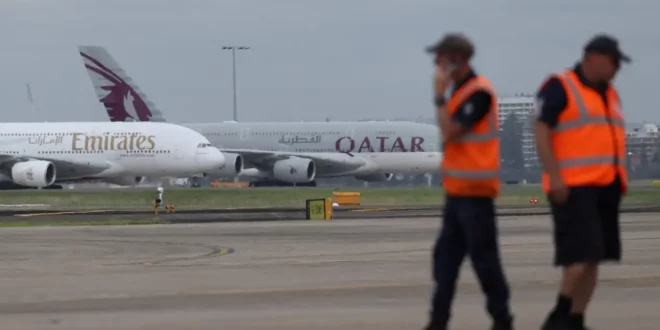
Together the region’s three largest carriers, Emirates, Qatar Airways and Etihad Airways, normally transport more than half of all passengers travelling between Europe and Australasia, including Australia, New Zealand and nearby Pacific markets, according to Cirium data.
Emirates alone operates more than 13 percent of flights between Europe and Asia, Cirium data shows.
In the short term, however, the biggest beneficiaries may lie beyond the Gulf. As airlines search for safe east-west corridors, traffic has been diverted through the Caucasus and Central Asia.
Azerbaijan, Georgia and Armenia have been the biggest beneficiaries, according to Linus Bauer, founder of aviation consultancy BAA & Partners.
He said other countries benefiting from the new routing patterns include Saudi Arabia and Oman, which are absorbing flights between South Asia and Europe that might previously have crossed Iranian or Iraqi airspace.
Further north, Kazakhstan and Uzbekistan are also handling higher volumes.