 Eurasia Press & News
For nearly two decades, the Litani River functioned as an informal red line in the uneasy balance between Israel and Hezbollah.
Under United Nations Security Council Resolution 1701, which ended the 2006 Lebanon War, the area south of the river was meant to be free of heavy Hezbollah military presence, while Israeli ground incursions beyond it remained politically and strategically constrained.
For over 20 years, that framework has failed, especially over the last two years of conflict. The ceasefire following the 2024 Israel-Hezbollah war was a non-starter. It mandated an Israeli withdrawal from southern Lebanon and required Hezbollah to pull back north of the Litani, with the Lebanese army filling the void. Neither was achieved.
Hezbollah remained south of the river and Israel, far from withdrawing, oversaw more than 10,000 violations of Lebanese airspace and over 1,400 military activities inside Lebanese territory, according to UNIFIL. It also continued to occupy five strategic hilltops.
The ceasefire, in retrospect, was less a peace agreement than a pause – one that allowed Hezbollah to re-group and Israel to consolidate its position in the south, thereby fanning the conditions for more fighting, regardless of the Iran war.
Last week’s news that Israeli forces pushed north of the Litani – the furthest such advance since 1982 – signals not merely an escalation, but an abandonment of the post-2006 order altogether.
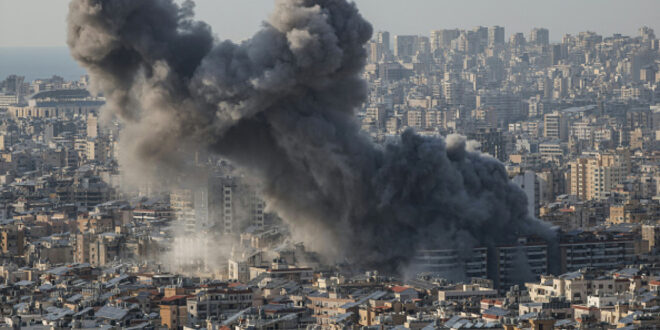
Israel has issued evacuation orders for 14% of the country’s territory, including much of southern Lebanon, alongside sweeping orders for Beirut’s southern suburbs of Dahiyeh on 5 March. On the same day, Israeli Finance Minister Bezalel Smotrich stood at the Lebanese border and told the world that “Dahiyeh will look like Khan Younis”.
As in the 2024 war, around one million people have been displaced. But unlike two years ago, Israel’s current invasion suggests a more far-reaching campaign of occupation; one that threatens permanent displacement and Gaza-like destruction.
Bulldozing from the sky
For Dr Zahera Harb, an academic at City St George’s, University of London, the current war triggers an acute sense of repetition.
“We’re living in 1982 again,” she told The New Arab. “Israel is invading deep into Lebanon, and the country is utterly divided around how we should respond to Israeli aggression. It’s the same political cycle, with a new geopolitical context.”
Harb, however, is quick to add that the comparison only goes so far. Today, Israel’s military means and goals are categorically more destructive, she argues.
“We have villages without one house standing. We didn’t see that level of bulldozing, from the sky and from the ground, when Israel invaded in 1978 and then 1982.”
Paul Salem, vice president for international engagement at the Middle East Institute, draws a similar parallel with his own caveats.
“1982 had a regime change goal. It removed the PLO and installed a new president. It was a whole political project,” he told TNA.
Today’s campaign is narrower but no less consequential: the creation of a buffer zone in south Lebanon, enforced through displacement and destruction, rather than political transformation.
The Gaza playbook
To understand what is happening in southern Lebanon, one must look to Gaza, says Harb.
“What Israel is doing now is a continuation of what they have done in Gaza,” she says. “They would not be able to carry out this kind of destruction and displacement – in Dahiyeh and the villages of the south – if they’d been stopped over there. And now they’re talking about buffer zones and no man’s land, just like they did in Palestine”.
Following its application in Gaza, Israel is now actively deploying what has become known as ‘yellow line’ tactics in southern Lebanon – a strategy aimed at carving out a depopulated area between northern Israel and Hezbollah.
The ‘yellow line’ concept, which emerged during Israel’s ongoing war in Gaza, is a progressively expanding security strip, cleared of civilians and infrastructure, that allows the Israeli military to operate with minimal constraint. In Lebanon, that model is now being adapted, says Harb.
Israeli leaders have openly discussed the creation of a ‘clean’ or sterile zone along the border, one in which no Lebanese villages would remain. Their justification for this is that distance equals security, thereby reducing the risk of cross-border attacks.
In practice, the strategy has meant large-scale evacuation orders reaching deep into southern Lebanon – tens of kilometres from the border – alongside systematic destruction of villages and infrastructure. As in Gaza, the yellow line is not fixed. It will likely expand and contract as the Israeli army sees fit.
For Harb and many other critics, this is not a temporary wartime measure but the foundation of a long-term occupation. “Israel talks about security, but we know that they also want water and land,” she says. “We’ve heard Israeli politicians gloat about Lebanon as part of Greater Israel.”
The logic of overwhelming force
Israel’s current campaign reflects a doctrine that has hardened through repeated cycles of inconclusive conflict.
Nadim Shehadi, a Lebanese political analyst and fellow at Chatham House, frames it with blunt strategic clarity. “If you were Benjamin Netanyahu,” he asks, “would you stop halfway again and then face the same problem in two years?”
The answer, he suggests, increasingly appears to be no. After engagements in 2006, in 2024, and across the years between, the calculus in Netanyahu’s office seems to have shifted toward something more permanent or dramatic.
“Their doctrine is to inflict as much destruction as possible,” Shehadi told TNA. “They want to use the opportunity to destroy as much Hezbollah infrastructure as possible. Maybe they think they can also turn people against Hezbollah. If so, it’s the wrong way to achieve it.”
Salem explains Israel’s violence, particularly its strategy of displacement, not as a byproduct of the campaign but as one of its central instruments.
“By emptying the villages and towns, they create a [demographic shift and humanitarian crisis],” he says.
This displacement has a three-part logic: to clear areas Israel wants to occupy or maintain as no-man’s land; to create zones it can strike at will; and to put enormous political pressure on Hezbollah, thereby straining its relationship with its own constituency and with other Lebanese factions.
However, Salem does not believe Israel wants Lebanon to collapse entirely. “I don’t think they want civil war in Lebanon, as that would only ultimately strengthen Hezbollah, who have the strongest military wing (and are the only political party in Lebanon with a formalised military wing)”.
A country without agency
Underlying all of this is another crisis: the inability of the Lebanese state to act as a state, for both external and internal reasons.
“The security strategy that the Lebanese people are being asked to accept is the security paradigm that Israel approves,” Harb says. “There is no agency for the Lebanese. It’s either the security that fits within the Israeli structure, or not.”
While the Lebanese state is held hostage by Israel’s military might, other commentators like Shehadi emphasise that the country is also being held hostage by Hezbollah’s Iran-funded military wing, which is more powerful than the Lebanese Armed Forces.
The result is a political stalemate that Israel uses to justify its wars, with Lebanese civilians absorbing the brunt each time.
His prescription is stark: Lebanon needs a full-blown and non-violent parliamentary confrontation with Hezbollah. “Maybe we’ll do it after the war,” he says, “over the rubble.”
Violence will not disarm Hezbollah
Central to Israel’s strategy is the assumption that sustained military pressure can permanently degrade Hezbollah. Few analysts believe this.
“Israel will not be able to de-weaponise Hezbollah by military intervention,” Harb says flatly. “Nor can they actually get rid of Hezbollah as a party and idea, as much as they couldn’t get rid of the PLO, despite deporting them from Beirut in 1982.”
Salem agrees, though he frames the conditions for change in regional terms. “I don’t see Hezbollah being disarmed unless the Iranian government falls, or if Iran comes to a deal with the US that includes Hezbollah’s disarmament.” Neither prospect, he concedes, seems likely in the near term.
The most probable outcome, in his assessment, is another prolonged stalemate: an Israeli military presence in parts of southern Lebanon, continued pressure, and an entrenched Hezbollah, with the population continuing to bear the cost of the impasse.
“As long as Israel’s military occupies South Lebanon, there will be military resistance,” says Harb. “Remember: the resistance movement in South Lebanon didn’t begin with Hezbollah. There were leftist, Marxist and nationalist groups long before them.”
In any case, what is unfolding in Lebanon today risks permanently redrawing the country’s physical and demographic landscape in ways that have not been seen for many decades.
The advance beyond the Litani, as well as the adoption of Gaza-style tactics, mass displacement and the systematic destruction of villages, all point to an Israeli strategy that is more brutal and unchecked than ever before.
If Gaza provided the tactical template for Israel’s approach in Lebanon, it may also have established the precedent for the international response. “One thing Gaza taught us is that international law has been fully abandoned,” says Harb.
Salem is equally sober. “Western countries did nothing about Gaza,” he says. “So, Israel is quite clear that nobody will do anything of substance to stop them.”