 Eurasia Press & News
Key Takeaways
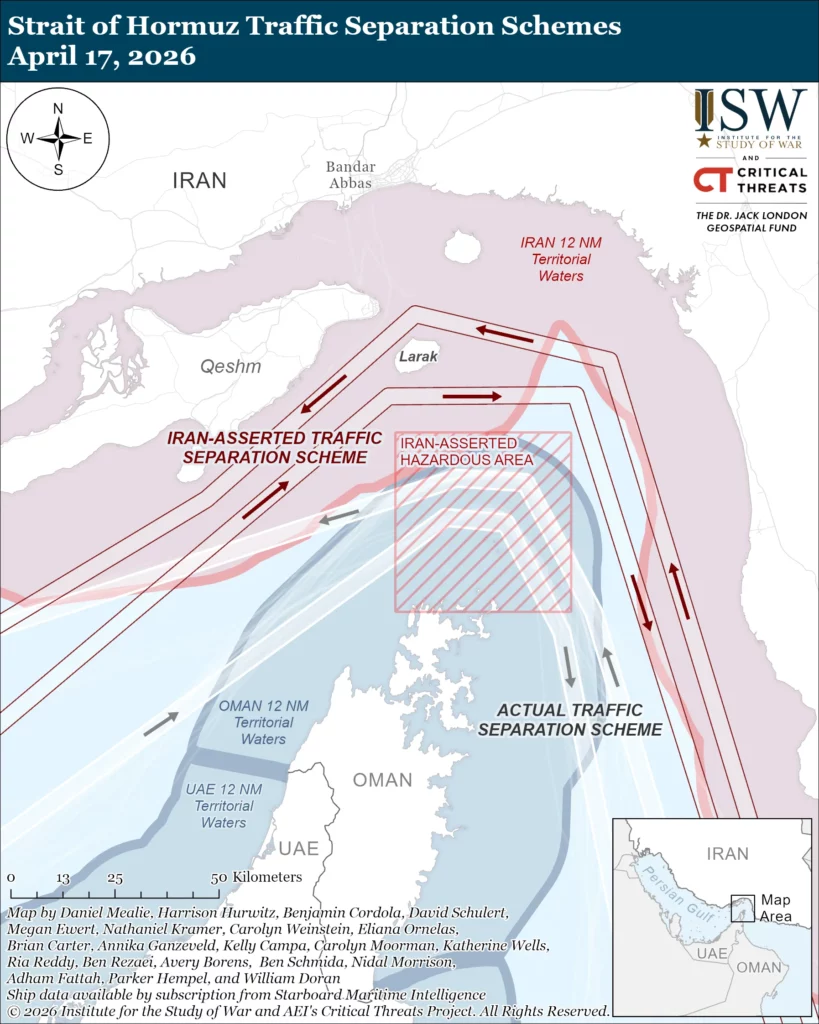
The Islamic Revolutionary Guards Corps (IRGC), which is the Iranian entity that has disrupted shipping in the Strait of Hormuz during the war, outlined specific conditions on April 17 for vessels to transit the strait that amount to Iran retaining control over maritime traffic through the strait. These conditions include: 1) only commercial vessels not “related to belligerent countries” may transit the strait, 2) vessels must transit the strait via Iran’s approved transit route through Iranian territorial waters, and 3) vessels must coordinate their passage through the strait with Iranian forces. These conditions indicate that the IRGC seeks to retain operational control over transit through the strait, likely to continue to use the strait as a point of leverage to try to extract concessions from the United States.
The IRGC harshly criticized Iranian Foreign Affairs Minister Abbas Araghchi after Araghchi announced on X that the Strait of Hormuz is “completely open.” The IRGC’s criticism of Araghchi is reflective of broader divisions within the Iranian regime, which CTP-ISW has consistently reported on in recent weeks.
Commercially available maritime data shows that no Iranian-linked vessels approached the US blockade line on April 17, and US officials have stated that US forces will engage Iranian-linked vessels beyond this line. CENTCOM announced on April 17 that 19 vessels have complied with US direction to turn around and that zero vessels have successfully breached the blockade. Commercially available maritime data shows that some non-Iranian-linked vessels have approached the US blockade line to exit the strait. These ships do not fall under the US blockade and are able to freely transit in and out of the strait.
There continue to be significant gaps between the US and Iranian negotiating positions, and the status of the negotiations remains unclear. The two sides disagree on several core issues, according to US, Iranian, and other officials and sources on April 16 and 17.
Some Iranian regime officials seek a preliminary agreement to extend the ceasefire to continue negotiations for a more comprehensive agreement. CTP-ISW previously noted that Iran is exploiting the current ceasefire to reorganize and regenerate its ballistic missile force, and Iran would almost certainly continue to do so if the United States and Iran agreed to a preliminary agreement and extended the ceasefire.
Toplines
The Islamic Revolutionary Guards Corps (IRGC), which is the Iranian entity that has disrupted shipping in the Strait of Hormuz during the war, outlined specific conditions on April 17 for vessels to transit the strait that amount to Iran retaining control over maritime traffic through the strait.[1] IRGC- and Armed Forces General Staff- affiliated media emphasized that the “temporary opening” of the strait is contingent upon vessels meeting certain conditions.[2] An informed source close to the Supreme National Security Council (SNSC) told IRGC-affiliated Fars News that Iran’s conditions include:
Only commercial vessels can transit the strait, and military vessels are prohibited from doing so. Vessels and the cargo they carry cannot “be related to belligerent countries.”[3]
Ships must pass through the Iranian-approved transit route, which forces vessels to transit the strait through Iranian territorial waters.[4]
Vessels must coordinate their passage through the strait with Iranian forces, particularly the IRGC Navy.[5]
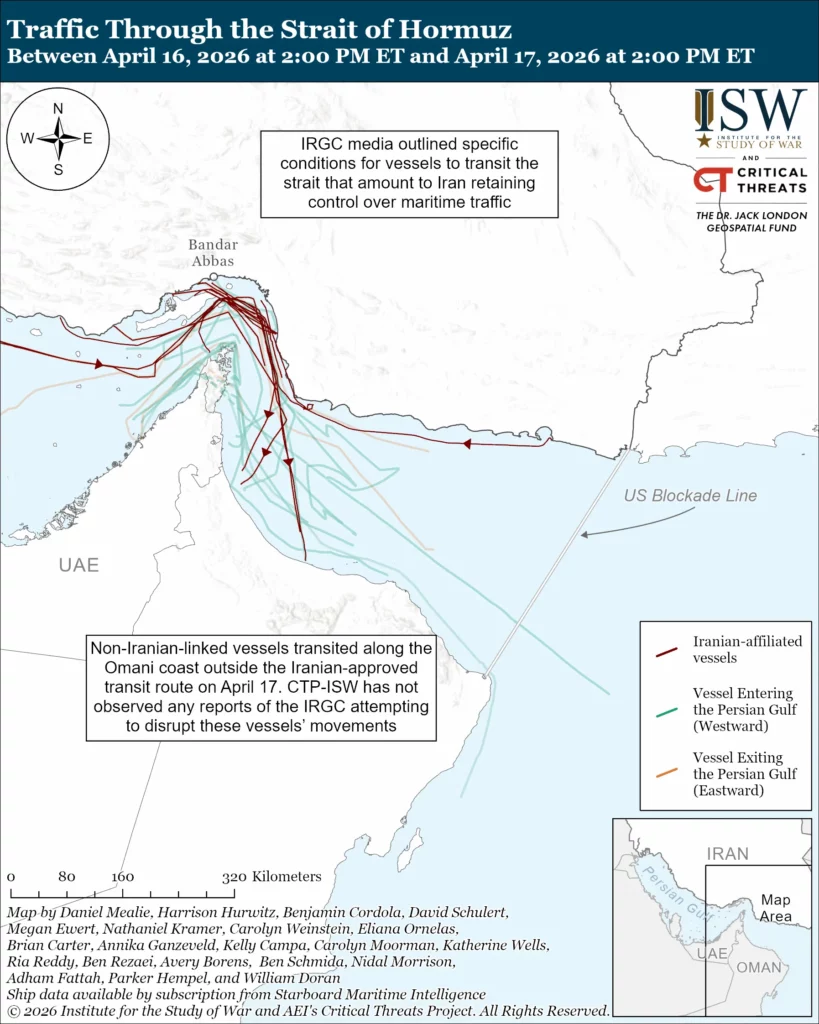
These conditions indicate that the IRGC seeks to retain operational control over transit through the strait, likely to continue to use the strait as a point of leverage to try to extract concessions from the United States. The source close to the SNSC added that Iran will “close” the strait again if the naval blockade continues.[6] Iranian forces have not conducted an attack on international shipping since April 7.[7] Ten non-Iranian-linked vessels transited along the Omani coast outside the Iranian-approved transit route on April 17, and CTP-ISW has not observed any reports of the IRGC attempting to disrupt these vessels’ movements.[8]
The IRGC harshly criticized Iranian Foreign Affairs Minister Abbas Araghchi after Araghchi announced on X that the strait is “completely open.”[9] Araghchi stated that, in line with the ceasefire in Lebanon, the Strait of Hormuz is “completely open” to “all commercial vessels” for the duration of the ceasefire.[10] Araghchi added that vessels must transit along Iran’s “coordinated route,” in reference to the Iranian-approved transit route.[11] US President Donald Trump amplified Araghchi’s statement that the strait is open.[12] IRGC-affiliated media outlets, including Fars News and Mehr News, criticized Araghchi’s post and argued that his statement created confusion, which allowed Trump to shape the narrative about the Strait of Hormuz.[13] Iranian Foreign Affairs Ministry Spokesperson Esmail Baghaei defended Araghchi’s statement and said that the decision to “open” the Strait of Hormuz was “not solely the decision of the Foreign Affairs Ministry.”[14]
The IRGC’s criticism of Araghchi is reflective of broader divisions within the Iranian regime, which CTP-ISW has consistently reported on in recent weeks.[15] Anti-regime media previously reported that internal disagreements within the regime disrupted the Islamabad talks and prompted senior Iranian officials to order the Iranian negotiating delegation to return to Tehran.[16] These reports suggest that different factions within the Iranian regime have very different negotiating positions. The factional infighting in the regime has been exacerbated by the death of former Supreme Leader Ali Khamenei, who used to cohere the regime’s various factions and act as an arbiter between the factions. The absence of a strong leader to keep IRGC factions in line means that these factions will likely continue to play a dominant role in shaping Iranian decision-making.
Commercially available maritime data shows that no Iranian-linked vessels approached the US blockade line on April 17, and US officials have stated that US forces will engage Iranian-linked vessels beyond this line.[17] US forces are enforcing a blockade on Iranian ports, not the strait itself.[18] CENTCOM announced on April 17 that 19 vessels have complied with US direction to turn around and that zero vessels have successfully breached the blockade.[19] Commercially available maritime data shows that some non-Iranian-linked vessels have moved toward the US blockade line to exit the strait.[20] These ships do not fall under the US blockade and are able to freely transit in and out of the strait. The Wall Street Journal reported on April 17 that at least five Iranian-linked tankers heading from the Gulf of Oman to Malaysia altered course after the US Navy warned that it could intercept ships transporting Iranian oil in international waters.[21]
There continue to be significant gaps between the US and Iranian negotiating positions, and the status of the negotiations remains unclear. The two sides disagree on several core issues, according to US, Iranian, and other officials and sources on April 16 and 17.[22] US President Donald Trump has continued to press for the complete removal of Iran’s highly enriched uranium (HEU) stockpile from Iran, while Iran appears unwilling to surrender all of its enriched uranium.[23] The parties also remain divided over Iran’s ability to enrich uranium. Iran has proposed a five‑year pause in enrichment, while previous reports indicated that US negotiators discussed a 20‑year moratorium on uranium enrichment.[24] President Trump said on April 17 that any agreement must go beyond a fixed timeframe and ensure that Iran can never acquire a nuclear weapon, however.[25] Trump also denied claims that the United States would unfreeze $20 billion USD worth of Iranian assets in exchange for Iran’s HEU stockpile.[26] Iranian officials have argued that a ceasefire in Lebanon must be part of Iran’s ceasefire with the United States, a demand that Trump rejected on April 17 by insisting that a US–Iran deal would “in no way [be] subject to Lebanon.”[27]
Some Iranian regime officials seek a preliminary agreement to extend the ceasefire to continue negotiations for a more comprehensive agreement. A senior Iranian official told Reuters on April 17 that Iran is pursuing an interim agreement to “create space for more talks on lifting sanctions on Iran and securing compensation for war damages.”[28] The official added that Iran would provide “assurances” to the international community about the peaceful nature of its nuclear program in exchange.[29] CTP-ISW previously noted that Iran is exploiting the current ceasefire to reorganize and regenerate its ballistic missile force, and Iran would almost certainly continue to do so if the United States and Iran agreed to a preliminary agreement and extended the ceasefire.[30]
US and Israeli Air Campaign
The IDF killed around 1,000 Basij members and other unspecified internal security personnel during its campaign against Iran.[31] The IDF targeted internal security and political figures at every echelon, from senior leaders such as Supreme Leader Ali Khamenei, Supreme National Security Council (SNSC) Secretary Ali Larijani, and Basij Organization Commander Brigadier General Gholamreza Soleimani to low-ranking Basij members manning checkpoints.[32] CTP assessed on March 19 that Israeli strikes on internal security forces likely caused shock and confusion within the Iranian internal security apparatus to some degree.[33] This effect may have been temporary, however, given that shock will dissipate if strikes on internal security targets subside.
Combined force strikes severely degraded Iran’s steel and petrochemical production capacity.[34] The IDF estimated that combined force strikes during the campaign damaged 40 percent of Iran’s steel production capacity and 75 percent of Iran’s petrochemical production capacity.[35] Steel and petrochemicals are among Iran’s most important exports and support both economic and military activity. The US naval blockade is currently disrupting Iran’s ability to export these goods and imposing further economic costs on Iran.[36] Iran halted petrochemical exports on April 13, at least in part due to the blockade. Strikes on Iran’s steel and petrochemical production facilities will also likely make it more difficult for Iran to reconstitute its ballistic missile program.[37]
The IDF estimated that it damaged 23 percent of Iran’s gas processing capacity.[38] The IDF struck some of Iran’s most important energy infrastructure, including facilities at the South Pars Gas Field in Bushehr Province.[39] These facilities are central to Iran’s domestic natural gas supply and broader energy system.[40]
The IDF destroyed Iran’s two satellite launchers during the campaign.[41] The Iranian Space Agency oversees satellite launches with the IRGC Aerospace Force and Iranian Ministry of Defense and Armed Forces Logistics (MODAFL).[42] The IDF struck the Iranian Space Research Center, which is a subsidiary of the Iranian Space Agency, on March 14, likely to disrupt Iranian space and missile-related research that could support long-range strike capabilities.[43] The US Defense Intelligence Agency (DIA) has assessed that Iran’s space launch vehicle program could enable the regime to develop a militarily viable intercontinental ballistic missile by 2035 if it chose to pursue the capability, which highlights US concerns about the overlap between Iran’s space launch vehicle program and intercontinental ballistic missile development.[44] The combined force destroyed the satellite launch site at the Shahroud Space Complex in Semnan Province during the war.[45] The IDF also noted on March 29 that it struck a site in eastern Tehran that produces satellite launchers.[46]
Iranian Response
Nothing significant to report.
Israeli Campaign Against Hezbollah and Hezbollah Response
Israel and Hezbollah began implementing the 10-day temporary ceasefire at 5:00 PM ET on April 16. Israeli and Lebanese officials agreed to a 10-day temporary ceasefire, which includes six provisions, on April 16.[47] The temporary ceasefire stipulates that Israel will not conduct any offensive military operations but reserves the right to act in self-defense against any “planned, imminent, or ongoing” Hezbollah threats against Israel.[48] This provision is similar to the clause in the November 2024 Israel-Hezbollah ceasefire that also granted Israel the right to self-defense.[49] Some OSINT journalists have noted that the April 16 ceasefire grants Israel a broader scope to operate against Hezbollah.[50] US President Donald Trump stated on April 17 that Israel will not “be bombing Lebanon any longer” and that the United States is prohibiting Israeli forces from doing so.[51] Israeli forces have continued to conduct ground operations to destroy Hezbollah infrastructure in southern Lebanon since the ceasefire took effect on April 16.[52]
Israeli, Lebanese, and Hezbollah officials continue to disagree on long-standing issues despite the temporary ceasefire. The April 16 ceasefire does not stipulate that Israeli forces must withdraw from Lebanese territory or that Hezbollah must disarm.[53] Israeli officials, including Defense Minister Israel Katz, have stated that Israel will respect the ceasefire, but noted that Israeli forces will retain positions in southern Lebanon.[54] Israeli Prime Minister Benjamin Netanyahu stated that the IDF is “not done” in Lebanon and that progress depends on Hezbollah’s disarmament.[55] Lebanese President Joseph Aoun reiterated on April 17 that the Lebanese government seeks to halt Israeli operations in Lebanon, secure an Israeli withdrawal from Lebanon, extend the state’s authority over all Lebanese territory, and secure the return of Lebanese prisoners held in Israel.[56] Hezbollah Political Council member Wafiq Safa told the BBC on April 17 that Hezbollah will “never, ever” disarm.[57] Safa added that Hezbollah will not disarm until Israeli forces withdraw from Lebanon, return Lebanese prisoners, and agree to a “real” ceasefire.[58] Hezbollah parliamentarian Hassan Ezzedine noted on April 17 that Hezbollah is committed to the ceasefire under the condition that it “restricts the [IDF’s] freedom of aggressive movement” and leads to an Israeli withdrawal from Lebanon.[59]
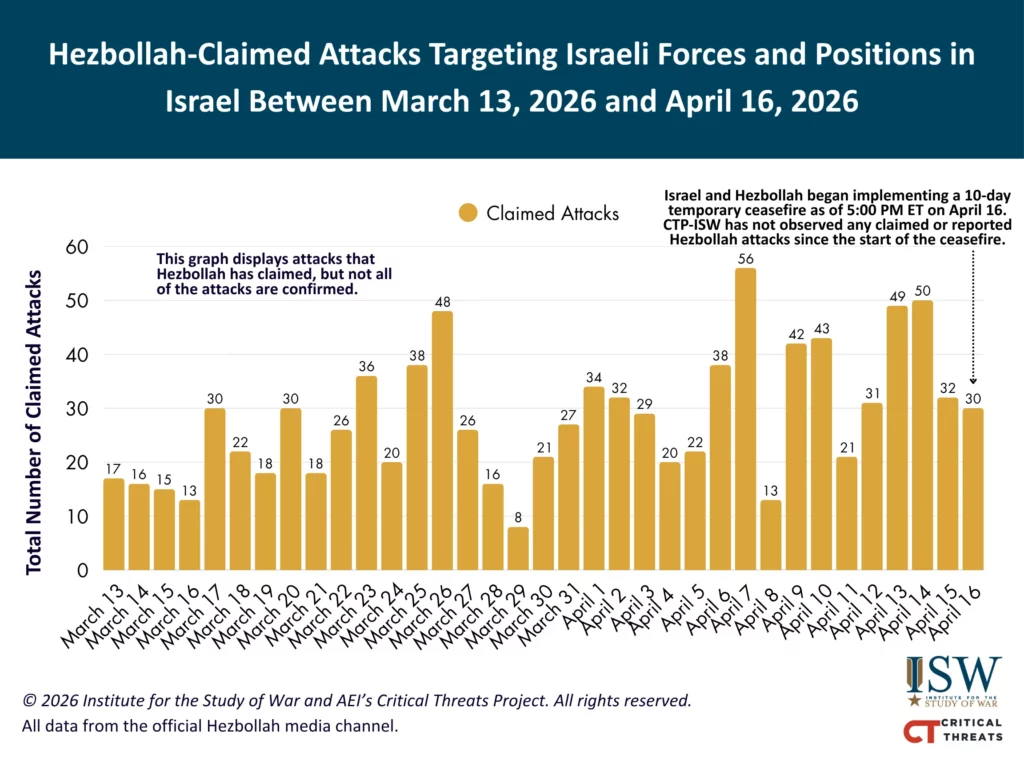
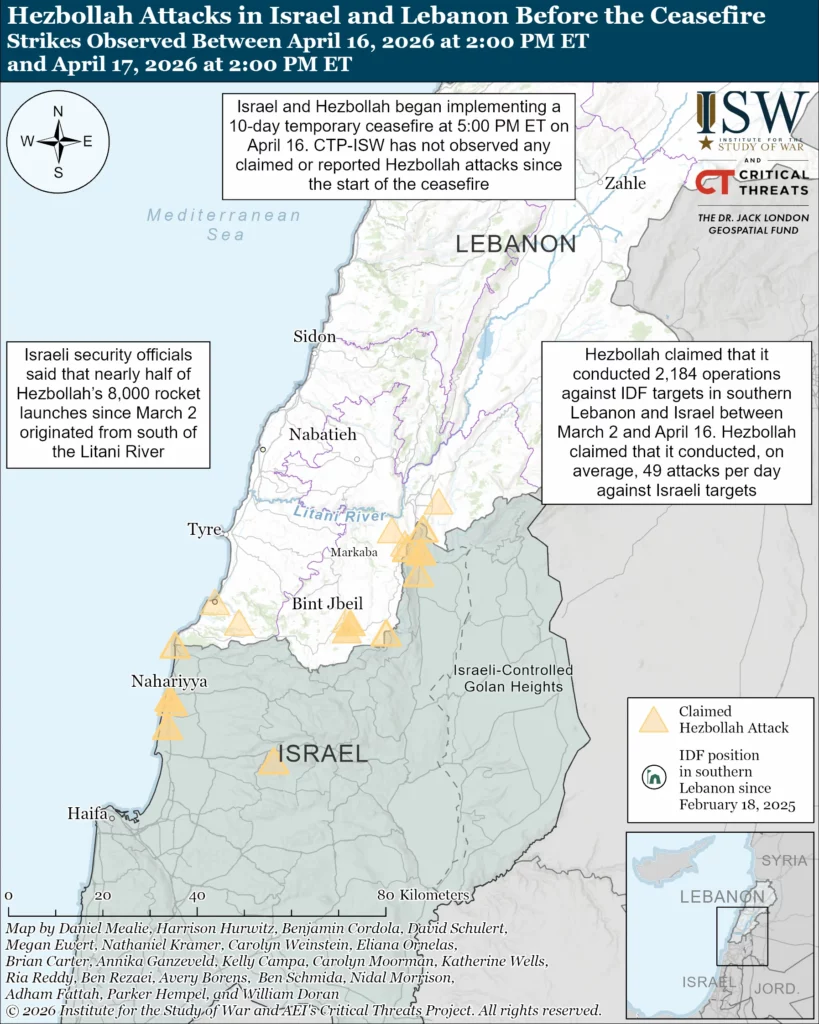
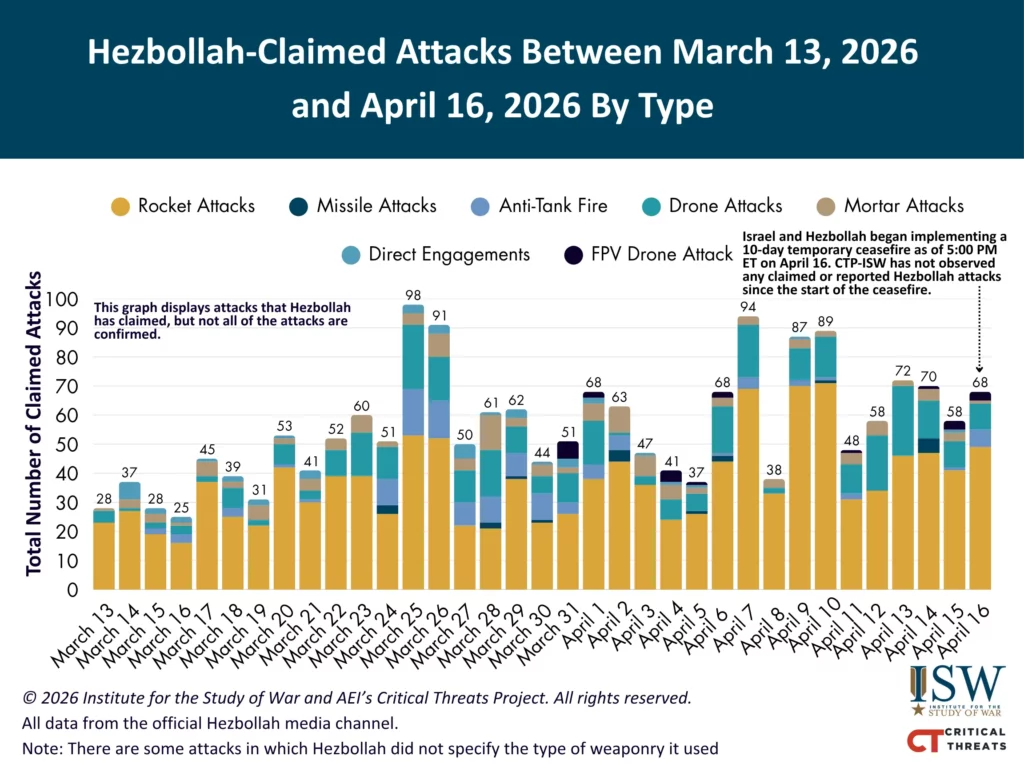
CTP-ISW has not observed any claimed or reported Hezbollah attacks since the start of the ceasefire at 5:00 PM ET on April 16. Hezbollah claimed 16 attacks targeting IDF infrastructure and Israeli communities in northern Israel between 2:00 PM ET and 5:00 PM ET on April 16 .[60] Israeli journalists reported that Hezbollah rocket barrages, which included around 30 rockets in total, injured three civilians in Karmiel and Nahariya, both in northern Israel, on April 16 prior to the start of the ceasefire.[61] CTP-ISW has not observed any Israeli reports of Hezbollah attacks or impacts in northern Israel since the start of the ceasefire. Hezbollah claimed that it conducted 2,184 operations against IDF targets in southern Lebanon and Israel between March 2 and April 16.[62] Hezbollah claimed that it conducted, on average, 49 attacks per day against Israeli targets.[63] The IDF announced on April 17 that Hezbollah launched around 8,000 rockets and missiles at Israeli targets in Israel and Lebanon since March 2.[64] The IDF said that a third of Hezbollah missile and rocket launches targeted sites in Israel and two-thirds targeted IDF units operating in Lebanon.[65] The IDF reported that 75 rockets struck locations in Israel.[66] The Wall Street Journal reported that nearly half of Hezbollah’s 8,000 rocket launches since March 2 originated from south of the Litani River, according to Israeli security officials.[67] The IDF also said that Hezbollah launched 300 drones at Israeli targets, 25 of which hit their intended targets.[68] Hezbollah also fired 140 anti-tank guided missiles (ATGM), 15 of which hit their intended targets, according to the IDF.[69]
Hezbollah claimed 13 attacks targeting Israeli forces in southern Lebanon between 2:00 PM ET and 5:00 PM ET on April 16.[70] Hezbollah claimed that it conducted rocket and anti-tank guided missile attacks targeting IDF units in the vicinity of Bint Jbeil and Ainata, Bint Jbeil District, southeastern Lebanon, before the start of the ceasefire.[71] The IDF said that it completed its “siege” of Bint Jbeil, on April 15.[72] Hezbollah also claimed that it detonated multiple improvised explosive devices (IED) targeting four IDF tanks attempting to advance north from Tayr Harfa to Majdal Zoun, both located in Tyre District, southwestern Lebanon.[73]
The IDF and Israeli officials provided an overview of the IDF’s recent operations against Hezbollah. Netanyahu said that the IDF has destroyed 90 percent of Hezbollah’s 150,000 rocket and missile stockpile that Hezbollah built up under former Hezbollah Secretary General Hassan Nasrallah.[74] The IDF announced on April 17 that it has dropped 5,000 munitions on targets in Lebanon since the beginning of the campaign on March 2.[75] The IDF also said that it killed around 1,700 Hezbollah operatives and destroyed “hundreds” of rocket launchers.[76] The IDF separately announced that it struck over 380 Hezbollah sites in southern Lebanon in the 24 hours prior to the ceasefire.[77] The IDF reported that it targeted Hezbollah fighters, command centers, and rocket launchers in the strikes.[78]
Israeli Air Force Unit 5101 “Shaldag” special forces soldiers captured the Christophani Ridge near Mount Hermon on April 16, prior to the start of the ceasefire.[79] The IDF capture of this ridge provides Israel with a key reconnaissance position as the ridge overlooks the Bekaa Valley region in Lebanon and the Beirut-Damascus highway.[80]
Lebanese media reported that the IDF conducted two separate airstrikes on vehicles in Haris and Kounine, both in Bint Jbeil District, southeastern Lebanon, after the start of the ceasefire on April 16 and 17, respectively.[81] The IDF has not commented on either reported strike at the time of this writing.
Other Axis of Resistance Response
Nothing significant to report.