 Eurasia Press & News
Toplines
Officials in Russian regions that the Kremlin has historically sought to shield from the effects of the war in Ukraine are beginning to acknowledge the impacts of Ukrainian long-range drone strikes in the Russian rear. Leningrad Oblast Governor Alexander Drozdenko told the Leningrad Oblast regional assembly on April 15 that Leningrad Oblast has become a “frontline oblast,” explicitly noting recent Ukrainian strikes against “economic and port” facilities in the oblast.[1] Drozdenko later published a post on his Telegram channel on April 17 stating that Russian authorities will bolster air defenses in Leningrad Oblast, including by providing additional material and tactical assistance to the Russian 6th Air Force and Air Defense Army (Russian Aerospace Forces [VKS] and the Leningrad Military District [LMD]).[2] Drozhenko stated that authorities will also begin recruiting reservists to form mobile fire groups to be stationed near industrial facilities and critical infrastructure. Drozdenko stated that reservists will sign military service contracts for up to three years through the Leningrad Oblast Military Registration and Enlistment Office and specifically called for veterans of the war in Ukraine or others with combat experience to volunteer. Ukraine’s recent successful long-range strike campaign against Russian port and oil infrastructure in Leningrad Oblast is likely forcing Russian regional authorities in areas deep in the rear to acknowledge the impact of Ukrainian strikes against critical infrastructure targets in Russia and Russia’s intensifying need to defend them.
Drozdenko’s statements suggest that Leningrad Oblast authorities may be preparing to conduct unpopular, limited compulsory reserve callup to defend critical infrastructure in the region.[3] The Russian Ministry of Defense (MoD) announced plans in October 2025 to deploy active reservists to protect infrastructure in deep Russian rear from Ukrainian drone strikes, though Russia’s existing efforts so far have not been sufficient to protect Russia’s dispersed industrial targets from Ukrainian strikes.[4] Leningrad Oblast officials may also be intensifying the ongoing Russian internet censorship campaign, at least in part to set conditions for compulsory reserve callup and prevent Ukrainian forces from using the internet connection to conduct drone strikes. Drozdenko warned on April 17 about possible reductions in mobile internet speed and St. Petersburg residents noted internet outages on the morning of April 17 and criticized Russians who complain about the internet outages by asking what these Russians are doing to help win the war.[5] Ukrainian forces have increasingly conducted long-range strikes against Russian oil and port infrastructure in Leningrad Oblast since March 2026, exploiting overstretched Russian air defenses and significantly damaging Russian oil export capabilities.[6] Ukrainian strikes are likely forcing Russia to deploy more resources to defend critical infrastructure in the Russian rear, which could restrain Russia from deploying those assets, including reservists, to the frontlines in Ukraine in the future.
Russian state polls are acknowledging growing societal discontent with Russian President Vladimir Putin against the backdrop of mounting war sacrifices and an unpopular censorship campaign. Russian state-owned polling institution All-Russian Public Opinion Research Center (VTsIOM) published on April 17 the results from a poll for the week of April 6 to 12, indicating that Russian President Vladimir Putin’s approval rating declined for the sixth week in a row from 72.9 percent during the week of March 2 to 8 to 66.7 percent during the week of April 6 to 12.[7] VTsIOM indicated that Putin’s approval ratings have declined from 72.9 percent from the week of March 2 to 8. VTsIOM polling also indicates that trust in Putin fell 1.8 percent to 72 percent during the week of April 6 to 12, down from 77.3 percent during the week of March 2 to 8. VTsIOM polling indicated that the level of support for the Kremlin’s ruling United Russia party fell to 27.3 percent during the week of April 6 to 12 from 32.1 percent during the week of March 2 to 8. The numbers from a Russian state polling organization are not reliable by themselves, but it is notable that a state-controlled institution is acknowledging a weekslong trend of growing domestic discontent with the federal government after four years of war. Other polling agencies also indicate that Russians are growing increasingly discontent with the Kremlin. Independent Russian polling organization Levada Center reported on April 16 that 61 percent of Russians have a negative opinion of the current political situation in Russia, including 52 percent who consider the political situation “tense” and nine percent who consider the situation “critical and explosive” — an increase of nine percent since May 2025.[8] The Levada Center polling also indicates that the percentage of Russians who have a positive view of the political situation in Russia fell to 36 percent since May 2025. The Kremlin has recently faced a downturn in support amidst intensified efforts to throttle access to Telegram and continues shutting down mobile internet in certain areas, increasingly censoring and imposing tangible hardships in the everyday lives of Russians as a result of the war.[9] The Russian domestic populace may also be growing increasingly tired as Russia continues its fourth year of war, especially as the total Russian casualty rate in Ukraine approaches one percent of the overall population.[10]
Russian seaborne oil exports have reportedly fallen following an escalation in Ukraine’s long-range strike campaign against Russian oil infrastructure and ports. Russian business newspaper Kommersant reported on April 16 that Russian seaborne oil exports in mid-April 2026 fell to the lowest level since Summer 2024 and noted that exports could fall to their lowest level since 2023 by the end of April 2026.[11] Kommersant cited a review from the Center for Price Indices (CCI) that Russia reduced its seaborne oil exports by 16.1 percent to 291,000 tons from April 6 to 12 due to Ukrainian strikes against port infrastructure. Kommersant noted that the port of Novorossiysk experienced the sharpest decline of seaborne oil exports, dropping by 73.2 percent to a total export volume of 19,000 tons, but noted that the Baltic Sea ports of Primorsk and Ust-Luga did not experience drops in seaborne oil exports between April 6 and 12. ISW continues to assess that Russia’s ability to sell oil is partially a function of its ability to transport it, and continued Ukrainian drone strikes will degrade Russia’s ability to transport oil.[12]
Ukrainian forces reportedly successfully operated a Sting interceptor drone at a range of 2,000 kilometers amid continued technical innovations to combat Russia’s long-range drone campaign. Ukrainian drone manufacturer Wild Hornets, which manufactures the Sting interceptor drone, announced on April 17 that a Ukrainian pilot used the Hornet Vision Ctrl remote piloting system to operate a Sting drone in northern Ukraine from abroad at a range of 2,000 kilometers.[13] Wild Hornets noted that the Hornet Vision Ctrl system previously enabled a Ukrainian Sting drone to intercept two Russian long-range Shahed drones at a range of 500 kilometers. The Sting drone is designed to combat Shahed jet-powered drones and can fly over 340 kilometers per hour and at a maximum altitude of 3,000 meters.[14] The Ukrainian defense industry continues to adapt and produce interceptor drones to more effectively counter Russia’s long-range drone strike drone capabilities.[15]
Ukraine continues to conclude joint production agreements with German defense industrial companies to support Ukraine’s air defense capabilities by expanding joint production efforts. Ukrainian defense industrial cooperation platform Council of Gunsmiths CEO Ihor Fedirko reported on April 14 that Ukrainian and German companies concluded six new cooperation agreements, including an agreement between Ukrainian strike drone and cruise missile producer Fire Point and German air defense systems manufacturer Diehl Defense on producing anti-ballistic missile systems.[16] Ukrainian defense company TAF Industries and German counter-drone system manufacturer THYRA signed on April 17 a memorandum of strategic cooperation under the Build with Ukraine program for the serial joint production of interceptor drones in Germany.[17] Ukraine and Germany recently signed 10 bilateral agreements on the supply of air defenses to Ukraine.[18] ISW continues to assess that expanded defense industrial cooperation with Western partners, including Germany, will bolster Ukraine’s defenses against intensifying Russian long-range strikes while enabling allies to bolster their own domestic defense industrial bases (DIBs).[19]
Key Takeaways
Officials in Russian regions that the Kremlin has historically sought to shield from the effects of the war in Ukraine are beginning to acknowledge the impacts of Ukrainian long-range drone strikes in the Russian rear.
Russian state polls are acknowledging growing societal discontent with Russian President Vladimir Putin against the backdrop of mounting war sacrifices and an unpopular censorship campaign.
Russian seaborne oil exports have reportedly fallen following an escalation in Ukraine’s long-range strike campaign against Russian oil infrastructure and ports.
Ukrainian forces reportedly successfully operated a Sting interceptor drone at a range of 2,000 kilometers amid continued technical innovations to combat Russia’s long-range drone campaign.
Ukraine continues to conclude joint production agreements with German defense industrial companies to support Ukraine’s air defense capabilities by expanding joint production efforts.
Ukrainian forces recently advanced near Slovyansk and in the Dobropillya tactical area.
Russian forces launched 172 long-range drones and one missile against Ukraine. Ukrainian forces continued their strike campaign against military assets in Russian border oblasts.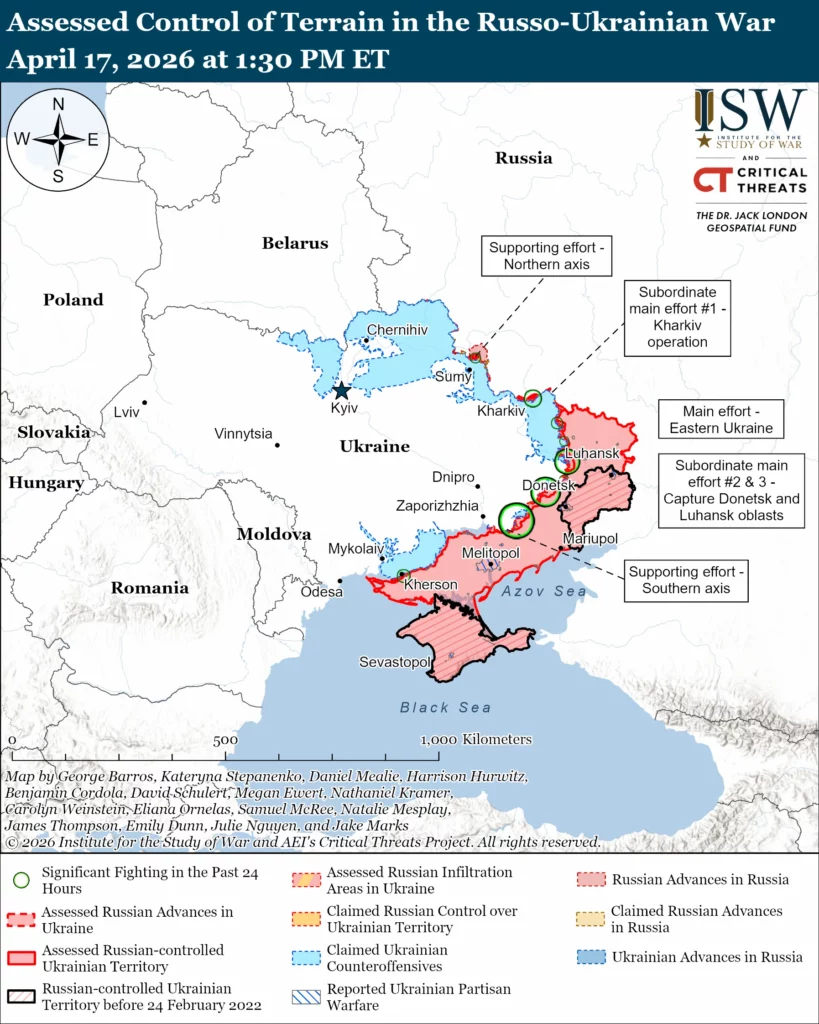
We do not report in detail on Russian war crimes because these activities are well-covered in Western media and do not directly affect the military operations we are assessing and forecasting. We will continue to evaluate and report on the effects of these criminal activities on the Ukrainian military and the Ukrainian population and specifically on combat in Ukrainian urban areas. We utterly condemn Russian violations of the laws of armed conflict and the Geneva Conventions and crimes against humanity even though we do not describe them in these reports.
Note: ISW is adjusting how we write the axis sections of the Russian Offensive Campaign Assessment. ISW will start collecting reader feedback on the changes shortly. ISW will temporarily cease publishing Russian ORBAT information on April 17-19. ISW will resume publishing Russian ORBAT information in a new format on April 20. ISW will continue collecting ORBAT information in this period and can make it available to selected readers upon request. Please contact [email protected] for any request for information.
Ukrainian Operations in the Russian Federation
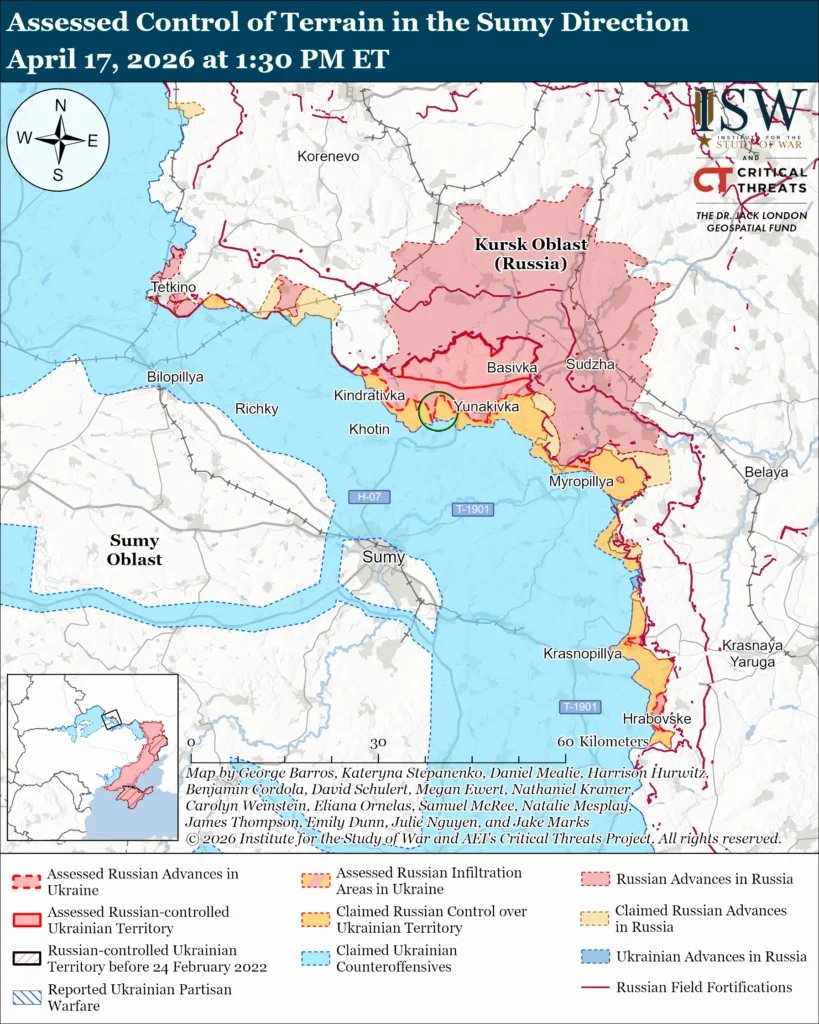
Ukrainian forces recently struck drone control assets near the Kursk Oblast border, likely in an attempt to inhibit Russian offensive operations in the Sumy direction. The Ukrainian General Staff reported that Ukrainian forces struck a Russian drone control point near Tetkino, Kursk Oblast on April 16 or the night of April 16 to 17.[20]
The Ukrainian General Staff reported that a strike on April 16 destroyed a Russian Nebo-B radar station in Chernovets, Belgorod Oblast and that a strike on April 15 destroyed a Podlyot radar station in Novomarievka, Rostov Oblast.[21]
Russian Supporting Effort: Northern Axis
Russian objective: Create defensible buffer zones in Sumy Oblast along the international border
Russian forces continued offensive operations and battlefield air interdiction (BAI) efforts in northern Sumy Oblast on April 17 but did not advance.[22]
Russian Main Effort: Eastern Ukraine
Russian Subordinate Main Effort #1 – Kharkiv Oblast
Russian objective: Push Ukrainian forces back from the international border to create a defensible buffer zone with Belgorod Oblast and approach to within tube artillery range of Kharkiv City
Russian forces continue to use small group infiltration missions to falsely claim the seizures of Ukrainian settlements in northern Kharkiv Oblast. Geolocated footage published on April 17 shows Ukrainian forces striking a Russian-occupied building in eastern Zybyne (northeast of Kharkiv City) after what ISW assesses was a Russian infiltration mission.[23] The Russian Ministry of Defense (MoD) claimed that Russian forces seized Zybyne, and Russian milbloggers credited elements of the Russian 69th Motorized Rifle Division (6th Combined Arms Army [CAA], Leningrad Military District [LMD]) and 71st Guards Motorized Rifle Division (14th Army Corps [AC], LMD) with the alleged seizure.[24]
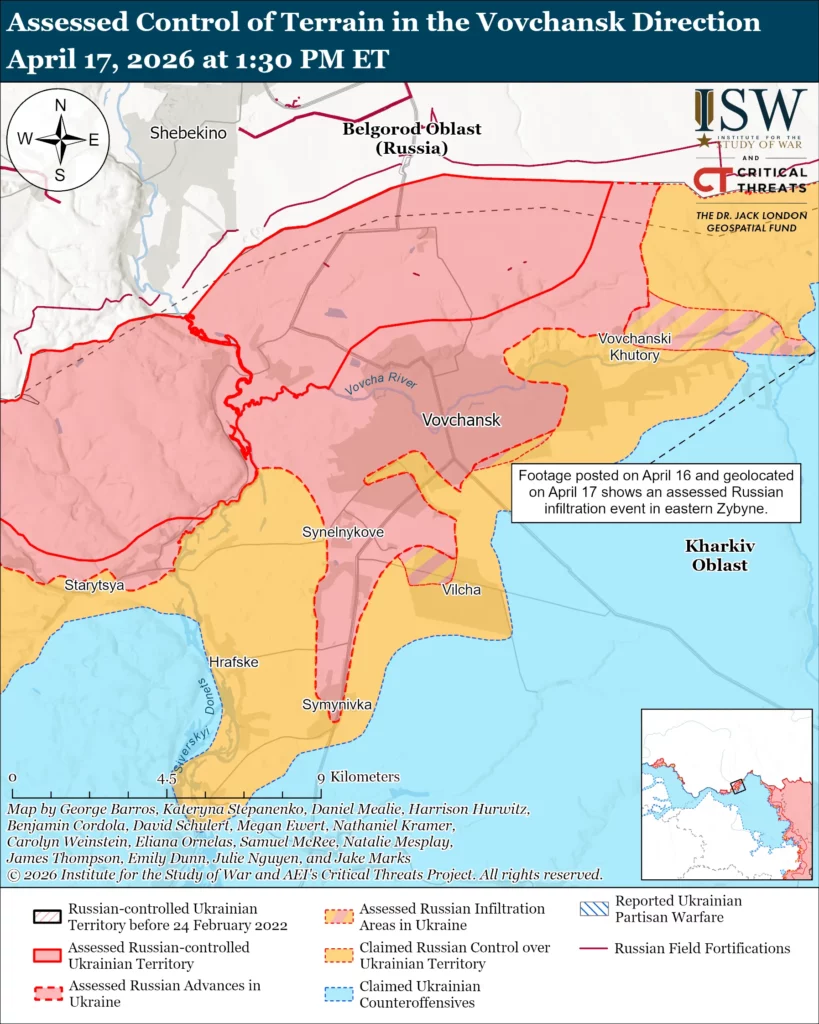
Russian forces are reportedly preparing for future assaults near and within Vovchansk (northeast of Kharkiv City), a settlement for which Russian forces have been fighting since May 2024 and lost control of in Fall 2022. Ukraine’s 16th AC reported on April 17 that Russian forces have been accumulating forces near Vovchansk for the past week (since roughly April 10) for future attacks toward Vovchanski Khutory (just east of Vovchansk) and Vilcha (just south of Vovchansk).[25] The 16th AC reported that Russian forces are focusing on crossing the Vovcha River and gaining a foothold in southern Vovchansk.
Neither Ukrainian nor Russian sources reported Russian ground attacks in the Velykyi Burluk direction on April 17.
Russian Subordinate Main Effort #2 – Oskil River
Russian objective: Cross the Oskil River in Kharkiv Oblast and push westward into eastern Kharkiv Oblast and northern Donetsk Oblast
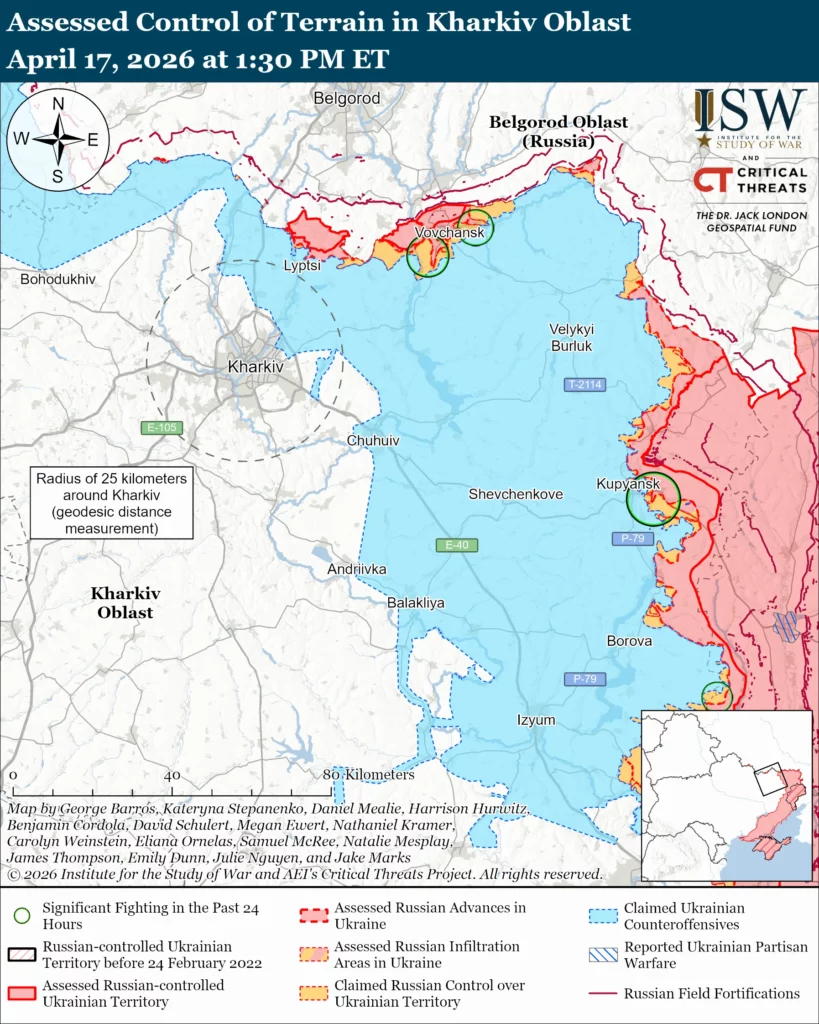
Russian forces continued offensive operations in the Kupyansk direction on April 17, primarily using small infantry groups and infiltration tactics, but did not advance.[26] Neither Ukrainian nor Russian sources reported Russian ground attacks in the Borova direction on April 17.
Ukrainian forces continued their mid-range strike campaign against Russian military assets in occupied Luhansk Oblast roughly 75 to 150 kilometers from the frontline. The Ukrainian General Staff reported that Ukrainian forces struck a Russian command and observation post near Dovhe (roughly 75 kilometers from the frontline), an ammunition depot near Dovzhansk (roughly 150 kilometers from the frontline), a materiel depot near Sabivka (roughly 85 kilometers from the frontline), and a fuel and lubricant depot near Rovenky (roughly 125 kilometers from the frontline) on April 16 or the night of April 16 to 17.[27]
Russian Subordinate Main Effort #3 – Donetsk Oblast
Russian objective: Capture the entirety of Donetsk Oblast, the claimed territory of Russia’s proxies in Donbas, and advance into Dnipropetrovsk Oblast
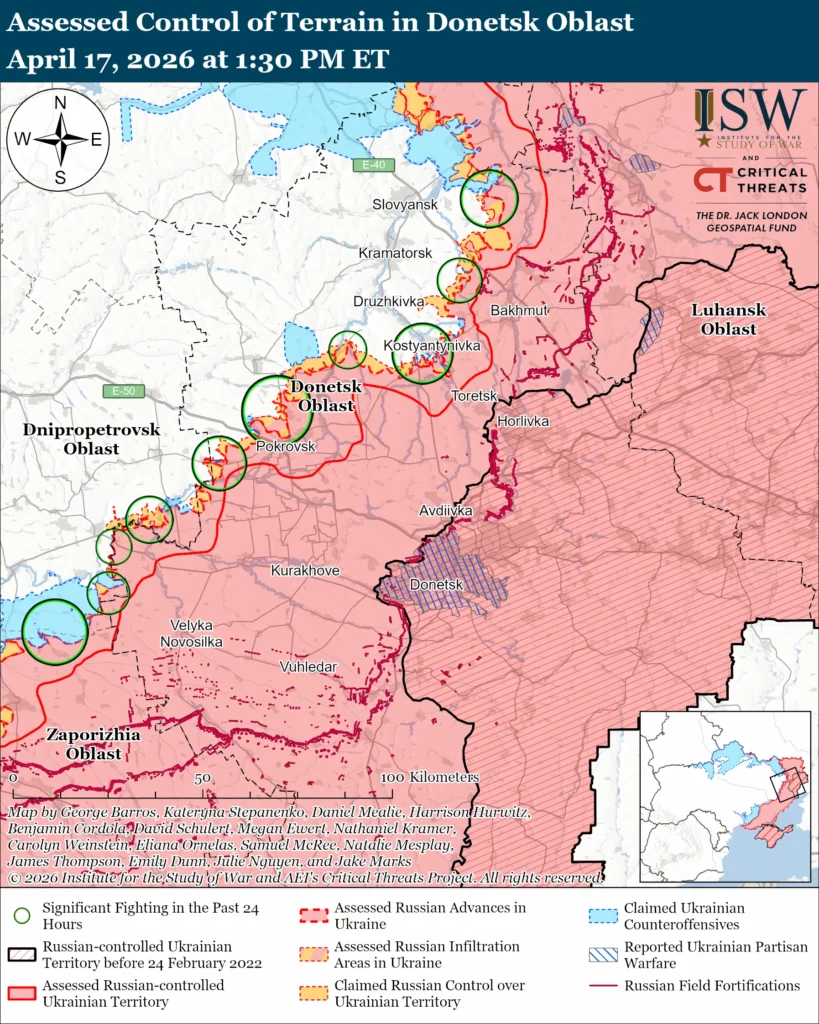
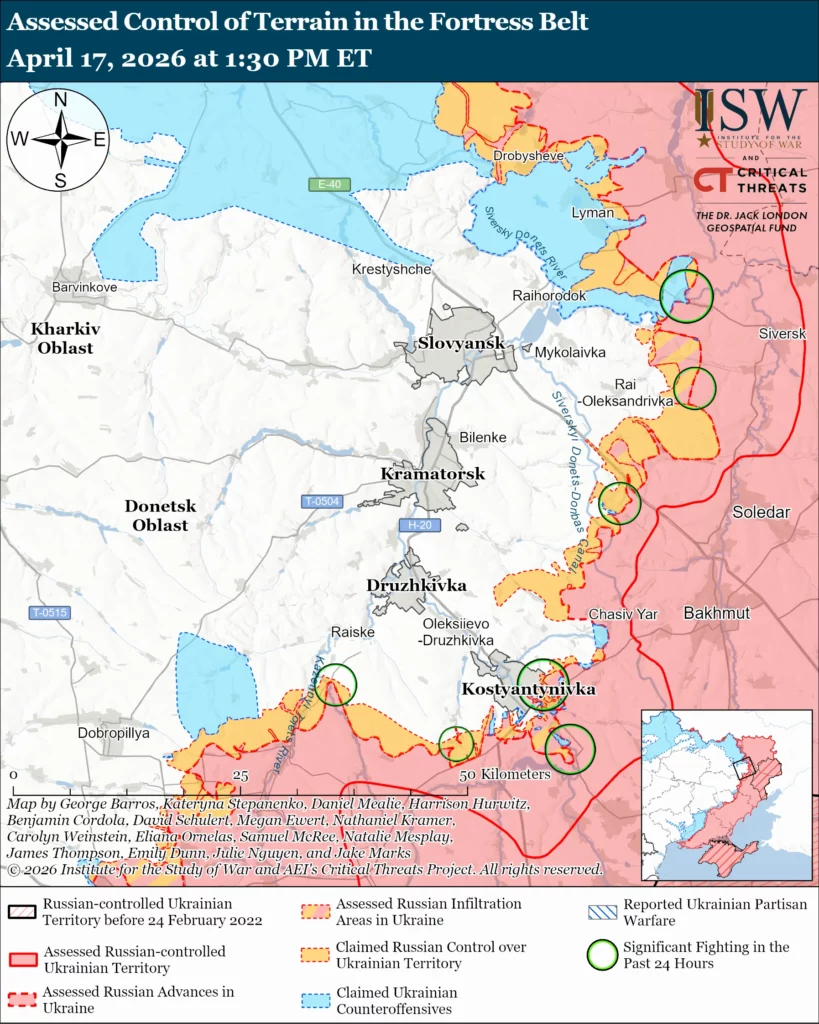
Ukrainian forces recently advanced in the Slovyansk direction and continued limited counterattacks.[28] Geolocated footage published on April 16 shows Russian forces striking a Ukrainian-occupied trench northwest of Zarichne (northeast of Lyman), indicating that Ukrainian forces recently advanced in the area.[29]
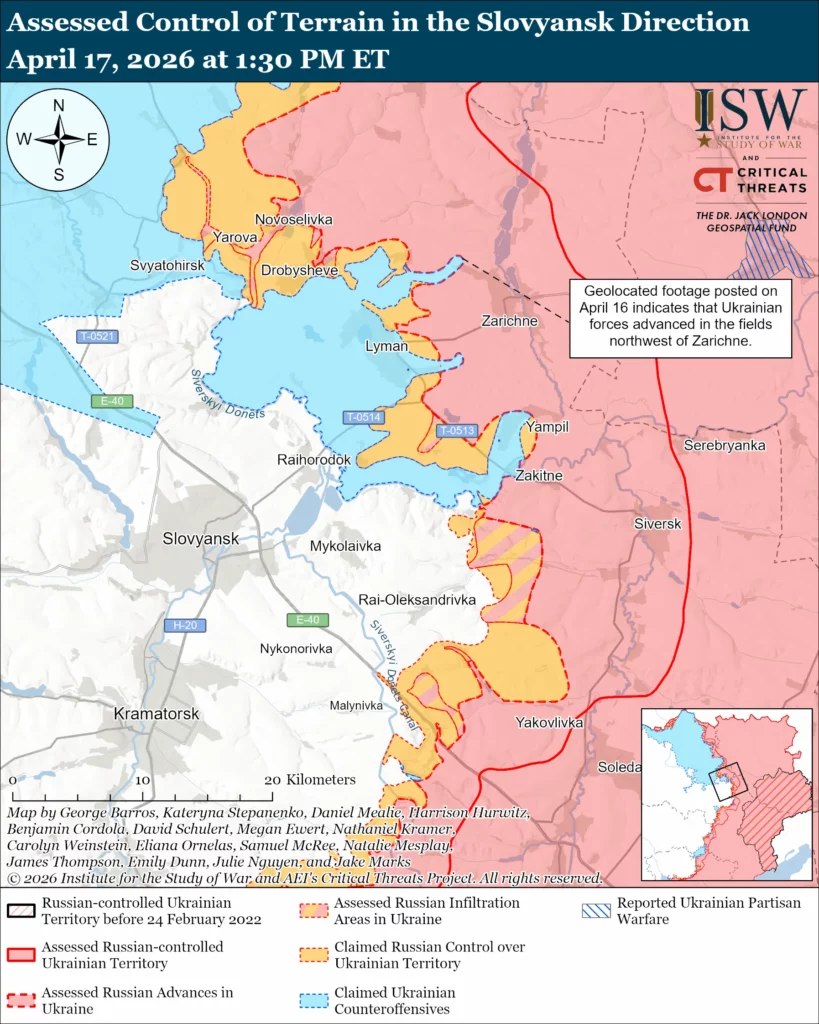
A Russian milblogger claimed that Russian forces advanced along the M-03 Bakhmut-Slovyansk highway southwest of Dibrova (southeast of Slovyansk).[30]
Russian forces recently conducted infiltration missions in the Kostyantynivka-Druzhkivka tactical area. Geolocated footage posted April 16 shows Ukrainian forces striking Russian positions in eastern Kostyantynivka and northeast of Berestok (southwest of Kostyantynivka) after what ISW assesses were Russian infiltration missions.[31] The spokesperson for a Ukrainian brigade operating in the Kramatorsk direction reported that Russian forces are also trying to infiltrate Maiske (northeast of Kostyantynivka) and are using many motorcycles to conduct infiltration missions.[32]
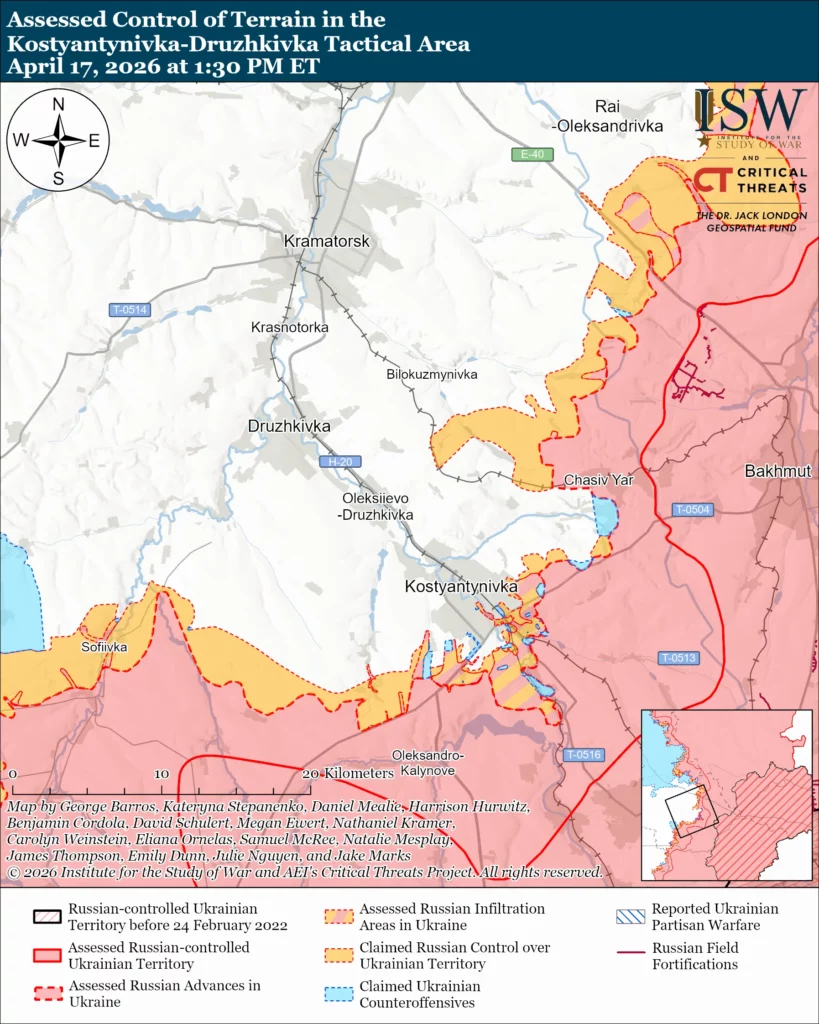
A Russian milblogger claimed that Russian forces seized Minkivka and advanced northwest of Holubivka and northwest of Novomarkove (all northeast of Kostyantynivka).[33]
Geolocated footage published on April 16 shows Russian forces striking a Ukrainian position on the western outskirts of Kostyantynivka – an area in which Russian sources previously claimed Russian forces maintained positions.[34]
Russian forces are reportedly trying to expand the kill zone in the Kramatorsk direction while Ukraine’s own kill zone is complicating Russian logistics in the area. The spokesperson of a Ukrainian brigade operating in the Kramatorsk direction reported that Russian forces are using more first-person view (FPV) drones to expand the kill zone (an area of elevated drone risk).[35] The spokesperson stated that Russian forces are mostly conducting logistics on foot but sometimes use unmanned ground vehicles (UGVs), likely due to the threat of Ukrainian strikes against vehicles.
Ukrainian forces recently advanced in the Dobropillya direction. Geolocated footage published on April 15 shows Russian forces shelling Ukrainian positions in northern Toretske (east of Dobropillya), indicating that Ukrainian forces recently advanced in the area.[36]
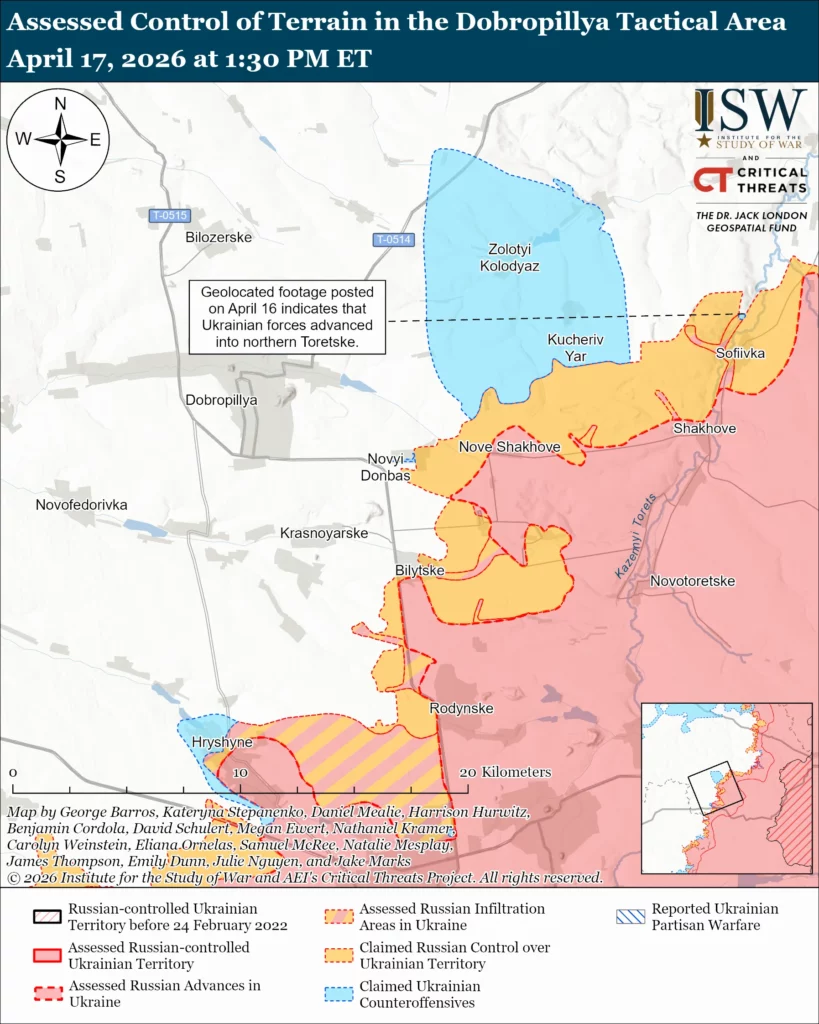
Russian forces continued offensive operations in the Pokrovsk direction on April 17 but did not make confirmed advances.[37] A Russian milblogger claimed that Russian forces advanced on the western outskirts of Hryshyne and near Vasylivka (both northwest of Pokrovsk).[38]
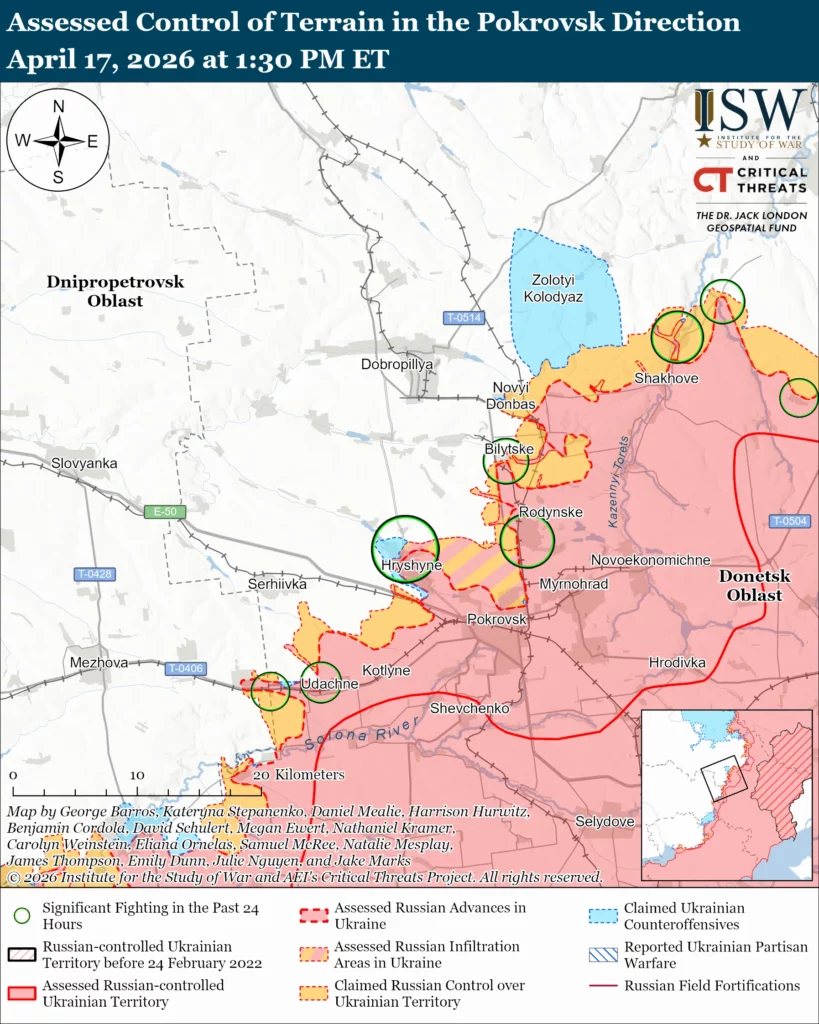
Neither Russian nor Ukrainian sources reported Russian ground activity in the Novopavlivka direction on April 17.
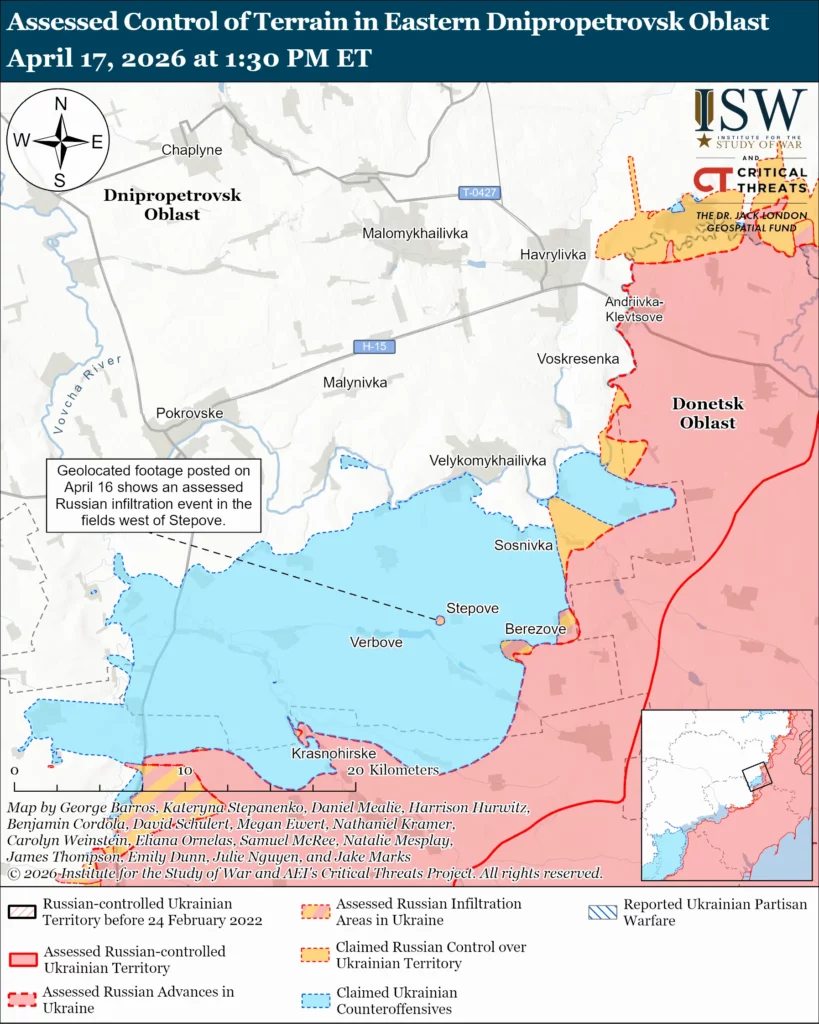
Russian forces recently conducted infiltration missions in the Oleksandrivka direction, as Ukrainian forces continued limited counterattacks.[39] Geolocated footage published on April 16 shows Ukrainian forces striking Russian positions west of Stepove (southeast of Oleksandrivka) conducting what ISW assesses was likely a Russian infiltration mission.[40]
Ukrainian forces continued mid-range strikes against Russian military assets, particularly against air defense systems, in occupied Donetsk Oblast. The Ukrainian General Staff reported that Ukrainian forces struck a Russian drone facility near Orlynske (about 30 kilometers from the frontline); an ammunition depot near Panteleimonivka (either about 20 or 37 kilometers behind the frontline); a weapons repair and maintenance base near Klynkyne (approximately 146 kilometers from the frontline); and a logistics hub near Manhush (approximately 100 kilometers from the frontline) on the night on April 16 to 17.[41] Geolocated footage published on April 17 shows Ukrainian Special Forces (SSO) striking a logistics hubs of the Russian Rubikon Center for Advanced Unmanned Technologies near Manhush.[42] The Ukrainian Unmanned Systems Forces (USF) and USF Commander Major Robert “Magyar” Brovdi posted footage on April 17 showing the USF striking a Russian Pantsir-S1 air defense system in occupied Mariupol overnight on April 16 to 17.[43] Brovdi added that Ukrainian forces have destroyed 16 Russian air defense systems and radars in the first 16 days of April.
Russian Supporting Effort: Southern Axis
Russian objective: Maintain frontline positions, secure rear areas against Ukrainian strikes, and advance within tube artillery range of Zaporizhzhia City
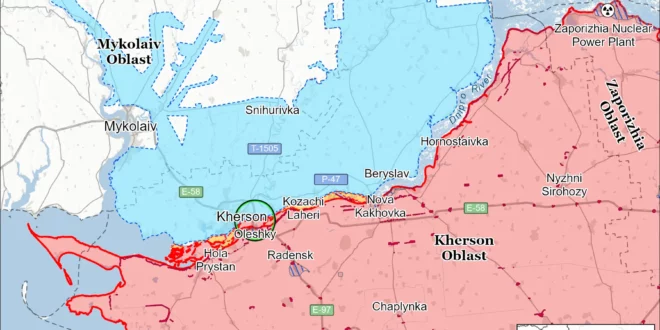
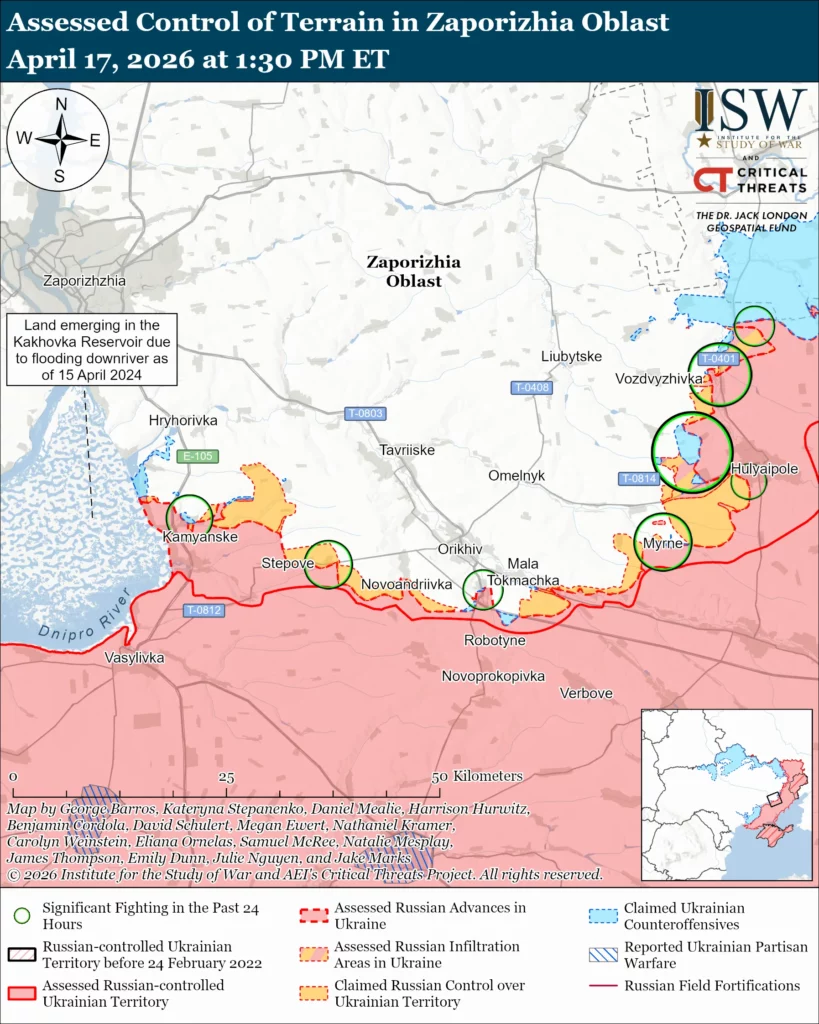
Russian forces continued offensive operations in the Hulyaipole direction, western Zaporizhia Oblast, and the Kherson direction on April 17 but did not advance.[44]
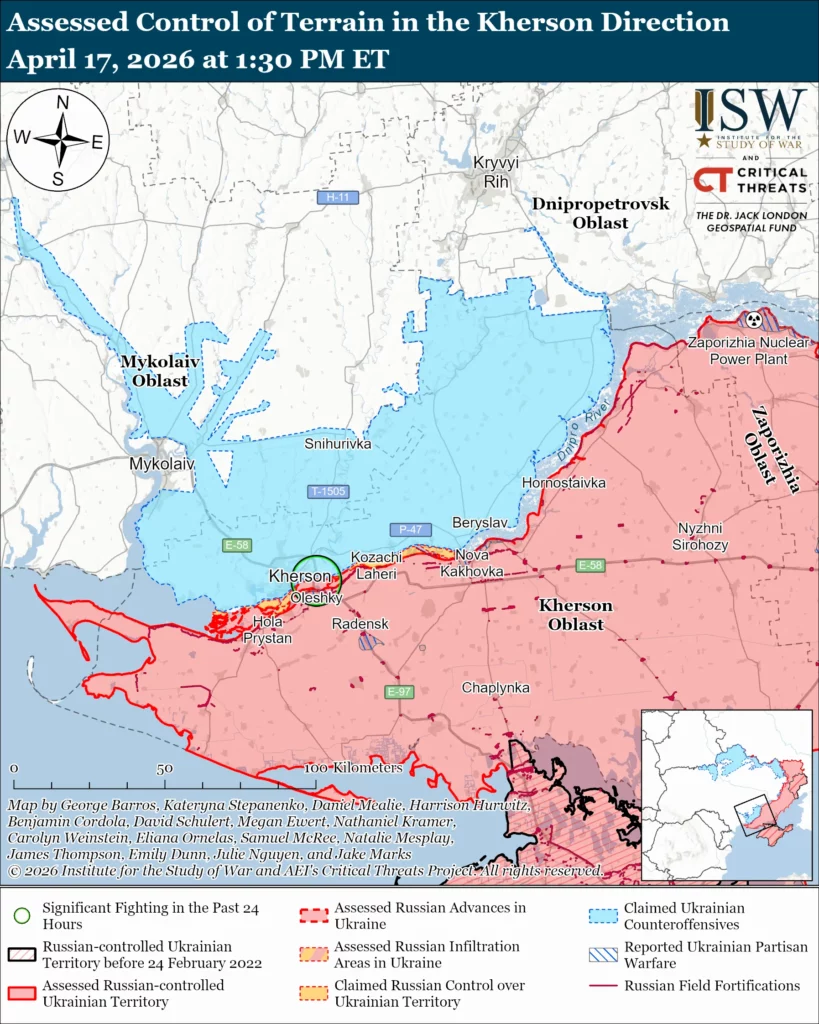
Russian forces continue to use first-person view (FPV) drones to target moving trains to disrupt critical Ukrainian infrastructure. Geolocated footage published on April 16 shows a Russian drone striking a Ukrainian passenger train in Kherson City.[45]
Ukrainian forces continued their mid-range strike campaign against Russian military assets in occupied Kherson Oblast and Crimea. The Ukrainian General Staff that Ukrainian forces struck a Russian ammunition depot near Skadovsk, Kherson Oblast (approximately 53 kilometers from the frontline) and a Russian storage facility for amphibious assault boats near Chronomorske, Crimea (approximately 120 kilometers from the frontline) on April 16 and the night on April 16 to 17.[46]
Russian Air, Missile, and Drone Campaign
Russian Objective: Target Ukrainian military and civilian infrastructure in the rear and on the front line
Russian forces continued long-range drone and missile strikes against Ukraine overnight on April 16 to 17. The Ukrainian Air Force reported that Russian forces launched one Iskander-M ballistic missile from occupied Crimea and 172 Shahed-type, Gerbera-type, Italmas-type, and other long-range strike drones, including about 120 Shaheds, from the directions of Bryansk, Kursk, and Oryol cities; Millerovo, Rostov Oblast; Primorsko-Akhtarsk, Krasnodar Krai, and occupied Hvardiiske, Crimea.[47] The Ukrainian Air Force reported that Ukrainian forces downed 147 drones, that the ballistic missile and 20 drones struck eight locations, and that drone debris fell at four. Ukrainian officials reported that Russian forces struck energy, transport, port, and residential infrastructure in Chernihiv, Dnipropetrovsk, Odesa, and Zaporizhia oblasts.[48] The Chernihiv City Council reported that power outages from Russian strikes deenergized a water supply facility in the city.[49]
The installation of cameras on Russian Geran drones is allowing Russian forces to target Ukrainian mobile fire groups. A Kremlin-affiliated Russian milblogger claimed on April 17 that Russian forces are using teams of two or more long-range strike drones to detect and strike Ukrainian mobile fire groups that are operating as part of Ukraine’s air defense umbrella against Russian Geran-type drones.[50] The milblogger claimed that Russian adaptations to include cameras on the drones are allowing Russian drone operators to strike Ukrainian mobile fire groups. The milblogger claimed that Russian drone operators sometimes conduct reconnaissance during the day after the overnight strike series to assess the success of the previous strikes and to identify changes in Ukrainian mobile fire group coverage. Russian forces have recently used long-range drones with live video guidance to target Ukrainian mobile fire groups in Dnipropetrovsk and Poltava oblasts.[51]
Ukrainian officials warned that Russia is preparing to conduct more regular large-scale missile and drone strikes against Ukraine. Ukrainian Foreign Minister Andriy Sybiha stated on April 17, citing Ukrainian intelligence, that Russian forces are preparing to conduct large-scale strikes consisting of at least 400 drones and 20 missiles at a frequency of seven times per month.[52] Russian forces have launched 11 drone and missile strike packages containing 420 or more total projectiles thus far in 2026.[53] Ukrainian Main Military Intelligence Directorate (GUR) Deputy Head Major General Vadym Skibitskyi stated that Russia is already increasing the frequency of combined missile and drone strikes to destroy Ukrainian infrastructure and shape the battlefield for the Russian Spring-Summer 2026 offensive.[54] Skibitskyi stated that Russia is intensifying ballistic missile strikes against Ukrainian cities in particular. Skibitskyi stated that Russia can produce about 60 Iskander missiles per month and is expanding its launcher capacity. It is unclear whether Skibitskyi is referring to Iskander-M ballistic missiles, Iskander-K cruise missiles, or both varieties.
Significant Activity in Belarus
Russian efforts to increase its military presence in Belarus and further integrate Belarus into Russian-favorable frameworks
Nothing Significant To Report.
Note: ISW does not receive any classified material from any source, uses only publicly available information, and draws extensively on Russian, Ukrainian, and Western reporting and social media as well as commercially available satellite imagery and other geospatial data as the basis for these reports. References to all sources used are provided in the endnotes of each update.