 Eurasia Press & News
The Institute for the Study of War (ISW) and The Critical Threats Project (CTP) at the American Enterprise Institute are publishing daily updates to provide analysis on the war with Iran. The updates focus on US and Israeli strikes on Iran and Iran and the Axis of Resistance’s response to the strikes. The updates cover events from the past 24-hour period.
Key Takeaways
Islamic Revolutionary Guards Corps (IRGC) Commander Major General Ahmad Vahidi and members of his inner circle have likely secured at least temporary control over not only Iran’s military response in this conflict but also Iran’s negotiating position and approach within the past 48 hours. The IRGC Navy attacked several commercial vessels on April 18 and declared that no vessel of “any type or nationality” is permitted passage through the strait, a reversal of Iranian Foreign Affairs Minister Abbas Araghchi’s announcement on April 17 that the strait was “completely open” to commercial traffic. IRGC-affiliated media also announced on April 18 that Iran has not agreed to participate in another round of negotiations with the United States due to “excessive” US demands.
 Vahidi and individuals close to him may have effectively controlled the negotiations process throughout the war, which is traditionally a role reserved for political leaders. Vahidi likely intended to impose IRGC oversight over the recent US-Iran talks in Islamabad. The IRGC continued to play an outsized role in Iran’s negotiations after the Islamabad talks.
The IRGC’s consolidation of control over Iranian decision-making indicates that the Iranian political officials currently negotiating with the United States do not have the authority to independently determine Iran’s negotiating positions. The IRGC appears to have sidelined more pragmatic figures with whom the United States has negotiated.
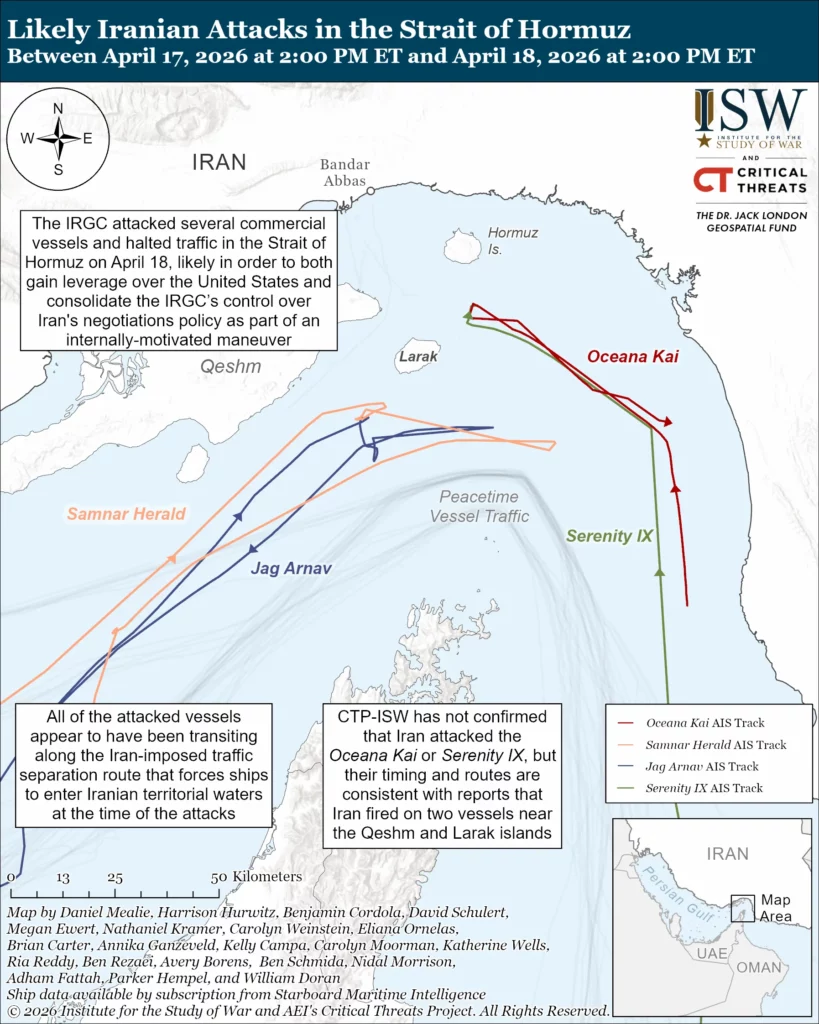
The IRGC attacked several commercial vessels and halted traffic in the Strait of Hormuz on April 18, likely in order to both gain leverage over the United States and consolidate the IRGC’s control over Iran’s negotiations policy as part of an internally-motivated maneuver. The IRGC likely aims to secure leverage over the United States by halting traffic and driving up shipping and oil prices to impose economic pressure on the United States. The IRGC’s actions are also likely intended to be an internal demonstration of power designed to exhibit the IRGC’s control within the regime, and in particular, its control over Iran’s negotiations policy.
The US Navy’s blockade of Iranian ports remains in place as of April 18. US CENTCOM said that it forced two ships to turn around and return to Iran between April 17 and 18. The US Navy has forced 23 ships to turn back since the United States began the blockade. No Iranian vessels have attempted to approach or test the blockade line as of this writing.
Toplines
Islamic Revolutionary Guards Corps (IRGC) Commander Major General Ahmad Vahidi and members of his inner circle have likely secured at least temporary control over not only Iran’s military response in this conflict but also Iran’s negotiating position and approach within the past 48 hours. The IRGC Navy attacked several commercial vessels on April 18 and declared that no vessel of “any type or nationality” is permitted passage through the strait, a reversal of Iranian Foreign Affairs Minister Abbas Araghchi’s announcement on April 17 that the strait was “completely open” to commercial traffic.[1] Traffic through the strait has virtually halted as of this writing except for Iranian vessels, according to maritime tracking data. No Iranian vessels have approached the US blockade line, however. IRGC-affiliated media also announced on April 18 that Iran has not agreed to participate in another round of negotiations with the United States due to “excessive” US demands.[2] The IRGC is responsible for coordinating and conducting military actions, but has historically not directly interfered in Iranian diplomacy and negotiations to the extent it currently is.
Regime institutions aligned with Vahidi are presenting a cohesive front against Araghchi and in support of the IRGC’s actions to halt traffic in the strait. The Khatam ol Anbia Central Headquarters, which is functionally controlled by the IRGC, cited the US naval blockade on Iranian ports as the reason for the IRGC’s reimposition of “control” over the strait.[3] Vahidi and Khatam ol Anbia Central Headquarters Commander Ali Abdollahi Aliabadi are reportedly driving the regime’s military decision-making, according to anti-regime media on April 7.[4] A source close to the Supreme National Security Council (SNSC) previously warned IRGC-affiliated Fars News on April 17 that Iran would “close” the strait if the United States continued its blockade.[5] The SNSC released a statement on April 18 that Iran will “exercise supervision and control” over traffic in the strait until the war ends.[6] The SNSC would almost certainly not have released this statement without the approval of SNSC Secretary Mohammad Bagher Zolghadr, which indicates that Zolghadr supports the IRGC’s actions in the strait. Zolghadr, who is a hardline IRGC veteran and long‑time power broker with deep ties to Iran’s security and judicial apparatuses, was appointed to his position during the war after Vahidi reportedly pressured Iranian President Masoud Pezeshkian to appoint him.[7]
Vahidi and individuals close to him may have effectively controlled the negotiations process throughout the war, which is traditionally a role reserved for political leaders. Vahidi likely intended to impose IRGC oversight over the recent US-Iran talks in Islamabad. Vahidi attempted to insert Zolghadr into the Iranian negotiating team in Islamabad despite protests from delegation leaders Parliament Speaker Mohammad Bagher Ghalibaf and Araghchi over Zolghadr’s lack of experience with diplomatic negotiations.[8] Vahidi presumably wanted to send Zolghadr to keep an eye on the negotiations and to inform leaders in Tehran if the negotiating delegation strayed from his or Supreme Leader Mojtaba Khamenei’s directives.[9] Zolghadr sent a complaint to senior IRGC leaders, almost certainly including Vahidi, that Araghchi had surpassed his mandate during the negotiations by expressing flexibility regarding Iran’s support for the Axis of Resistance.[10] Zolghadr’s anger caused senior leaders in Tehran, including former IRGC Intelligence Organization Chief and long-time member of Mojtaba’s inner circle, Hossein Taeb, to call the negotiating delegation back to Tehran.[11]
The IRGC continued to play an outsized role in Iran’s negotiations after the Islamabad talks. Pakistani Army Chief Field Marshall Asim Munir recently met with Ghalibaf and Aliabadi in Tehran on April 16 as part of his mediation efforts.[12] Aliabadi is not a member of the Iranian negotiating team, and it is highly unusual for the Khatam ol Anbia Central Headquarters commander to be involved in diplomatic discussions about negotiations. The Khatam ol Anbia Central Headquarters is formally responsible for joint and wartime operations.
The IRGC’s consolidation of control over Iranian decision-making indicates that the Iranian political officials currently negotiating with the United States do not have the authority to independently determine Iran’s negotiating positions. CTP-ISW recently assessed that the United States is negotiating with a divided committee of hardliners and pragmatists that lacks a cohesive, unified position.[13] The IRGC appears to have sidelined more pragmatic figures with whom the United States has negotiated. Araghchi and Ghalibaf’s negotiating team reportedly did not have full authority to finalize a deal with the United States in Islamabad, for example.[14]
This current dynamic likely reflects Vahidi’s position, relationships, and control over IRGC military elements, which has enabled him to wield significant authority over decision-making compared to other senior regime leaders such as Ghalibaf. Vahidi holds the most influential position in the regime at this time, apart from the Supreme Leader, who is reportedly seriously injured or incapacitated.[15] Vahidi is a long-time and experienced IRGC commander, having served as Iran’s first IRGC Quds Force commander between 1988 and 1997 and currently serving as the senior-most IRGC commander.[16] Vahidi was one of the senior IRGC commanders who pushed the Assembly of Experts to select Mojtaba as Supreme Leader in March.[17] Vahidi and his affiliates have reportedly fought with more pragmatic regime officials such as Ghalibaf over Iran’s national security and foreign policy decisions throughout the conflict.[18] Ghalibaf, in contrast, is a former IRGC commander who transitioned into politics in the early 2000s and lacks the influence and control over military elements that Vahidi has.[19] Vahidi and his inner circle appear to have marginalized Ghalibaf, although he is publicly reiterating IRGC rhetoric.[20] Ghalibaf likely lacks the leverage or formal executive authority to shape decision-making.
The IRGC Navy attacked several commercial vessels and halted traffic in the Strait of Hormuz on April 18, likely in order to both gain leverage over the United States and consolidate the IRGC’s control over Iran’s negotiations policy as part of an internally-motivated maneuver.[21] The IRGC appears to have intervened and reasserted Iranian “control” over the Strait of Hormuz after Araghchi announced on April 17 that the strait was open to commercial shipping.[22] At least nine vessels exited the strait through Omani territorial waters and outside of Iran’s imposed traffic separation scheme on April 17 and early on April 18 following Araghchi’s announcement.[23] The IRGC, however, harshly criticized Araghchi’s statement and outlined specific conditions for vessels to transit the strait that amount to Iran retaining control over maritime traffic through the strait.[24] The IRGC Navy later announced that “no vessel of any kind” should approach the strait, or it will be targeted.[25] The IRGC likely aims to secure leverage over the United States by halting traffic and driving up shipping and oil prices to impose economic pressure on the United States. The IRGC’s actions are also likely intended to be an internal demonstration of power designed to exhibit the IRGC’s control within the regime, and in particular, its control over Iran’s negotiations policy.
The IRGC Navy likely used fast attack craft to attack and intimidate at least four vessels in order to deter vessels from transiting the strait on April 18.[26] All of the attacked vessels appear to have been transiting along the Iran-imposed traffic separation route that forces ships through Iranian territorial waters at the time of the attacks.[27] IRGC Navy “gunboats” fired on a likely Indian-flagged tanker east of Larak Island, and “unknown projectiles” struck a likely Iranian-flagged container ship in the same area.[28] Reuters also reported that two vessels reported being struck by gunfire between Qeshm and Larak islands.[29] All four vessels turned around.[30] The IRGC also broadcasted radio messages to vessels in the strait, warning them that the strait is “closed.”[31] Numerous vessels traveling toward the strait turned around after the Iranian attacks, according to maritime tracking data.
The US Navy’s blockade of Iranian ports remains in place as of April 18. US CENTCOM said that it forced two ships to turn around and return to Iran between April 17 and 18.[32] The US Navy has forced 23 ships to turn back since the United States began the blockade.[33] Commercially available maritime tracking data shows that Iranian-flagged tankers and cargo ships continued to transit inside the strait on March 18 after the IRGC attacks, but no Iranian vessels have attempted to approach or test the blockade line as of this writing.
US President Donald Trump warned on April 18 that the ceasefire may not be extended if no agreement is reached by April 22.[34] The Supreme National Security Council (SNSC) Secretariat stated on April 18 that Iran has received a new US proposal conveyed through Pakistani Army Chief Field Marshal Asim Munir during his recent visit to Tehran and is currently reviewing the US proposal.[35] Iranian Deputy Foreign Minister Saeed Khatib Zadeh stated on April 18 that no date has been set for further talks and emphasized that Iran and the United States must first agree to a framework before they can hold another round of talks.[36] Khatib Zadeh described US demands as “maximalist” and unacceptable and stated that the transfer of Iran’s enriched uranium is a “non-starter.”[37]
US and Israeli Air Campaign
Nothing significant to report.
Iranian Response
Nothing significant to report.
Israeli Campaign Against Hezbollah and Hezbollah Response
CTP-ISW has not observed any claimed or reported Hezbollah attacks against the Israel Defense Forces (IDF) in southern Lebanon or Israeli communities in northern Israel since the start of the 10-day ceasefire at 5:00 PM ET on April 16.[38]
The IDF conducted military operations against Hezbollah fighters and infrastructure within the Israeli security zone in southern Lebanon in accordance with the temporary ceasefire agreement.[39] The IDF stated on April 18 that IDF soldiers directed airstrikes and artillery fire targeting Hezbollah operatives who “violated the ceasefire” and posed an “immediate threat” to IDF forces in the Israeli security zone in southern Lebanon in the past 24 hours.[40] The IDF said that it also destroyed Hezbollah infrastructure in the area.[41] The IDF separately said on April 18 that 401st Armored Brigade (162nd Armored Division) forces identified and directed a strike against a Hezbollah cell that approached IDF units within the IDF’s forward defense line in southern Lebanon.[42] The 401st Armored Brigade was most recently operating in the vicinity of Bint Jbeil, southeastern Lebanon, as of April 14.[43] The IDF also said that it struck the entrance to a Hezbollah underground tunnel in southern Lebanon.[44] The ceasefire agreement contains a provision that permits Israel to act in self-defense against any “planned, imminent, or ongoing” Hezbollah threats against Israel.[45] US officials confirmed to Axios and Israeli media on April 17 that Israel has the right to self-defense under the ceasefire agreement.[46] US President Donald Trump had previously stated on April 17 that Israel would not “be bombing Lebanon any longer” and that the United States was prohibiting Israeli forces from doing so.[47] Lebanese sources reported on April 17 and 18 that the IDF has demolished buildings in Lebanese towns within Israel’s “security zone” in southern Lebanon.[48] An Israeli geospatial analyst published footage on April 18 showing the IDF demolishing buildings in Bint Jbeil, southeastern Lebanon.[49]
Likely Hezbollah fighters engaged a UNIFIL patrol in southeastern Lebanon on April 18, killing one French UNIFIL peacekeeper and injuring three others.[50] UNIFIL reported on April 18 that “non-state actors” engaged a UNIFIL patrol with small arms in a “deliberate attack,” killing one UNIFIL peacekeeper and injuring three others in Ghandouriyeh, Bint Jbeil District.[51] UNIFIL has commonly used the term ”non-state actors” to refer to Hezbollah when the group has previously fired on UNIFIL positions.[52] French President Emmanuel Macron said on April 18 that “everything suggests” that Hezbollah fighters killed the UNIFIL peacekeeper, who was a French soldier.[53] Macron called on the Lebanese government to arrest the perpetrators immediately.[54] Lebanese Prime Minister Nawaf Salam released a statement on April 18 condemning the attack.[55] Salam said that he ordered an “immediate” investigation into the incident to hold the perpetrators accountable.[56] The Lebanese Armed Forces confirmed on April 18 that it has begun to investigate the incident.[57] Hezbollah denied that its fighters conducted the attack.[58]
Other Axis of Resistance Response
An Iranian delegation headed by IRGC Quds Force Commander Brigadier General Esmail Ghaani discussed Iranian-backed Iraqi militia disarmament and Iraqi government formation with Shia Coordination Framework and militia leaders in Baghdad on April 18.[59] An unspecified source told Iraqi media that Ghaani held a series of separate meetings with unspecified militia and framework leaders to discuss Iraqi political developments, including integrating militias into the Iraqi security establishment and selecting a “consensus” candidate for the Iraqi premiership.[60] The United States has continuously pressured the Iraqi federal government to disarm Iranian-backed Iraqi militias and dissolve the Iranian-backed Popular Mobilization Forces (PMF), which is an Iraqi state security service that consists of numerous militias that answer to Iran instead of the Iraqi Prime Minister.[61] The framework continues to debate State of Law Coalition head and former Prime Minister Nouri al Maliki’s nomination to the premiership.[62] The Iraqi Parliament elected Nizar Amidi as President on April 11, following months of deliberations by the main Iraqi Kurdish parties.[63] The Iraqi constitution stipulates that the newly elected President will select the candidate of the largest parliamentary bloc—the framework—to attempt to form a government within 15 days of the President’s election, which corresponds to April 26.[64] Ghaani also reportedly discussed disassociating some unspecified political leaders from their affiliated militias.[65] Multiple Iranian-backed Iraqi militias, such as Asaib Ahl al Haq and Kataib Hezbollah, have political wings in the framework.[66]
Ghaani likely also coordinated with Iraqi militia leaders about their involvement in a potential resumption of the war between the United States, Israel, and Iran. The Iraqi militias have launched drone and rocket attacks targeting US and foreign interests in Iraq, as well as the Gulf countries, during the war.[67] CTP-ISW assessed on April 13 that Iranian-backed Iraqi militias were likely responsible for at least some of the recent drone attacks against Gulf countries, following the Bahrain Defense Force’s interception of seven “Iranian” drones on April 13.[68] Iran supplies drones to its Iraqi partners, and Bahrain’s use of “Iranian drones” could refer to drones used by the Iraqi militias.[69] Saudi Arabia and Bahrain summoned the Iraqi ambassador to their countries on April 12 and 13, respectively, in response to Iraqi militia drone attacks targeting Gulf Cooperation Council states.[70]
The US Treasury Department sanctioned seven Iranian-backed Iraqi militia officials on April 17 for their involvement in attacks targeting US positions in Iraq.[71] The Treasury Department sanctioned three Kataib Hezbollah members, including one “operational leader” and two officials involved in operations, two senior Kataib Sayyid al Shuhada officials, and a Harakat Hezbollah al Nujaba military trainer.[72] These three militias are part of the Islamic Resistance Iraq, which is a coalition of Iranian-backed Iraqi militias that has claimed regular attacks targeting “enemy” bases in Iraq and the region during the war.[73] The Islamic Resistance in Iraq also conducted over a hundred attacks targeting both Israel and US bases in Iraq and Syria during the October 7 War.[74] The Treasury Department also sanctioned on April 17 a senior Asaib Ahl al Haq official and military commander who also serves as the group’s head in Salah al Din Province.[75] The Treasury Department stated that Asaib Ahl al Haq conducted drone attacks targeting US and coalition forces in northern Iraq in March 2026.[76] Iraq analysts have long noted that Asaib Ahl al Haq’s leadership, particularly its founder Qais al Khazali, has focused on politics more than kinetic action in recent years.[77] The US-Israeli combined force has struck positions belonging to all of the militias that the Treasury Department sanctioned on April 17 during the war in order to degrade the militias’ ability to attack the United States and Israel.[78]