 Eurasia Press & News
The Russian military continued to experiment with improving its employment of uncrewed aerial systems (UAS) in support of its maneuver forces.
Both Russian and Ukrainian forces face coordination challenges and internal debates regarding the “ownership” of different depths of the battlespace and the command-and-control relationship between independent drone units and ground commanders.
While Ukraine typically leads in initial technological innovation, Russia has proven effective at copying these advancements and scaling them through systemic experiments across various military districts.
Despite narrowing the capability gap in 2025 through new employment concepts and elite units, Russian advancements failed to produce a decisive military breakthrough.
The following analysis was originally published on Two Marines, a newsletter on Russia’s war in Ukraine, defense technology, and modern warfare, on April 3, 2026.
During 2025, the Russian military continued to experiment with improving its employment of uncrewed aerial systems (UAS) in support of its maneuver forces. The Russian military actively records statistics on the effectiveness and success of different types of UAS in its units and develops recommendations for improving their efficiency. One of these initiatives was titled “Drone Line” by Russia’s 2nd Combined Arms Army (2 CAA), which began last summer. It was developed in response to the rapidly expanding role of UAS in the war and to Ukraine’s own Drone Line initiative, which was scaled at the end of 2024 and beginning of 2025. However, these two initiatives differed despite the same title.
Ukraine’s Drone Line involved the establishment of five UAS regiments and brigades, which were intended to reinforce the maneuver brigades holding the front line. These units were initially assigned to the Ukrainian Ground Forces but were later transferred to the newly formed Unmanned Systems Forces. These Drone Line units were supposed to operate further past the forward line of enemy troops (FLET) than the UAS units within a regular maneuver brigade. The goal was to extend the “kill zone” from 10 kilometers beyond the FLET to 15 kilometers.
The Russian 2nd Combined Arms Army’s Drone Line was instead a method of task organizing the employment of strike UAS units within the army, which was responsible for 32 kilometers of frontage. The concept was an attempt to more systematically organize strike UAS assets in support of offensive operations instead of having each regiment or brigade’s UAS assets focus on its own area of responsibility.
In the 2 CAA’s case, the system was divided into two echelons and 18 sectors covering 32 kilometers of the front line. The first echelon was titled the “total clearance zone” from the FLET to 5 kilometers past the FLET. It was divided into 10 sectors, each approximately 3 kilometers on average. For this echelon, the group had assigned an authorized strength of 165 personnel.
The second echelon was the “zone of detection of advancing forces’ logistics,” which is assigned to target logistics routes from 5 to 10 kilometers past the FLET. It was divided into 8 sectors, averaging 4 kilometers each. The authorized strength for this grouping was 293 personnel, and was mostly composed of UAS personnel from spetsnaz, reconnaissance, and artillery units. The group was allocated 560 UAS per day: 360 copter-type first-person view (FPV), 111 fiber optic cable FPV, and 89 fixed-wing type FPV (Molniya). Lastly, detachments from the Rubicon Center were responsible for engaging targets at a depth of more than 10 kilometers past the FLET.
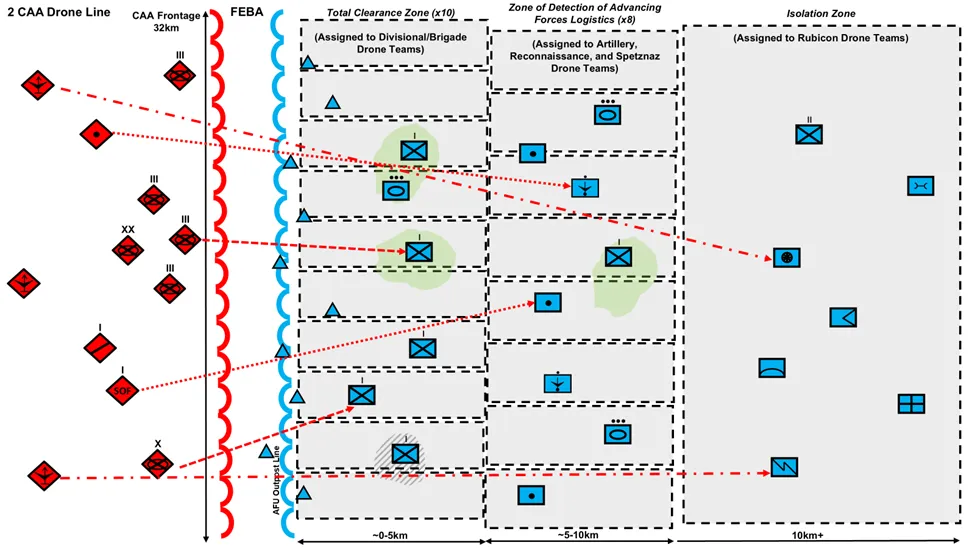
Graphic depicting the 2nd Combined Arms Army’s Drone Line Concept from the summer of 2025. (Courtesy of Cole Petersen)
The Drone Line experiment with the 2 CAA was scaled and later employed by the entire Center Group of Forces (GOF) by the end of the summer. For Center GOF, it initially involved 60 sectors along the front line with two echelons in depth. These sectors were divided up by the GOF’s subordinate formations, with 15 sectors assigned to the 2nd Combined Arms Army, 12 to the 8th Combined Arms Army, 14 to the 41st Combined Arms Army, 14 to the 51st Combined Arms Army, and 5 to the 90th Tank Division.
As with the previous scheme, the total clearance zone ran from the FLET to 5 kilometers past the FLET and involved 33 sectors. The second echelon, zone of detection of advancing forces’ logistics, involved 27 sectors that ranged from 5-10 kilometers past the FLET. Responsibility for this second zone was also assigned to spetsnaz, reconnaissance, and artillery units, as was the case for the 2 CAA’s initial scheme.
For the third echelon from 10 kilometers and further beyond the FLET, Center GOF modified the initial 2 CAA concept by assigning specific sectors for units. Twenty two “isolation” sectors were assigned to separate spetsnaz brigades and Rubicon detachments. For this third echelon, Center GOF assigned three to the Rubicon-7 detachment, three to Rubicon-Ts (Center), four to Rubicon-D (Dnepr), two to Rubicon-8, and two to Rubicon-V (East). There were also four assigned to both the 3rd and 24th Spetsnaz Brigades’ Vega fire support battalions. The Rubicon-DM (distance mining) detachment was later deployed and initially assigned 9 areas for remote mining by UAS, including Molniya. At the end of the summer, Center GOF had placed a limit on usage of 4,000 first-person view (FPV) per day—including both quadcopter and fixed-wing variants.
Center GOF’s leadership continued to refine the concept during the fall. The total number of sectors in the first two echelons was reduced from 60 to 54, the number of isolation zones was reduced from 22 to 12, and the number of remote mining zones was increased to 14. Notably, Center GOF did not include the UAS units from the 68th Army Corps or naval infantry grouping, including the 40th, 155th, 61st, 336th naval infantry brigades, and 177th Naval Infantry Regiment, in the drone line system when they were deployed in its area of responsibility. By the fall, Russia’s Center Group of Forces had approximately 1,700 UAS crews operating under its command, including those from attached units. This was the densest coverage of Russian UAS capabilities along the front line.
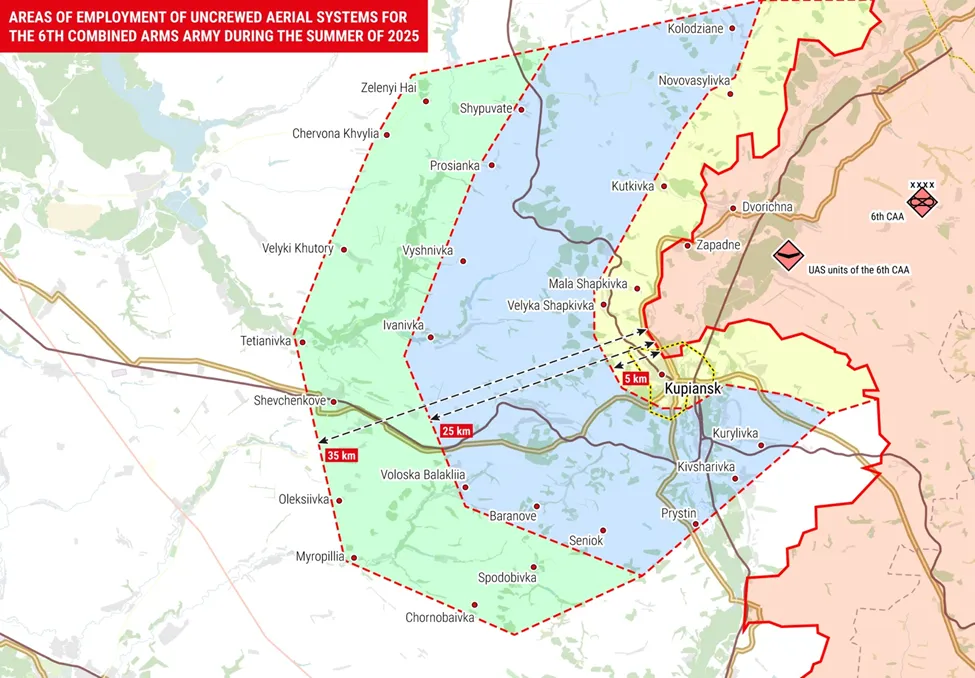
Russia’s 6th Combined Arms Army—part of the West Group of Forces—operating in the Kupyansk direction also experimented with the Drone Line concept last summer, but assigned sectors and zones in a different manner. The first echelon ran from the FLET to 5 kilometers past the FLET. The priority targets were personnel, equipment, and weapons, intending to immobilize Ukrainian forces. At least 100 UAS crews were assigned to this zone, including a company from the 16th Spetsnaz Brigade. These units were equipped with FPVs with fiber optic cables, Vobla-type UAS, R-18-type bomber UAS, and UAS interceptors.
Up to 60 UAS crews were assigned to the 2nd echelon, which extended from the FLET to 25km past the FLET. The priority targets in this zone included antennas, repeaters, satellite communication systems, electronic warfare, artillery, supply routes, and concentrations of forces and reserves. The UAS assigned for this area included Orlan-10, Zala-16, and Supercam intelligence, surveillance, and reconnaissance (ISR) UAS, as well as Molniya and Lancet kamikaze UAS. The 3rd echelon ran from 25-35km from the FLET, and the priority targets included UAS launch sites, logistics centers, supply routes, and concentrations of units and reserves. Eight crews were assigned to this zone, equipped with Orlan-10, Zala-16, and Merlin ISR UAS, as well as Lancet and Kub strike UAS. In total, approximately 170 UAS crews were assigned to support the 6th Combined Arms Army during this period. According to Ukrainian units in this direction, the system was effective, and Russian employment of UAS was becoming more sophisticated.
Conclusions
As with Ukraine, the Russian military is constantly revising its methods for employing UAS most effectively. This includes task organizing the responsibility of recon and strike UAS at different depths. More specialized units, including those from separate spetsnaz brigades and Rubicon detachments, have better funding and support, and can operate at greater depths beyond the front line due to their higher-quality equipment and better-trained teams.
Similar debates have occurred in the Ukrainian military regarding ownership of depths and coordination between different formations. This is in part a reflection of the command-and-control relationship for Ukrainian UAS units. Units in Unmanned Systems Forces can be placed in direct support of Ground Forces units, but they are typically not subordinate to army corps commanders who own the battlespace along the front line, which can create friction and coordination issues.
Notably, Russia’s Drone Line experiments are occurring across military districts and groups of forces. Center GOF was one of the first to scale the system; however, the Western GOF’s 6th Combined Arms Army, as well as the Southern GOF’s 3rd Combined Arms Army, have also experimented with the concept themselves. In each case, the number of sectors differed. Throughout the war, Ukraine has typically innovated first with UAS, UGVs, and other new capabilities. The Russian military learns from these developments and will often copy them and scale them more effectively.
In 2025, the Russian military narrowed the gap in UAS employment with Ukraine in part through the emphasis on scaling elite UAS units like Rubicon and GROM Kaskad, and new employment concepts. Nonetheless, these developments did not prove decisive, and the deployment of elite UAS units in the Center GOF direction did not lead to a breakthrough in the fall of 2025.