 Eurasia Press & News
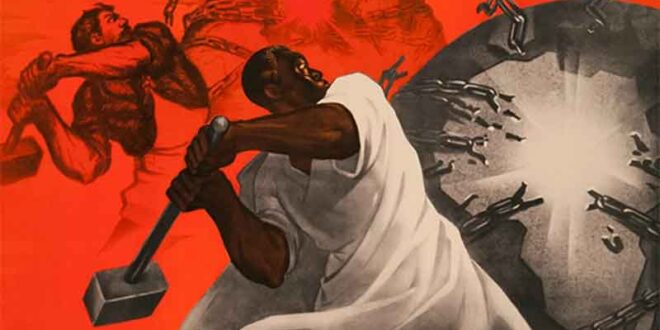
Western Marxism thus surrendered to defeatism and adopted its own version of the end of history, as in the abstract negativity of Marcuse’s Great Refusal, replacing revolutionary praxis.
In his doctoral thesis on the ancient philosopher Epicurus, Karl Marx compared Epicurus to Prometheus, the Titan of Greek mythology, who was bound with unbreakable adamantine chains to a rock for what was intended to be eternity by Hephaestus on the orders of Zeus. Prometheus’s crime was that he had provided fire, standing for universal enlightenment (the name Prometheus means “foresight”) and creative, emancipatory powers to humanity.1 The symbolism was important. Marx quoted Epicurus (via Lucretius) several times in his dissertation on “breaking the bonds of fate,” arguing that a materialist perspective was not necessarily rigidly deterministic or fatalistic, but rather was compatible with notions of human freedom, which would always break free or swerve away from any imposed limits.2
For Marx, no adamantine fetters stood in the way of the progress of freedom. As the 20-year-old revolutionary Frederick Engels wrote in “Retrograde Signs of Our Times,” all reactionary movements “eventually disintegrate in conflict with one another and under the adamantine foot of the forward moving time,” which inevitably creates new conditions and new revolts.3
In Aeschylus’s great dramatic trilogy, Prometheus Bound was succeeded by Prometheus Unbound, and then Prometheus the Firebearer, standing for the great gift of freedom to humanity. Marx, who read Aeschylus every year in the original Greek, never lost sight of the revolutionary implications of the Greek myth.4
The post-Second World War Western Marxist philosophical tradition departed from the revolutionary spirit of classical historical materialism, in effect accepting the notion of adamantine chains imposed by capitalism on the working class, while abandoning the notion of “breaking the bonds of fate.”
The ancient Greek Promethean myth, as presented by Aeschylus, was inverted, becoming a symbol not of enlightenment, hope, defiance, and revolution, but of the adamantine fetters imposed by modern capitalism, which could not be surmounted. For Herbert Marcuse in his Eros and Civilization, Prometheus stood for toil, order, and imprisonment. This was not the Prometheus of Aeschylus, representing defiance and revolt on behalf of humanity, but the Cold War version of the Prometheus myth armed against Marxism.5
Western Marxism thus surrendered to defeatism and adopted its own version of the end of history, as in the abstract negativity of Marcuse’s Great Refusal, replacing revolutionary praxis.6
None other than Perry Anderson wrote in Considerations on Western Marxism in 1976, “The hidden hallmark of Western Marxism as a whole is…that it is a product of defeat. The failure of the socialist revolution to spread outside Russia…is the common background to the entire theoretical tradition of this period…. This unbroken record of political defeat—for working-class struggle, for socialism—could not but have profound effects on the nature of Marxism formed in this era.”7
Here Anderson ignored revolutions in the periphery, such as those of China and Cuba, as of no significance in this regard, since occurring outside a developed occidental capitalism.
The Dialectic of Defeat
At the root of the retrogression of Western Marxism was a belief in the complete economic triumph of capitalism.
As Marcuse wrote in One-Dimensional Man, “The enchained possibilities of advanced industrial societies are: development of the productive forces on an enlarged scale, extension of the conquest of nature, growing satisfaction of needs for a growing number of people, creation of new needs and possibilities. But these possibilities are gradually being realized through means and institutions which cancel their liberating potential, and this process affects not only the means but the ends.”8
The result of such a Western Marxist conception was the writing off altogether of proletarian-based revolutions, which were undermined by capitalism’s “enchained possibilities.”
The various material successes that Marx pointed to in his panegyric to the bourgeoisie in the first half of Part One of The Communist Manifesto were seen by Marcuse as freed of the contradictions that Marx introduced a few pages later: economic crises; the sorcerer’s apprentice, standing for the unforeseen rifts between society and nature; and the rise of capital’s gravedigger in the form of the modern proletariat.
Capitalism was thus presented as victorious in a material sense. “On theoretical as well as empirical grounds, the dialectical concept,” Marcuse stated, pronounces its own hopelessness. The human reality is its history, and, in it, contradictions do not explode by themselves. The conflict between streamlined, rewarding domination on the one hand, and its achievements that make for self-determination and pacification [of the struggle for human existence] on the other, may become blatant beyond any hope of denial, but it may well continue to be a manageable and even productive conflict, for with the growth in the technological conquest of nature grows the conquest of man by man.
Summing up, he wrote, “dialectical theory is not refuted, but it cannot offer the remedy. It cannot be positive.”9
The view that saw a Weberian “iron age” imposed by capitalism based on its economic and technological successes became the default position of the Frankfurt School and the Western Marxist philosophical tradition as a whole. Writing during the first quarter-century after the Second World War in what is today called “the golden age,” Western Marxists adopted the view that not only was the capitalist economy an overriding success, but the proletariat had been enriched and permanently “bourgeoisified,” enchained in its subservient role by the petty rewards obtained in the process of capitalism’s successful development.
This was evident in the work of Theodor Adorno, who argued in 1964 that, contrary to the Marx and Engels of The Communist Manifesto, workers now had much “more to lose” than simply their chains. He referred here to their “cars and motorcycles.”10
What Adorno meant by this, from the standpoint of his negative dialectics, was that these commodities, symbolizing the embourgeoisement of the proletariat, represented new socio-psychological chains of oppression. Marx’s absolute general law of accumulation, in which he had emphasized that the relative gap between the capitalist class and the working class constantly increased, creating ever-greater class polarization, whether the workers’ wages were “high or low,” was trivialized by Adorno, in line with Cold War ideology, as a mere “theory of immiseration.”11
Following in the footsteps of Engels and V. I. Lenin in this respect, Adorno insisted that Western workers were now to a considerable degree bourgeoisified.
However, Adorno did not follow Engels and Lenin in analyzing such embourgeoisement in terms of the labor aristocracy theory, whereby a privileged section of workers benefited from the surplus of monopoly capitalism/imperialism.12
Nor did he subscribe to the notion, emphasized by Engels, in relation to Britain, that the existence of a labor aristocracy and the embourgeoisement of a significant section of the proletariat was fleeting, eventually to be undermined by the waning of colonial/imperial dominance.
Rather, Adorno’s Eurocentric analysis left no room for the critique of imperialism, or even a developed analysis of monopoly capitalism.
As the German critic Hans Mayer, who had known Adorno since 1934, remarked: “Europe sufficed for him entirely. No India or China, no Third World, not the people’s democracies and not the workers’ movement.”13
What is at issue here can be clarified by saying that the main thrust of the philosophical tradition of Western Marxism is characterized by four retreats: (1) from class, (2) from materialism, (3) from the dialectics of nature, and (4) from the critique of imperialism. Behind this is not a denial of Marxist theory altogether, but rather its enclosure in a permanent bourgeois universe, which could be critically analyzed for its lack of true liberation but not transcended.14
The retreat from class was built into the notion that in its golden-age capitalism was lessening class distinctions and removing any radicalism on the part of an affluent bourgeoisified working class with their cars and motorcycles.15 The retreat from materialism was both an abandonment of genuine economic critique and, more importantly, of the materialist conception of nature, the dialectical counterpart of the materialist conception of history. The retreat from the dialectics of nature meant that the human relation to external nature could be reduced to a technological conquest of nature (what Max Horkheimer and Adorno dubbed the “dialectic of Enlightenment”).16 The retreat from critique of imperialism meant that Europe was the final destiny and the definition of modernity. As Georg Wilhelm Friedrich Hegel had written: “the History of the World travels from East to the West, for Europe is absolutely the end of History.”17
Western Marxism was a retreat from Marx, not so much to Hegel, but rather to Max Weber, who rejected the Marxian theory of class and class struggle (in favor of the mere competition for life chances on the market); replaced historical materialism with neo-Kantian idealism, dualism, and methodological individualism; and conceived of the West as the only source of cultural phenomena of “universal significance and value” based on formal or instrumental rationality.
Hence, the world was an “iron cage,” from which there was no escape.18 In its long, convoluted dialectical inversion, Western Marxism went from the left-Hegelian notion that “the rational is real” not to its opposite, the right-Hegelian notion that “the real is rational,” but rather steering toward the pseudo-critical, pseudo-Freudian position that the irrational is real, ruled by the “death instinct,” with the world permanently stripped by capitalism of any genuine materialist-revolutionary content.19 It thus increasingly converged with the anti-rationalist reaction of Friedrich Nietzsche. This is what Russell Jacoby called, in the title of his book, the Dialectic of Defeat.20 The dialectic of defeat of Western Marxism was not of course the dialectic of a spiral, embodying the negation of the negation, but what Adorno termed “negative dialectics,” denying a positive moment altogether, and thus caught up in an endless circling back to bourgeois views.21
Where Western Marxism thrived was in its analysis of the subjective, particularly in the application of psycho-analytic categories drawn from Sigmund Freud, and the critique of reification. There were detailed analyses of the culture industry and media domination. Yet, this gave rise not to analysis of the vicissitudes of class consciousness but rather to the reified, enchained world of class unconsciousness, turning Georg Lukács’s History and Class Consciousness on its head.22
The problem, as Marcuse put it in Weberian terms, is that the “administered individuals” of modern one-dimensional society must “liberate themselves from themselves as well as from their masters.”23 The almost exclusive focus thus became the self-destruction of the human material for change. So great was the problem as conceived in critical theory that Marcuse, as we have seen, asked whether the critical theory of society must abdicate altogether, “the dialectic having pronounced its hopelessness.” He concluded his book by highlighting the bare possibility that “the historical extremes may meet again: the most advanced consciousness of humanity and its most exploited force. It is nothing but a chance.”24
The Longer and Wider View
Raymond Williams strongly warned against “long-run adjustments to short-run problems,” the tendency to see the condition of the immediate moment as determining the long-run trajectory.25 Rather, as Paul A. Baran insisted, it was necessary to take “the longer view” directly into account in all of one’s immediate actions, in order to understand the contradictions, and possibilities for revolutionary praxis. Baran was a Russian Marxist economist who was a researcher at the Institute for Social Research in Frankfurt prior to Adolf Hitler’s rise to power, and who emigrated to the United States at the commencement of the Second World War. In the 1960s, he wrote Monopoly Capital with Paul M. Sweezy, which exhibited some aspects of the Frankfurt School analysis, but which was also a historical critique of the irrational monopolistic and imperialistic capitalism of the twentieth century.
Although Baran and Sweezy, like Marcuse, ended their book with the observation that the working class was not then in revolt in the United States, unlike Marcuse they did not see this as a permanent phenomenon, but rather as something that would change with changing historical conditions. Writing in the mid-1960s, they concluded that “even if the present protest movements should suffer defeat or prove abortive, that would be no reason to write off permanently the possibility of a real revolutionary movement in the United States.”26 Not only were militarism and imperialism at the center of Baran and Sweezy’s book, but Baran had published the pioneering dependency analysis, The Political Economy of Growth, less than a decade before.27
Baran and Sweezy argued, based on concrete reality, that the main revolutionary struggle between workers and capital had shifted in the twentieth century to the periphery of the system in the Global South, which was the basis of the contemporary world revolution inspired by Marxist theory.
Baran had a long friendship with Marcuse going back to the early 1930s, when they were both at the Institute for Social Research in Frankfurt. Marcuse sent him the manuscript of One-Dimensional Man in 1963, prior to publication. Seeing the flaws in the work, Baran wrote to Sweezy:
What is at the present time at issue and indeed most urgently so is the question of whether [the] Marxian dialectic has broken down, i.e. whether it is possible for Scheisse [shit] to accumulate, to coagulate, to cover all of society (and a goodly part of the related world) without producing the dialectical counter-force which would break through it and blow it into the air. Hic Rhodus, hic salta! If the answer is affirmative then Marxism in its traditional form has become superannuated. It has predicted the misery, it has explained full well the causes of [this misery] becoming as comprehensive as it is; it was in error, however, in its central thesis that the misery generates itself the forces of its abolition.
I have just finished reading Marcuse’s new book (in MS) [One-Dimensional Man], which in a laborious kind of a way advances this very position which is called the Great Refusal or the Absolute Negation. Everything is Dreck [dirt]: monopoly capitalism and the Soviet Union, capitalism and socialism as we know it; the negative part of the Marx story has come True—its positive part remained a figment of imagination. We are back at the state of the Utopians pure and simple; a better world there should be but there ain’t no social force in sight to bring it about. Not only is Socialism no answer, but there isn’t anyone to give that answer anyway. From the Great Refusal and the Absolute Negation to the Great Withdrawal and the Absolute Betrayal is a very short step….
What is required is a cool analysis of the whole situation, the restoration of a historical perspective, a reminder of the relevant time dimensions and much more.28
There is no doubt that in many cases, as Baran intimated, the Great Refusal and the Absolute Negation did turn into the Great Withdrawal and the Absolute Betrayal. The argument that the real is irrational, when divorced from a “cool [materialist] analysis of the whole situation, the restoration of a historical perspective, and a reminder of the relevant time dimensions”—not excluding the Eurocentric failure to confront imperialism—led to an absolute retreat into what Lukács called the “Grand Hotel Abyss.”29
It was only a step beyond this to retrograde forms of post-modernism and post-humanism, representing purportedly radical views that undermined what was left of the radical Enlightenment.
Hegel ended his final work with the question “reform or revolution?” (clearly preferring the former).30 The post-Marxist left is no longer capable of doing even that, identifying with populism or republicanism, anything but genuine socialist praxis rooted in the international working class, as if it were a relic of a different age. But with this was lost any hope of transcending the existing society. “The history of [Western] Marxism,” Jacoby wrote, “is the loss of the dialectical critique of bourgeois society.”31
Material Crisis of Our Time and the Necessity of Freedom
In truth, there is no such thing as an objective dialectic of defeat. History is a process of continuity and change, of the negation of the negation, with no possibility of a final ending short of nuclear or environmental oblivion (real possibilities today).
Western Marxism inculcated a view that history had reached a resting point, even if it continued to peer out between the bars of the iron cage—most often simply peering about within.
The main focus of critical theory was understanding the persuasive power of capital and the capitulation of the working class that this brought about. Class analysis gave way in postmodernist thinkers, like Gilles Deleuze and Felix Guattari, who took this logic to its conclusion, to the treatment of capitalist induced schizophrenia.32
As Galileo is supposed have said (doubtless apocryphal) as he reached down to the earth, after being compelled by the Church to renounce the Copernican view of the universe: “And yet it moves.”33
Western Marxism’s retreats from the dialectics of nature and from imperialism, along with materialism and class, left it ill-equipped to address actual economic, social, and environmental change on a global level. By rejecting both materialism and the dialectics of nature and thereby natural science, Western Marxists were unprepared to address ecological issues when they arrived.
Alfred Schmidt’s Concept of Nature in Marx, a doctoral thesis written under the supervision of Horkheimer and Adorno, published in the same year as Rachel Carson’s Silent Spring, partly recognized the significance of Marx’s notion of metabolism, but missed altogether his theory of metabolic rift, or ecological crisis. Arguing against Bertolt Brecht and Ernst Bloch, who, following Marx, had theorized the revolutionary reconciliation and harmonization of nature and humanity, Schmidt pointed to the inescapable rule of the conquest of nature or the so-called dialectic of the Enlightenment. Nature and natural science were seen as largely alien to any understanding of society as second nature.34 The retrieval of Marx’s ecology was thus delayed, even as the world became aware of the mounting planetary ecological crisis.
A similar phenomenon happened with respect to class. More and more, Western Marxists, as Ellen Meiksins Wood explained in The Retreat from Class in 1986, dissociated politics from class, moved toward a technological determinism, substituted loosely defined “democratic forces” for the working class, and adopted mass “populist” politics that ignored class relations.
In this way, Western Marxists tended to merge with liberal ideology, creating what could be called an Inverted Marxism.35
Today, these arguments have morphed into the position that Marx is better seen as a republican, or as advocating a politics limited to the democratic citizen, than a militant socialist concerned with revolutionary working-class transformation aimed at substantive democracy.36
Even the famous analysis of the “culture industry” of Adorno and others lacked any concrete significance when placed against the critical-realist political economy of communication and the contemporary revolt for control of the cultural apparatus.37
The ultimate retreat of Western Inverted Marxism was its tendency to see the quintessential modern capitalism as representing “the rational capitalistic organization of (formally) free labour” in Weber’s terms, divorced from the theory of monopoly capitalism/imperialism and even from Marx’s theory of exploitation.38 Socialist humanism and radical historical materialism were both roundly criticized by structuralist thinkers such as Louis Althusser, despite their role in all genuine revolutions erupting in the Global South. Peripheral capitalist societies were seen, according to the logic of modernity, as moving inexorably toward developed capitalism, and thus the West—insofar as they could be seen as modernizing at all. As Bill Warren argued, supposedly basing his analysis on the Marx of the early 1850s, imperialism was the “pioneer of capitalism.”39 So indifferent were Western Marxists to Third World struggles, as Domenico Losurdo pointed out, that they saw 1968 in Europe and its defeat as more important than the decades of revolutionary struggle around the globe—from China to Cuba, from Kwame Nkrumah’s Ghana to Salvador Allende’s Chile—associated with what L. S. Stavrianos called The Global Rift.40 Curiously, with revolutions against colonialism, imperialism, and dependency taking place throughout the three continents of the Global South, Western Eurocentric Marxists frequently spoke myopically of the failure of revolution, since this was supposed to take place only in mature capitalist societies in the West.
Unmoored from history and materialism in this way, the Inverted Marxism of the West, while full of penetrating ideas, can restore its fading place in Marxism as a whole only through a process of rescue and retrieval, putting it on its feet once again. This requires reconnecting with the classical historical-materialist tradition of Marx and Engels, and with the revolutionary struggles against imperialism and capitalism, both past and present, being fought throughout the Global South. Today this coincides with the great antisystemic battle to save the planet as a place of human habitation. These realities have required paradigm shifts in historical-materialist theory to incorporate the ubiquitous new dangers of capitalism’s limitless globalization and the rift that this has created in the biogeophysical flows of the planet—viewed as a place of earthly habitation for humanity and all living species.41 These crucial paradigm shifts require regrounding Marxism in its original materialist, dialectical, and revolutionary bases, with their more universal aims.
It should be acknowledged today that the development of Marxist theory and praxis, in the present historical context, is today occurring more rapidly in countries such as China, Venezuela, and Cuba than in the so-called “advanced countries” of the West. The former have delinked to some extent from the imperialist world system and are pursuing their own sovereign socialist projects in cooperation with other countries in the Global South. The main contradictions are now planetary: the Earth System crisis, the threat of thermonuclear war, the reality of hyperimperialism, and the necessity of an international labor alliance. All these struggles point to socialism as the only possible alternative.
Breaking the Adamantine Chains
Prometheus did not remain in chains for eternity, despite Zeus’s original intentions, but regained his freedom after only 30,000 years. In Aeschylus’s Prometheus Unbound, of which we have only fragments, Prometheus was freed from his unbreakable adamantine chains by Heracles/Hercules, the son of Zeus and the mortal Alcmene, who broke the unbreakable shackles, achieving the impossible. Prometheus was able to use his foresight as leverage on the tyrant Zeus, who needed the farsighted Prometheus to reveal the details of his own possible future so as to prevent his being deposed.42 In the final part of Aeschylus’s trilogy, Prometheus the Firebearer, Prometheus, as George Thomson surmised from the structure of the first two plays, and what little evidence can be derived of the third, comes to be worshiped by humanity as the deliverer.43
In the late eighteenth and early nineteenth-century, Enlightenment/Romantic figures like Samuel Taylor Coleridge, Mary Wollstonecraft, and Percy Bysshe Shelley wrote of human freedom and the release from adamantine chains, breaking the bonds of fate.44 For the young Engels, an admirer of Shelley, the “adamantine foot” of time, which kicked loose all existing material conditions and created new ones, altered the realm of human possibility and social relations, providing openings for historical change. Marx referred to both “golden chains,” when workers and their potential allies were bought off, and the “chain” of “illusion” in which mysticism, religion, and commodity fetishism constantly constrained (but did not contain) the struggle for human freedom. Nevertheless, he insisted that the fetters represented by the existing relations of production could be broken.45
In the present day, the alienated material necessity of capitalism in the form of the concentration and centralization of immense wealth and power among a very few, the scaling up of wars of extermination, and the planetary ecological crisis can only be overcome by the revolutionary emergence of a society of substantive equality, ecological sustainability, and social freedom.
The agent of that change is best conceived today as the global environmental proletariat, the working class in its broadest, most universal materialist form—a new emergent reality of revolt. Just as ecological civilization, as it is conceived at present primarily in China, represents the highest form of the socialist struggle, so the environmental proletariat is the mature form of the material class struggle, directed at sustainable human development. If the capitalist class expropriated both humanity and the earth, the environmental proletariat is the necessary negation of the negation if the world is to free itself from capitalist perdition. The chains of humanity are self-imposed, meaning that the present can be unshackled—but only if the struggle for human freedom is progressively widened.