 Eurasia Press & News
Key Takeaways
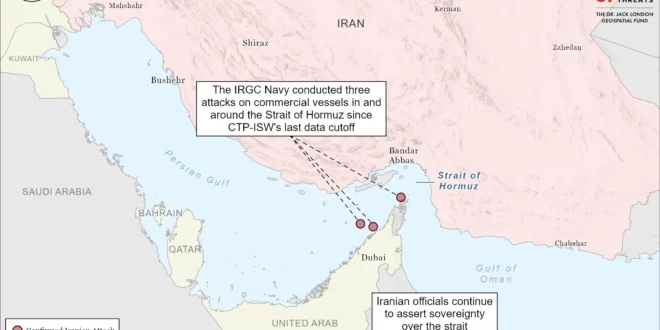
Iran is attempting to demonstrate its “control” over the Strait of Hormuz in response to US attempts to secure freedom of commercial navigation in the strait. Iran is attempting to disrupt these US efforts and demonstrate its control by attacking commercial vessels, oil infrastructure in the United Arab Emirates (UAE), and a civilian building in Oman.
It is against the United States’ interests to allow Iran to exert control over the Strait of Hormuz and thus a large part of international maritime commerce. Allowing Iran to exert control over the strait enables Iran to impose economic costs on the United States and the international economy while simultaneously giving it leverage in negotiations over other important issues, such as Iran’s nuclear program.
US President Trump indicated on May 4 that the most recent Iranian attacks did not constitute a ceasefire violation, however. Trump stated that there was no “heavy firing” when asked whether Iran’s actions violated the ceasefire.
Toplines
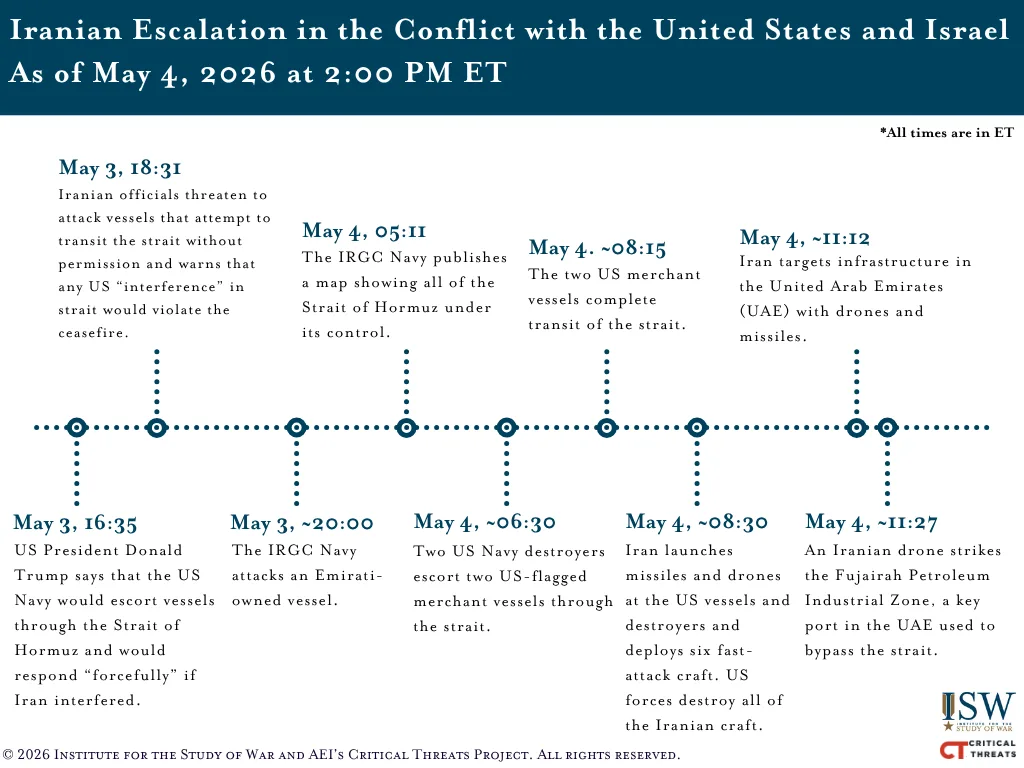
Iran is attempting to demonstrate its “control” over the Strait of Hormuz in response to US attempts to secure freedom of commercial navigation in the strait. Iran is attempting to disrupt these US efforts and demonstrate its control by attacking commercial vessels, oil infrastructure in the United Arab Emirates (UAE), and a civilian building in Oman. Iranian decisionmakers seek to retain “control” over the strait because this “control” is a key piece of leverage over the United States. “Control” of the strait allows Iran to place upward pressure on the global price of oil, which imposes economic and political costs on the United States, the longer the conflict goes on. US President Donald Trump said on May 3 that the US Navy would escort commercial vessels through the strait beginning on May 4. Successful transits under escort would undermine Iran’s ability to credibly threaten commercial shipping. Iran’s ability to ”control” the strait is dependent on its ability to credibly threaten commercial shipping to compel shipping to pay Iran and use Iranian-dictated travel separation schemes.
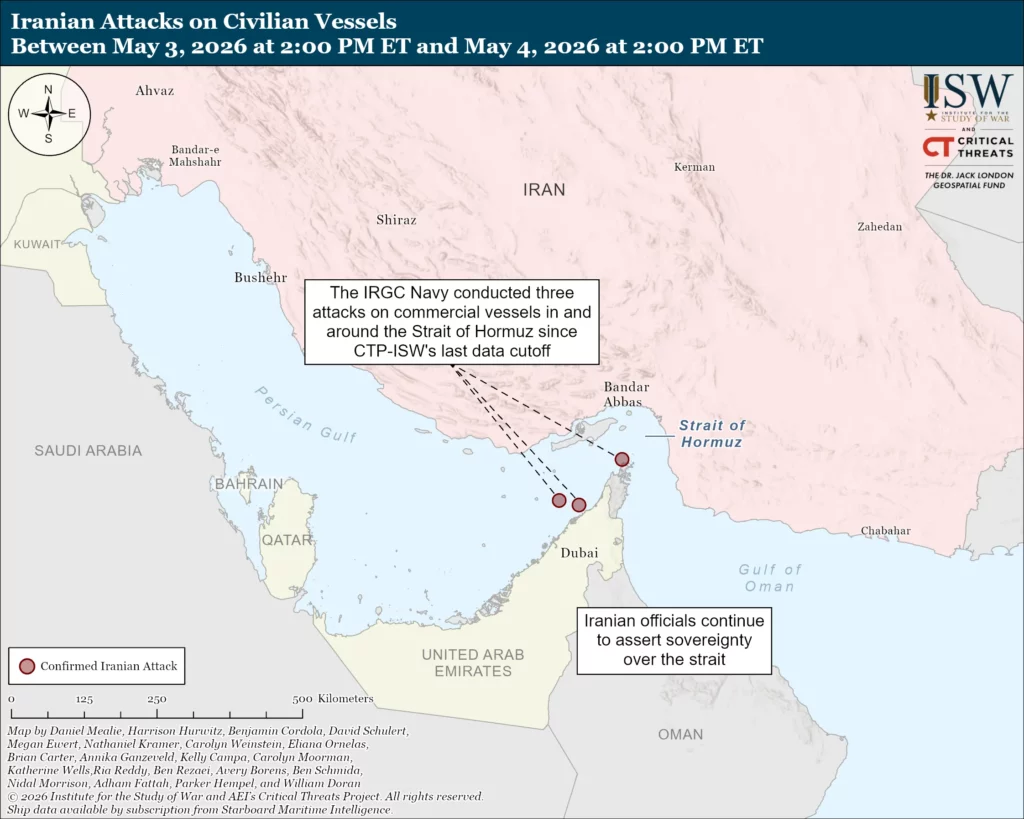
Hardline Iranian officials immediately recognized the risk that successful escorts would undermine their ability to threaten shipping and compel shipping to cooperate, and responded rhetorically and militarily. The Iranian Parliament’s National Security and Foreign Policy Commission Chairman, Ebrahim Azizi, stated on May 3 that Iran would consider any US interference with Iran’s blockade of the Strait of Hormuz to be a ceasefire violation.[1] Iranian forces then attacked an Emirati-affiliated tanker on May 3 with two drones as it tried to pass through the strait.[2] Khatam ol Anbia Central Headquarters Commander Brigadier General Ali Abdollahi Aliabadi threatened on May 4 to attack US warships and commercial vessels that try to transit through the Strait of Hormuz without Iranian permission.[3] The IRGC Navy also published a map of the Strait of Hormuz that claimed that Iran controlled all of the strait.[4] IRGC-affiliated media reported afterwards on May 4 that the IRGC Navy fired ”a warning shot“ at a US warship.[5] US Central Command (CENTCOM) announced on May 4 that two US destroyers guided two US-flagged commercial vessels through the strait without damage.[6] Iran reportedly fired cruise missiles and drones at the vessels and destroyers.[7] Iran also reportedly sent six fast attack craft after the commercial vessels, all of which US forces sank.[8]
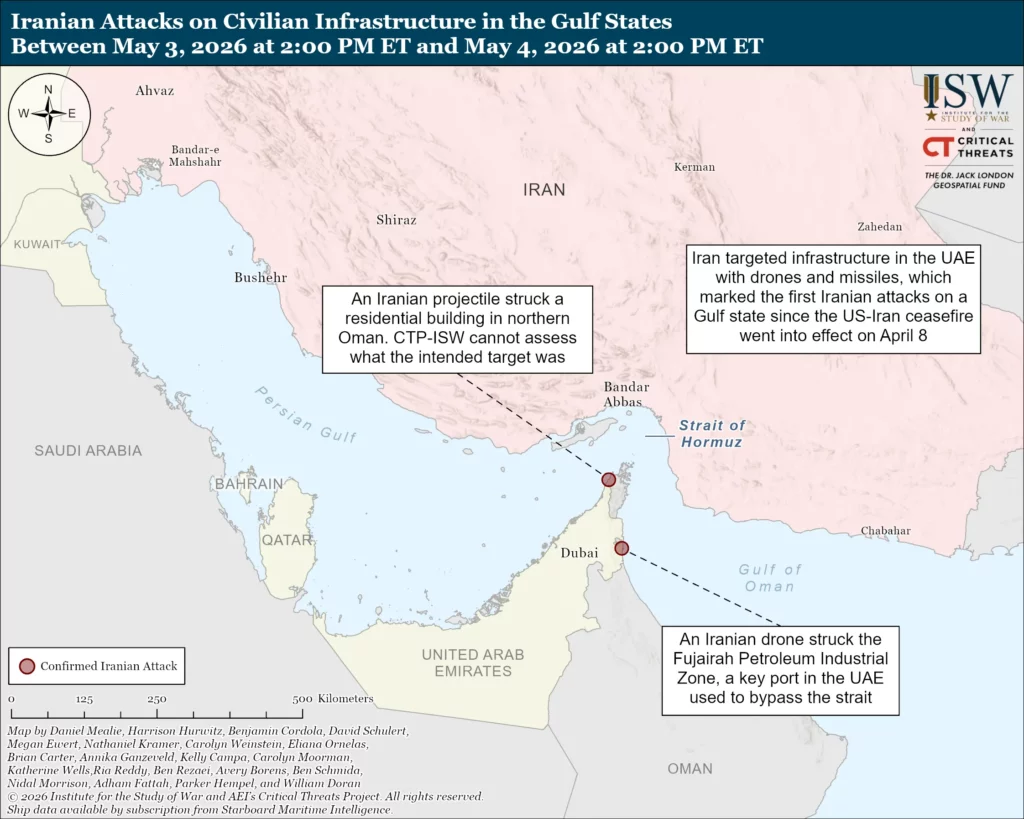
Iran then escalated its attacks by targeting naval and land targets in the UAE and Oman on May 4, possibly to try to deter US allies from using the Strait of Hormuz after these initial steps failed to compel the United States to stop its efforts to escort shipping. The Emirati Defense Ministry announced on May 4 that its forces intercepted three of four Iranian cruise missiles fired at the UAE, with one falling in the sea.[9] Iran reportedly launched a drone at an unspecified target at the Fujairah Petroleum Industrial Zone in Fujairah, UAE, which injured three people.[10] The IRGC then reportedly struck a South Korean cargo vessel named HMM Namu, about 36 nautical miles north of Dubai, UAE.[11] The IRGC also reportedly struck an unknown vessel about 14 nautical miles west of Mina Saqr, UAE.[12] The Emirati Defense Ministry announced afterwards that its air defenses engaged Iranian projectiles at least three more times.[13] An Iranian projectile also struck a residential building in the Tabat area of Bukha Province, Musandam Governorate, Oman, but it is unclear if Iran sought to target this building.[14]
US President Trump indicated on May 4 that the most recent Iranian attacks did not constitute a ceasefire violation, however. Trump stated that there was no “heavy firing” when asked whether Iran’s actions violated the ceasefire.[15]
It is against the United States’ interests to allow Iran to exert control over the Strait of Hormuz and thus a large part of international maritime commerce. Allowing Iran to exert control over the strait enables Iran to impose economic costs on the United States and the international economy while simultaneously giving it leverage in negotiations over other important issues, such as Iran’s nuclear program. Iranian officials have previously stated that Iran will impose a new regime in the Strait of Hormuz that will have “economic benefits” for Iran. Iranian Supreme Leader Mojtaba Khamenei stated on April 30 that Iran will impose a “new management” in the strait that will reap “economic benefits” for Iran, for example.[16] Iran has planned different versions of toll schemes that would allow Iran to charge vessels of its choosing to pass through the strait. Iran offered to “open” the strait in its proposal on April 26, but caveated that it would charge vessels a toll to transit through the strait, for example.[17] Iran could also exploit control over the strait to extract concessions from the United States in talks on issues like Iran’s nuclear program. Iranian Armed Forces General Staff-run Defa Press argued on May 2 that the US-Iran conflict is one of attrition, in which each side is trying to impose economic costs on the other in a bid to extract concessions.[18]
Maritime Development
US CENTCOM reported on May 4 that US forces have directed 50 vessels to turn around or return to port since the start of the US blockade on Iranian ports.[19]
US and Israeli Air Campaign
Nothing significant to report.
Iranian Internal Dynamics
Nothing significant to report.
Israeli Campaign Against Hezbollah and Hezbollah Response
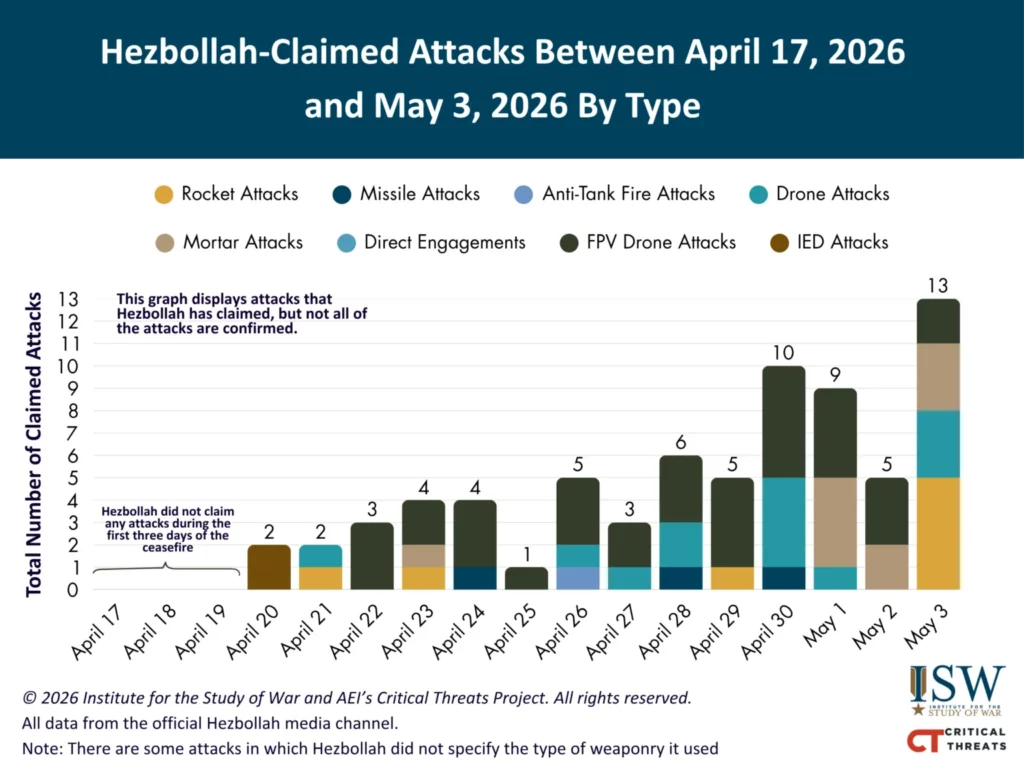
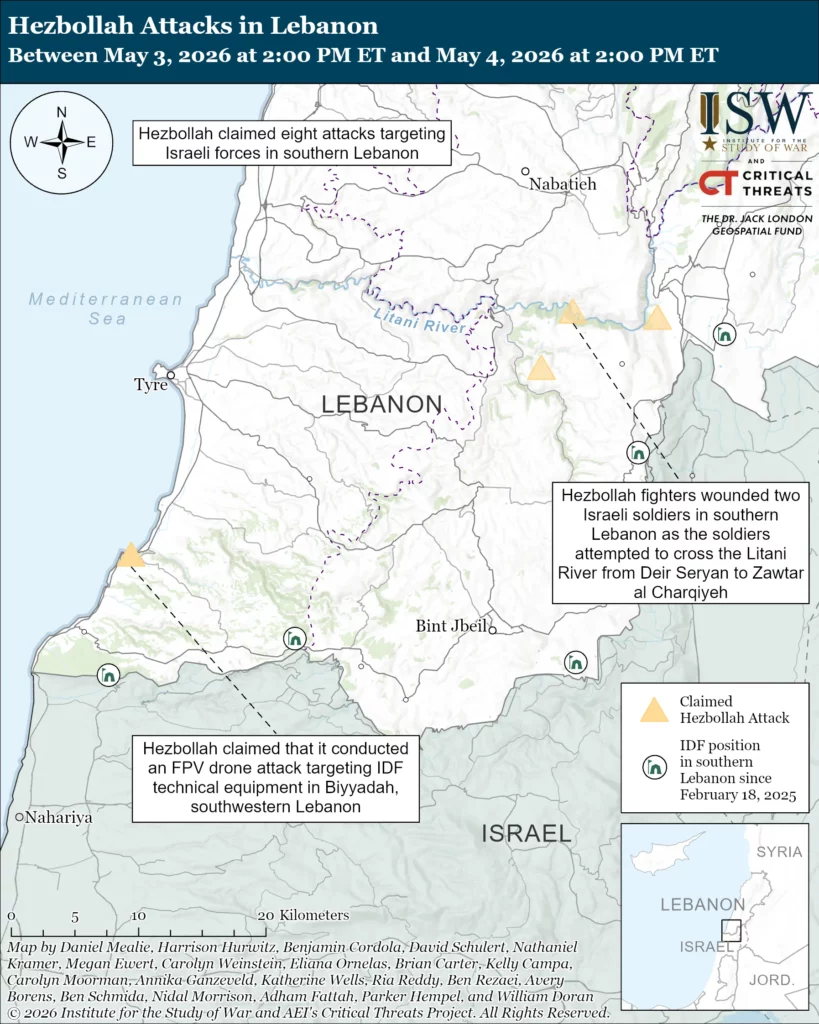
Hezbollah has continued to claim attacks, including first-person view (FPV) drone attacks, against Israeli forces in southern Lebanon. Hezbollah claimed eight attacks targeting Israeli forces in southern Lebanon since ISW-CTP’s last data cut off on May 3.[20] Hezbollah fighters wounded two 1st (Golani) Brigade (36th Division) soldiers in southern Lebanon as the soldiers attempted to cross the Litani River from Deir Seryan to Zawtar al Charqiyeh, both in southeastern Lebanon.[21] Hezbollah also claimed that it conducted an FPV drone attack targeting Israel Defense Forces (IDF) technical equipment in Biyyadah, southwestern Lebanon.[22] An Israeli military correspondent reported on May 4 that a Hezbollah drone lightly wounded an IDF soldier in southern Lebanon.[23] Hezbollah Secretary General Naim Qassem said on May 4 that Hezbollah fighters are currently choosing to conduct attacks designed to maximize Israeli casualties, rather than attempting to seize or hold territory.[24] The IDF estimates that Hezbollah has deployed around 100 drone operators who are operating in small squads operating throughout southern Lebanon, according to Israeli media on May 4.[25] The Hezbollah operators will reportedly typically launch a reconnaissance FPV drone to identify and select potential targets before launching FPV drones equipped with explosives to strike targets.[26] The IDF estimated that these Hezbollah drone operators use fiber-optic FPV drones, which are immune to jamming, in the majority of their attacks.[27]
The IDF is continuing to implement battlefield adaptations to address the threat of Hezbollah’s FPV drones. Israeli media reported on May 3 that the IDF has begun to deploy drone interceptor systems in Lebanon.[28] These drone interceptor systems use radar to identify enemy drones and then launch an interceptor drone equipped with a net to neutralize the incoming drone.[29] IDF drone industry sources told Israeli media that the interceptor system could not effectively detect enemy drones in previous testing about a year ago, however.[30] Ukrainian Unmanned Systems Forces has increasingly and successfully intercepted Russian drones using interceptor drones in their war.[31] An Israeli correspondent reported on May 4 that the IDF has purchased hunting shotguns and is preparing to issue them to IDF units in Lebanon “soon.”[32] Ukrainian and Russian units have also issued shotguns to anti-drone units as a drone countermeasure.[33] The IDF reportedly estimates that its new countermeasures will reduce Hezbollah FPV drone strikes on IDF forces by 80 percent.[34] ISW has observed in the war in Ukraine that the development of successful drone countermeasures requires a rapid innovation cycle, which involves countermeasure prototype testing by frontline units who can communicate with defense industry partners to adapt these prototypes to frontline conditions and then quickly redeploy these adapted countermeasures back to the frontline units.[35]
Other Axis of Resistance Response
Nothing significant to report.