 Eurasia Press & News
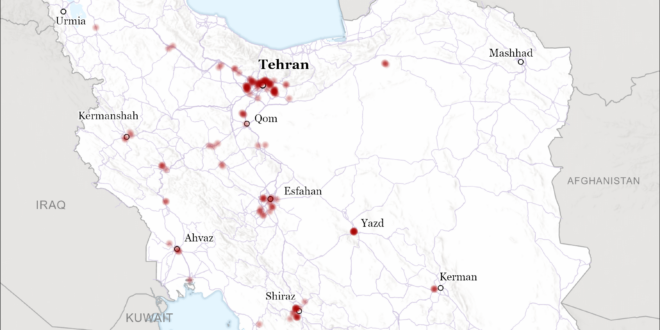
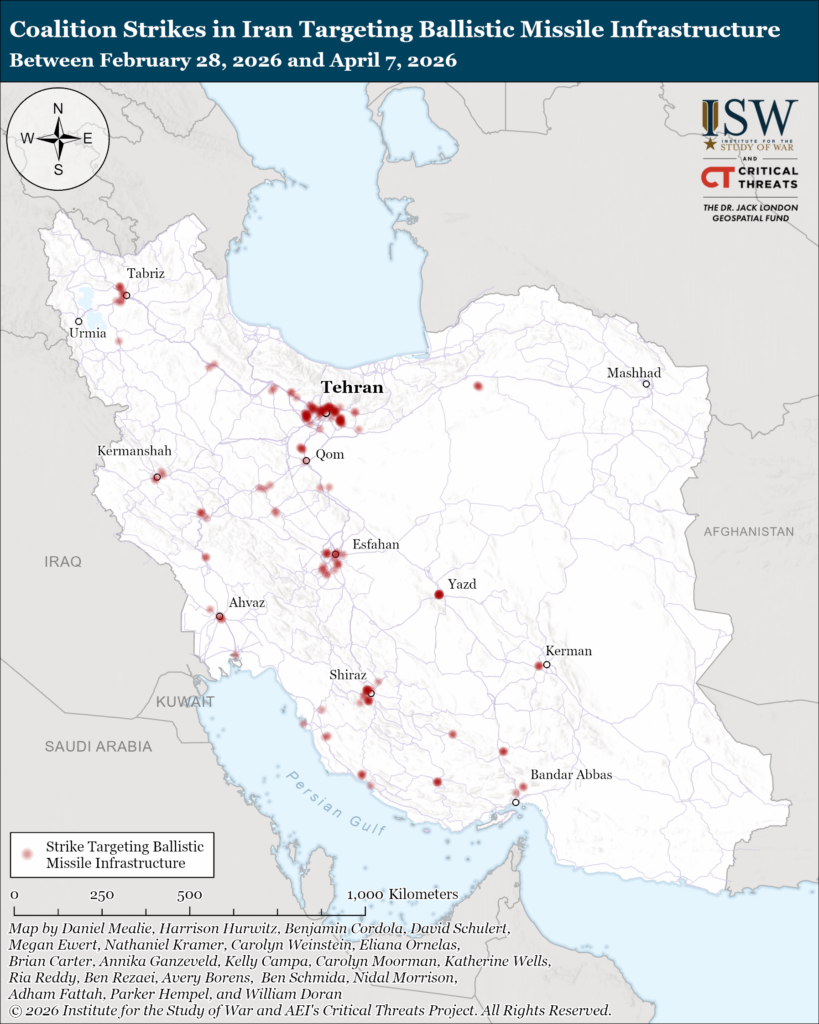
The US-Israel combined force achieved meaningful operational and strategic successes vis-à-vis the Iranian ballistic missile program before the ceasefire. The combined force spent weeks striking a wide range of missile facilities across Iran based on long-standing US air warfare theory and doctrine. This effort disrupted Iran’s missile operations, degraded its missile capabilities, and destroyed much of the industrial and knowledge bases supporting the missile program. The combined force prevented the Iranian missile force from executing its concept of operations and accomplishing its campaign objectives. The combined force has also degraded the Iranian ability to reconstitute and improve its missile capabilities without years of rebuilding.
The US-Israeli campaign before the ceasefire was meant to achieve those qualitative effects—rather than simply to destroy a list of targets—and should be evaluated against those objectives. Focusing solely on quantitative measures of success, such as the number of Iranian missiles and launchers destroyed or rendered combat ineffective, ignores the design of the campaign, which was meant to shock and disrupt the enemy force and prevent it from executing its own campaign plan and achieving its objectives. It is very difficult to assess the damage done to the missile force using quantitative measures alone. Quantitative measures are captivating because they imply a degree of scientific precision and exact measurement. But the Iranian missile force is much more than its munitions and launchers; it is also commanders, launch crews, communications and computer networks, production and logistical facilities, and much more. US air campaigns involve striking all such elements to generate effects across the entire enemy system.[i] Tallying only materiel losses will lead to inaccurate conclusions about the effects of the campaign. Rather, one must evaluate the cumulative effects of strikes against the entire enemy system.
The US-Israeli combined force sought to disrupt the Iranian missile force at the operational level in order to prevent it from executing its campaign plan while degrading it at the strategic level in order to prevent it from expanding its stockpile and building more advanced systems. Achieving that strategic effect was especially critical since one of the core Israeli war aims is to eliminate the long-term threat posed by Iranian missiles. The combined force achieved the intended operational and strategic effects by striking centers of gravity rapidly across Iran and at every level of war, which is consistent with the US approach known as “parallel warfare.”[ii] That approach is meant to render the enemy force ineffective—unable to fight in its intended manner—rather than to destroy every missile and launcher or prevent Iran from firing a single missile. In this respect, the US-Israeli combined force was relatively successful in that Iran could not fire large missile salvoes by the time of the ceasefire.
Operational Success: Disrupting Iranian Missile Operations
The combined force achieved operational success by preventing the Iranian missile force from executing its concept of operations. Iranian leaders entered the war apparently planning to sustain massed fire at the United States and its partners as long as the war continued, seeking to impose significant costs that would exhaust the willingness of the United States and its partners to fight. This Iranian concept of operations was evident when the Iranian missile force launched large-scale missile barrages across the Middle East on the first day of the war.[iii]
This Iranian concept of operations was based on lessons learned from firing missiles at Israel in 2024 and 2025. Iranian leaders found that they could not reliably penetrate Israeli air defenses and destroy precise military targets in order to achieve significant operational effects.[iv] Too many Iranian missiles would malfunction, miss, or get intercepted, preventing Iran from generating the kind of mass needed to overwhelm Israeli air defenses. Iranian leaders concluded that they needed to dramatically expand their missile stockpile—preparing to have 10,000 by 2028—in order to compensate for those challenges and still mass significant force.[v] After the 12-Day War in June 2025, they rapidly reconstituted their missile program and pursued the stockpile expansion.[vi] They also examined using maneuverable reentry vehicles and other technical improvements to missile accuracy, which could have made individual projectiles harder to intercept and more destructive.[vii]
The Iranian missile force thus needs to be able to mass and then sustain fire in order to accomplish its campaign objectives. To use the technical language of center-of-gravity analysis, massing and sustaining fire are two critical capabilities for the missile force. Iranian leaders view mass as necessary to overwhelm and penetrate advanced air defenses, as previously noted. But mass is insufficient on its own. The missile force would need to sustain an adequate amount of mass over time.
The US military defines a center of gravity as “the source of power or strength that enables a military force to achieve its objective and is what an opposing force can orient its actions against that will lead to enemy failure.”[viii]
Three components make up a center of gravity: critical capabilities, critical requirements, and critical vulnerabilities. Critical capabilities are “essential to the accomplishment of the mission.”[ix] The center of gravity requires critical requirements to employ its critical capability.[x] These requirements can be conditions, resources, or means. The US military also identifies critical vulnerabilities, which “are aspects of critical requirements vulnerable to attack.”[xi]
The combined force deprived the Iranian missile force of those two critical capabilities by striking Iranian missile units, commanders, and stockpiles, among other targets. Those targets are critical vulnerabilities that the missile force needed to defend in order to sustain its critical capabilities. Strikes on missile units, especially the launch crews, suppressed missile fire to some extent while likely creating a pervasive sense of fear in the missile force that would have undermined combat operations. The size of Iranian missile salvoes quickly declined, indicating that launch crews hoped to return to cover quickly and preserve themselves rather than coordinate with other units to achieve massed or sustained fire. Strikes on missile commanders and command-and-control (C2) networks broadly further disrupted the missile force. C2 is a critical requirement that enables the missile force to coordinate across units and concentrate their fires simultaneously in order to achieve mass. Strikes on missile commanders and C2 networks likely prevented missile units from effectively coordinating and thus contributed to the overall paralysis that the missile force experienced.[xii] Finally, strikes on missile stockpiles and launchers created bottlenecks that the missile force needed to overcome. Losing missiles and launchers attrited some of the most vital assets that the missile force had and forced it to make more economical decisions about when to fire and risk certain assets. Fewer munitions and launchers available make it harder to sustain massed fires and, in the extreme case, difficult to sustain any fire at all.
The Iranian missile force failed to sustain massed fire due to these strikes. The missile force managed to fire a significant volume of projectiles on the first day of the war. But the combined force rapidly reduced the rate of Iranian missile fire by 90 percent.[xiii] This effect did not eliminate Iranian missile fire altogether, of course, which would have been extremely difficult if not impossible. It instead brought Iranian missile fire to a manageable level that US and partner air defenses could consistently handle. This was most evident regarding Iranian fire at Israel. The Iranian missile force struggled to fire more than one missile at a time at Israel by the time of the ceasefire.[xiv] Some launch crews were reportedly unwilling to execute orders.[xv] Others deserted.[xvi] For a missile force that planned to launch hundreds of missiles per salvo in order to inflict widespread destruction, this is mission failure.
Iran still inflicted some damage with its missiles, to be sure. Some Iranian missiles penetrated US and partner air defenses and struck military targets.[xvii] Additionally, Iran tried to adapt by firing more missiles with cluster munition warheads, which disperse dozens of bomblets over a wide area.[xviii] Iranian leaders likely recognized that they could not reliably generate the mass needed to defeat Israeli air defenses and destroy discrete military targets. They therefore opted to use cluster munitions that are harder to intercept completely and cause extensive destruction in a general area. The Iranian missile force used the cluster munitions to terrorize Israeli civilians and society.
Iran still failed to achieve its central-most objective, however, which was imposing so much damage that the United States and its partners became unwilling to continue fighting. The Iranian failure to achieve that objective is the key criterion—derived from US air warfare theory and doctrine—by which one must evaluate the counter-missile component of the campaign.
Strategic Success: Destroying the Iranian Missile Forces’ Industrial and Knowledge Bases
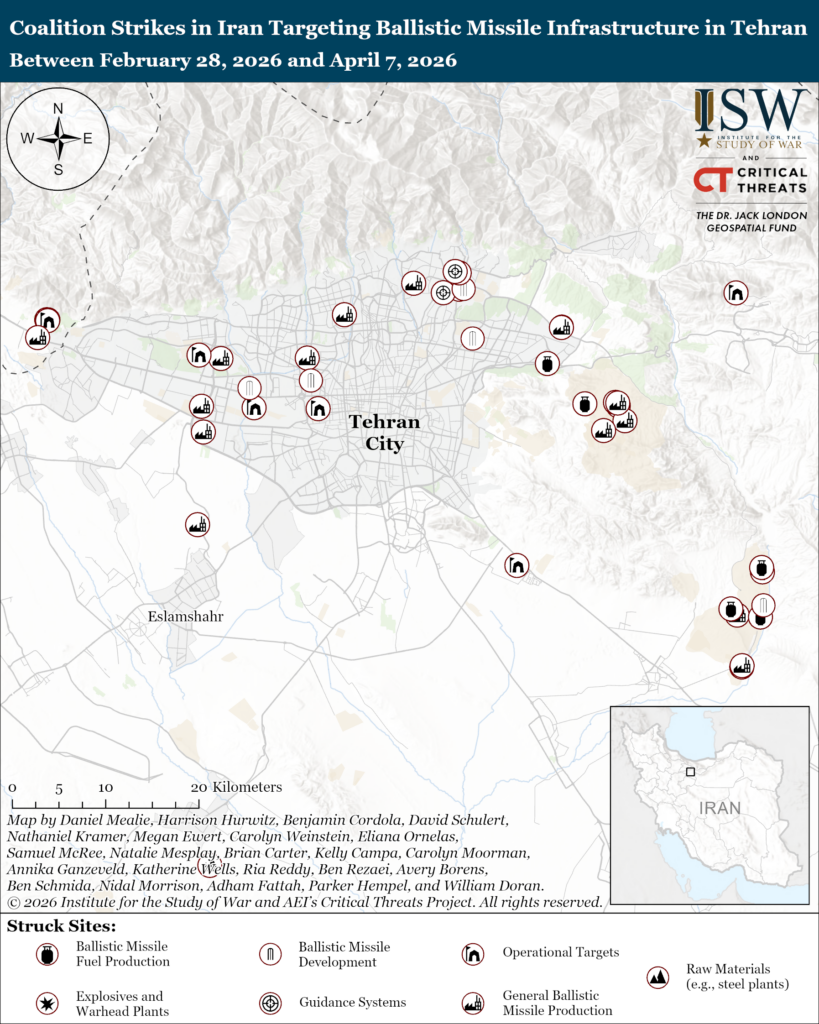
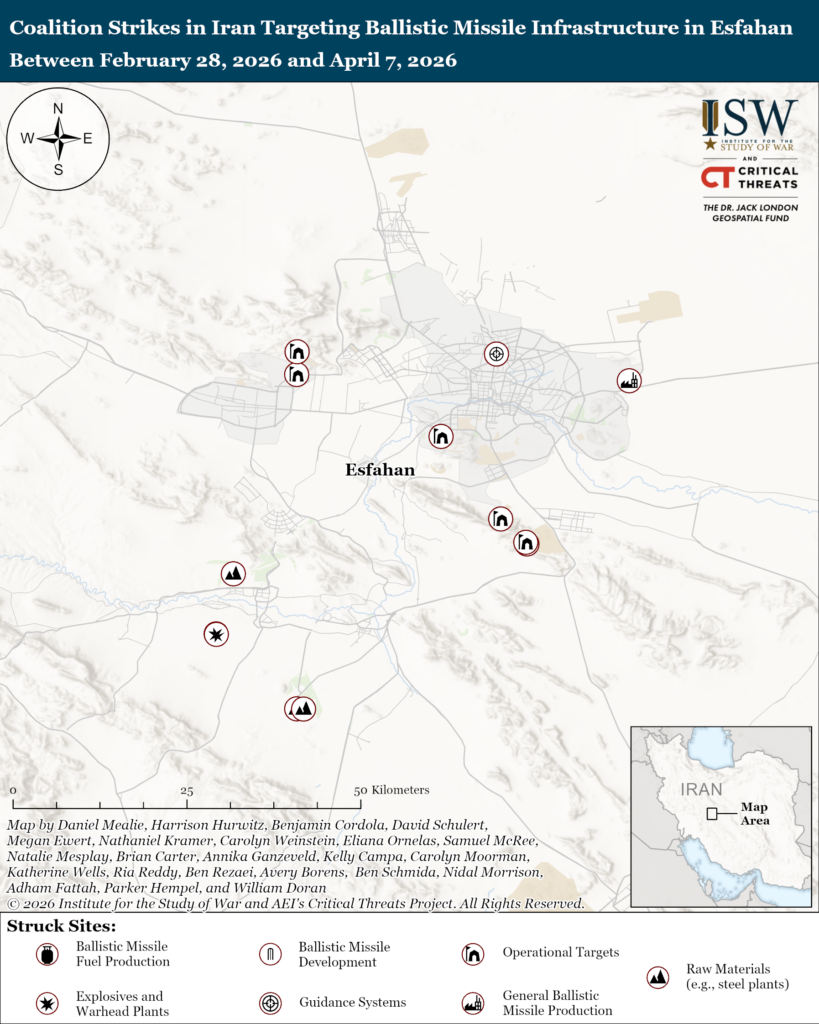
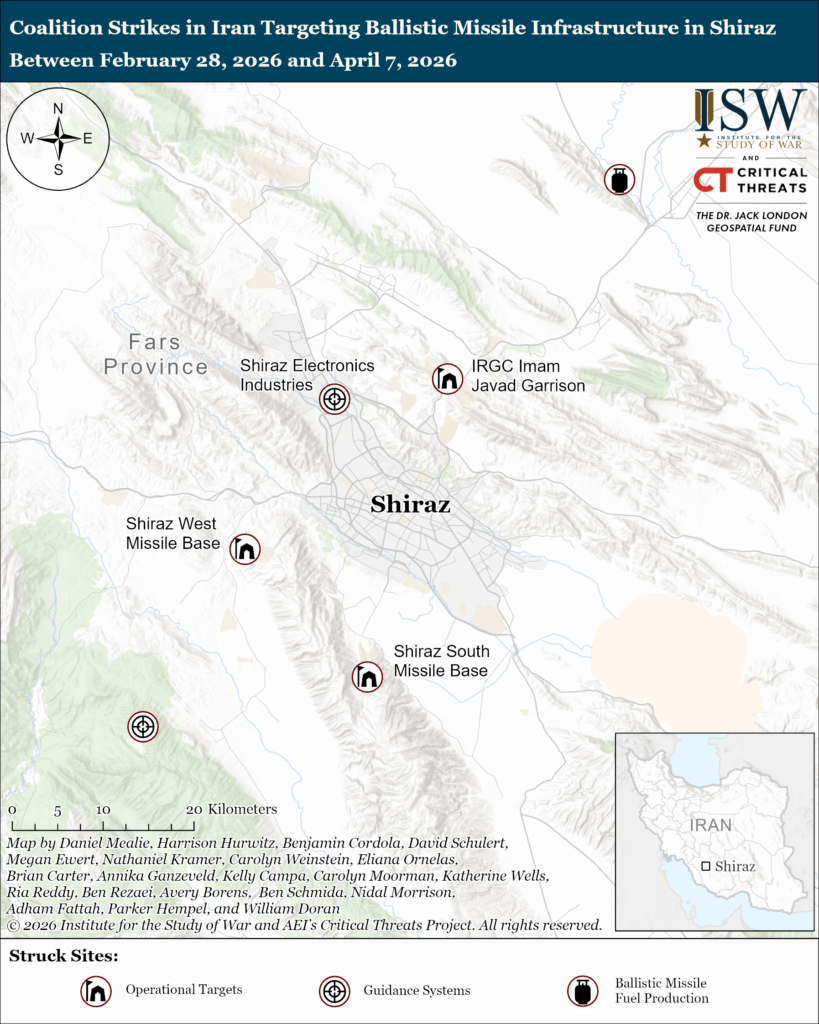
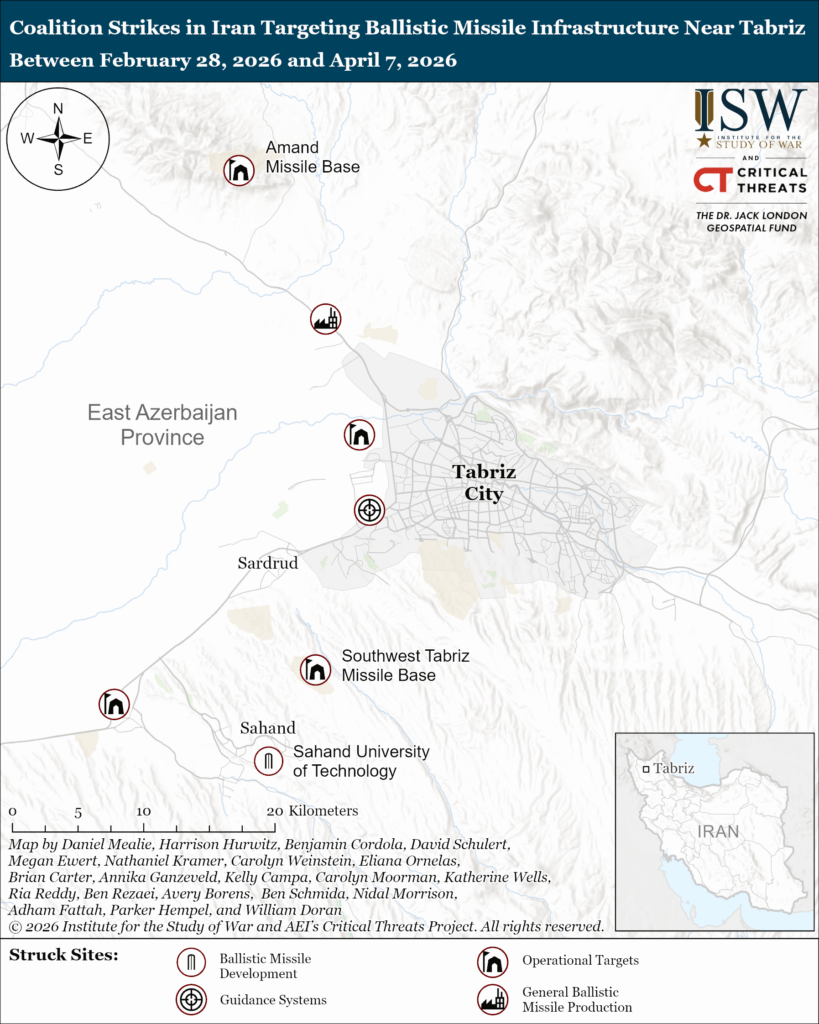
The combined force has achieved some strategic success by destroying much of the industrial and knowledge bases that Iran needs to reconstitute its missile force and improve its missile capabilities. The combined force struck virtually every element of the production and supply chain from raw material facilities (preparing steel, aluminum, missile fuel, etc.) to final assembly plants. We have recorded strikes on at least 15 facilities responsible for guidance systems (including one of the very few Iranian ball bearings plants—key for inertial guidance in ballistic missiles), 18 missile fuel production plants, six explosives and warhead manufacturing plants, and 45 other facilities associated with production.[xix] The combined force also struck at least 11 research and development facilities that supported technical improvements to missile capabilities. These numbers probably represent only a fraction of the missile facilities struck due to the limitations of publicly available information. The strikes on those facilities were far more substantial than those that the Israel Defense Forces conducted in the 12-Day War. Iran will need significant time and resources to rebuild these capacities and cannot reconstitute its missile force fully until then.
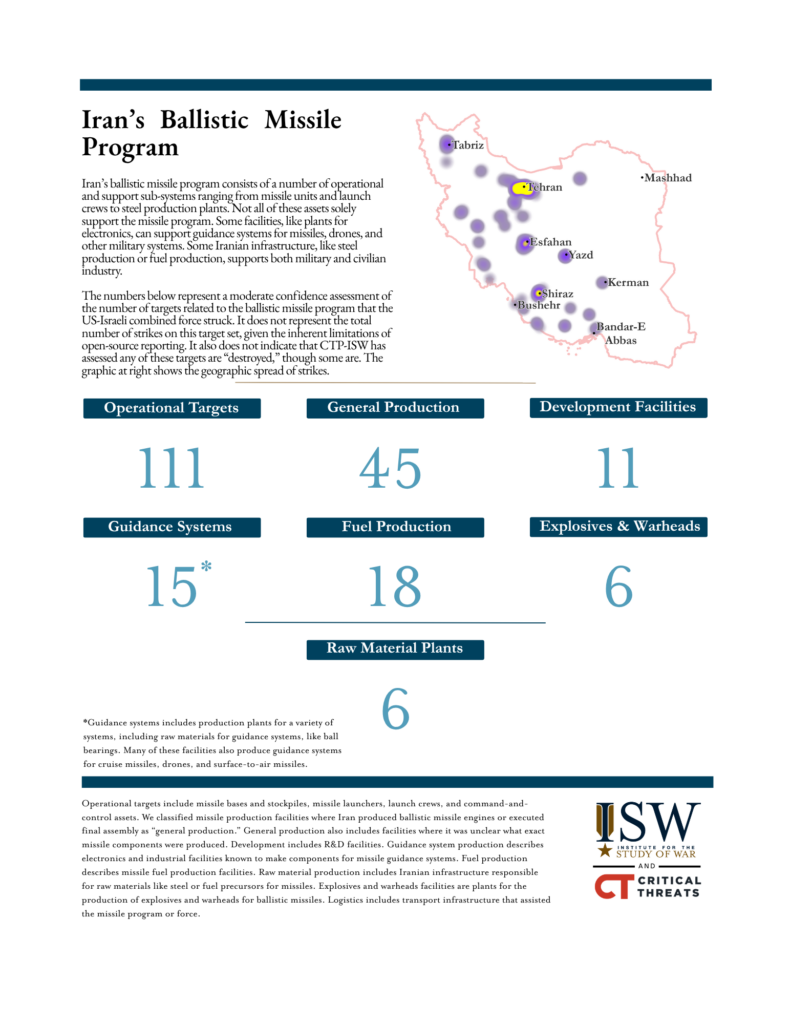
Iran needs to produce deep missile magazines and develop more advanced and possibly longer-ranged systems in order to mass and sustain fire. Building missiles and a deep inventory of them requires a large, sophisticated production chain that includes purpose-built production facilities. The production chain also includes factories for various sub-components and industrial inputs, not all of which are solely military in nature (steel plants, for example). The long-term viability of the program also requires research facilities to develop advanced technologies, such as maneuverable re-entry vehicles, or longer-range systems. Those facilities include wind tunnels and laboratories for research on new designs as well as elements of the civilian space program that support the development of longer-range systems. The missiles that Iran fired at Diego Garcia may have been based on lessons learned from the Iranian space program, according to a Dutch missile expert, though there is no definitive evidence.[xx]
The production chain and research facilities are vulnerable because they are too numerous for Iran to protect adequately. The challenges associated with striking them, however, come from their dispersion and size. The IDF struck only individual elements of Iran’s production chain in June 2025 without attacking the entire chain, meaning that Iran could rapidly replace the destroyed equipment without needing to fix the remainder of the industrial network. Attacking the program using a parallel warfare approach addresses that problem because it involves striking every node in the production chain across the country, such that the program cannot be restarted without entirely rebuilding a large amount of sophisticated infrastructure.
Iran will need to rebuild its production chain to resume missile manufacturing at the pre-war rate. It is impossible to forecast how long that process will take, but the scope of the US-Israeli strikes indicates that it will probably be significantly longer than the reconstitution process after the 12-Day War. Additional research is required to forecast exactly how long it will take Iran to rebuild the facilities described above. Key questions include how badly each facility is damaged, how much each facility costs, how much time Iran requires to rebuild the facilities, what Iran’s internal assessment of the relative importance of its ballistic missile program compared to other funding priorities is, and how much money Iran has to devote to such projects relative to the pre-war period. An assessment that offers a definitive timeline for reconstitution but fails to answer these questions and others not mentioned should be interrogated.
Short- and Long-Term Implications
The ceasefire has likely enabled Iran to rapidly recoup the operational setbacks that it has suffered. Shock within the Iranian missile force and the inability of commanders to communicate laterally and vertically in their organization are temporary effects. The missile force will recover psychologically. Commanders have likely resumed communications absent tangible military pressure. The engineering crews responsible for retrieving launchers inside collapsed underground facilities proceeded to do so without interference. Iran will likely be able to launch relatively more missiles more effectively in the days after the resumption of fighting. As fighting resumes, this increase should be understood as a result of the operational pause during the ceasefire rather than a broader failure of the campaign.
Nevertheless, the serious damage to the missile program highlighted above suggests that the United States and Israel have achieved key strategic effects. Iran sought to build thousands of missiles and upgrade them over time to create an effective deterrent against the United States and Israel. Such circumstances would have hamstrung the ability of the United States to act in support of its interests in the Middle East lest it incur thousands more Iranian missiles targeting US forces and regional partners.
Positive strategic effects and trends do not mean that the war is an overall strategic success, however. It remains unclear if and how the strategic effects highlighted above can be maintained absent “spot-hitting” the missile program. Even a years-long setback to the missile program is recoverable. The war is not over, and the final judgment of its success must be based on the political agreement that ends it. Overall success must ultimately be determined by whether the United States achieves its political objectives.
Appendix: Strikes on Iranian Missile Infrastructure in Tehran, Esfahan, Shiraz, and Tabriz Cities