 Eurasia Press & News
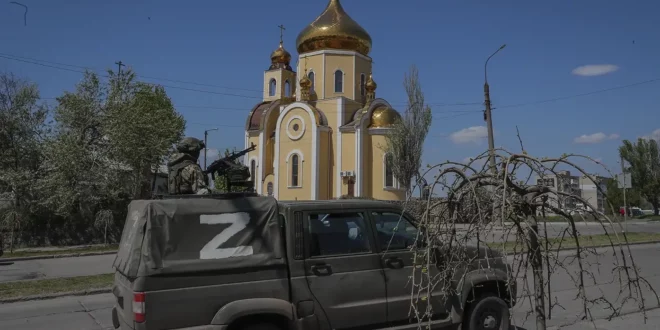
Russia is consistently building a system of religious control in the occupied territories of Ukraine. Russian troops are destroying and capturing churches, new authorities are subjecting to repression of clergymen, forcing them to report to parishioners and allow checks right during services. Communities are filtered – they are forced to register according to Russian laws. According to the Ukrainian authorities, by the spring of 2025, the Russian military killed at least 67 religious figures, and in the occupied territories of Donetsk and Luhansk regions, most religious communities ceased to exist or went underground.
Religious Map of War
During the four years of the full-scale war in Ukraine, the project “Religion on fire” recorded at least 742 cases of destruction or damage to religious objects. Among them are Orthodox churches, Protestant prayer houses, Catholic churches, synagogues, mosques, buildings of other religious communities and religious educational institutions.
Most of the destruction was recorded in the regions, some of which were or remain under Russian occupation: in Donetsk – at least 146 objects, Luhansk – at least 83, Kherson – not less than 78, Zaporizhzhia – not less than 51. The religious infrastructure there fell under missile, artillery and drone strikes, and some of the buildings were destroyed after the capture of settlements by Russian troops.
In Mariupol, which after many months of siege was under Russian occupation, buildings of different religious communities were destroyed. In May 2022, it became known that Russian troops completely destroyed the local synagogue and the premises of the center of the Jewish community.
The pastor of the Seventh-day Adventist Church Valentin Zagreb said that both of his community’s buildings in the city were also completely destroyed. One of them was on Nikolaevskaya Street – in the historical building of the former synagogue, transferred to the Adventist Church. The second – on Shevchenko Boulevard – other Protestant communities were used.
In the occupied territories, religious buildings were not only shelled. They were captured, closed, transferred to the occupation structures for military and administrative facilities.
Religious buildings were not only shelled – they were captured, closed and handed over to the occupying authoritiesIn Melitopol, the Russian military seized the Church of Evangelical Christians “Grace”, founded back in 1910. In Soviet times, the community experienced repression and confiscation of buildings. The room on the main street of the city was returned to believers only in 1991. Worship services were held there until September 2022, until armed men in masks broke into the temple.
They blocked the exit, withdrew parishioners in groups, took away the documents and searched. Pastor Mikhail Britsyng and the administrator of the church were detained and interrogated, and then they were presented with an ultimatum: to leave the city for two days. The church was accused of “extremism.”
Now, according to Britsyn, the building “Blagodati” was given to the so-called Ministry of Culture of the Zaporizhzhia region. From the facade removed the cross – now in the former church there are concerts and rewarded by propagandists.
It wasn’t just the buildings that were hit. According to the Ministry of Foreign Affairs of Ukraine, by the spring of 2025, Russian forces had killed at least 67 clergymen of different faiths. Some were executed for refusing to cooperate with the occupation administration or public disagreement with Russian aggression. Others died in the shelling of churches and houses, staying close to their communities.
Some were executed for refusing to cooperate with the occupiers or public disagreement with the aggression, others died during the shellingIn February 2024 in the occupied part of the Kherson region, the Russian military Remove the Priest’s House the Orthodox Church of Ukraine (OCU) Stepan Podolchak, who served in Kalanchak. He was taken out barefoot, with a bag on his head.
Two days later, the priest’s body was found with traces of torture. Before the full-scale war, Podolchak conducted Ukrainian services in Kalanchak and continued to do so even after the occupation. He was called several times for “conversations” in the FSB and demanded to move to the Moscow Patriarchate. He refused.
Some religious figures in the occupied territories were through arrests, interrogations and imprisonment. In Melitopol, the Russian military detained the pastor of the Protestant Church “Word of Life” Dmitry Bodya after he took part in public prayers for Ukraine and helped the faithful to leave the city.
In the Kherson region, the priest of the Ukrainian Orthodox Church (UOC) Igor Novoselsky spent 262 days in captivity. He demanded that he abandon the use of the Ukrainian language and directly obey the Russian Orthodox Church, but he did not agree to this and was captured.
Maxim Vasin, director of international advocacy and research at the Institute of Religious Freedom, says that Ukrainian priests, pastors, imams and other religious figures in the occupied territories were often among the first targets of the Russian occupation authorities. But as Russia consolidated in the region, pressure changed the form: outright violence gradually replaced the “legal” forms of repression – through the introduction of Russian legislation.
“It is repressive in fact – serves as a screen for the international community. The law covers the systemic destruction of any dissent both in Russia itself and in the territories of Ukraine it controls, ”says Vasin.
From Destruction to Management
After the beginning of a full-scale invasion, Russia transferred to the occupied territories of the south and east of Ukraine a model of religious control that has been practiced since 2014 in the occupied territories of the country. Thus, in parts of the Donetsk and Luhansk regions under the control of Russia, most religious communities ceased to exist, and believers were forced to pray at home or gather underground. After the introduction of Russian legislation, the prosecution became possible to formalize through administrative and criminal procedures.
Mikhail Britzyn, director of the Department of Religious Freedom of the International Christian Organization Mission Eurasia and the elder of the Church of Blessing, says that a legally designed pressure model allows the occupying authorities to represent the persecution of believers as “establishing order” or “fighting extremism.” Such a system intimidates communities not only by direct violence, but also by fines, courts, documents and registers. “The violence has not disappeared. It was built into a bureaucratic and judicial shell,” says Britzyn.
One of the main tools of this pressure is compulsory registration of communities under Russian law. According to Maxim Vasin, the occupation authorities threaten the faithful with the confiscation of church buildings and other property, demanding to re-register under Russian rules. To do this, the head of the religious community and its founding members are obliged to obtain Russian citizenship.
“The demand to accept Russian citizenship is part of a strategy for the violent Russification and destruction of the Ukrainian identity of the local population of the occupied territories of Ukraine, including churches and other religious communities,” Vasin said. At the same time, the re-registration itself, according to him, does not guarantee the preservation of property. Moreover, the personal data of the founders submitted during the execution of documents, the FSB can use for subsequent surveillance and raids on “illegal” home meetings of believers.
In practice, the requirement of registration is often presented to church leaders during the calls to the commandant’s office – on the so-called preventive conversations, says Britsiyn. There, the ministers are threatened: either register in one form or another, or face a ban, repression and deportation.
Under Russian law, religious activities without registration or without a notice of the beginning of activities are prohibited. “Servicemen are actually faced with a difficult choice: to agree to the terms of the occupation authorities or go underground,” says Britzin. Against those who still continue to hold services without registration, first open administrative, and then criminal cases.
Ministers are threatened: either register in one form or another, or face a ban, repression and deportationThe registration requirement works not only as a way to legalize the community, but also as a selection mechanism: some allow to exist officially, others are denied this. In the occupied Luhansk region, all Protestant communities received a refusal to register. They could not obtain permission for the activities and Orthodox churches that do not belong to the Moscow Patriarchate. And Jehovah’s Witnesses, already banned in Russia, decided not to submit documents in principle, fearing the prosecution and disclosure of the data of believers.
Refusal of registration leaves the community without legal status, and therefore without the formal right to use the church building. In practice, this opens the way to the power seizure of property: the Russian military and special services occupy church buildings, export property, saw off crosses and use premises for the needs of the occupation authorities. According to Britsyn, by the summer of 2023, at least 15 churches of different faiths had been seized in Melitopol. In one of the buildings, policemen now live, in the other opened an occupation “ministry of young people”, somewhat more are empty.
Another tool of pressure is Russian restrictions on “missionary activities”. In the usual sense, this is a sermon and spread of faith, but after the adoption of the “Spring package” in 2016, the legislation of the Russian Federation began to interpret missionary work much more widely. The amendments were accepted as anti-terrorist, but in the religious sphere allowed to punish for almost any spread of religious beliefs outside the officially permitted premises. Under violation, it was possible to bring prayer meetings, home services, talk about faith and the dissemination of religious literature.
In the occupied territories, this mechanism hits primarily communities that have lost buildings or cannot be registered under Russian rules. If a community without official status meets at home, the assembly itself can be declared “illegal missionary activity.”
In the citySorokin such pressure was replaced by a community of evangelical Christians-Baptists (ECHB), a member of the International Union of Churches of the ECB and fundamentally not undergoing state registration. In recent years, the security forces repeatedly came with searches and raids on her services, and pastor Vladimir Rytkov and other ministers were fined for “illegal missionary activity”. In March 2026, Rytkov Obliged leave the occupied part of the Luhansk region within two weeks. The order for expulsion was issued ten days after the next protocol for “conservation without permission”.
Even tougher in the occupied territories of Ukraine are Russian norms on “extremism” and prohibited organizations. “For example, Jehovah’s Witnesses have no chance to preserve their religious activities, avoid open persecution and imprisonment, since in Russia they are recognized as an extremist organization,” Vasin explains.
Went to the service – got to check the FSB
Even if the religious community in the occupied territory manages to maintain legal status, worship services cease to be a safe space. Russian security forces can come during the service with a check. “During such raids, they are trying to find signs of disloyalty of parishioners. First of all, they check the presence of Russian passports. Then they are looking for Ukrainian contacts in phones, links with military or volunteers, subscriptions to Ukrainian social networks, anti-Russian messages, banned applications, ”says Mikhail Britsiyn.
If the occupation authorities have doubts about the loyalty of a person, he can come home with a search. “And it often turns out that the Ukrainian house almost always has something Ukrainian, which means “prohibited”,” says the pastor.
Control is not limited to raids. Protestant pastor Dmitry Bodyu remained in the city for some time, but already understood that he could not continue the service. To stay, he would have to accept the terms of the occupation authorities and cooperate. It’s not just about formal loyalty. According to Bodyu, the security forces demanded that he hand over the lists of parishioners, their personal data, including place of work and income, and report on the mood about the occupation.
In Ukrainian churches, such information is not collected, and this, says the pastor, caused failure among the security forces. During the interrogation, he was asked about who oversaw him from the SBU. “I say, we don’t have that. – How not? This can not be,” says Bodyu talk with the siloviki. According to him, they did not understand how the church can exist without a curator from the special services: “This is a different format of thinking, a different view of life. For them, it is logical and understandable, but for us it is not.” The pastor did not want to cooperate with the occupation authorities and left Melitopol.
Russian security forces did not understand how the church could exist without a curator from the special servicesAfter his departure, another minister remained in the city, but, according to Dmitry Bodyu, he also could not stand for a long time. He was asked to bring a Sunday sermon in advance for verification and only after permission it could be pronounced in front of the community.
People who are now going to gather in worship, “go in a minefield,” says the pastor: “We need to very selectively express your opinions, think to whom you say it.”
In such an atmosphere, people begin to be afraid to come to church, pray aloud, speak Ukrainian, bring children, gather their homes. According to Britsyn, there are cases when priests were asked to tell what they had heard in confession, the secret of which is forbidden to disclose.
Self-censorship appears even in ordinary conversations: it is better not to talk about this, it is better to ignore this assessment. “Church life from a space of trust turns into a space of fear and self-control,” says Mikhail Britsin.
Who’s under attack
According to Maxim Vasin, the repression primarily includes clergy and communities, which the Russian special services consider clearly pro-Ukrainian: independent of Moscow Orthodox Church of Ukraine (OCU), the Ukrainian Greek Catholic Church (UGCC, subordinate to the Vatican) and Protestant denominations, primarily Baptists, Pentecostals and Adventists. “Evangelical churches, among other things, are stereotyped as pro-American structures and “dangerous” sects that allegedly seduce the Orthodox majority,” adds Vasin.
In Crimea, Vasin says, the Russian authorities actually destroyed the presence of the OCU and the UGCC, eliminating all their parishes, and the Protestant churches forced to break the spiritual and administrative ties with Kiev.
In the new occupied territories, the presence of the OCU remains, but in an underground format. According to the Primate of the Orthodox Church of Ukraine, Metropolitan Epiphany of Kiev and All Ukraine, priests of the OCU still remain in the Donetsk, Luhansk and Kherson regions. The Church does not disclose the statistics and details of their activities, so as not to expose people to additional risks.
In the Zaporozhye region, the UGCC was banned by a separate order of the occupation administration. In a document of December 26, 2022, the church was accused of working “in the interests of foreign special services”, the participation of parishioners in anti-Russian rallies, the storage of weapons and explosive devices, as well as the activities of “extremist organizations”. Property and land plots of the UGCC were transferred to the military-civil administration, lease agreements were terminated, and it was forbidden to register the communities of the UGCC.
The head of the UGCC, the supreme archbishop of Kiev-Galitsky Svyatoslav Shevchuk reported that there was not a single Greek Catholic parish left in the occupied territory of Ukraine. This means that the parishioners of the UGCC were left without a sacrament of confession and communion, which only the ordinated priest can perform. And where to find him in the occupation?” says Mikhail Britsyn.
Before the occupation, Protestant churches in Melitopol were a significant part of the city life. Pastor Dmitry Bodyu says that interfaith council had previously worked in the city, communities held joint events with local Ukrainian authorities, and ministers could directly contact the mayor, deputies and officials, if help was needed.
“We have a small city, the relationship between people is very important. This is not a matter of curatorship, but cohabitation in one city and work for the benefit of our community,” says Bodyu. During the detention, the Russian security forces wondered why the pastor had contacts of the mayor, deputies, the chief of police, the prosecutor and the head of the SBU on the phone. “The replicas were: we did not expect churches in Melitopol so influential, so organized,” he recalls. Bodyu believes that the security forces did not come to him by chance: they studied local churches in advance, knew where he lives, and for some time they watched him.
“The reason for the repression is simple: these religious communities have their own horizontal connections, authority among people and often do not fit into the religious vertical controlled by Moscow. They are accustomed to the basic democratic norms by which they lived in Ukraine, ”said Mikhail Britsi.
The “Right” Religion
In the occupied territories of Ukraine, pressure affects different faiths. But in the case of the Ukrainian Orthodox Church (UOC), canonically associated with the Moscow Patriarchate, the occupation authorities act differently. It is often not completely replaced, but forcibly built into the church vertical of the ROC. According to Maxim Vasin, the Russian authorities demand that the bishops and priests of the UOC abandon the Ukrainian language, break ties with Kiev and directly submit to the Russian Orthodox Church: “For the Russian authorities, local church communities and religion as a whole are a tool for propaganda and control over the population of the occupied territories.”
The Russian authorities demand from the priests of the UOC to abandon the Ukrainian language, to break ties with Kiev and directly obey the ROCAfter the beginning of the full-scale war, the UOC declared independence and independence from the Moscow Patriarchate, but the ROC did not recognize this: the charter of the Russian Orthodox Church of the UOC is still considered its self-governing part. Several dioceses of the UOC in the occupied territories have already joined the ROC, and bishops and priests who disagree with this decision are being displaced or persecuted.
In the Berdyansk diocese, its leader, Metropolitan Ephraim of Berdyansk (Yarinko), spoke out against the transition, but most of the priests asked Patriarch Kirill to receive their parishes in the Moscow Patriarchate. In May 2023, the diocese was included in the ROC, and instead of Ephraim, another bishop was appointed.
One of the priests who refused to sign an appeal to Patriarch Kirill was Konstantin Maksimov. Two weeks later, he was detained by the occupation authorities. In August 2024, a court in the occupied Crimea sentenced Maximov to 14 years in a strict regime colony in the case of espionage. According to the investigation, he collected data on Russian air defense systems and transferred them to an SBU officer.
In parallel, the ROC not only built the occupied dioceses into its vertical, but also gave Russian aggression religious meaning, calling the war “holiday”. Priest of the OCU Andriy Dudchenko, who survived the occupation in the Kiev region, said that the chaplain of the Russian Orthodox Church convinced Russian soldiers of morality and the need for war against Ukraine.
Patriarch Kirill and other representatives of the Russian clergy continue to justify the war, despite the death of civilians and the destruction of civilian infrastructure, including Orthodox churches. “The leadership of the ROC and other religious structures loyal to Russia legitimize hatred and xenophobia of the regime, using religious terms: “spiritual struggle”, “flips”, “traditional values”, “Russian world”, says Mikhail Britsyn.
Religious genocide
Mikhail Britsyn calls the repression of the Russian authorities against religious communities in the occupied territories a religious genocide. He sees this not as a set of individual episodes of pressure, but a systemic policy of destroying the religious identity and habitual life of communities.
In essence, the very essence of religious freedom is being destroyed – the ability to live by their faith and their beliefs. The Kremlin regime, merging with the Russian Orthodox Church and adopting the ideology of the “Russian world”, staged a total cleansing of the religious sphere. All those who refuse to openly support this system are subject to pressure and displacement,” says Britshin.
The very essence of religious freedom is being destroyed – the opportunity to live by one’s faith and their beliefsUkrainian believers are forced to choose “between the bad and the worst.” Those who left are looking for their communities again – in other cities and countries. Those who stayed move to home meetings, closed communication, personal pastoral support and very cautious forms of service. “Communities are divided, lose publicity, but do not always disappear. They continue to exist in small groups, thanks to scattered support networks and personal connections,” explains Britseyn.
In Melitopol, says Pastor Dmitry Bodyu, after the capture of church premises from the former public life of the communities remained at least. More often, elderly parishioners come to the services, who are easier to adapt to the new conditions. “The church is now in a state of survival. Believers need to gather, communicate, pray, so as not to lose heart. The minimum the church can do now, it’s doing,” says Bodyu.
Mikhail Britsyn talks about what is happening not only as a researcher, but also as a pastor. For him, the survival of communities is not limited to the preservation of buildings, registration or the ability to conduct public services. “The real Church of God knows how to survive in any conditions. She is not afraid of neither lulling luxury and prosperity, nor repression and murder,” he believes.