 Eurasia Press & News
Toplines
Russian authorities and energy companies are increasingly restricting the sale of gasoline and diesel in Russia as Ukraine’s long-range strikes against Russian oil infrastructure cause shortages. Russian opposition outlet Verstka reported on June 16, citing the hotlines of Russian gas station operators, that Russian state oil company Rosneft, Republic of Bashkortostan-owned fuel company Bashneft, and Rosneft subsidiary TNK have banned the sale of gasoline in fuel canisters in all Russian federal subjects, citing “increased seasonal demand.”[1] Verstka reported that these gas station operators are also restricting fuel sales writ large, with some hotline operators advising customers to check restrictions at their local gas stations as they change daily, and other operators describing fuel sale limits at about 90 liters (23.7 gallons)per customer in unspecified regions of Russia. Russian news agency Interfax reported on June 16 that the Republic of Tatarstan-owned fuel company Tatneft introduced temporary limits on gasoline and diesel fuel sales at all its gas stations in Russia and is only accepting cash payment for gasoline and diesel.[2] Interfax reported that Tatneft gas stations in Chelyabinsk City are limiting sales of gasoline to 30 liters (7.9 gallons) per passenger car and limiting diesel sales to 60 liters (15.8 gallons) per passenger car and 300 liters (79.2 gallons) per truck. Russian sources reported that Tatneft had begun limiting sales of gasoline and diesel fuel in Moscow City, St. Petersburg, and Kazan as of June 12.[3] Radio Free Liberty/Radio Europe (RFE/RL) reported on June 16 that authorities and diesel companies, including Tatneft and its subsidiary TANECO, have imposed gasoline and diesel restrictions in Samara, Ulyanovsk, Orenburg, and Nizhny Novgorod oblasts and the republics of Tatarstan, Chuvashia, and Udmurtia.[4] These restrictions follow Ukraine’s strikes against the Republic of Tatarstan’s two largest oil refineries on the night of June 11 to 12, and at least one of the refineries reportedly halted operations following the strikes.[5] A Russian insider source claimed that central Russia, the Volga Federal Okrug, Siberia, and the Far East are increasingly suffering shortages of AI-92 and AI-95 gasoline.[6]
Russia will likely continue to struggle with fuel shortages writ large throughout the summer due to increased demand. The Ukrainian General Staff reported on June 16 that Ukrainian intermediate- to long-range strikes against 16 oil refineries in an unspecified time frame have reduced overall Russian refining capacity by 30 percent, that Russian oil production has fallen to around nine million barrels per day, and that Russian gasoline production has fallen to a 16-year low.[7] Russia reportedly recently extended its decision to allow some refineries to release substandard gasoline and diesel to the domestic market due to the ongoing shortages.[8] Ukraine’s intensified strike campaign against Russian refineries and Russian logistics since March 2026 has renewed shortages across occupied Ukraine and extended to some Russian regions.[9] Further Ukrainian strikes against Russian energy infrastructure will likely cause shortages to continue to spread across Russia and exacerbate existing shortages.[10]
Ukrainian President Volodymyr Zelensky continues to express willingness to meet with Russian President Vladimir Putin — an invitation the Kremlin continues to reject. Zelensky met with US President Donald Trump on the sidelines of the G7 summit in France on June 16, and Trump stated that Russia “should make a deal” with Ukraine to end the war.[11] Zelensky stated on June 16 that he wants to have peace talks with Putin before the beginning of Winter 2026-2027 in a “neutral country” and stated that the United States could be a venue for such talks.[12] Zelensky stated on June 15 that he and Trump discussed on June 14 the possibility of Ukraine and Russia holding peace negotiations in the United States in a format that is more difficult for Putin to refuse.[13] Zelensky offered on June 15 to meet Putin at the G7 summit in France but stated that Russia did not provide a clear response.[14] Kremlin Presidential Aide Yuriy Ushakov claimed on June 16 that Russia has not received any offers to organize a meeting between Putin and Zelensky in the United States and added that Putin and Trump did not discuss the possibility of a meeting with Zelensky in the United States during their June 14 phone call.[15] Kremlin Spokesperson Dmitry Peskov claimed on June 16 that Zelensky did not invite Putin to meet on the sidelines of the G7 summit.[16] Ukraine has repeatedly offered to arrange high-level peace negotiations with Russian officials, including Zelensky’s open letter to Putin on June 4, in which he offered a head of state leader-level meeting that Putin subsequently rejected.[17] The Kremlin’s routine rejection of such meetings signals its continued unwillingness to end the war in Ukraine on any terms that do not amount to Ukraine’s full capitulation to Russia.
Russia reportedly has one remaining operational Oreshnik intermediate-range ballistic missile (IRBM) left in its arsenal but will likely seek to manufacture more. A Ukrainian private intelligence and data analysis company Dallas Analytics reported on June 16 that Russian President Vladimir Putin issued a directive to expedite the production of four additional Oreshnik IRBMs following the first Oreshnik strike on Dnipro City in November 2024.[18] Dallas Analytics added that Russia has since fired three out of the four Oreshniks in 2026 — one in Lviv Oblast on the night of January 8 to 9, and two in Bila Tserkva, Kyiv Oblast, and the reported failed strike in which an Oreshnik crashed in occupied Donetsk Oblast on the night of May 23 to 24, which would leave Russia with one operational Oreshnik from the original contract.[19] Russia’s source, reportedly from the Russian Ministry of Defense (MoD) claimed to Dallas Analytics that Oreshnik manufacturing facilities bypassed the quality-assurance protocols to meet Putin’s deadlines. Dallas Analytics reportedly obtained sensitive Russian procurement documents from March 2025 suggesting that a vulnerability within the Soviet-designed GU-503 aviation gyroscope has compromised the Oreshnik IRBM’s precision guidance capabilities, causing the missile to deviate tens of kilometers from its intended target.
Key Takeaways
Russian authorities and energy companies are increasingly restricting the sale of gasoline and diesel in Russia as Ukraine’s long-range strikes against Russian oil infrastructure cause shortages.
Ukrainian President Volodymyr Zelensky continues to express willingness to meet with Russian President Vladimir Putin — an invitation the Kremlin continues to reject.
Russia reportedly has one remaining operational Oreshnik intermediate-range ballistic missile (IRBM) left in its arsenal but will likely seek to manufacture more.
Neither Ukrainian nor Russian forces recently advanced.
Russian forces launched two ballistic missiles and 132 drones against Ukraine overnight.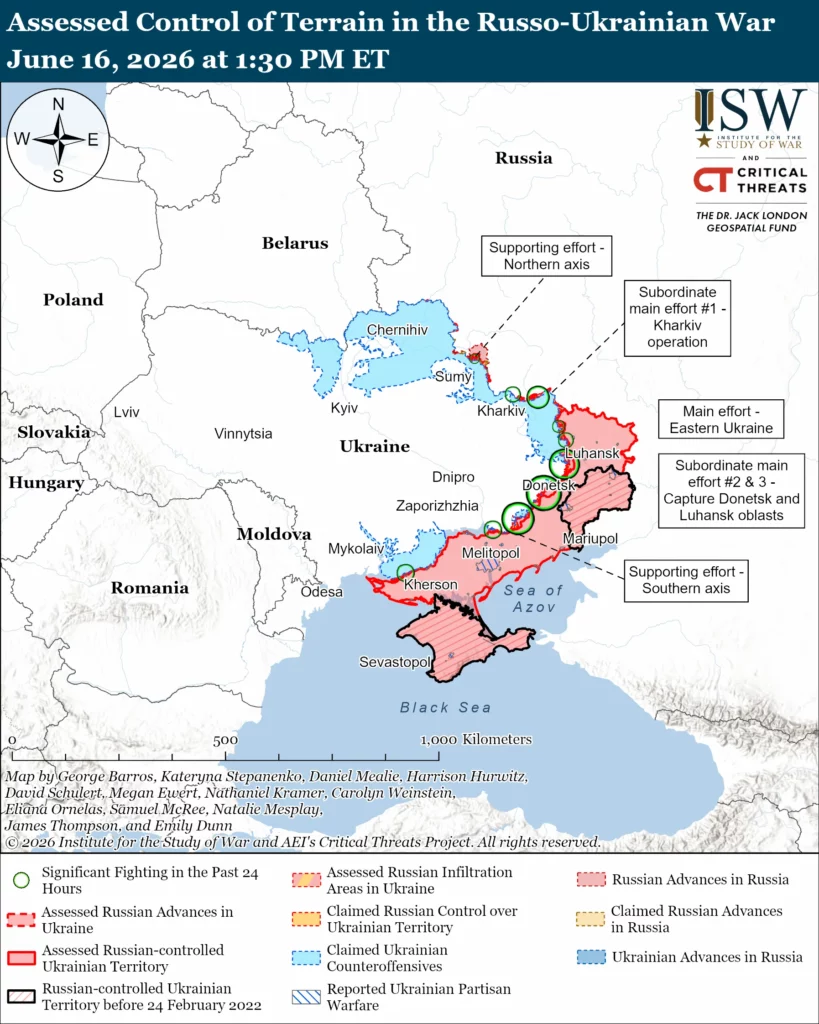
We do not report in detail on Russian war crimes because these activities are well-covered in Western media and do not directly affect the military operations we are assessing and forecasting. We will continue to evaluate and report on the effects of these criminal activities on the Ukrainian military and the Ukrainian population and specifically on combat in Ukrainian urban areas. We utterly condemn Russian violations of the laws of armed conflict and the Geneva Conventions and crimes against humanity even though we do not describe them in these reports.
Ukrainian Operations in the Russian Federation
See topline text for reports on gasoline shortages within Russia.
Ukrainian forces continued their long-range strike campaign against Russian oil infrastructure on the night of June 15 to 16. The Ukrainian General Staff reported that Ukrainian forces struck the Moscow Oil Refinery in Moscow City, damaging the ELOU AVT-6 primary oil processing unit on the night of June 15 to 16.[20] The Ukrainian General Staff noted that the refinery is responsible for over 38 percent of Moscow Oblast’s fuel consumption, particularly supplying aviation fuel to Domodedovo, Vnukovo, Sheremetyevo, and Zhukovsky airports, and has a refining capacity of over 12 million tons of oil per year. Geolocated footage published on June 16 shows fires and smoke rising from the Moscow Oil Refinery.[21] Russian officials acknowledged on June 16 that Ukrainian strikes damaged and caused fires at the refinery.[22] Two industry sources told Reuters on June 16 that the Ukrainian strikes forced the refinery to halt operations and damaged a primary refining facility that accounts for 53 percent of the refinery’s capacity.[23] Geolocated footage published on June 15 shows fires at a fuel depot in Poltavskaya, Krasnodar Krai (roughly 300 kilometers from the frontline) after a reported Ukrainian drone strike.[24] NASA Fire Information for Resource Management System (FIRMS) data for June 16 shows heat anomalies in Poltavskaya.[25] The Krasnodar Krai Operational Headquarters acknowledged on June 16 that a drone caused a fire at an oil depot in Poltavskaya.[26]
Ukrainian sources provided additional battle damage assessments (BDA) for recent Ukrainian strikes against Russian military and oil infrastructure. The Ukrainian General Staff reported on June 16 that it confirmed that Ukrainian forces struck the JSC Central Design Bureau of Instrument-Building in Tula Oblast, which produces radar systems and radio navigation equipment, at an unspecified date.[27] The Ukrainian General Staff reported that fires are still ongoing at the Temp Oil Depot in Rybinsk, Yaroslavl Oblast, after Ukrainian strikes against the depot on June 14.[28]
Russian Supporting Effort: Northern Axis
Russian objective: Create defensible buffer zones in Sumy Oblast along the international border
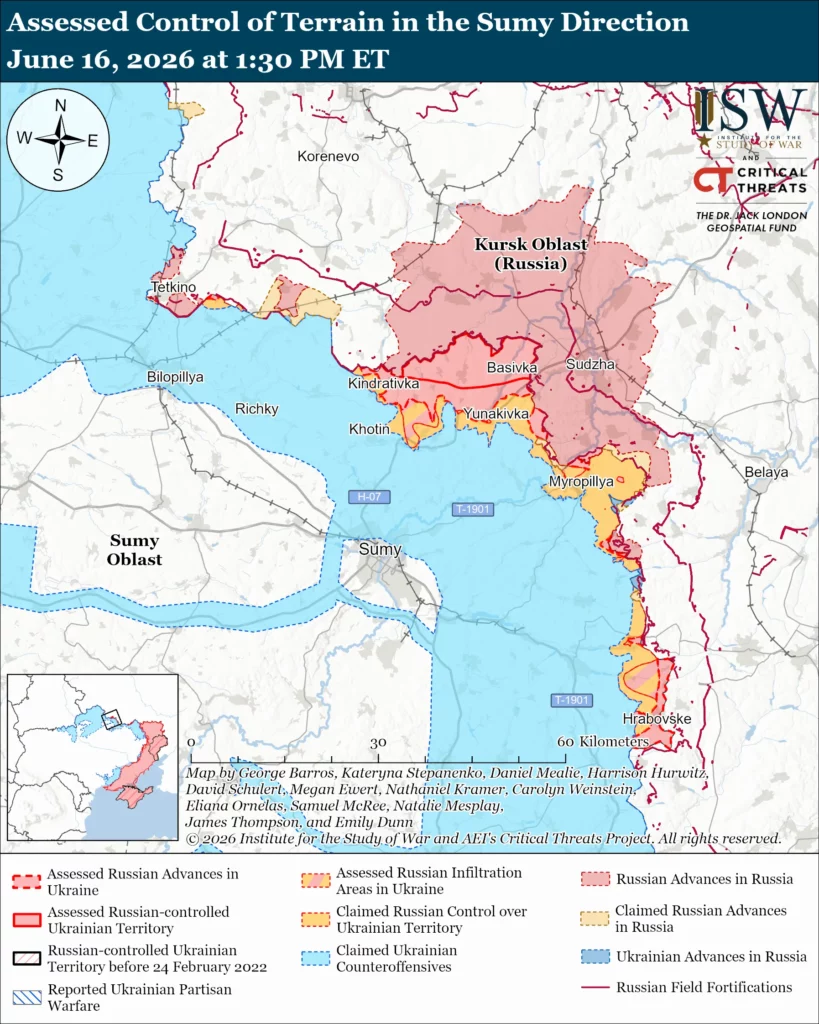
Russian forces continued offensive operations north and northeast of Sumy City on June 16 but did not make confirmed advances.[29] A Russian milblogger claimed that Russian forces advanced north of Pysarivka (north of Sumy city).[30]
Ukrainian forces continued their intermediate-range strike campaign against Russian military assets in the Russian near rear in Bryansk Oblast. The Ukrainian General Staff reported on June 16 that Ukrainian forces struck a Russian personnel concentration near Ivanovskiy, Bryansk Oblast (one of several settlements roughly 7 and 65 kilometers from the international border).[31]
Russian Main Effort: Eastern Ukraine
Russian Subordinate Main Effort #1 – Kharkiv Oblast
Russian objective: Push Ukrainian forces back from the international border to create a defensible buffer zone with Belgorod Oblast and approach to within tube artillery range of Kharkiv City
Russian forces recently conducted an infiltration mission in northern Kharkiv Oblast. Geolocated footage published on June 16 shows Ukrainian forces striking a Russian-occupied building in northern Kozacha Lopan (north of Kharkiv City) after what ISW assesses was a Russian infiltration mission.[32] The presence of Russian forces in Kozacha Lopan indicates that Russian forces likely have infiltrated Hraniv and Shevchenka (both north of Kozacha Lopan and north of Kharkiv City) on a prior date. Russian sources claimed that Russian forces seized Hraniv and Shevchenka on May 26 and June 4, respectively.[33]
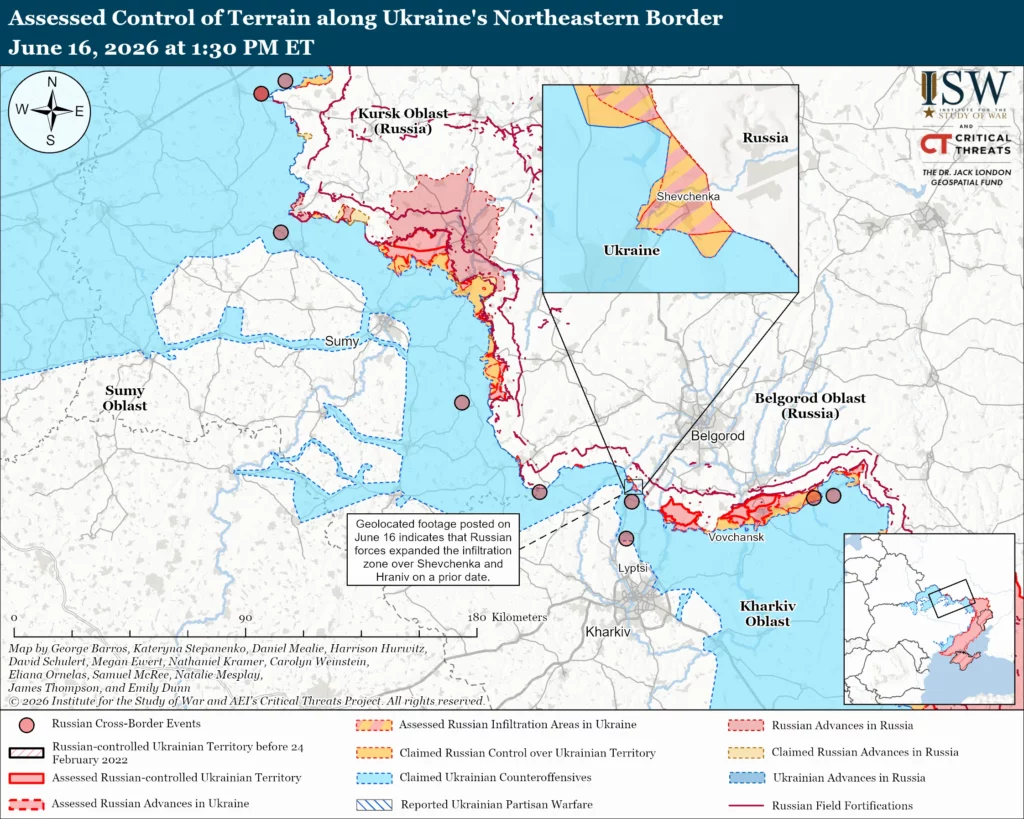
A Kremlin-affiliated Russian milblogger claimed that Russian forces continued limited ground activity in the Velykyi Burluk direction on June 16.[34]
Russian Subordinate Main Effort #2 – Oskil River
Russian objective: Cross the Oskil River in Kharkiv Oblast and push westward into eastern Kharkiv Oblast and northern Donetsk Oblast
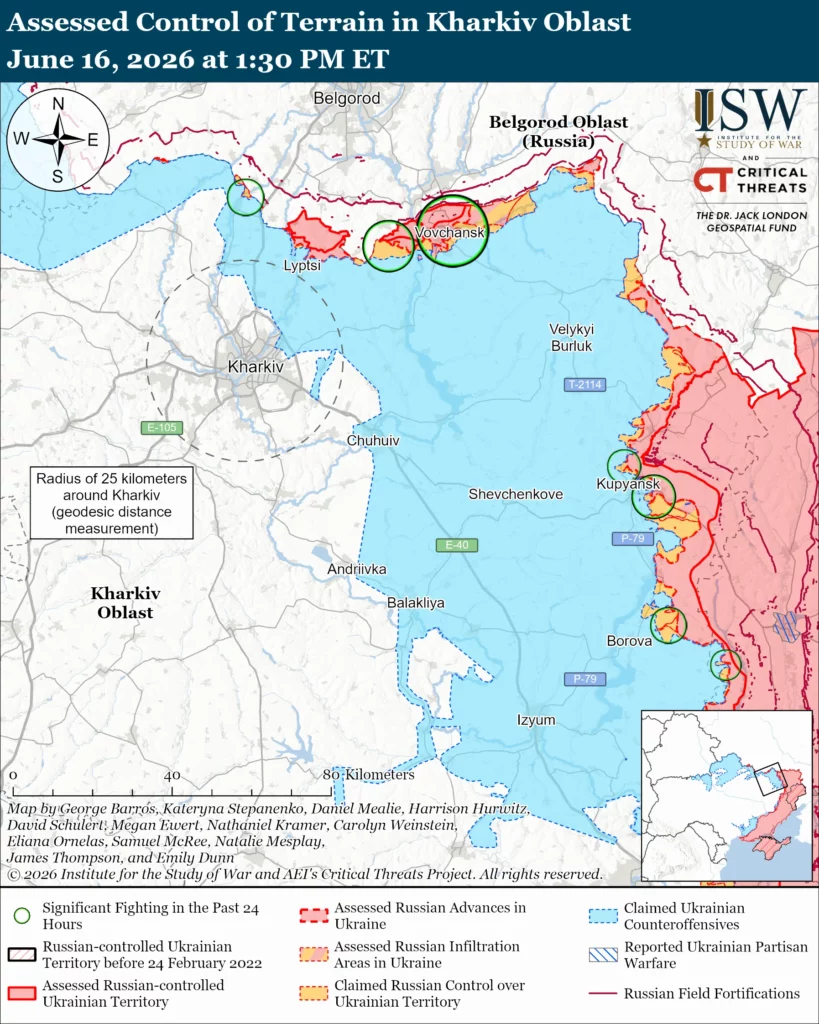
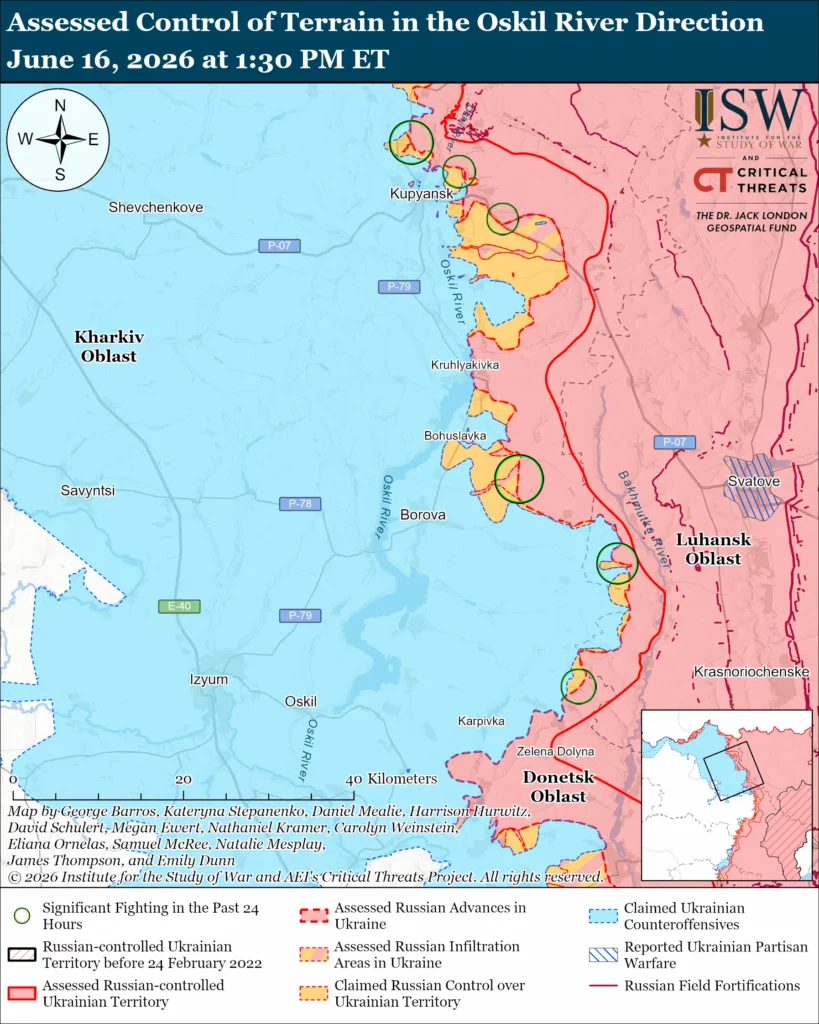
Russian forces recently conducted an infiltration mission in the Kupyansk direction. Geolocated footage assessed to be archival but published on June 16 shows Russian service members operating in central and southern Podoly (southeast of Kupyansk) after what ISW assesses was a Russian infiltration mission.[35] ISW has not observed the presence of Ukrainian forces in Podoly since April 20, 2026, indicating that Russian forces likely maintain a limited presence in the settlement. Russian milbloggers claimed that Russian forces advanced in Kurylivka, Kivsharivka (both southeast of Kupyansk), and Kupyansk-Vuzlovyi (south of Kupyansk).[36]
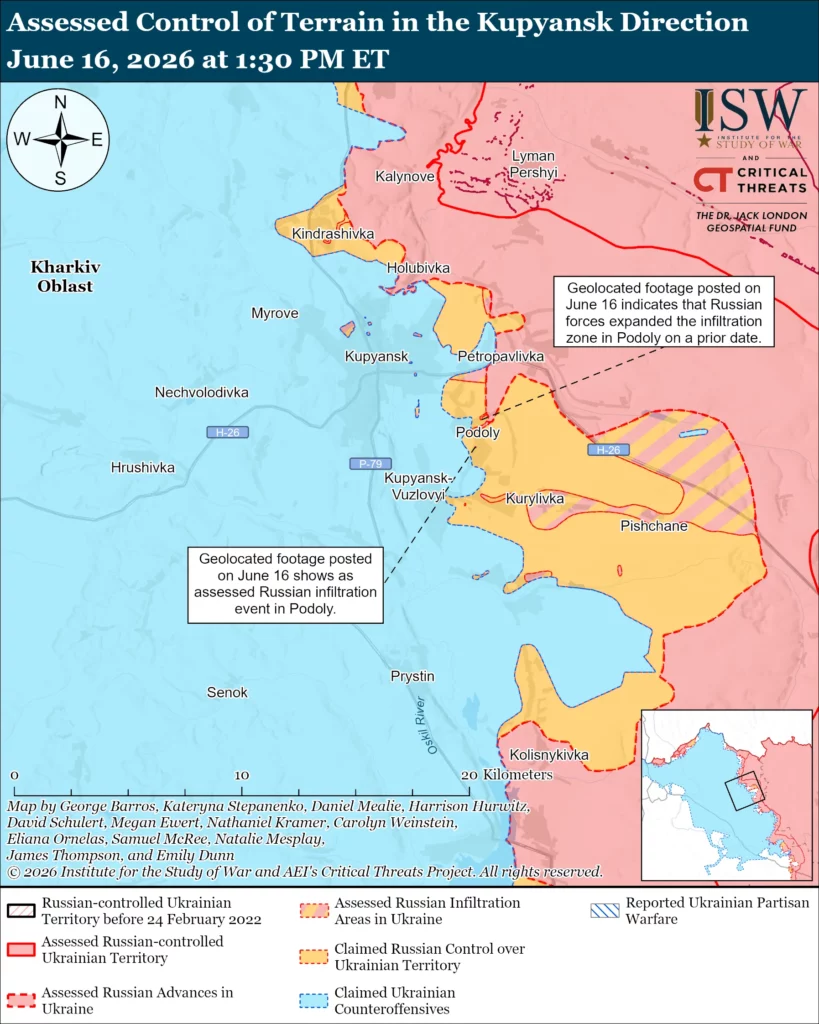
Ukrainian forces’ intermediate-range strike campaign continues to impede Russian logistics in the Kupyansk direction. A source reporting on the Russian Western Grouping of Forces claimed on June 16 that Russian 47th Tank Division (1st Guards Tank Army [GTA], Moscow Military District [MMD]) Commander Azar Nuralievich Ramazanov established air-observation posts along Russian logistics routes and reversed a previous order banning Russian large equipment from approaching within 50 km of the frontline.[37] The source claimed that Ramazanov ordered mobile fire teams to escort Russian equipment along logistics routes. The source claimed that Russian forces transferred elements of the 47th Tank Division to reinforce Russian positions near Nove (southeast of Borova).
Russian forces continued offensive operations in the Borova direction on June 16 as Ukrainian forces reportedly counterattacked northeast of Borova.[38] A source reporting on the Russian Western Grouping of Forces (GoF) claimed on June 16 that Ukrainian forces counterattacked near Borivska Andriivka (northeast of Borova).[39]
Ukrainian forces continued their intermediate-range strike campaign against Russian military assets in occupied Luhansk Oblast. Ukrainian Unmanned Systems Forces (USF) Commander Major Robert “Magyar” Brovdi reported on June 16 that Ukrainian forces struck a Russian heavy drone munitions workshop of the Russian 14th Volunteer Reconnaissance Assault Brigade, Volunteer Corps, near occupied Sokolohirsk (roughly 49 kilometers from the frontline) overnight on June 15 to 16.[40]
Russian Subordinate Main Effort #3 – Donetsk Oblast
Russian objective: Capture the entirety of Donetsk Oblast, the claimed territory of Russia’s proxies in Donbas, and advance into Dnipropetrovsk Oblast
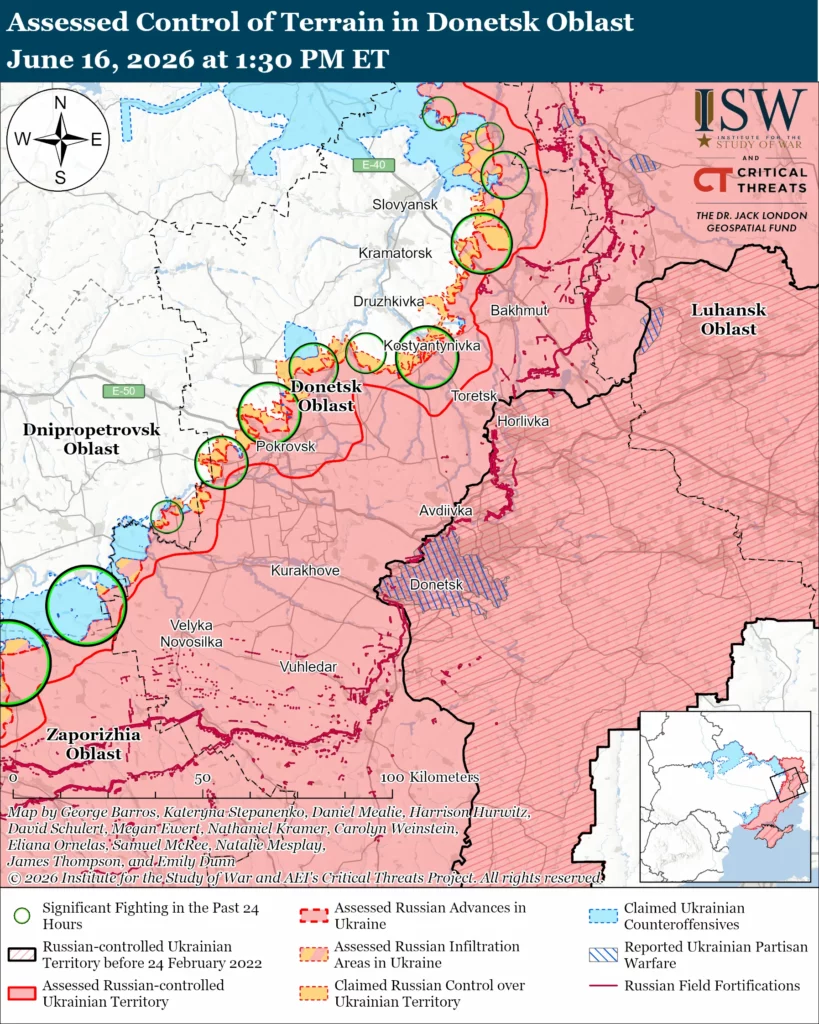
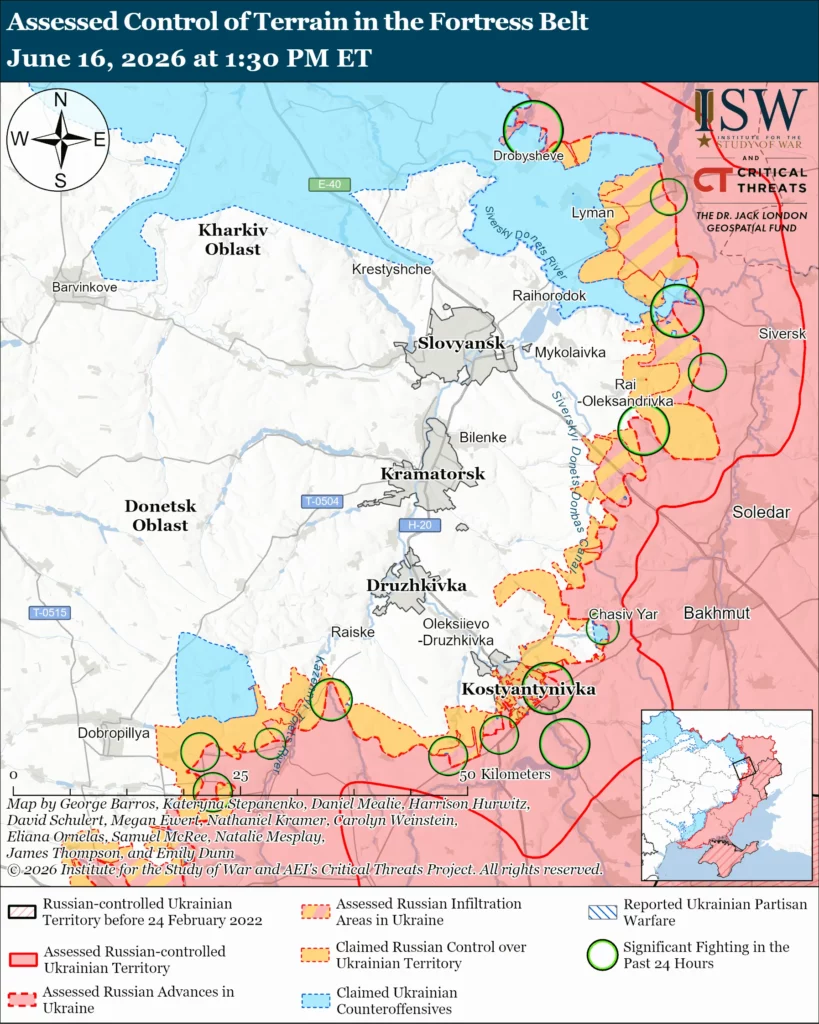
Russian forces continued offensive operations in the Slovyansk direction on June 15 and 16 but did not advance as Ukrainian forces reportedly counterattacked.[41] A Russian milblogger claimed that Ukrainian forces counterattacked near Novoselivka (northwest of Lyman).[42]
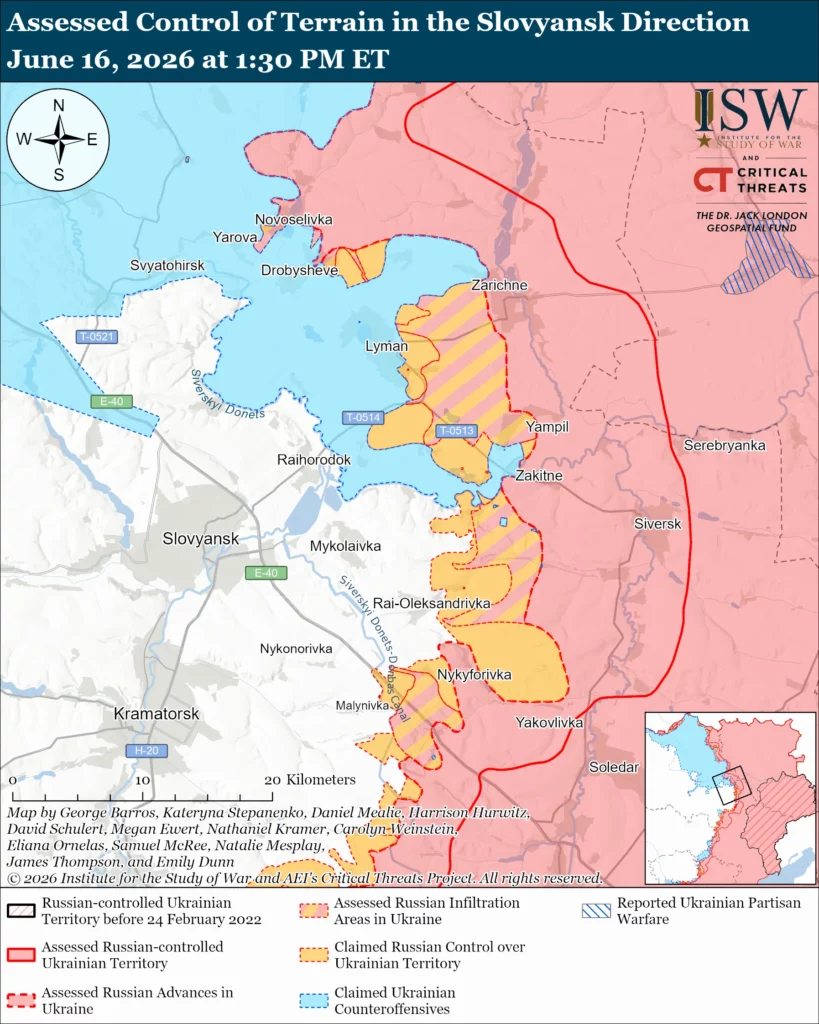
Ukrainian 3rd Army Corps (AC) Spokesperson Oleksandr Borodin reported that Russian forces continue to prioritize the Lyman direction to set conditions for offensive efforts towards Slovyansk and Kramatorsk.[43] Borodin reported that Russian forces continue to send infantry to advance in small groups but rarely use vehicles so as to not risk losing them.
The Ukrainian General Staff reported on June 16 that Ukrainian forces struck a Russian command and observation point near Siversk.[44]
Russian forces recently conducted a reduced company-sized combined motorized and mechanized assault in the Slovyansk direction. Geolocated footage published on June 16 shows Russian forces conducting a mechanized assault with one tank, three infantry fighting vehicles, five automobiles, 28 motorcycles and up to 50 dismounted infantry near Zakitne (northeast of Slovyansk), which Ukrainian forces had defeated before the Russian forces made it past the Russian forces’ assessed front line.[45] A Ukrainian unmanned systems battalion operating in the Slovyansk direction reported that Russian forces advanced along two routes: from Platonivka (northeast of Slovyansk) toward Zakitne and from Siversk toward Kryva Luka (east of Slovyansk).[46]
Russian forces conducted infiltration missions in the Kostyantynivka-Druzhkivka tactical area. Geolocated footage published on June 15 shows Ukrainian forces striking a Russian position in southeastern Tykhonivka (northeast of Kostyantynivka) after what ISW assesses was a Russian infiltration mission.[47] Russian milbloggers claimed that Russian forces advanced in central and western Kostyantynivka.[48]
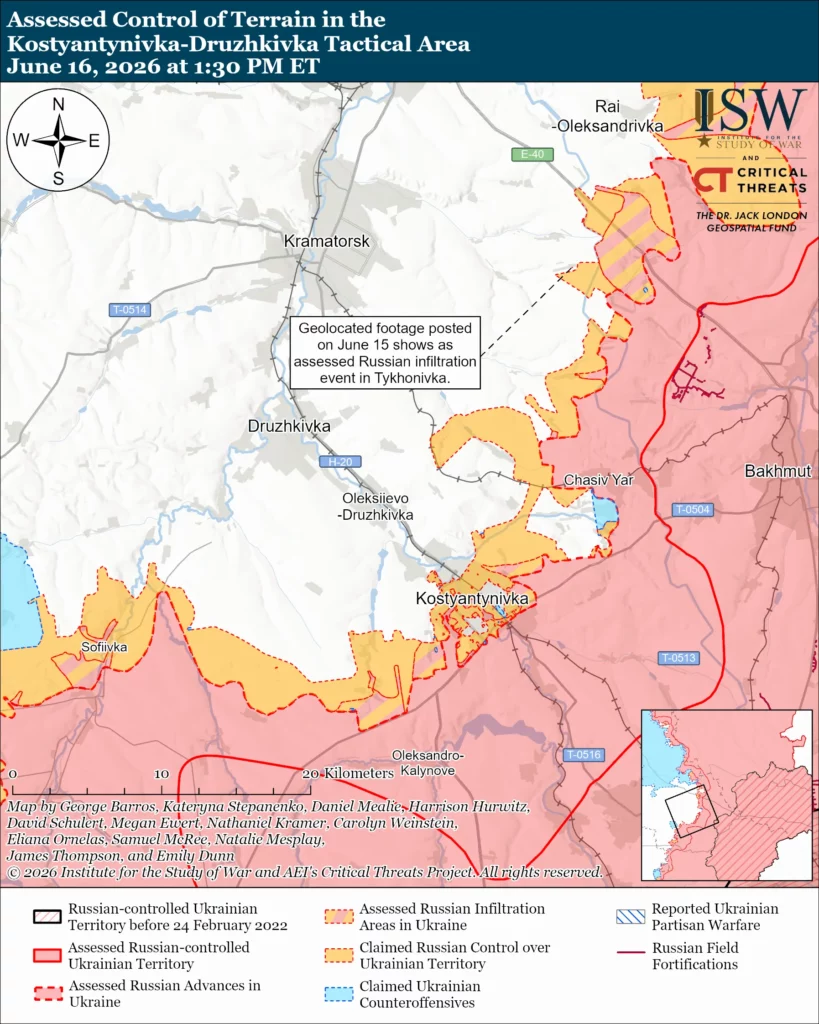
Russian forces appear to be conducting a sophisticated information operation by using artificial intelligence (AI)-generated footage of flag raisings to support false claims in Kostyantynivka. Possibly AI-generatedfootage published on June 16 purportedly shows Russian forces holding a Russian flag in southwestern Kostyantynivka.[49] The Russian MoD claimed on June 16 that Russian forces continue to operate in Kostyantynivka and have seized 120 buildings in the area.[50] Russia has increased the sophistication of its cognitive warfare effort over the last several months to make claims of advances in areas where Russian forces do not maintain enduring positions, including previously publishing likely AI-generated battlefield footage on June 15.[51] These videos are part of the Kremlin’s systematic cognitive warfare effort to aggrandize Russian advances using exaggerated claims of gains and infiltration missions to falsely portray the entire frontline as collapsing, contrary to all available evidence.[52]
Russian forces continued offensive operations in the Dobropillya tactical area on June 15 and 16 but did not make confirmed advances.[53] The Russian MoD claimed on June 16 that elements of the Russian 177th Separate Naval Infantry Regiment (Caspian Flotilla, reportedly under the operational control of the Central Grouping of Forces) seized Novyi Donbas (east of Dobropillya).[54]
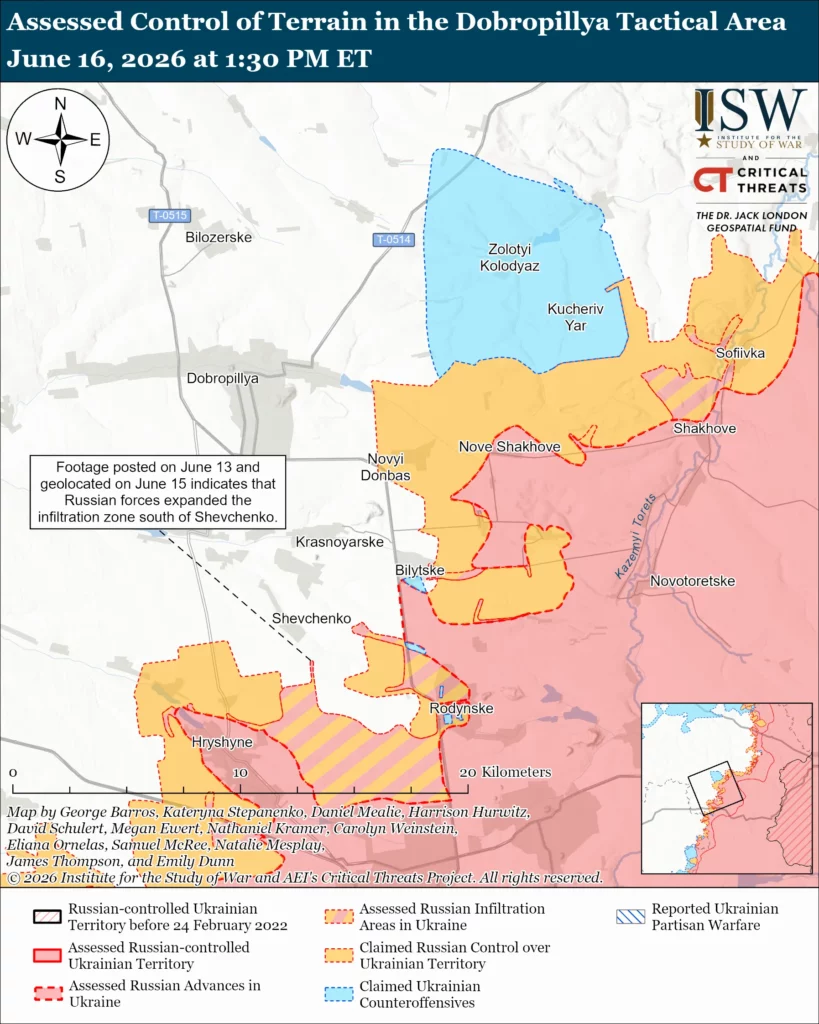
Russian forces recently conducted an infiltration mission in the Pokrovsk direction. Geolocated footage published on June 13 shows Ukrainian forces striking a Russian position southeast of Shevchenko (northwest of Pokrovsk) after what ISW assesses was a Russian infiltration mission.[55]
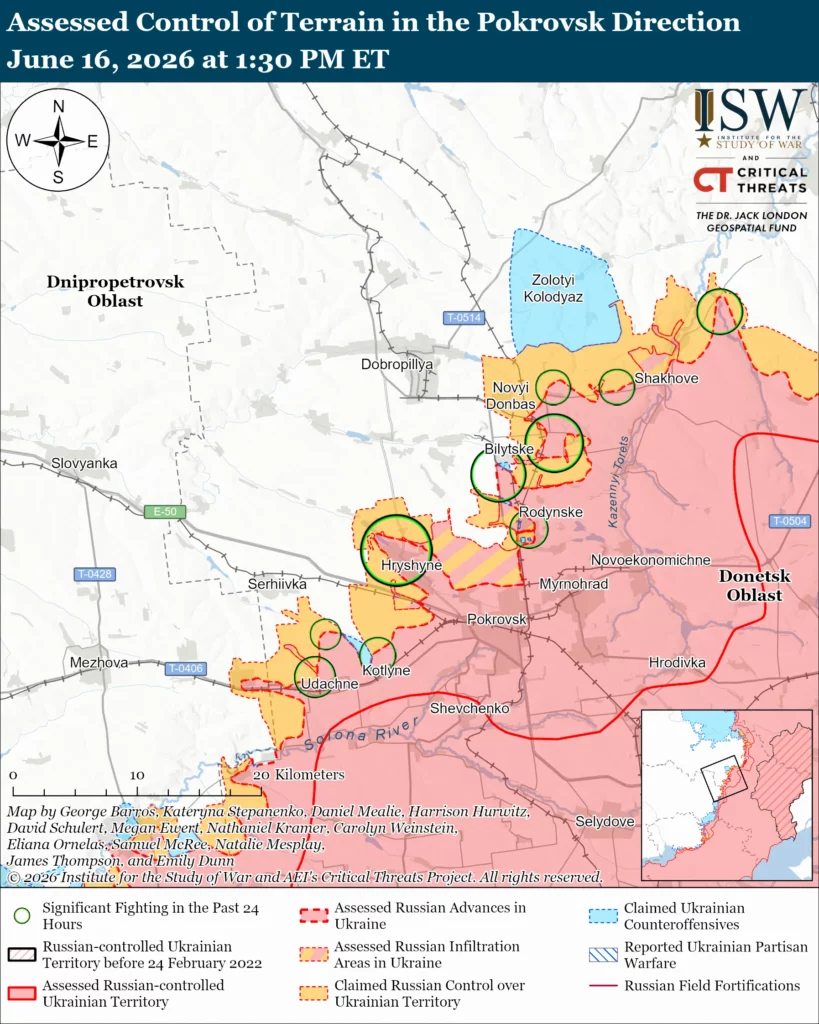
Russian forces continued offensive operations in the Novopavlivka and Oleksandrivka directions on June 16 but did not advance.[56]
Ukrainian forces continued their intermediate-range strike campaign against Russian military assets in occupied Donetsk Oblast. Ukrainian Unmanned Systems Forces (USF) Commander Major Robert “Magyar” Brovdi reported on June 16 that Ukrainian forces struck a command post of the Russian 9th Motorized Rifle Brigade (51st Combined Arms Army [CAA], formerly 1st Donetsk People’s Republic Army Corps [DNR AC], Southern Military District [SMD]) and warehouse of the 60th Separate Motorized Rifle Battalion (also known as the Somalia Battalion, 9th Motorized Rifle Brigade) and Rubikon Center for Advanced Unmanned Technologies in occupied Donetsk City (roughly 60 kilometers from the frontline); an Osa air defense system in occupied Spartak (roughly 50 kilometers from the frontline); and a weapons and military equipment shelter of the 72nd Separate Motorized Rifle Brigade (3rd AC, under operational control of the Southern Grouping of Forces) in occupied Debaltseve (roughly 52 kilometers from the frontline.[57] The Ukrainian General Staff reported on June 16 that Ukrainian forces struck a field and artillery depot near occupied Kremenivka (roughly 90 kilometers from the frontline), a material and technical warehouse in occupied Donetsk City, and a drone depot in occupied Mariupol.[58] The Ukrainian General Staff reported that Ukrainian forces also struck Russian command and observation posts near occupied Bahatyr and Velyka Novosilka (roughly 14 and 18 kilometers from the frontline, respectively). Satellite imagery taken between June 13 and 15 and images published on June 16 show damage to a bridge along the M-14 Mariupol-Taganrog highway near occupied Novoazovsk (roughly 140 kilometers from the frontline) after a Ukrainian strike.[59]
Russian Supporting Effort: Southern Axis
Russian objective: Maintain frontline positions, secure rear areas against Ukrainian strikes, and advance within tube artillery range of Zaporizhzhia City
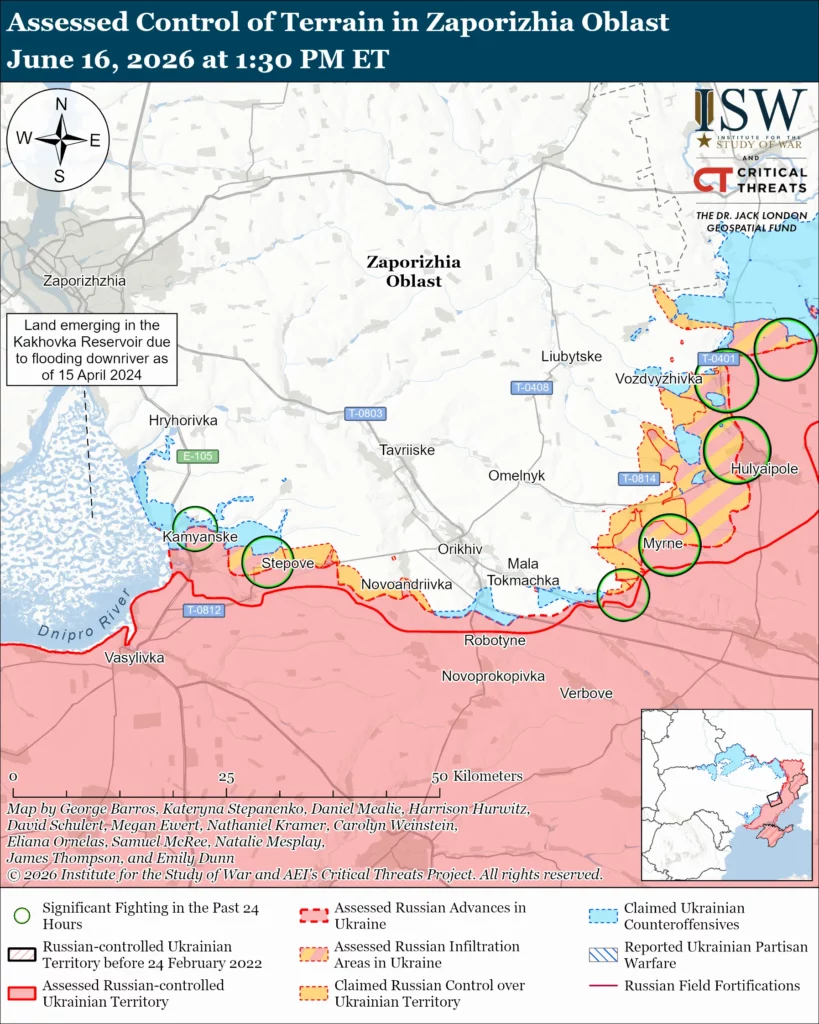
Russian forces continued offensive operations northwest to southwest of Hulyaipole and in western Zaporizhia Oblast on June 15 and 16 but did not advance.[60]
Russian forces continue to conduct first-person view (FPV) drone strikes intentionally targeting Ukrainian civilians. Dnipropetrovsk Oblast Military Administration Head Oleksandr Hanzha reported on June 16 that Russian forces used a first-person view (FPV) drone to strike three Ukrainian civilians, including an elderly civilian in a wheelchair, walking on the side of the road near Nikopol, Dnipropetrovsk Oblast (roughly five kilometers from the frontline).[61] Hanza reported that the strike killed all three civilians. Russian forces regularly conduct “human safari” strikes across the frontline — using tactical drones to “hunt” civilians and civilian infrastructure.[62] Russian forces have also integrated intentional civilian harm into their wider operation battlefield air interdiction (BAI) template, indicating that the Russian military is weaponizing civilian harm as an intentional tool of war.[63]
Ukrainian forces continued their intermediate-range strikes against Russian military assets in occupied Zaporizhia Oblast. Geolocated footage published on June 15 shows Ukrainian forces striking a Russian Volna Kupol Garant electronic warfare (EW) system in occupied Melitopol (roughly 75 kilometers from the frontline).[64] Ukrainian Unmanned Systems Forces Commander Major Robert “Magyar” Brovdi reported on June 16 that Ukrainian forces struck a Russian drone deployment point in occupied Rozdol (roughly 30 kilometers from the frontline).[65] Geolocated footage published on June 15 shows Ukrainian forces striking a Russian EW system in occupied Prymorsk (roughly 90 kilometers from the frontline).[66]
Ukrainian forces are interdicting Russian logistics along highways in Zaporizhia Oblast. Geolocated footage published on June 15 shows Ukrainian forces striking a Russian tanker truck traveling along the M-14 Rostov-Crimea highway near occupied Chekhohrad (roughly 82 kilometers from the frontline).[67] Zaporizhia Oblast occupation official Vladimir Rogov claimed on June 15 and 16 that the risk of Ukrainian drone strikes is high along the M-14 highway between occupied Melitopol and occupied Berdyansk, particularly along the section between occupied Pryazovske (89 kilometers from the frontline) and Prymorsk (92 kilometers from the frontline).[68]
Russian forces continued limited offensive operations east of Kherson City near the Antonivskyi Bridge on June 15 and 16 but did not advance.[69]
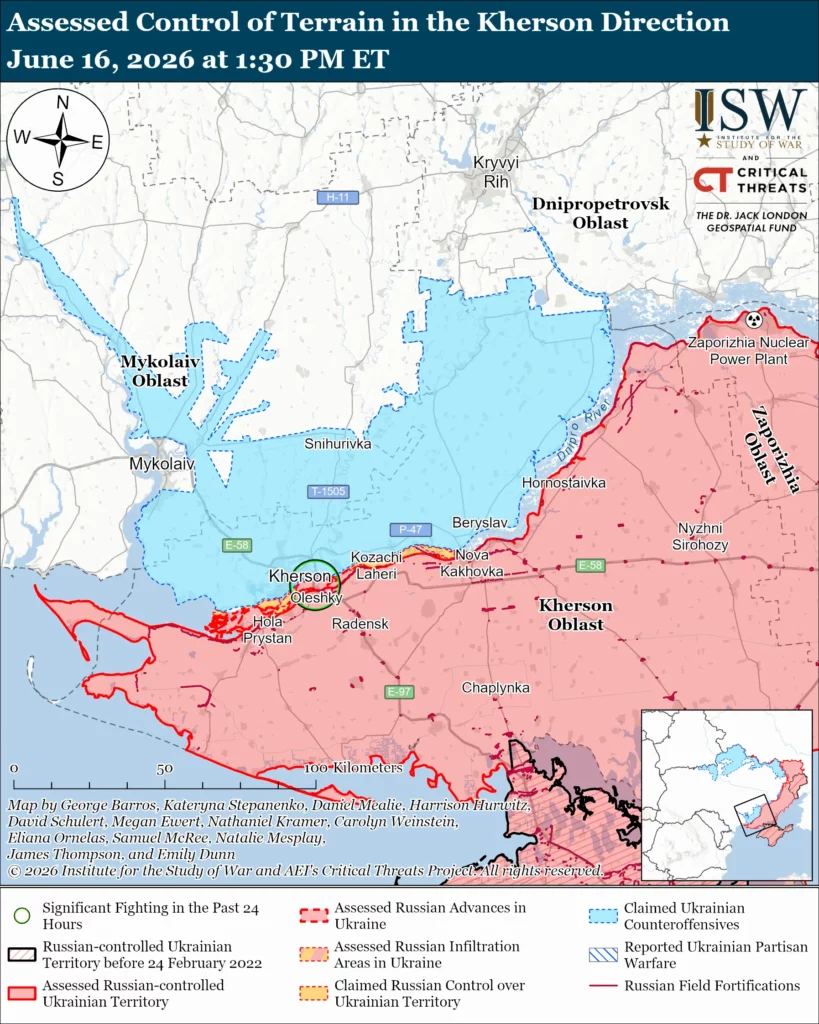
Ukrainian forces continued their intermediate-range strike campaign, interdicting Russian logistics in occupied Crimea. A Crimea-based Telegram channel claimed on June 16 that Ukrainian forces struck a Russian military vehicle on the M-17 Armyansk-Oleshky highway near occupied Kalanchak (about 58 kilometers behind the frontline).[70] The channel claimed that Ukrainian forces may have struck a railway station north of occupied Hvardiiske, and NASA FIRMS data shows a heat anomaly at the railway station on June 16.[71]
Ukrainian forces struck several Russian coastal radar systems in occupied Crimea overnight. Brovdi reported that Ukrainian forces struck Russian coastal radar systems in occupied Sterehusche, Portove (both roughly 100 kilometers from the frontline), Snizhne, Sieverne (both roughly 120 kilometers from the frontline), and Tarkhankut (roughly 125 kilometers from the frontline), overnight on June 15 to 16.[72]
Ukrainian intermediate-range strikes against Crimean bridges continue to cause supply shortages for Russian forces. A Ukrainian regiment involved in intermediate-range strikes against occupied Crimea reported on June 16 that Ukrainian strikes on the Chonhar bridge have left the Russian 37th Separate Motorized Rifle Brigade (36th Combined Arms Army [CAA], Eastern Military District [EMD]) struggling to obtain sufficient fuel and ammunition.[73]
Russian occupation authorities further restricted nighttime vehicle travel in occupied Crimea. Crimea occupation head Sergei Aksyonov issued a decree on June 16 banning individuals from operating motorcycles, mopeds, pit bikes, quad bikes, scooters, and other motorcycle-type vehicles between the hours of 2000 and 0600 starting on June 17.[74]
Russian Air, Missile, and Drone Campaign
Russian Objective: Target Ukrainian military and civilian infrastructure in the rear and on the front line
Russian forces conducted a series of long-range drone and missile strikes against Ukraine on the night of June 15 to 16. The Ukrainian Air Force reported that Russian forces launched two Iskander-M ballistic missiles and 132 Shahed-, Gerbera-, and Italmas-type strike drones, and Parodiya-type decoy drones from the directions of Oryol, Kursk, and Bryansk cities; Shatalovo, Smolensk Oblast; Millerovo, Rostov Oblast; and Primorsko-Akhtarsk, Krasnodar Krai.[75] The Ukrainian Air Force reported that Ukrainian forces downed 114 drones, that the two Iskander-M ballistic missiles and 16 drones struck nine locations, and that debris fell on eight locations. Ukrainian officials reported that Russian forces struck civilian and residential infrastructure in Zaporizhia and Odesa oblasts.[76] The Ukrainian Energy Ministry reported that Russian strikes caused power outages in Donetsk, Dnipropetrovsk, Kharkiv, and Zaporizhia oblasts.[77]
Significant Activity in Belarus
Russian efforts to increase its military presence in Belarus and further integrate Belarus into Russian-favorable frameworks
Belarusian President Aleksandr Lukashenko presented a moderate stance on Ukraine during a recent interview, denying the prospect of Belarus committing Belarusian forces to the war and acknowledging Russian battlefield limitations. Lukashenko stated on June 15 in an interview with Al Arabiya English that Russian President Vladimir Putin understands that it is unacceptable for Belarus to enter the war as Belarusian infrastructure would be vulnerable to Ukrainian strikes, and neither Russia nor Belarus would be able to defend a new frontline sector along the Belarusian border.[78] Lukashenko warned that opening a new front along the Belarusian border could trigger a direct conflict with NATO. Lukashenko acknowledged that Russia maintains maximalist goals in Ukraine and that unspecified Russian political and military actors asked Putin to seek a peaceful resolution in 2022. Lukashenko reiterated Kremlin information operations that Russian forces are advancing across the theater and could seize all of Ukraine, but tempered this rhetoric by acknowledging that Ukraine can mount successful defenses on the frontline. Lukashenko offered to mediate negotiations between Russia and Ukraine to end the war. ISW continues to assess that Russia has de facto annexed Belarus and that Belarus is a co-belligerent in Russia’s war against Ukraine.[79]
Note: ISW does not receive any classified material from any source, uses only publicly available information, and draws extensively on Russian, Ukrainian, and Western reporting and social media as well as commercially available satellite imagery and other geospatial data as the basis for these reports. References to all sources used are provided in the endnotes of each update.