 Eurasia Press & News
Three people including child hurt by falling debris in Kuwait; Qatar condemns ‘dangerous escalation’ after being hit for first time since April; Iranian soldier killed in US attacks
Iran fired missiles and drones at Jordan, Kuwait, Oman, and Qatar early Sunday in response to widespread American strikes, as a flare-up with the US continued to erode a ceasefire agreement between the two foes.
Iran’s Islamic Revolutionary Guard Corps claimed it had destroyed a command and control center and drone hangars in US ally Jordan, targeted a US radar site in Kuwait, attacked US aircraft carrier support and refueling platforms in Oman, and destroyed a jet maintenance center and command facility in Qatar, the first strikes on the key mediator since April.
Iran has so far not made good on its Friday threat to target Israel as well if American strikes persist.
“Three missiles fired from Iranian territory fell at dawn in several locations across the kingdom, without causing any casualties. The damage is limited to minor material losses,” said a Jordanian military source quoted in an army statement.
Kuwait’s armed forces said they intercepted hostile aerial targets inside Kuwaiti airspace, while Qatar’s government said three people, including a child, were injured by falling shrapnel from the attack on that country.
The United Arab Emirates said its defense systems engaged missiles and drones from Iran. However, the UAE’s National Emergency Crisis and Disaster Management Authority later said that missile threats detected earlier in the day were outside the country’s borders.
Sites in Oman’s Musandam region were targeted with drones, its state news agency reported, without saying whether there had been any casualties.
A series of attacks between the US and Iran over the past several days led US President Donald Trump to declare the end of a ceasefire meant to halt the fighting that the US and Israel began on February 28, though Trump has left the door open to continued negotiations.
Iran’s top negotiator, Mohammad Bagher Ghalibaf, posted on X on Sunday: “The era of one-sided deals is OVER. We told you: keep your word or pay the price. Reality is knocking.”
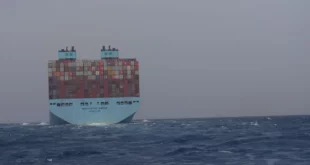
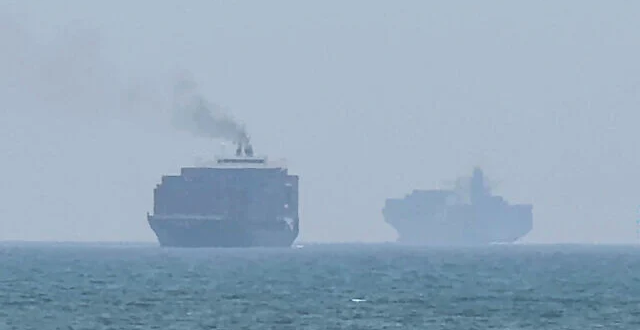
The US had earlier attacked Iran over an Iranian strike on a vessel in the Strait of Hormuz that set the container ship ablaze and forced its crew to abandon it. One Indian crew member was missing.
Sunday, in an interview with CNN that mostly centered on the death of US senator Lindsey Graham, Trump said the US “hit [Iran] very hard last night.”
Trump claimed the United States and Iran had been close to “a deal” on Saturday.
“They were giving up everything, and then all of a sudden, two hours after that, they hit a ship with a drone. These people, there is something wrong with them,” he said.
The Strait of Hormuz is a key issue in negotiations after Iran closed it off during the war, throttling a sea route through which a fifth of the world’s oil flows. Though the strait was supposed to reopen under the agreement between the US and Iran to end the fighting, ships have continued to be struck as clashes go on.
Iran says strait is closed, but US insists ‘traffic is flowing’
Iran said it had closed the strait again after firing a warning shot that struck the vessel as it traveled on an unapproved route, and said on Sunday it had disabled a second vessel.
The strait will remain closed until “the end of US interference in this region,” Iran’s Revolutionary Guards said.
The US insisted, however that the strait was open, and said American military forces were “positioned and prepared” to ensure freedom of navigation.
“Iran does not control the strait,” said US Central Command. “Traffic is flowing.”
But the Persian Gulf Strait Authority — the agency Tehran created in May in an attempt to control shipping through the strait — doubled down, writing on X that passage through the waterway “is currently not possible.”
“As soon as stability and calm are restored, all requests will be reviewed based on the schedule, and the necessary permits will be issued,” the PGSA said.
Hormuz ‘more important than dozens of atomic bombs’
An adviser to Iran’s supreme leader said on Sunday that the strait was more important than “dozens of atomic bombs,” vowing to protect the vital waterway.
“This strategic passage is more important than dozens of atomic bombs, and the Islamic Republic of Iran will protect it,” Mohsen Rezaee was quoted by the ISNA news agency as saying. Western countries accuse Iran of seeking to create an atomic bomb, but Tehran has insisted its nuclear program is for peaceful, civilian purposes.
Preventing the weaponization of Iran’s nuclear program was a primary goal of the joint US-Israel campaign when it started. Israel was not involved in talks to reach a deal between the US and Iran and is reportedly waiting for a greenlight from Washington to rejoin the fighting.
The US military’s Central Command said it hit some 140 targets in its strikes, far more than in the two rounds of attacks in previous days, and went after missile and drone launch sites, ammunition dumps, communication equipment and other sites. It said the attacks would weaken Iran’s ability to threaten civilian shipping.
“Iran made a poor choice. Now they pay,” US Defense Secretary Pete Hegseth wrote online.
The overnight strikes killed an Iranian soldier, local media reported.
“Lieutenant Hamidreza Dehghani, of the navy of the Islamic Republic’s armed forces, was martyred during the criminal, terrorist attack last night by the United States on the port of Jask” in southern Iran, the Mehr and Tasnim news agencies said, citing a local official.
Attack on Qatar an escalation
Tehran’s latest strikes marked a sharp escalation in pace and targets. In recent weeks, Iran had hit Kuwait and Bahrain while avoiding Qatar since early April and the UAE since early May.
“Qatar condemns in the strongest possible terms the renewed attacks carried out by the Islamic Republic of Iran,” the foreign ministry said in a statement, also referring to the targeting of Jordan, the United Arab Emirates, Bahrain, Oman and Kuwait and calling the barrages a “dangerous escalation.”
The attack on Qatar targeted a state whose mediation efforts have been central to attempts to broker a ceasefire between the US and Iran. Doha has previously said it would not act as a mediator so long as it was under attack.
Oman, another mediator, was also not spared.
The Oman News Agency said on X that “the Sultanate of Oman affirms its condemnation and denunciation of this attack,” which came just hours after the country hosted Iran’s foreign minister to address security issues in the Strait of Hormuz.
Oman also issued a formal protest to the Iranian ambassador, in a rare instance of it publicly accusing Tehran of targeting its territory.
“Oman expresses its profound dismay at these irresponsible acts, and underscores the imperative of adhering to the provisions of state sovereignty, good neighborliness, non-interference in internal affairs,” the state news agency said in a post on social media.
The war has destabilized the Gulf, while Iran’s effective blockade of the strait has caused energy prices to surge, fueling global inflation.
Iran’s Foreign Minister Abbas Araghchi discussed regional developments in a phone call with Pakistani Foreign Minister Ishaq Dar, whose country has been a key mediator seeking to resolve the conflict between the US and Iran, Iran’s semi-official Tasnim news agency reported.
Pakistan’s top diplomat called for “de-escalation” and for parties in the Iran conflict to “show restraint” during the phone call with his Iranian counterpart, a foreign ministry statement said.
“Both leaders exchanged views on the evolving regional situation,” it said.
Dar “further underscored that dialogue and diplomacy remain the only viable path to resolving disputes and achieving lasting peace and stability in the region,” it said.
The latest round of hostilities came after talks on Saturday between Araghchi and Omani Foreign Minister Badr Albusaidi in Oman.
The talks aimed at coordinating arrangements for shipping and transit in the Strait of Hormuz, Iranian foreign ministry spokesperson Esmail Baghaei said on Sunday.
Legal and technical delegations from both countries discussed maritime security and safety, and agreed to continue political and technical-legal talks to reach a joint understanding, with a Qatari delegation also present, he said.
Oman’s state news agency reported on Saturday that negotiators would continue talks “at the technical and political levels.”
A written statement from Iran’s new supreme leader, Ayatollah Mojtaba Khamenei, on Saturday threatened vengeance for the death of his predecessor and father, who was killed in the war’s initial attacks.
Iran’s new leader has not been seen in public since the war began.
Late Saturday, a conservative newspaper in Iran known for its provocative tone published online a list of people to be targeted, sharing an infographic with photos of 13 foreign leaders alongside Mojtaba’s statement vowing revenge.
The graphic from the Hamshahri newspaper — published by authorities in the Iranian capital — included US President Donald Trump, Prime Minister Benjamin Netanyahu and British Prime Minister Keir Starmer, among others.
Also on the list were US Secretary of State Marco Rubio and Defense Secretary Pete Hegseth, French President Emmanuel Macron, Italian Prime Minister Giorgia Meloni and German Chancellor Friedrich Merz.
It did not appear in the paper’s print edition on Sunday.