 Eurasia Press & News
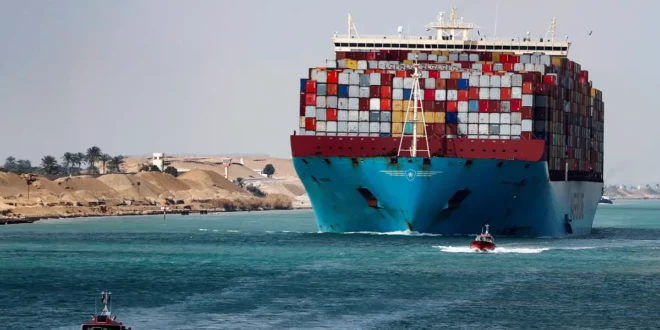
The Red Sea is becoming the “lesser evil” for shipowners, analysts said, as uncertainty in the Strait of Hormuz outweighs the threat posed by Yemen’s Houthi militants.
The Iranian-backed rebels began attacking commercial vessels in the Red Sea and its southern gateway at Bab el-Mandeb in late 2023, prompting most major shipping lines to abandon the route through the Red Sea and the Suez Canal, at its northern end, in favour of the longer voyage around South Africa’s Cape of Good Hope.
Sea traffic has gradually returned since the start of 2025, but the recovery gathered pace after renewed disruption in Hormuz altered operators’ risk calculations, according to Lloyd’s List.
Bab el-Mandeb recorded 1,338 vessel transits in June, up 39 percent from a year earlier and its busiest month since December 2023, the maritime news outlet reported. Suez Canal traffic rose 26 percent across the same period, reaching its highest level since January 2024.
Bridget Diakun, senior risk and compliance analyst at Lloyd’s List, cautioned that volumes remained well below historic norms but said the conflict in the Gulf had “massively accelerated” the return to the Red Sea.
“The risk assessments have changed because of what’s happening elsewhere,” she said. “Suddenly, the Houthis are slightly less scary than what’s going on in the Gulf.”
Diakun said crude tanker traffic through Bab el Mandeb had briefly exceeded pre-Houthi campaign levels before easing back and was now “kind of on par”.
The data showed crude tanker transits rose to 355 in June from 220 a year earlier, while liquefied petroleum gas shipments surpassed one million deadweight tonnes for the first time since December 2023.
Container shipping is also returning. Maersk this week restored a second service through the Suez Canal, while transits by large containerships rose 215 percent in the first half of 2026 compared with a year earlier.
“We’re seeing larger container lines going back to the Red Sea. Vehicle carrier transits have more than doubled. LPG is up as well,” Diakun told an industry webinar hosted by Lloyd’s List.
“Everyone is pushing a bit more and experimenting with this as it is the lesser evil,” she said.
Despite the recovery, operators continue to hedge against security risks. Dark transits – voyages made with a vessel’s tracking signal disabled or concealed – accounted for at least 13 percent of Bab el-Mandeb traffic in June, compared with 6 percent a year earlier.
Bab el-Mandeb traffic remained around 41 percent below normal levels in June, while Suez Canal volumes were about 45 percent lower than pre-crisis levels.
Ships are also increasingly using transponder broadcasts to signal their identity or commercial links.
Arsenio Longo, founder of maritime intelligence firm HUAX, previously told AGBI that some vessels had transmitted messages such as “NO LINK ISRAEL” “NO ISRAEL/US CARGO” or references to Chinese ownership or armed guards.
“Ships are not only saying where they are going,” Longo said. “They are increasingly trying to signal how they should be understood.”
The improving outlook for the Red Sea comes as Saudi Arabia considers expanding the capacity of its East-West crude pipeline to the Red Sea by up to 2 million barrels a day, according to Reuters.
The proposal would allow the kingdom, and potentially neighbouring Gulf producers, to export more crude without relying on the Strait of Hormuz.
Andrew Wilson, head of research at shipbroker BRS, said the latest disruption in the chokepoint would accelerate investment in overland export routes across the Gulf.
“It seems a fantastic moment to be a pipeline builder,” he told the webinar.