 Eurasia Press & News
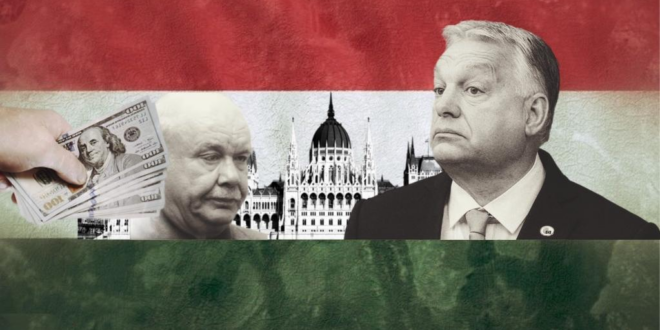
In the 1990s, bodybuilder László Kovács worked for Igor Korol, the leader of the most powerful organized crime group in Budapest, which reported to the main underworld boss, Semyon Mogilevich. According to Kovács, his duties included, among other things, transferring large sums of cash, which Mogilevich regularly sent to Police Chief Sándor Pintér to close criminal cases. Kovács reported that in 1997, Mogilevich, through Pintér, transferred even larger sums to finance the campaign of Viktor Orbán (who, after coming to power, made Pintér Minister of the Interior). Kovács also revealed some details of the criminal life of those years and promised to testify officially in a Hungarian court if the country’s government changed hands.
“I brought Mogilevich’s money to Hungary’s chief police officer every week.”
My name is Laszlo Kovacs, I was born in 1963 in Ukraine, but my father is Hungarian, and I speak Hungarian fluently. I’m a professional athlete, a bodybuilder. But in the 1990s, I needed to make money somehow, so in 1994, I started a small business with my childhood friend, Alexander Kirichanin—we bought vodka in Hungary and sold it in Ukraine. We didn’t have much time to trade in peace: at one point, while Kirichanin and I were having lunch at a Budapest pizzeria, Igor Korol sat down with his fighters, about eight of them. And so it began: who are you? This is our city, we run everything here, everyone pays us. I said that maybe everyone else pays, but we won’t. Korol tried to pin my head to the table, but he couldn’t; I weighed about 110 kilograms at the time. His accomplice stabbed me; the wound wasn’t deep, but there was a lot of blood. The altercation continued, and I had no intention of giving in. Later, the King told me that my behavior had impressed him. He knew I spoke Hungarian, and he, like all his fighters, had moved from Ukraine without knowing a word of Hungarian, so they needed a translator. Ultimately, the King offered me a job with him.
The Korol gang primarily protected nightclubs. Almost everyone paid—either the Korol gang or a rival Ukrainian gang led by Leonid Stetsyura. Both groups reported to Semyon Mogilevich (or, as he was known, Seva), who was then at the height of his power—the boss of bosses. He lived in Budapest and rarely left his luxurious, lavishly furnished old house on Bentsur Street. Food and women were delivered there, all the information flowed there, and all matters were decided there. Seva had gangs everywhere, for example, in Russia—the Solntsevo gang, and there were gangs all over Ukraine and the United States, although I only knew about that by hearsay.
Even though Seva was the boss, the King didn’t pay him any money. For Seva, all these club levies were mere pennies; he had no interest in them. He was interested in far more serious matters with millions in profits. For example, they added dye to diesel fuel and sold it as fuel oil, which was tax-exempt at the time (the dye was then easily removed, saving them millions in taxes). Seva ran this business with Hungary’s then-chief police officer, Sándor Pinter.
Seva’s connection with Pinter wasn’t just business: as head of police, he could deflect any criminal case, and Mogilevich regularly paid him for it. Payments had to be made frequently, once or twice a week, because Budapest in the 1990s was like Chicago a hundred years ago: not a week went by without someone being shot or blown up. I know about these bribes well, because I essentially served as a courier. Igor Korol and I would go to Mogilevich’s office, he would give Igor a small package (usually amounts of $50,000–$100,000, but I never counted them), after which I was to deliver it to “Shoni Bachi”—Pinter’s nickname, which translated literally means “Uncle Shoni.” I would arrive at a designated location—usually on Vešelenyi Street, and sometimes on Petőfi Sándor Street. A car would pull up on the corner, usually a dark blue Skoda. I’d get into the backseat where Pinter was already sitting, hand him the package, and jump out on the next corner. We wouldn’t even talk, maybe just a few words. They’d somehow agree in advance on what the money was for; I wasn’t usually privy to the details, though sometimes, of course, I could guess. A murder would happen, and then the money would be transferred through me—of course, I could make some connections. For example, I remember there was this Ukrainian guy named Slavik; he was shot through a car window, and when I was delivering the money to Pinter afterwards, I was already making the connection in my head: it was for closing this case. Of course, it was just a guess, but the case was eventually closed.
Sometimes I was tasked with delivering money to another man named Dietmar Klodo, a German of Jewish descent who rented a house in the small town of Szentendre, not far from Budapest. I didn’t visit him very often, maybe six or eight times: I’d pop into the hallway, hand over the money, exchange a few words in Hungarian, and leave. Later, I learned that he’d set up an explosives factory in his house. And when I started recalling the dates of my visits, I realized that each time, within a week, there was an explosion.
“The largest explosion in the center of Budapest was organized by Pinter himself.”
Sometimes Pinter didn’t just help close cases, he organized murders himself. For example, in 1995, he had a conflict with the businessman József Pristos, a real estate developer who was one of Hungary’s richest men at the time. Pinter had set his sights on one of his buildings. Pristos was a very tough and independent man; he never worked with the police, solved all his problems himself, and was unafraid of anyone. Pristos didn’t want to sell the building, and very tough negotiations ensued. Pristos invited Igor Korol there with a couple of his men for security, and I acted as translator. This took place in the Fifth District, at the Korona Hotel. Pinter’s close aide, Tamás Portik , was there on his behalf. He had participated with Pinter in a scheme to sell diesel fuel while evading taxes and was later responsible for all of Pinter’s dirty dealings. Several of Portik’s men also came with him, and the conversation was very harsh. Everyone left the table dissatisfied. Portik said that the consequences would be very bad: “Shoni Bachi will be very unhappy with your refusal.”
About two weeks later, Pristosh was getting into his car—he had an expensive SUV and drove without security—and as soon as he opened the door and put one foot down, a cyclist riding alongside fired a pistol with a silencer into his head. The court later determined that the perpetrator was Josef Rogáč, a Slovak citizen and Portik’s hitman.
Another of Pinter’s victims was József Boros, Pinter, Portik, and Mogilevich’s accomplice in the diesel trading business; he knew everything about everyone. In 1998, he gave a video testimony on camera, recounting everything, including names, events, and dates. And at the end, he said there was one more person, a key participant in these events, whom he would not name for now. Everyone knew he was referring to Pinter, the police chief. He was promised that the video recording of this testimony would not be distributed, but within a few days, everyone in Budapest, including me, had it. From then on, everything followed the same pattern: Pinter gave Portik the go-ahead, and Portik recruited Rogács. He planted explosives in an old, abandoned Fiat that had been parked for a long time in the city center, not far from Boros’s office. Borosh always took the same route to work, and as he passed the Fiat, Rogach, who was waiting in the bushes nearby, pressed the button. The explosion was monstrous, and nothing remained of Borosh. His lawyer and two other bystanders were also killed, and several dozen people were injured—this was, after all, the very center of the city. The surrounding buildings looked as if they had been bombed by aircraft.
“Large sums were intended for Orban”
As I’ve already mentioned, the bundles of cash were usually small, but in 1997, sums far exceeding 300,000 began to arrive: half a million, and one day Mogilevich handed over a large leather sports bag containing a million dollars. All these large sums were intended for “Vitka”—that’s what Mogilevich called Orbán. Orbán and Pinter were already close, which was no secret. However, neither of them ever showed up at Mogilevich’s office; at least, I never saw them there.
Parliamentary elections were scheduled for 1998, and Seva, of course, expected Orbán’s arrival would give him complete freedom of action. At first, everything seemed to be going according to plan: in 1998, when Orbán won, he immediately appointed Pinter as Minister of the Interior.
Seva was generally very dismissive of Hungarians, and especially of politicians. Orbán was no exception; Seva would easily say something like, “This stinking Hungarian lives off my money, he’ll do what I say, or I’ll f*ck him.” I don’t know all the details of their relationship, only what was discussed in my presence during meetings between Igor Korol and Mogilevich. Igor was generally very taciturn, but Seva loved to chat.
When Orbán was elected as an opposition figure, all those explosions and murders that outraged society helped his approval ratings, but when he came to power, his former friends and sponsors became a liability, and with the help of Pinter, he quickly got rid of them, putting them all behind bars. Mogilevich himself was also forced to leave Hungary. As far as I know, he moved to Russia. Could the Russian authorities use the dirt Mogilevich has on Orbán? I don’t know anything for sure, but I think they certainly could.
“My blood covered the entire staircase.”
In 1998, I had a falling out with Igor Korol. It all started when my childhood friend, Sasha Kirichanin, the same one with whom we started the vodka business, called me in a trembling voice and asked me to come see him immediately—he named a town near Budapest. I found him badly beaten, with broken ribs. They’d robbed him of his car, watch, and money, demanding another hundred thousand rubles, threatening to slaughter his entire family. Of course, I immediately confronted Igor Korol about how you’re so trusting with me, pretending we’re friends, how I picked up your wife from the hospital, how I’ve always helped you—and you allow this to happen to my friend? He responded with a cynical tone, as if to say, “That’s just my decision.” I offered to take my car, which was better and more expensive, and give it to Kirichanin. He refused and even pretended to be offended by such an offer.
I knew who got the car, I knew where he lived, I went to his place, threw him out of the car, got in myself, and returned it to Kirichanin. A few hours later, I got a call, not from Igor himself, but from his people, demanding a meeting. So, we met, and they said: since you’re such a hero, really give me your car. Then I snapped, and I said: you should have taken it when I offered, but now you’re not getting anything. After that, Igor called and threatened me, and I told him: stop attacking me, because don’t forget that I know a lot of things. If you keep attacking me, you and Pinter will go to jail.
I knew there would be consequences, of course, but I thought the worst they’d do was smash my car. However, on December 23rd, two men got into my car, one put a noose around my neck, and the other started stabbing me. I resisted at first, but then it became clear I wouldn’t get out of the car alive, so I pretended to lose consciousness. I heard one of them say something to the other in Russian like “it’s done,” and they left.
“One of them put a noose around my neck, and the other started stabbing me. Realizing I wouldn’t escape alive, I pretended to lose consciousness.”
They hit my artery, and the blood was gushing terribly. With the last of my strength, I made it to my fifth-floor apartment; the entire staircase was covered in blood, and I started losing consciousness once I got home. The ambulance told me it was a miracle I survived: I’d lost 3.5 liters of blood. For a normal person, that would have been a death sentence, but as a bodybuilder, I weighed 120 kilograms, and I was taking a lot of chemicals, steroids, so it saved me. Ultimately, I not only survived, but also recovered, and a year later I was competing again.
I completely switched to sports, started training others for competitions, sold sports nutrition, and made a decent living. Oddly enough, they didn’t bother me anymore. In 2001, Igor Korol expelled another very close associate, Igor Radchenko, and he asked me to get him a job in my business. I said I would, on the condition that he tell me how it all happened. And he told me everything, including that Igor Korol had been the instigator of the assassination attempt on me. Then I completely lost it again, and I started calling Korol, demanding a personal meeting, threatening him with the vilest language. Normally, even a tenth of such insults would have been enough for him to kill me, but here he calmed me down, asked me to drop the subject, and changed my phone numbers. Then one of his men asked me to stop doing this because our phones were being tapped, and if we had actually met, the police would have simply busted us. Ultimately, at some point after leaving Hungary, the King was not allowed back into the country. And so it was with everyone: some were expelled, others were imprisoned.
My turn came, too, and at Sándor Pinter’s behest, I was sentenced to seven years in prison on a trumped-up charge—accused of kidnapping, even though there were witnesses who testified in court that I hadn’t kidnapped anyone. Investigators came to me in prison, wanting me to tell them everything. But I explained to them: you understand that Sándor Pinter is essentially your boss, and if you think you can leak this information, you’re very naive.
When the government changes in Hungary, I will definitely testify in court. I really want to look Sándor Pinter in the eye.