 Eurasia Press & News
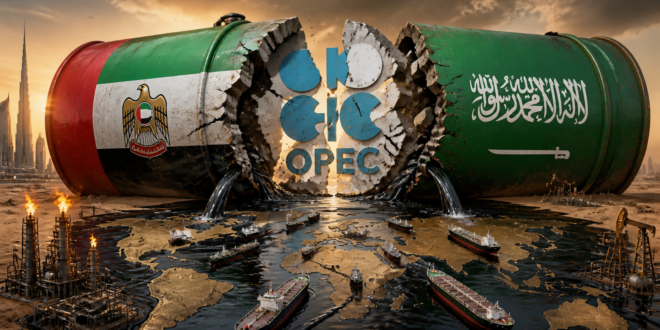
The United Arab Emirates’ exit from OPEC is not a technocratic adjustment to oil policy; it is a geopolitical signal. Beneath the surface of production quotas and market strategy lies a deeper rupture: the erosion of Gulf unity as a guiding principle of regional order.
Accelerated by wartime vulnerability, sharpened by diverging alliances, and rooted in long-standing tensions with Saudi Arabia, Abu Dhabi’s decision marks a decisive shift. What is ending is not just membership in a cartel but the illusion that the Gulf still acts as a cohesive strategic bloc.
The Limits of Security Guarantees
The ongoing confrontation involving Iran has exposed a critical contradiction at the heart of the UAE’s regional positioning: a state built on stability and economic openness remains deeply vulnerable to geopolitical shocks. Despite its sophisticated defense systems and strategic partnerships, the UAE found itself directly exposed to missile and drone threats in ways that unsettled its carefully cultivated image as a secure hub for global capital. Within just the first few weeks of the war, hundreds of billions of dollars were wiped out of the UAE. The issue is not simply material damage but reputational risk: vulnerability undermines the very economic model on which the UAE depends.
The UAE’s decision is best understood not as a rupture, but as a revelation. It exposes the extent to which the foundations of Gulf cooperation have already shifted
By contrast, Saudi Arabia appeared relatively insulated, not immune but better shielded diplomatically and strategically. Riyadh’s longstanding networks, including its ability to mobilize intermediaries and leverage broader geopolitical relationships, helped mitigate the scale and frequency of direct confrontation. This asymmetry did not go unnoticed in Abu Dhabi. It reinforced a growing perception within the Emirati leadership that collective security frameworks in the Gulf are uneven at best and unreliable at worst. Indeed, it led Abu Dhabi to punish Pakistan for helping the Saudis more than Islamabad could help the Emiratis. The implication is profound: if regional coordination cannot guarantee security in moments of crisis, then its value diminishes. Under such conditions, adherence to collective economic mechanisms like OPEC becomes harder to justify.
Towards Regional Dealignment
The UAE’s exit must also be situated within a broader reconfiguration of its regional alliances. Over the past decade, Abu Dhabi has steadily moved toward a model of strategic autonomy—prioritizing flexibility over alignment and bilateralism over multilateral consensus.
This shift is visible across multiple domains. The UAE’s normalization of relations with Israel under the Abraham Accords marked a clear departure from traditional Gulf consensus positions. Its engagement in conflict zones such as Yemen and Sudan has frequently diverged from Saudi priorities, revealing competing visions of regional order. Even within economic policy, the UAE has pursued aggressive diversification strategies that occasionally place it in competition—not coordination—with its neighbors.
Tensions with Saudi Arabia have been particularly consequential. Disputes over oil production quotas within OPEC+ have surfaced repeatedly in recent years, with the UAE pushing for higher baseline production levels to reflect its expanded capacity. These disagreements reached a visible peak in 2021, when negotiations nearly collapsed over Emirati objections. While temporary compromises were achieved, the underlying divergence persisted.
Beyond oil, the two states are increasingly competing as economic hubs. Saudi Arabia’s efforts to attract multinational headquarters to Riyadh—through policies such as requiring firms to base regional operations in the Kingdom—have been widely interpreted as a direct challenge to Dubai’s dominance. This competition extends to logistics, tourism, and investment, eroding the informal division of labor that once underpinned Gulf economic cooperation.
Within this context, the UAE’s decision to leave OPEC is less an isolated policy move than the culmination of a broader strategic trajectory. Emirati officials have indicated that the country is reassessing aspects of its multilateral engagement, emphasizing flexibility and national interest over institutional commitments. The message is clear: the era of automatic alignment is over. The more ‘flexible’ approach is a proxy term for what lies ahead: more dealignment, more divergence, and more conflict within the Gulf. The regional fault line is no longer between Iran and the GCC; it lies within the GCC as well. It is specifically targeting the Saudis.
The UAE’s exit from OPEC means that more oil will be available in the market. It also means oil prices would shift to decrease over time. Saudi Arabia needs high oil prices — around $90 (€77) per barrel —to fund government spending and its ambitious Vision 2030, a set of huge infrastructure projects to cut the Kingdom’s reliance on fossil fuels. Every extra barrel the country holds back means lost revenue, which hurts the country’s ability to grow its economy.
From Cartel Discipline to Competitive Energy Statecraft
At its core, OPEC represents a model of collective discipline, one in which member states coordinate production to influence global prices. For decades, this framework relied not only on shared economic interests but also on a degree of political cohesion among key Gulf producers. That cohesion is now eroding.
The UAE has invested heavily in expanding its oil production capacity, aiming to reach and sustain higher output levels in the coming years. Remaining within OPEC, however, would require continued adherence to quotas that constrain this capacity. From a purely economic perspective, the opportunity cost is significant, especially in a market environment characterized by volatility and shifting demand patterns.
More importantly, the logic of coordination itself is being questioned. As global energy markets evolve—with the rise of US shale, the energy transition, and increasing geopolitical fragmentation—the effectiveness of cartel-based management has diminished. States are increasingly prioritizing agility over discipline, seeking to maximize national advantage in a less predictable environment.
For the UAE, exiting OPEC offers several advantages: the ability to adjust production more rapidly, the freedom to pursue bilateral energy partnerships, and the flexibility to respond to market signals without institutional constraints. It aligns with a broader shift toward what might be called “competitive energy statecraft,” in which states act as independent players rather than coordinated members of a bloc.
This shift has significant implications for OPEC itself. The departure of a major producer like the UAE weakens the organization’s internal cohesion and raises questions about its future effectiveness. While OPEC Plus—which includes non-OPEC producers like Russia—has provided an expanded framework for coordination, its stability ultimately depends on the willingness of key actors to subordinate national interests to collective goals. The UAE’s exit suggests that such willingness is no longer assured.
Beyond Exit: A New Gulf Order
The UAE’s decision is best understood not as a rupture, but as a revelation. It exposes the extent to which the foundations of Gulf cooperation have already shifted. Looking ahead, this transformation is likely to deepen. Saudi Arabia will continue to assert leadership within OPEC, but with diminished authority. Other Gulf states may not follow the UAE’s path immediately, yet they too are navigating the tension between coordination and autonomy. The result may not be the collapse of regional institutions, but their gradual hollowing out.
At the same time, the move signals a broader trend in global politics: the decline of multilateral discipline in favor of flexible, state-centric approaches. In energy markets, as in security, the emphasis is shifting toward adaptability and unilateral capacity. For the Gulf, the stakes are particularly high. The region’s influence has long depended on its ability to act collectively, whether in managing oil markets or shaping geopolitical outcomes. As that collective capacity erodes, so too does the coherence of the “Gulf” as a strategic concept. It might exist as a geography, but not as a regional political alliance. The UAE has moved first, but it is unlikely to be the last to rethink the value of consensus. What emerges in its place will not be unity, but something more fluid—and potentially more unstable.