 Eurasia Press & News
ƒDespite apparent military setbacks, the U.S. war against Iran may represent a broader strategy aimed at reshaping global energy flows and strengthening Washington’s geopolitical leverage.
The US war on Iran — at face value — appears to be a catastrophic tactical and strategic US failure demonstrating the limits of its military power and further exposing the limits of its military-industrial capacity.
However, just as with its still-ongoing proxy war on Russia in Ukraine, its inability to overwhelm targeted nations with outright military power distracts from the many ways the US is still advancing its geopolitical objectives by other means.
In Ukraine, the US has categorically failed in defeating Russian forces through its support of its Ukrainian proxies. However, it has used the war to lock Russia into an expensive, prolonged, high-intensity conflict that has demonstrably compromised Russian interests beyond Europe — especially regarding the 2024 collapse of Syria.
While the US does indeed face growing challenges in terms of its military power and its military industrial base, it is pursuing full-spectrum dominance using multi-domain warfare — spanning not just military force but economic and financial force
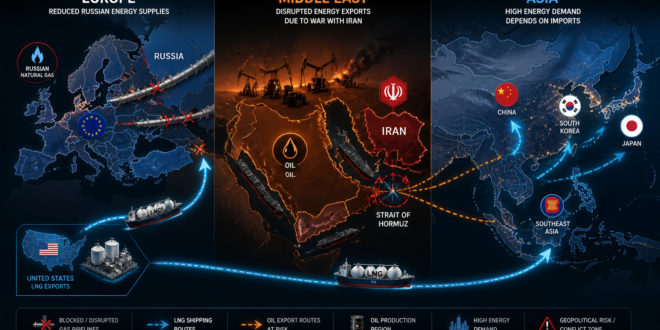
The war has also succeeded in cutting Europe off from cheap, reliable, and plentiful Russian energy and is placing Europe under increasing and likely irreversible energy dependence on the United States.
This energy dependence on the US obviously benefits US-based energy corporations financially but also enhances Washington’s strategic leverage or even outright control over Europe. This control is being used to successfully create a united front across Europe against Russia.
In a similar manner, the US is using its war on Iran to strangle energy exports from the entire Middle East to Asia to decouple Asia from cheap, reliable, plentiful gas and oil and place it under US energy dependence, thus providing the US strategic leverage over Asia to create a similar united front against China.
Decoupling Europe from Russian Energy Through War Was Planned
In the 2019 RAND Corporation paper titled “Extending Russia: Competing from Advantageous Ground,” a number of “economic” and “geopolitical” measures were laid out, designed to “extend” Russia and possibly precipitate a Soviet Union-style collapse like that which ended the Cold War.
Under “economic measures,” the paper lists “hinder petroleum exports,” “reduce natural gas exports and hinder pipeline expansions,” “impose sanctions,” and “enhance Russian brain drain.”
The paper first argues that one of the main methods of implementing these measures is to expand US oil and gas production and its export to Europe.
However, under a section titled “likelihood of success,” the paper explicitly admits:
“Reducing European peacetime consumption of Russian gas has a medium to low likelihood of success. Diversifying away from Russia is expensive, and projects might be difficult to accomplish.”It should be remembered that at the time, the US was already investing in LNG export facilities and even exporting LNG targeting markets in Europe — at a time US policymakers admitted it made no financial or economic sense to do so.
However, the paper was far from finished. Under “geopolitical measures,” the paper lists first and foremost, “provide lethal aid to Ukraine.”
The paper admits that:
“Expanding U.S. assistance to Ukraine, including lethal military assistance, would likely increase the costs to Russia, in both blood and treasure, of holding the Donbass region. More Russian aid to the separatists and an additional Russian troop presence would likely be required, leading to larger expenditures, equipment losses, and Russian casualties. The latter could become quite controversial at home, as it did when the Soviets invaded Afghanistan.”In other words, by providing lethal aid to Ukraine — which the US began doing under the first Trump administration — the US would be knowingly attempting to provoke a war with Russia in Ukraine.
Not only would the resulting war generate high costs for Russia militarily, it would also obviously transform the chief obstacle to reducing/hindering Russian oil/gas exports and expanding US LNG exports — that chief obstacle being “peacetime”— into unending wartime.
Indeed, while sanctions began targeting Russia’s economy from 2014 onward, the war in Ukraine provoked by the US through its policy of militarily building up Ukraine on Russia’s borders resulted in the destruction of the Nord Stream pipelines and ever-tightening sanctions on Russian energy exports that have made otherwise irrational US LNG imports to Europe essential.
To further tip the balance of energy dominance in America’s favor, it was revealed by the New York Times in late 2025 that it was the US Central Intelligence Agency (CIA) and the US military supercharging “a Ukrainian campaign of drone strikes on Russian oil facilities and tankers.”
The US-provoked war provided the perfect means to decouple Europe from otherwise cheap, reliable, and plentiful Russian energy exports that had flowed during peace. While the process of decoupling has taken years and is still in the process of being fully implemented, it has proven successful — so much so that it is almost inconceivable US interests haven’t considered repeating that success regarding the Middle East and Asia.
Strangling China
US foreign policy papers spanning decades have discussed options, proposed policies, and guided actual weapons and force organizational programs seeking to strangle China economically through blockades — often specifically in the Asia-Pacific region but also at maritime chokepoints and ports around the globe.
A 2018 Naval War College Review paper titled, “A Maritime Oil Blockade Against China – Tactically Tempting but Strategically Flawed” would list the obstacles facing such a policy and various means to overcome them.
It focused on not only cutting off maritime shipping to China at chokepoints such as the Malacca Strait in what it called a “distant blockade” (a blockade imposed beyond the reach of most of China’s military capabilities), it also discussed severing China’s Belt and Road Initiative (BRI) projects built specifically to enable China to circumvent these chokepoints.
At one point in the paper, it discusses the Myanmar-China oil pipeline, which allows China to offload Middle East energy at port facilities on Myanmar’s coast and pipe the energy across Myanmar directly into China’s southern Yunnan Province.
The paper suggests:
“A distant blockade also would need to interdict the Myanmar–China oil pipeline, which eventually could move as much as 440 kbd of crude oil from Kyaukpyu in coastal Myanmar to Yunnan Province in southwest China. Preventing tankers from offloading at the Kyaukpyu terminal would require few, if any, naval platforms to remain onsite. The area could be declared an exclusion zone for the duration of a conflict, and if the Myanmar authorities failed to comply, the facility could be disabled via air strikes, aerial mining, or other kinetic action. In short, US forces likely would be able to neutralize rapidly China’s overland routes for seaborne oil imports to avoid the Strait of Malacca and other choke points farther east and prevent them from diverting forces needed to seal other maritime ingress routes.”Far from just theoretical proposals, the US has been backing armed militants in Myanmar for years fighting against the central government. These militants have repeatedly attacked the Myanmar-China oil pipeline and have, in recent instances, attempted to seize territory through which the pipeline crosses.
In other words, rather than waiting for a US-China conflict to erupt before attacking the pipeline with US military assets, the US has instead used armed proxies to attack it before any direct US-China conflict even begins. Such attacks serve as evidence that the US hasn’t just considered the notion of a “distant blockade” on China but has already decided to incrementally impose them.
The US has backed armed militants disrupting similar pipelines and economic corridors in Pakistan, while the US itself continues growing its military footprint in the Asia-Pacific region to threaten maritime shipping near both Taiwan and in the South China Sea.
However, the notion of a “distant blockade” isn’t restricted to just the Asia-Pacific region. The US war on Iran has created a de facto blockade much further from China still — in the Middle East.
The war has not only impeded maritime traffic through the Strait of Hormuz through both Iranian and US-imposed restrictions, but US attacks on Iranian energy production facilities have resulted in retaliatory strikes on the energy production facilities of Persian Gulf Arab states hosting US troops.
The reduced energy production across the entire region, coupled with disrupted maritime traffic through the Strait of Hormuz, has resulted in an energy crisis for nations dependent on the Middle East for their energy imports — especially Asia, including China.
Decoupling Asia from the Middle East
Asian states like Pakistan, Myanmar, Vietnam, the Philippines, Thailand, Japan, and South Korea get anywhere between 50% to 90% of their total imported energy from the Middle East, according to Western publications like Politico.
China receives up to 50% of its imported energy from the Middle East. Its island province of Taiwan gets over 60% of its imported energy from the Middle East.
With production and exports disrupted by yet another US-provoked war, Asian states — instead of Europe — have now been forced to look elsewhere to meet their energy needs.
And just as the US had done regarding its premeditated decoupling of Europe from Russian energy imports, the US has spent years proposing, investing in, constructing, and even bringing online LNG export facilities specifically targeting markets in Asia. With this capacity already partially online, it is in place just in time to take full advantage of the energy crisis the US itself created in the Middle East, now threatening nations across Asia.
Nations like Vietnam — for example — have been left with two choices: either leave tens of millions of their people without energy, including essential commodities like cooking gas, or buy the only alternative available to make up for disrupted imports from the Middle East.
Vietnam’s state-owned gas major has reportedly purchased up to 66,000 tons of LPG (liquefied petroleum gas) from the US vs. 44,000 tons from the Middle East. It should be noted that this is the first year it has ever purchased US energy.
Vietnam, of course, has close ties with Moscow and purchases part of its energy mix from Russia and also imports coal from China, but neither has sufficient capacity to immediately make up for the over 80% of Middle East energy imports Vietnam depended on that are now disrupted.
Other nations, including Thailand, Japan, and South Korea, as well as the island province of Taiwan, have all likewise been forced to seek alternatives. While in some cases Russia has been approached and able to make up for some shortfalls, the US has deliberately positioned itself as the only other alternative.
It should be mentioned that the LNG export projects the US invested in over recent years to target Asian markets struggled to propose a viable business model during their early proposal and approval stages — just as LNG export projects targeting European markets had until the US proxy war on Russia began. .
One project — Alaska LNG by Glenfarne — made“energy security”and routes through “uncontested and safe shipping lanes” a primary selling point as recently as 2025. However, at the time, there were no contested or unsafe shipping lanes impeding the flow of energy exports to Asia to justify this selling point.
The only shipping lanes that might ever be contested or made unsafe would be the various straits the US has discussed and prepared to contest and make unsafe for decades — not just in the Asia-Pacific region but also the Strait of Hormuz in the Middle East and beyond.
Of course — now with the US war on Iran disrupting energy exports from the Middle East, projects like Alaska LNG have gone from poor business proposals to a desperately needed and perfectly positioned source of energy — all of it, just like with US LNG exports to Europe, by design.
A recent Wall Street Journal article titled,“U.S. Energy Exports Hit Records as World Adjusts to a Closed Persian Gulf” would note that “oil, and gas shipments have soared, but the U.S. will face obstacles turning wartime demand into a permanent boost.”
The false assumption made is that the US war on Iran is not connected to US oil and gas shipments soaring or to “wartime demand”—and that this is just somehow a profitable coincidence.
But just as the RAND Corporation made clear back in 2019, any policy proposal like decoupling Europe from Russian energy that doesn’t work during “peacetime,” can be made to work by simply taking “peacetime” and transforming it into “wartime.”
That is what the US did to Europe — it is now clearly repeating this process, targeting Asia.
It will be up to Russia, China, Iran, and the rest of the independent world — including nations across Asia and in particular South and Southeast Asia — to carefully navigate this dangerous trap that has been sprung by the US and avoid complete energy dependence on the US, as has been imposed upon Europe.
Europe has already suffered what is likely irreversible political and economic damage from its political capture by the US and now its growing energy dependence on the US.
Asia risks being likewise weakened by growing energy dependence on the US, making political capture much more likely by the US, then being transformed into a united front — this time against China rather than Russia — and used to wage war on the US’ behalf at the expense of the people, peace, and prosperity of Asia.
While the US does indeed face growing challenges in terms of its military power and its military industrial base, it is pursuing full-spectrum dominance using multi-domain warfare — spanning not just military force but economic and financial force, operating not only in the physical space of the battlefield most people associate warfare with but in political space and, most importantly, information space.
The US has repeatedly demonstrated its ability to sidestep its growing military weakness relative to the rest of the world and leverage its political capture of nations around the globe, its monopoly over global information space, and now its growing weaponization of energy.
The US is weaponizing energy both through the production and export of energy from the US and by carrying out a systematic attack on and seizure or destruction of alternative energy sources in Venezuela, Russia, and Iran, among others.
Only time will tell if the multipolar world can adequately organize itself not just in the domain of military power but also in all other domains the US is waging war against them in.