 Eurasia Press & News
Toplines
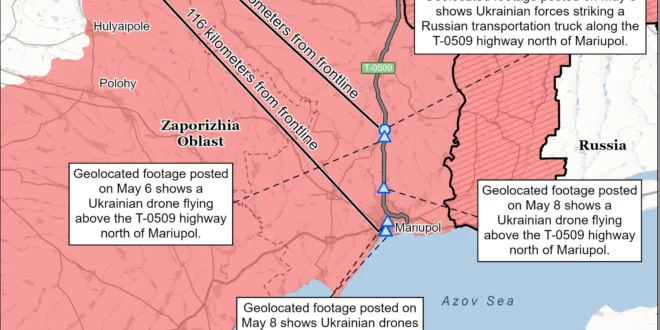
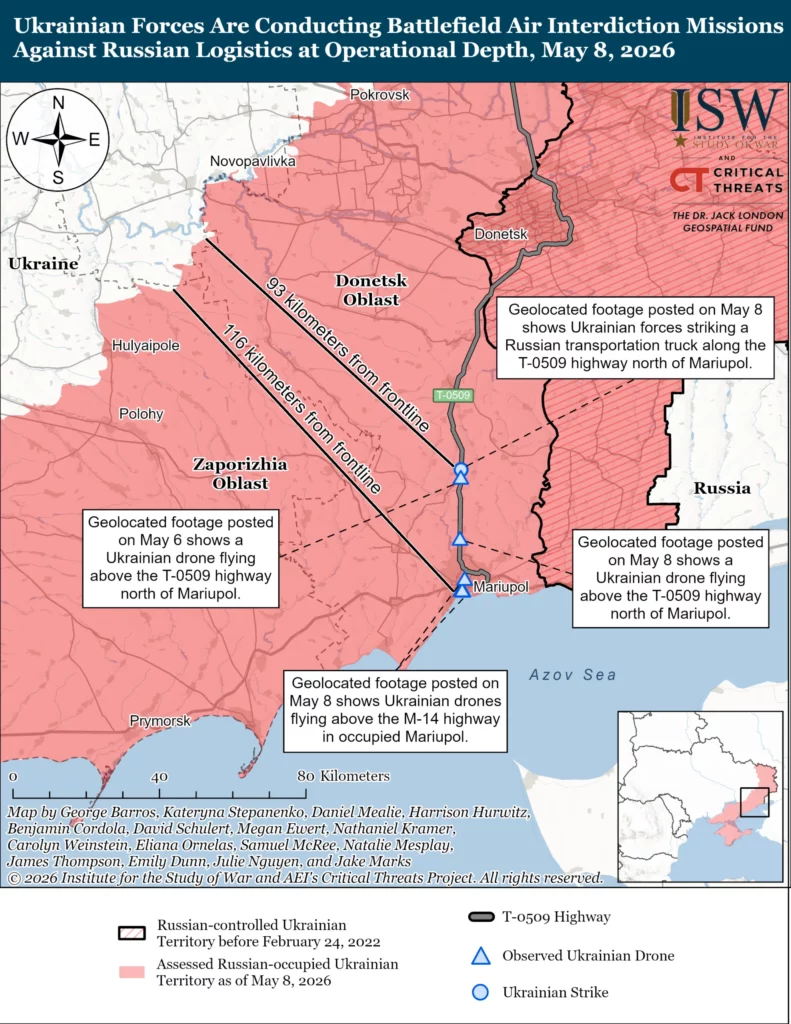
Ukrainian forces are reconnoitering and interdicting Russian ground lines of communication (GLOCs) in and near occupied Mariupol, Donetsk Oblast (about 105 kilometers from the frontline), demonstrating increased capabilities as part of Ukraine’s intensifying mid-range strike campaign. The Ukrainian 1st Azov National Guard Corps reported on May 8 that it struck Russian military targets near occupied Mariupol, Donetsk Oblast (roughly 105 kilometers from the frontline) and is interdicting Russian logistics at depths of up to 160 kilometers from drone operator positions.[1] Geolocated footage published on May 6 and 8, including from the 1st Azov Corps, confirms that Ukrainian forces flew drones and struck a truck along the T-0509 Mariupol-Donetsk City highway (also called the H-20 highway) at a point approximately 95 kilometers from the frontline.[2] Additional geolocated footage from the 1st Azov Corps shows Ukrainian drones operating at points along the T-0509 highway about 95 to 104 kilometers from the frontline and within Mariupol itself along the M-14 Mariupol-Berdyansk-Melitopol highway.[3] The T-0509 supplies Russian forces operating along the frontline north of Mariupol and further northeast, supporting the ongoing Russian offensive against Ukraine’s Fortress Belt.[4] The M-14 highway extends west into occupied Zaporizhia and Kherson oblasts and supports Russian logistics to the Orikhiv direction and east (left) bank of the Dnipro River. Ukraine’s ability to conduct drone strikes against moving targets over 100 kilometers from the frontline, in areas where Russian forces previously were able to conduct logistics relatively risk free, will likely achieve partial effects of battlefield air interdiction (BAI) that degrade Russian forces’ ability to conduct future offensive operations, or defend against Ukrainian counterattacks. Ukrainian forces have been intensifying their mid-range strike campaign against Russian GLOCs and military assets in occupied Ukraine since late December 2025 and have markedly increased the intensity and frequency of such strikes since March 2026, and will likely continue to do so.[5] Intensified and sustained Ukrainian BAI efforts at operational depth may support future Ukrainian counterattacks that, such as the Ukrainian counterattacks that liberated large portions of Kupyansk in November 2025 and over 400 square kilometers in southern Dnipropetrovsk Oblasts in early 2026.
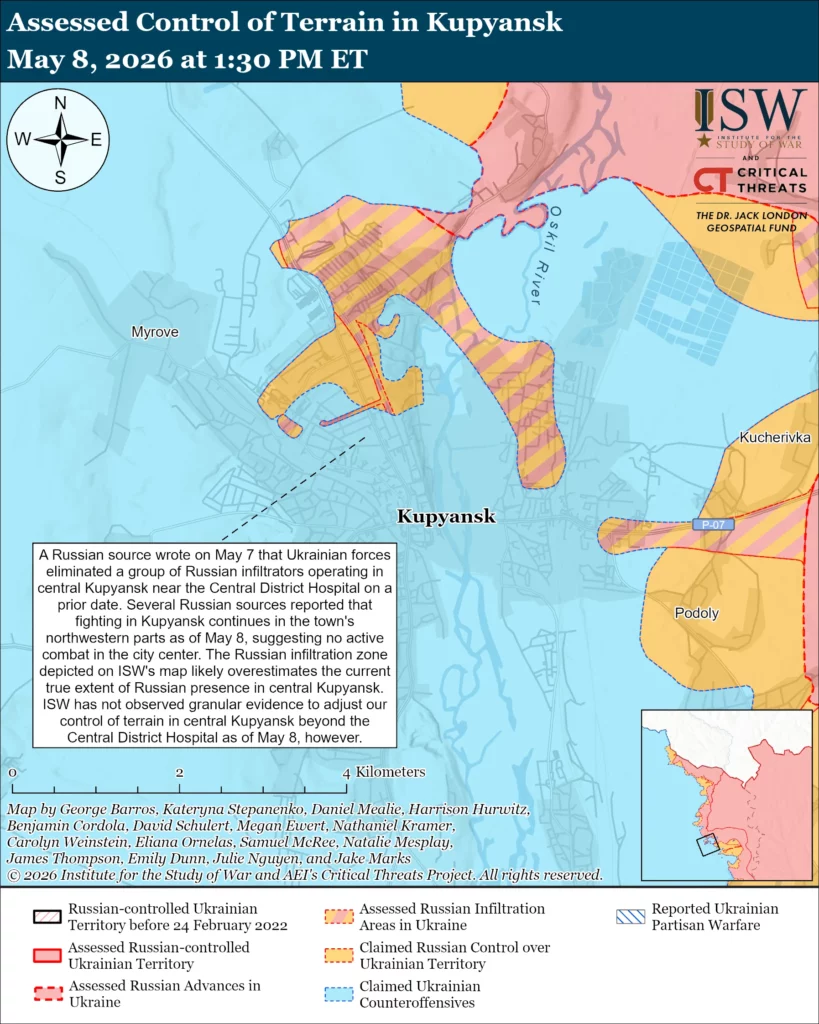
Russian forces likely do not maintain positions in Kupyansk after struggling for months to support a small and isolated group of servicemembers that infiltrated into the city. A Russian milblogger reported on May 7 that a group of roughly 20 Russian soldiers who had reportedly remained encircled in the Kupyansk City Hospital since December 2025 fought “their last battle” and “held their positions until the very end” after a Ukrainian airstrike destroyed the hospital and killed most of the surviving personnel, implying that Russian forces no longer hold positions in central Kupyansk.[6] Ukrainian Joint Forces Task Force Spokesperson Colonel Viktor Trehubov reported on March 28 that Ukrainian forces identified only six active Russian call signs in Kupyansk representing roughly 12 to 18 Russian personnel in the city center.[7] Trehubov later stated on April 21 that roughly 10 Russian call signs remained active in Kupyansk.[8] Several Russian sources reported that fighting in Kupyansk continues in the town’s northwestern parts as of May 8, suggesting no active combat in the city center. The Russian infiltration zone depicted on ISW’s map likely overestimates the current true extent of Russian presence in central Kupyansk.[9] These reports indicate that Ukrainian forces likely eliminated any enduring Russian positions in the Kupyansk city center. ISW has not observed granular evidence to adjust our control of terrain in central Kupyansk beyond the Central District Hospital as of May 8, however. ISW will continue collecting and verifying data and will update its control of terrain assessment as the evidence permits.
Ukraine and Russia agreed to a three-day ceasefire from May 9 to 11 for the May 9 Victory Day parade and a prisoner of war exchange. US President Donald Trump, Ukrainian President Volodymyr Zelensky, and Kremlin Presidential Aide Yuriy Ushakov announced on May 8 that Ukraine and Russia are instituting a three-day ceasefire and an exchange of 1,000 prisoners-of-war (POWs) from each side.[10] Zelensky noted that Ukraine has “clearly communicated” to Russia the “principle of symmetry” in Ukraine’s actions.[11] Zelensky signed a decree on May 8 specifically “to allow” Russia to hold its May 9 Victory Day parade in Moscow, stipulating that Ukraine will not strike Moscow’s Red Square for the parade’s duration, starting at 1000 local time on May 9.[12]
Russia continued to threaten retaliatory strikes against Kyiv City ahead of the May 9 to 11 ceasefire announcement. The Russian MoD claimed on May 8 that Ukrainian forces continued launching drones and conducting artillery missions after the unilaterally-declared Russian ceasefire went into effect and that Russian forces launched retaliatory strikes against Ukrainian military targets.[13] Russian Foreign Minister Sergei Lavrov reiterated on May 8 recent Russian Ministry of Defense (MoD) and Ministry of Foreign Affairs (MFA) threats to strike buildings that contain decision-making centers in Kyiv City if Ukraine strikes Moscow during the May 9 Victory Day parade, stating that Russia will show “no mercy” if Ukraine tries to disrupt the Victory Day holiday.[14] Some Russian officials recently invoked a threat that Russian forces may use Oreshnik intermediate-range ballistic missiles (IRBMs) in retaliatory strikes against Kyiv City.[15] The use of Oreshnik IRBMs against a Ukrainian population center would not be a novel escalation, however. Russia used Oreshniks against Dnipro City in November 2024 and Lviv City in early 2026.[16] Russia has similarly conducted numerous strikes against Kyiv, including against decision-making centers before. The Kremlin’s warnings may be alluding to a more intense strike package that contains a high number of ballistic missiles, possibly including Oreshnik missiles. Russia has never before launched a high volume of ballistic missiles concentrated at decision-making centers in Kyiv City, which would be a novel escalation from the Kremlin.
The Russian MoD announced on May 7 the terms of the Kremlin’s then-unilateral ceasefire from midnight local time on the morning of May 8 to midnight on the morning of May 10, and claimed on the morning of May 8 to have launched retaliatory strikes in response to alleged Ukrainian violations of this ceasefire.[17] Russian authorities issued these statements before the US-Ukrainian-Russian announcements of the May 9 to 12 ceasefire agreement. The Kremlin’s escalating threats leading up to the May 9 Victory Day are likely intended to obfuscate Russia’s weakness and its inability to reliably defend large portions of Russia’s airspace from Ukrainian deep rear strikes. Russian threats to use Oreshniks are likely an attempt to scare Ukraine and the West into capitulating to Russia’s longstanding political demands.
A senior Kremlin official explicitly stated that the Kremlin demands that Ukrainian forces withdraw from the remainder of Donetsk Oblast as a precondition for a ceasefire — a battlefield objective that Russian forces have thus far failed to achieve. Russian Presidential Aide Yuri Ushakov, a senior Kremlin official who regularly comments on the status of negotiations involving Ukraine in an official capacity, claimed on May 7 that another round of trilateral US-Ukrainian-Russian negotiations currently makes no sense as Ukraine must take “one serious step” of withdrawing from unoccupied Donetsk Oblast before Russia will agree to cease hostilities and continue peace negotiations.[18] The Kremlin reportedly has long held a demand over unoccupied Donbas as a precondition for enacting a ceasefire or reaching a peace settlement in Ukraine.[19] Ceding the remainder of unoccupied Donetsk and Luhansk oblasts would grant Russia control over Ukraine’s Fortress Belt, a series of fortified cities that have served as the backbone of Ukraine’s defense in the area since 2014.[20] This Kremlin demand notably does not guarantee that Ukraine and Russia will conclude a peace agreement, so the Kremlin is effectively demanding territory from which it can launch a renewed offensive against less prepared Ukrainian positions at a time of its choosing during the negotiations process.
Russian forces are performing worse on the battlefield in Spring 2026 than when the Kremlin emphasized its demand for Donetsk Oblast in 2025. Russian President Vladimir Putin and other senior Kremlin officials began intensifying their demands for Ukraine to surrender territory that Russia does not control, especially the remainder of unoccupied Donetsk Oblast, in early 2025, when the battlefield was more favorable to Russian forces than in Spring 2026.[21] Ukrainian forces have been increasing the economic, human, and material costs of Russia’s war since then. Ukrainian forces have been steadily increasing the range, volume, and intensity of their long-range strike campaigns against Russian oil infrastructure and military assets to exploit the Kremlin’s inability to defend against Ukrainian strikes.[22] Ukrainian forces have significantly intensified their mid-range strike campaign against Russian logistics, military equipment, and manpower in early 2026, degrading Russia’s ability to conduct offensive operations. Russian advances across the theater stalled to an average of 2.9 square kilometers per day in the first four months of 2026, and Russian forces suffered a net loss of territory in April 2026.[23] Russian forces are simultaneously struggling with an increasing casualty rate that has recently exceeded Russia’s recruitment rate in late 2025 and into early 2026.[24] ISW has previously assessed that the Kremlin is trying to create a false sense of political urgency among its negotiating partners by trying to force Ukraine to cede the unoccupied part of Donbas, which Russian forces have been unable to take on the battlefield.[25] Ushakov is likely now attempting to justify the Kremlin’s refusal to participate in negotiations that do not acquiesce to the Kremlin’s long-held demands even though Russia’s stagnating battlefield performance is placing the Kremlin in a worse position to extract major political concessions. Ukrainian forces can and will continue to impose higher costs on Russian forces conducting offensive operations in Ukraine, particularly against the Fortress Belt as part of the ongoing Spring-Summer 2026 offensive that has failed to yield operationally-significant gains so far.[26]
Key Takeaways
Ukrainian forces are reconnoitering and interdicting Russian ground lines of communication (GLOCs) in and near occupied Mariupol, Donetsk Oblast (about 105 kilometers from the frontline), demonstrating increased capabilities as part of Ukraine’s intensifying mid-range strike campaign.
Russian forces likely do not maintain positions in Kupyansk after struggling for months to support a small and isolated group of servicemembers that infiltrated into the city.
Ukraine and Russia agreed to a three-day ceasefire from May 9 to 11 for the May 9 Victory Day parade and a prisoner of war exchange.
Russia continued to threaten retaliatory strikes against Kyiv City ahead of the May 9 to 11 ceasefire announcement.
A senior Kremlin official explicitly stated that the Kremlin demands that Ukrainian forces withdraw from the remainder of Donetsk Oblast as a precondition for a ceasefire – a battlefield objective that Russian forces have thus far failed to achieve.
Russian forces are performing worse on the battlefield in Spring 2026 than when the Kremlin emphasized its demand for Donetsk Oblast in 2025.
Ukrainian forces recently advanced in the Slovyansk direction and in the Hulyaipole direction.
Ukrainian forces continued their long-range strike campaign against Russian defense, oil, and transportation infrastructure. Russian forces launched 67 drones toward Ukraine overnight.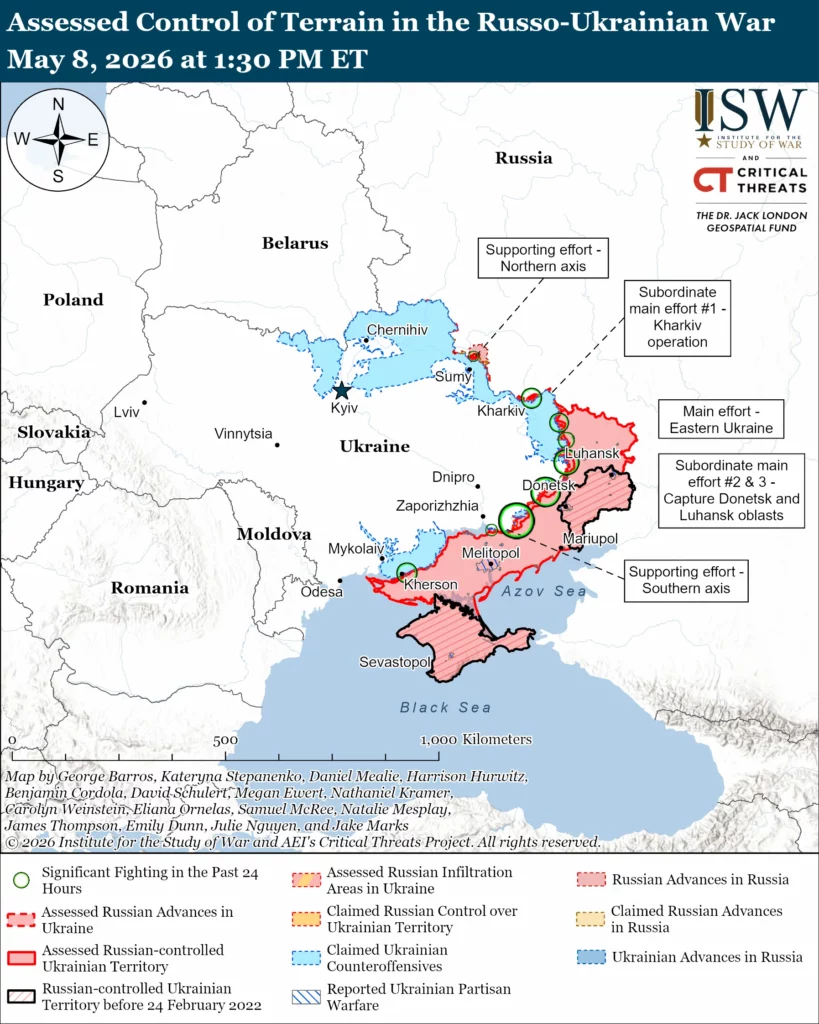
We do not report in detail on Russian war crimes because these activities are well-covered in Western media and do not directly affect the military operations we are assessing and forecasting. We will continue to evaluate and report on the effects of these criminal activities on the Ukrainian military and the Ukrainian population and specifically on combat in Ukrainian urban areas. We utterly condemn Russian violations of the laws of armed conflict and the Geneva Conventions and crimes against humanity even though we do not describe them in these reports.
Ukrainian Operations in the Russian Federation
Ukrainian forces continued their long-range strike campaign against Russian oil and defense infrastructure on the night of May 7 to 8. Ukraine’s Security Service (SBU) reported on May 8 that Ukrainian forces struck the Lukoil-Permnefteorgsintez oil refinery in Perm City, Perm Krai (roughly 1,500 kilometers from the frontline), the second Ukrainian strike on the Lukoil-Permnefteorgsintez oil refinery since Ukrainian forces struck the facility yesterday and the third Ukrainian strike against the facility overall.[27] Perm Krai Governor Dmitry Makhonin acknowledged on May 8 that a Ukrainian drone struck an industrial facility in Perm City.[28] Satellite imagery published on May 8 shows smoke rising from the Lukoil-Permnefteorgsintez refinery after the strike.[29] Ukrainian President Volodymyr Zelensky reported on May 8 that Ukrainian forces struck the Yaroslavnefteorgsinetz oil refinery in Yaroslavl (roughly 700 kilometers from the international border) and posted footage of a fire at the facility.[30] The Ukrainian Unmanned Systems Forces (USF) reported that the oil refinery is among the top five largest oil refineries in Russia and is designed to process roughly 15 million tons of oil per year.[31] Yaroslavl Oblast Governor Mikhail Yevrayev acknowledged on May 8 that a Ukrainian drone struck an industrial facility in Yaroslavl Oblast.[32] Geolocated footage published on May 7 shows Ukrainian forces striking a building in Grozny’s Khankala Neighborhood (Republic of Chechnya – roughly 865 kilometers from the front line), in which the headquarters of the Russian 42nd Motorized Rifle Division (58th Combined Arms Army [CAA], Southern Military District [SMD]) is reportedly located.[33] Geolocated footage published on May 8 shows Ukrainian drones striking a Russian FSB building in Znamenskoe, Republic of Chechnya (roughly 810 kilometers from the front line).[34] Geolocated footage published on May 7 shows fires at the Radar Research and Development Center in Rostov-on-Don, Rostov Oblast, following a likely Ukrainian strike.[35]
Russian Supporting Effort: Northern Axis
Russian objective: Create defensible buffer zones in Sumy Oblast along the international border
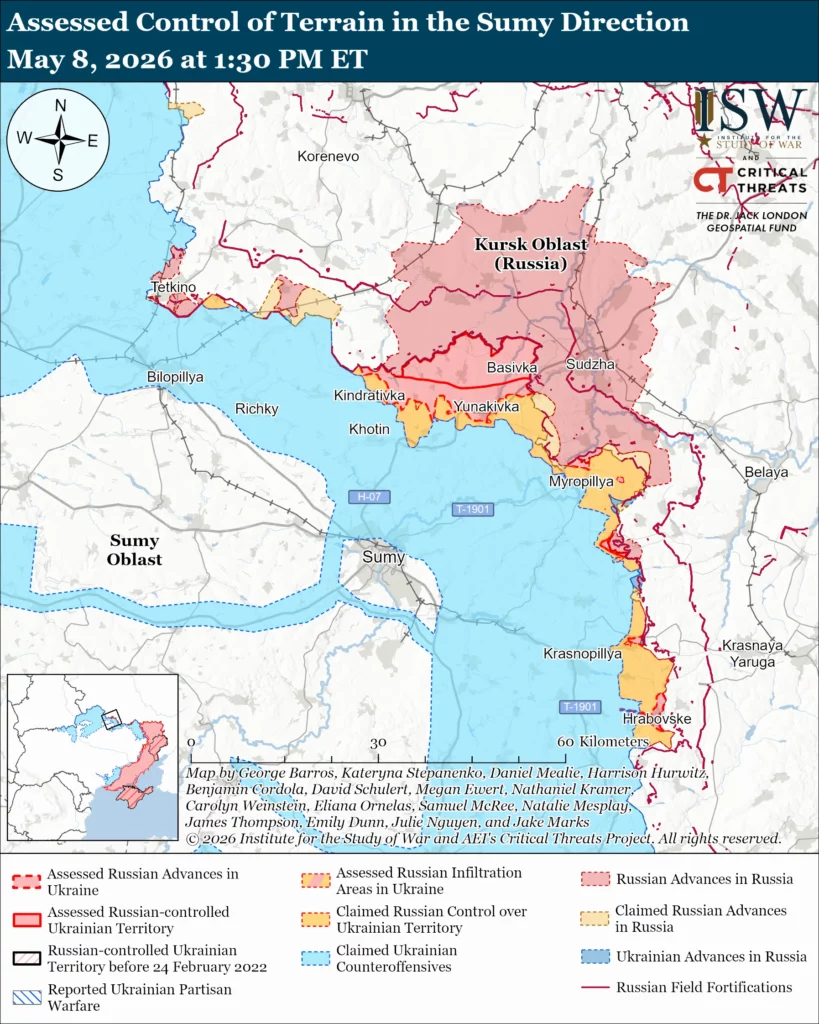
Russian forces continued offensive operations in Sumy Oblast on May 8 but did not advance.[36]Ukrainian forces continue to hold positions in Myropillya (northwest of Sumy City) despite Russian claims to the contrary. The Ukrainian Kursk Group of Forces reported that the Russian Ministry of Defense’s (MoD) May 2 claim that Russian forces seized Myropillya is false.[37] The Kursk Group of Forces speculated that Russian forces may be overstating their gains to claim battlefield successes before the Russian May 9 Victory Day holiday.
Russian Main Effort: Eastern Ukraine
Russian Subordinate Main Effort #1 – Kharkiv Oblast
Russian objective: Push Ukrainian forces back from the international border to create a defensible buffer zone with Belgorod Oblast and approach to within tube artillery range of Kharkiv City
Russian Subordinate Main Effort #1 – Kharkiv Oblast (Russian objective: Push Ukrainian forces back from the international border to create a defensible buffer zone with Belgorod Oblast and approach to within tube artillery range of Kharkiv City)
Russian forces recently conducted an infiltration mission in the Kharkiv direction as Ukrainian forces counterattacked on May 8.[38]
Geolocated footage published on May 7 shows Ukrainian forces striking a Russian position in western Veterynarne (north of Kharkiv City) after what ISW assesses was a Russian infiltration mission.[39] A Russian milblogger claimed that Russian forces advanced west of Losivka (northeast of Kharkiv City).[40]
Neither Russian nor Ukrainian forces reported ground activity in the Velykyi Burluk direction on May 8.
Russian Subordinate Main Effort #2 – Oskil River
Russian objective: Cross the Oskil River in Kharkiv Oblast and push westward into eastern Kharkiv Oblast and northern Donetsk Oblast
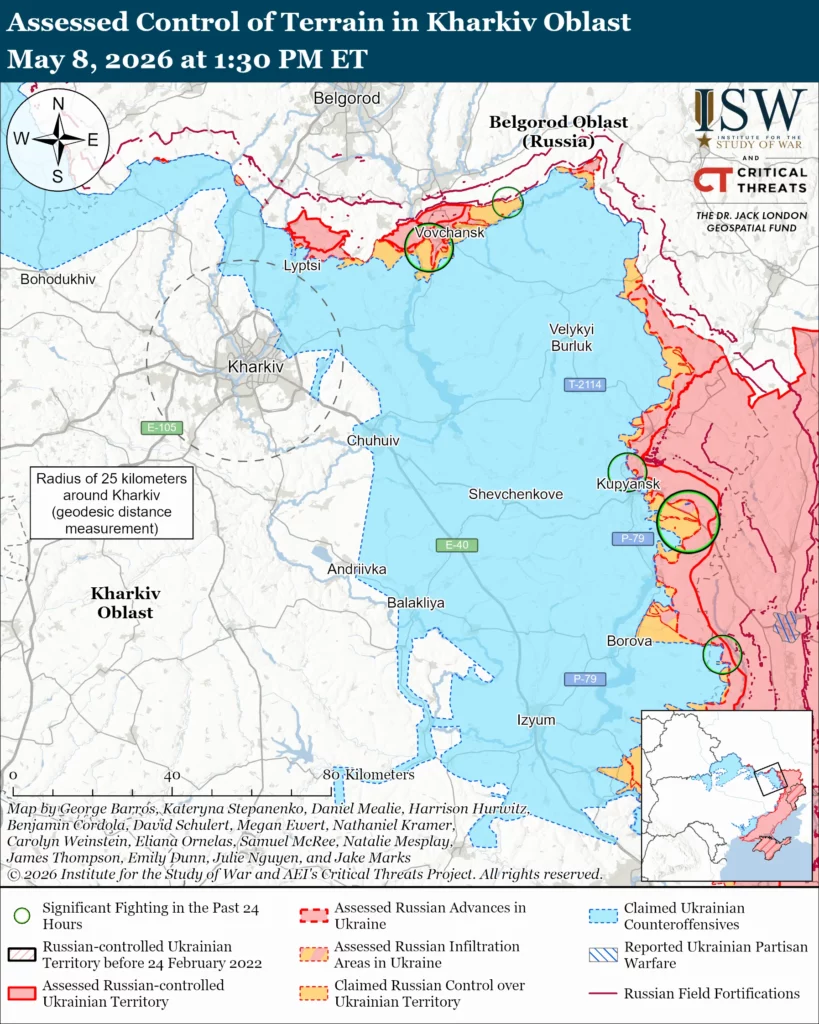
Russian forces continued offensive operations in the Kupyansk direction on May 8 but did not advance.[41]
See topline text for reports of Russian activity in Kupyansk.
Russian forces continued limited ground operations in the Borova direction on May 7 and 8 but did not advance.[42]
Ukrainian forces continued mid-range strikes against Russian military assets in occupied Luhansk Oblast. The Ukrainian Unmanned Systems Forces (USF) reported on May 8 that Ukrainian forces struck railway tank cars carrying fuel and lubricants, an underground fuel and lubricant storage facility, an additional fuel and lubricant depot, an ammunition depot, and a Russian manpower and equipment concentration in occupied Luhansk Oblast.[43]
Russian Subordinate Main Effort #3 – Donetsk Oblast
Russian objective: Capture the entirety of Donetsk Oblast, the claimed territory of Russia’s proxies in Donbas, and advance into Dnipropetrovsk Oblast
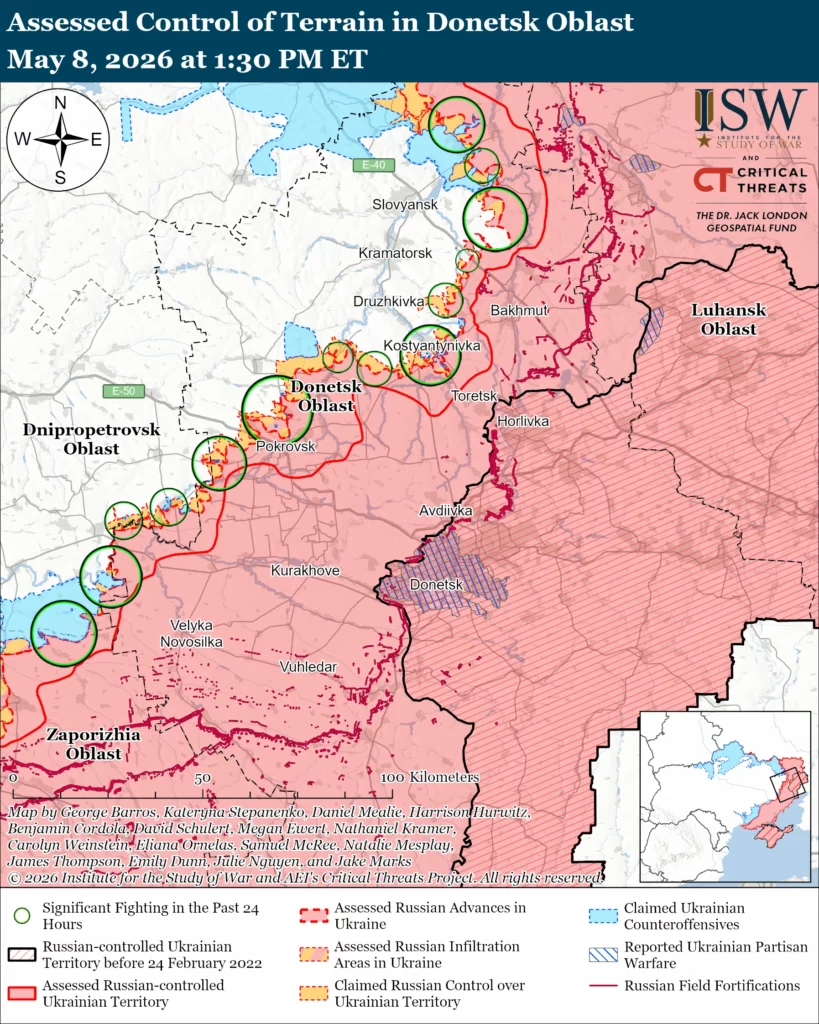
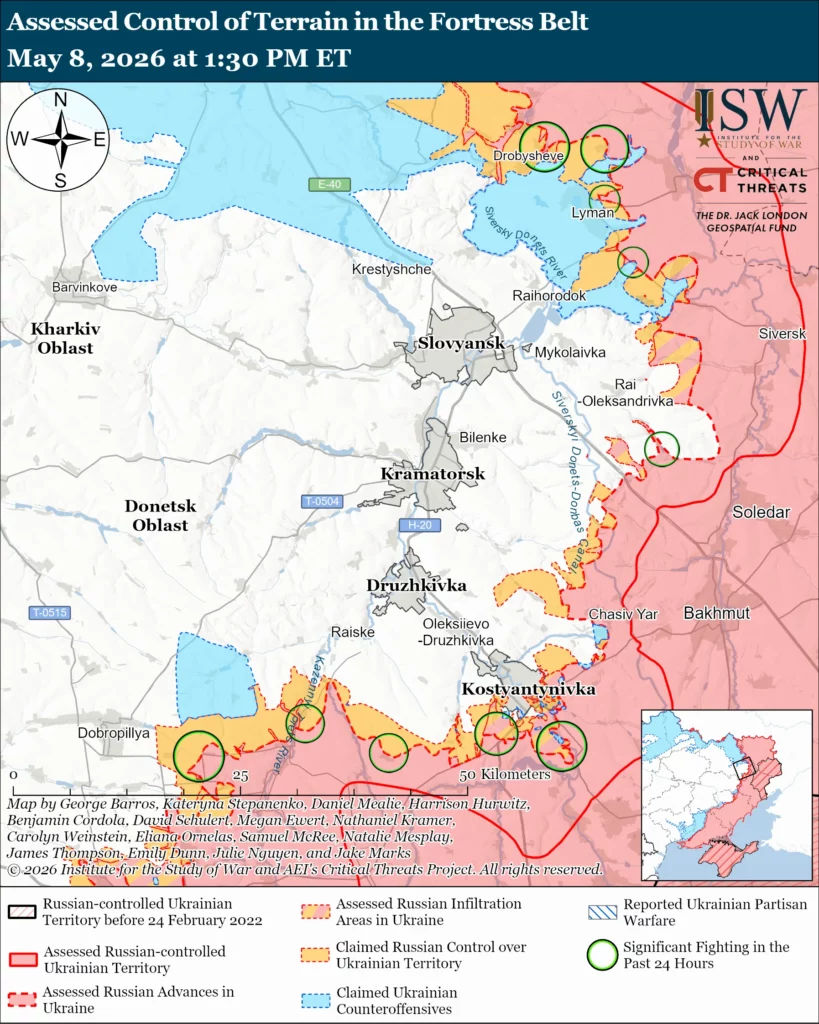
Ukrainian forces recently advanced as Russian forces continued infiltration missions in the Slovyansk direction. Geolocated footage published on May 7 shows Russian forces striking Ukrainian positions in northern Dibrova, Kramatorsk Raion (south of Lyman) and near the T-0513 Siversk-Lyman highway northwest of Dibrova, indicating that Ukrainian forces recently advanced in eastern and northern Dibrova.[44] Geolocated footage published May 7 shows Ukrainian forces striking a Russian position in western Dibrova, Bakhmut Raion (southeast of Slovyansk) after what ISW assesses was a Russian infiltration mission.[45] The Russian Ministry of Defense (MoD) and Russian milbloggers claimed on May 8 that elements of the Russian 7th Separate Motorized Rifle Brigade (3rd Combined Arms Army [CAA], formerly 2nd Luhansk People’s Republic Army Corps [LNR AC], Southern Military District [SMD]) seized Kryva Luka (east of Slovyansk).[46]
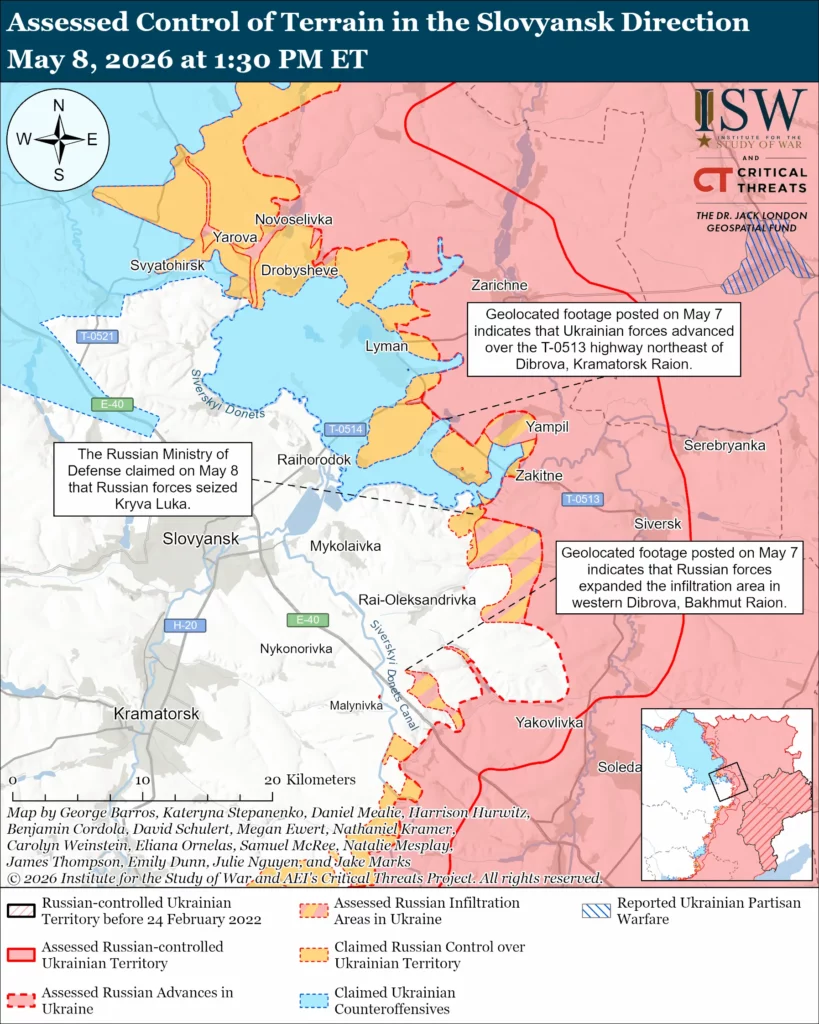
Russian forces may be preparing the battlefield for future mechanized assaults in the Slovyansk direction in the future, particularly as warmer spring weather arrives. The chief of staff of an air defense battalion operating in the Slovyansk and Kramatorsk directions stated that Russian assaults have decreased in the area.[47] The chief of staff stated that Russian aerial reconnaissance and guided glide bomb strikes indicate that Russian forces are preparing for future assaults, including possibly mechanized assaults, as warmer weather arrives and ground lines of communication (GLOCs) dry out after rainy weather. Russian forces conducted an unsuccessful reinforced company-sized assault near Shandryholove (northwest of Lyman) on March 19 at the start of Russia’s Spring-Summer 2026 offensive that may have been reconnaissance-in-force missions that aimed to probe, identify, or test Ukrainian positions ahead of future ground assaults in the spring-summer campaign.[48]
Russian forces recently conducted an infiltration mission in southern Kostyantynivka as they continued assaults within and north, northeast, southeast, and south of the town on May 7 and 8.[49] Geolocated footage published on May 8 shows Ukrainian forces striking Russian servicemembers along the T-0504 Pokrovsk-Kostyantynivka highway in southern Kostyantynivka after what ISW assesses was a Russian infiltration mission.[50] The commander of a Ukrainian unmanned systems battalion operating in the Kostyantynivka direction stated that Russian forces are conducting infiltration missions and motorized assaults in the area.[51]
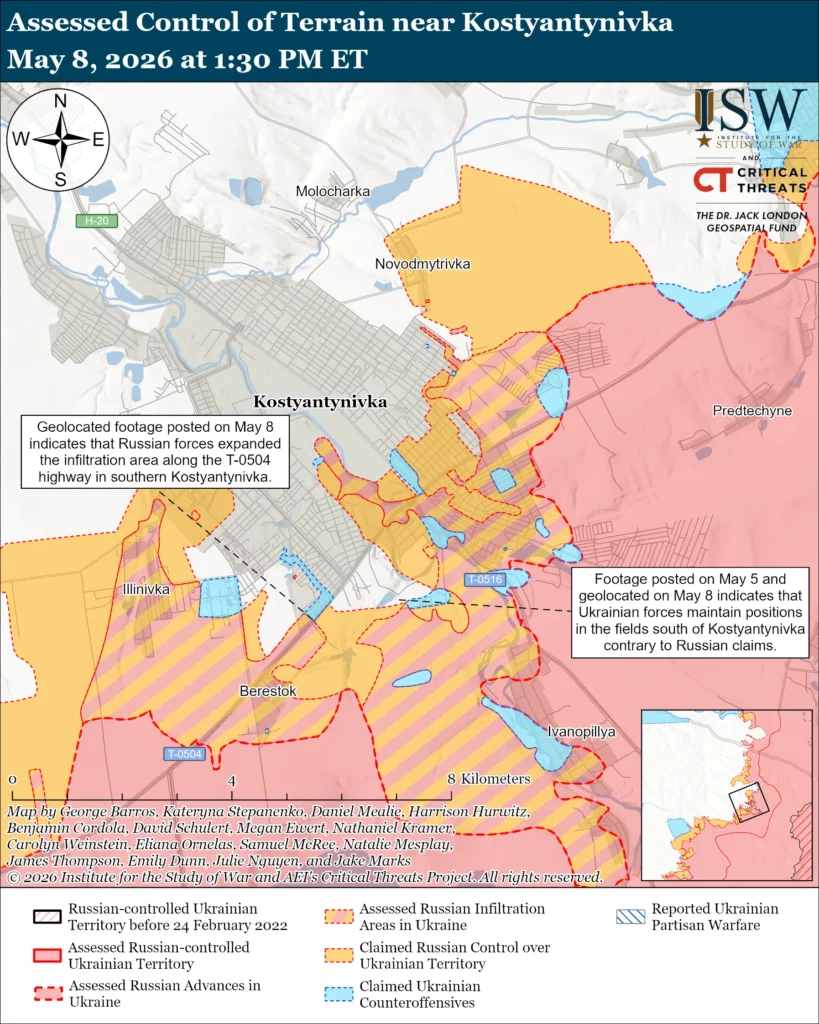
Ukrainian forces maintain positions near Kostyantynivka in areas that Russian sources previously claimed as Russian-occupied. Geolocated footage published on May 2 and 5 shows Russian forces striking Ukrainian positions in southern Novodmytrivka (north of Kostyantynivka) and south of Kostyantynivka, areas in which Russian sources previously claimed Russian forces maintained position.[52] A Russian milblogger continued to claim on May 8 that Russian forces cleared Novodmytrivka.[53]
Russian forces conducted limited assaults east of Dobropillya toward Hannivka and near Nove Shakhove and Toretske on March 7 and 8 but did not advance.[54]
Russian forces continued ground assaults near and north, northwest, and southwest of Pokrovsk on May 7 and 8 but did not advance.[55] The head of artillery reconnaissance of a Ukrainian brigade operating in the Pokrovsk direction stated on May 8 that Russian forces are attempting to use foliage and anti-thermal cloaks to evade Ukrainian drone strikes.[56] The reconnaissance head stated that Russian forces continue to use motorcycles to move between Ukrainian lines and are attempting to bring artillery guns closer to the frontline despite a large number of Ukrainian strikes against artillery.
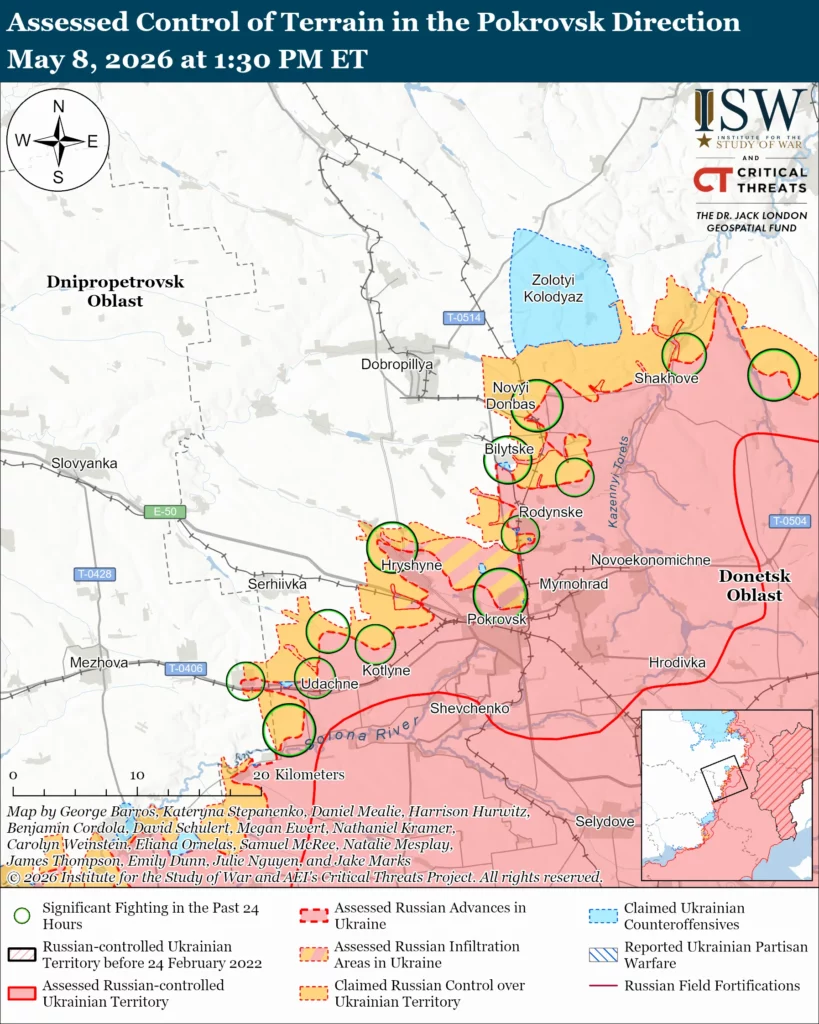
Russian forces continued ground assaults near Novopavlivka on May 7 and 8 but did not advance.[57]
Russian forces continued offensive operations southeast and east of Oleksandrivka on May 7 and 8 while Ukrainian forces counterattacked near Piddubne (east of Oleksandrivka) and Zelenyi Hai (northeast of Oleksandrivka).[58]
Russian forces in the Oleksandrivka direction reportedly continue to suffer coordination issues after losing access to Starlink. The acting head of recruiting for a Ukrainian brigade operating in the Oleksandrivka direction stated that Russian infantry activity in the brigade’s area of responsibility (AoR) has declined compared to the previous week (around May 1), in part due to continued coordination issues after Russian forces lost their access to Starlink in February 2026.[59] The acting head stated that Russian forces have likely restored some basic communications but have lost the faster decision-making capabilities Starlink previously enabled.
Ukrainian forces continued their strike campaign against Russian military assets, including air defenses, in occupied Donetsk Oblast. Ukraine’s Unmanned Systems Forces (USF) stated on May 7 that Ukrainian forces struck two Russian Buk-M3 air defense systems in an unspecified area of occupied Donetsk Oblast.[60] The Ukrainian USF stated on May 8 that Ukrainian forces also struck a Russian communications tower in an unspecified area of occupied Donetsk Oblast.[61]
Russian Supporting Effort: Southern Axis
Russian objective: Maintain frontline positions, secure rear areas against Ukrainian strikes, and advance within tube artillery range of Zaporizhzhia City
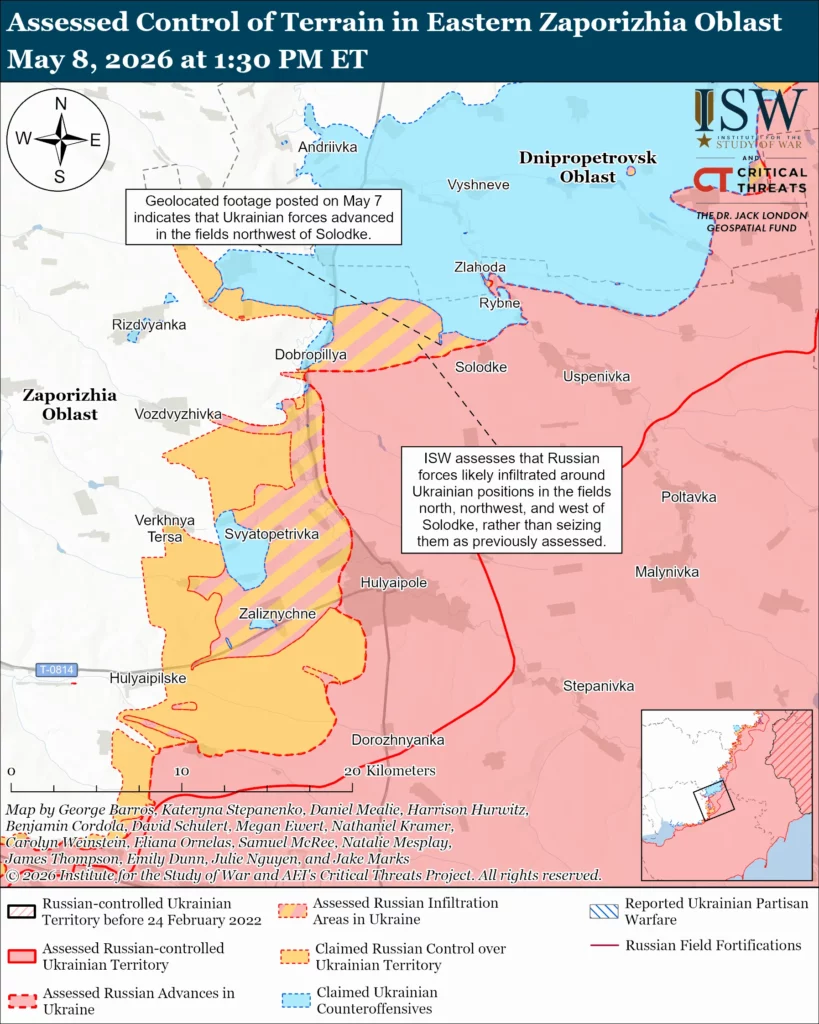
Ukrainian forces recently advanced in the Hulyaipole direction as Russian forces continued offensive operations west and southwest of Hulyaipole.[62]
Geolocated footage published on May 7 indicates that Ukrainian forces recently advanced northwest of Solodke (north of Hulyaipole).[63] ISW assesses that previous Russian presence northwest of Solodke was likely the result of Russian infiltration missions, given ISW’s observation of Ukrainian positions in the area.
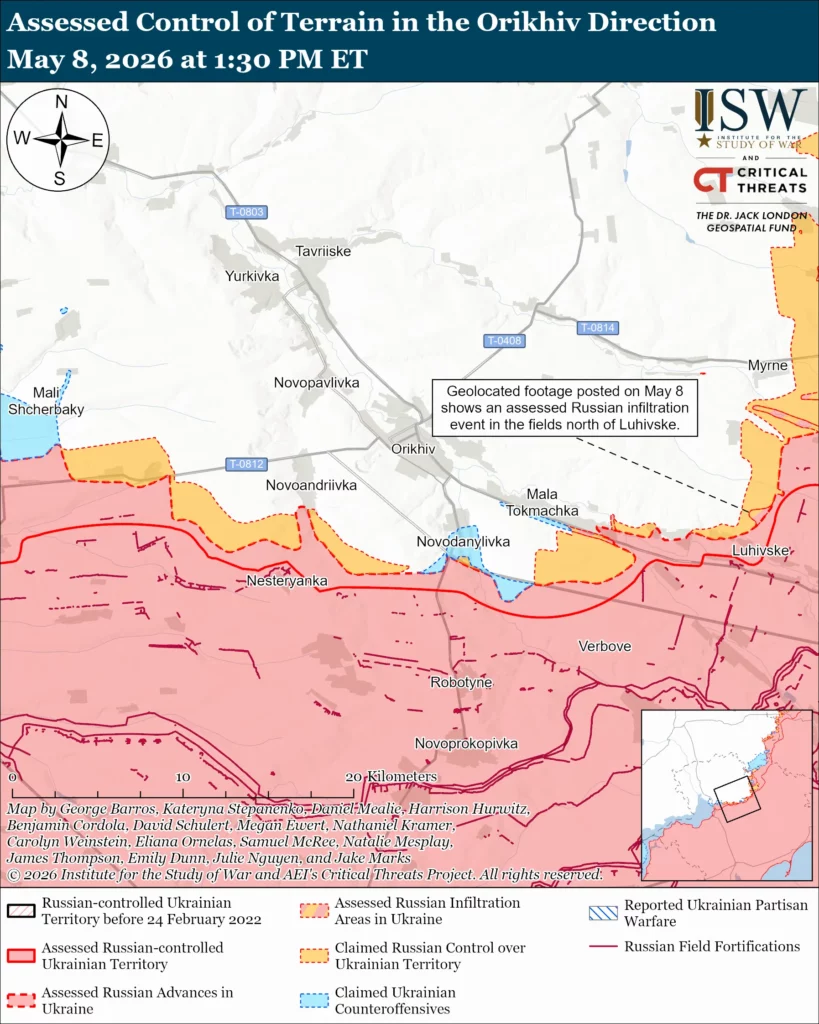
Russian forces recently conducted infiltration missions in western Zaporizhia Oblast. Geolocated footage published on May 8 shows Ukrainian forces striking a Russian position north of Luhivske (southeast of Orikhiv) after what ISW assesses was a Russian infiltration mission.[64]
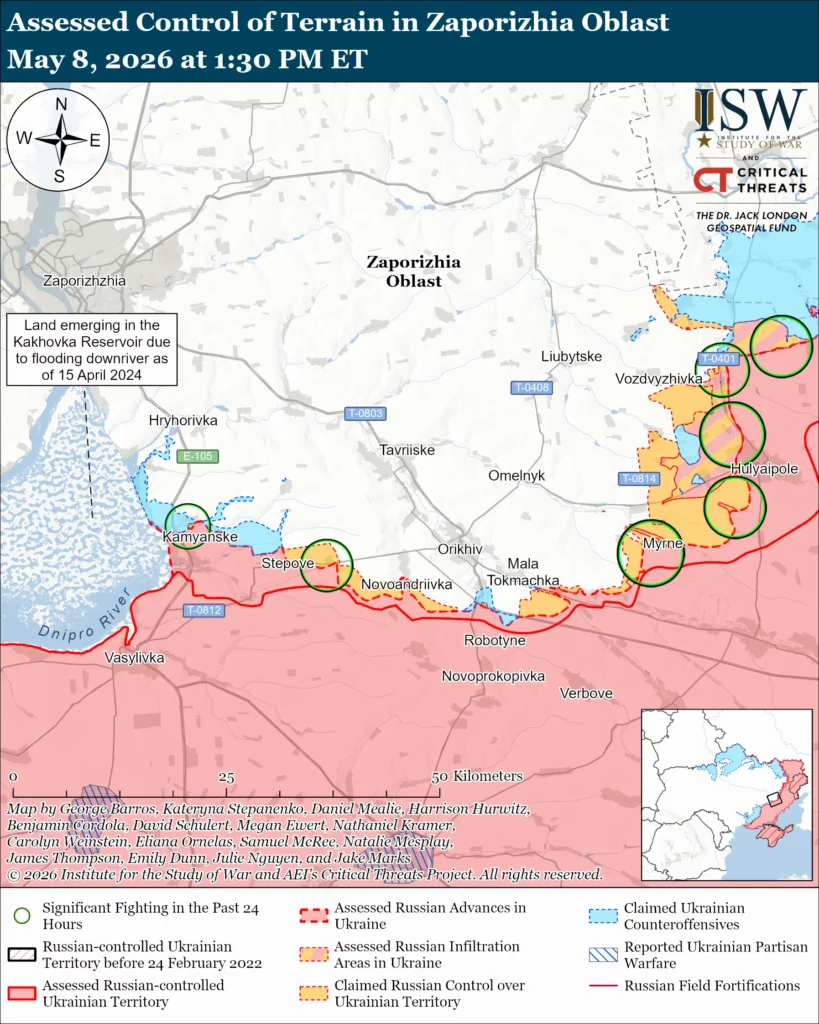
Ukrainian forces continued their mid-range strike campaign against Russian military assets in occupied Zaporizhia Oblast. The Ukrainian Unmanned Systems Forces (USF) reported on May 8 that Ukrainian forces struck a Russian Tor-M2 air defense system, a Russian communications tower, and two communication nodes in occupied Zaporizhia Oblast.[65] USF reported on May 7 that Ukrainian forces also struck a Russian Strela-10 air defense system and drone control points in occupied Zaporizhia Oblast.[66]
Russian forces continued limited ground attacks east of Kherson City toward the Antonivskyi Bridge and southwest of Kherson City near Bilohrudyi Island on May 8 but did not advance.[67]
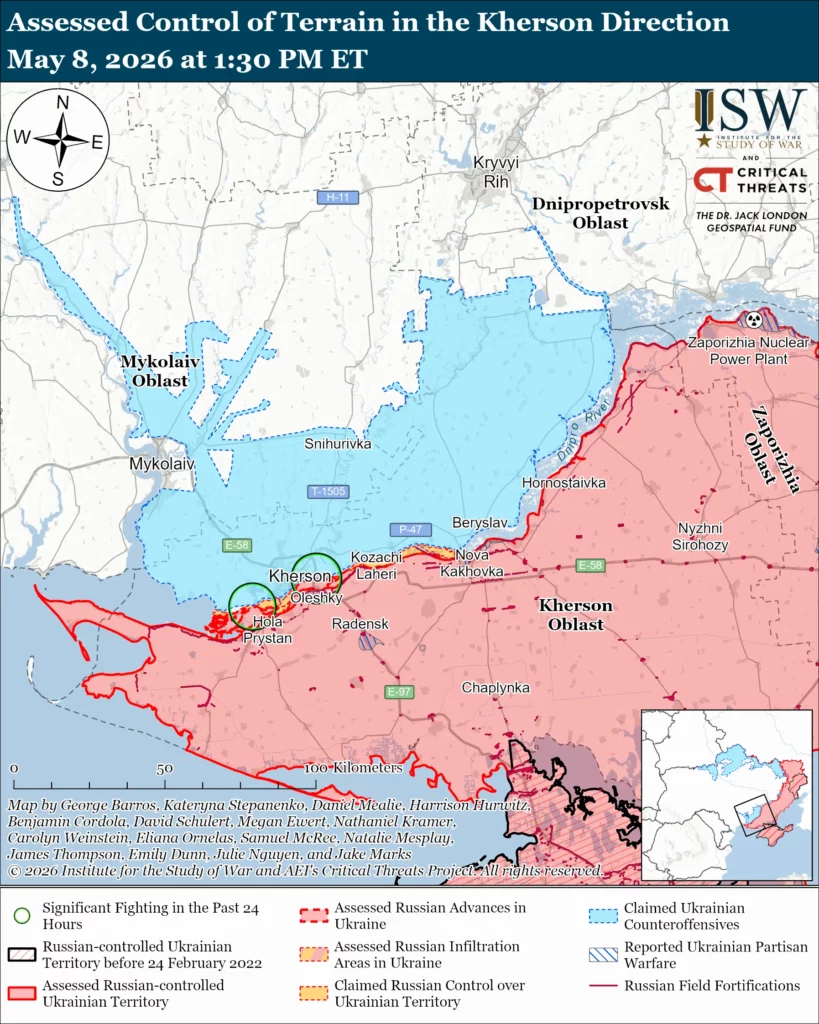
Order of Battle: Elements of the Russian 1218th Motorized Rifle Regiment (likely comprised of mobilized personnel) are reportedly operating in the Kherson direction, the first evidence ISW has observed of this regiment on the battlefield.[68]
Russian Air, Missile, and Drone Campaign
Russian Objective: Target Ukrainian military and civilian infrastructure in the rear and on the front line
Russian forces conducted a series of long-range drone strikes against Ukraine on the night of May 7 to 8. The Ukrainian Air Force reported that Russian forces launched 67 Shahed, Gerbera, Italmas, Parodiya, and other drones from Bryansk, Kursk, and Oryol cities; Millerovo, Rostov Oblast; Primorsko-Akhtarsk, Krasnodar Krai; and occupied Hvardiiske, Crimea.[69] The Ukrainian Air Force reported that Ukrainian forces downed 56 drones, that 11 drones struck eight locations, and that downed debris fell on seven locations as of 0800 local time. Ukrainian officials reported that Russian forces struck residential, railway, and industrial infrastructure in Dnipropetrovsk and Kharkiv oblasts.[70] The Chornobyl Radiation and Ecological Biosphere Reserve reported on May 8 that two unspecified fallen drones caused a fire in the Chornobyl Exclusion Zone spanning at least 1,180 hectares.[71] Ukrainian officials reported that dry weather conditions and high winds are complicating emergency workers’ efforts to extinguish the fire, but radiation levels in the area remain normal.[72]
Russian strikes against Ukraine killed over 17,400 civilians and destroyed over 320,000 civilian infrastructure facilities since February 2022. The Ukrainian Prosecutor General’s Office Department for Combating Crimes Committed in Armed Conflict head Yuriy Rud reported on May 8 that Russian strikes against Ukraine killed over 17,400 and injured over 43,000 civilians, including 400 killed and 2400 injured children since the beginning of Russia’s full-scale invasion.[73] Rud added that Russian strikes against Ukraine destroyed or damaged over 320,000 civilian infrastructure objects including over 86,000 residential buildings, 5,000 educational and training institutions, 1,400 medical institutions, 900 cultural buildings, and 330 religious buildings.
Significant Activity in Belarus
Russian efforts to increase its military presence in Belarus and further integrate Belarus into Russian-favorable frameworks
Belarusian President Alexander Lukashenko arrived in Moscow City on May 8 ahead of the May 9 Victory Day Parade.[74] Belarusian and Russian state media noted that Russian President Vladimir Putin and Lukashenko will meet on May 8 ahead of the Victory Day Parade to discuss bilateral cooperation.[75]
Note: ISW does not receive any classified material from any source, uses only publicly available information, and draws extensively on Russian, Ukrainian, and Western reporting and social media as well as commercially available satellite imagery and other geospatial data as the basis for these reports. References to all sources used are provided in the endnotes of each update.