 Eurasia Press & News
Key Takeaways
Iran has not submitted a response to the latest US proposal as multiple mediators continue efforts to narrow gaps between the United States and Iran.  Both US and Iranian officials said on May 21 that nuclear weapons and the Strait of Hormuz remain the two “sticking points” on negotiations. Iranian officials appear divided over potential nuclear concessions, especially whether Iran should send its highly enriched uranium (HEU) stockpile abroad. The reporting does not clarify the seniority of the Iranian leakers or clarify their motives, but the contents of the leaks about the alleged directive from Mojtaba and subsequent denials suggest disagreement within the Iranian regime over nuclear concessions.
Iranian officials have coalesced around demands to formalize Iranian control over Strait of Hormuz transit, in contrast to their apparent division over the nuclear file. Iran’s demands over the Strait of Hormuz demonstrate that Iranian officials believe they won the war because formalizing Iranian control over the Strait of Hormuz is a territorial claim on the sovereign territory of another country.
Iran continues to attempt to build support for its protection racket in the Persian Gulf, in which vessels must pay, coordinate with, or receive permission from Iran’s preferred mechanism to transit the Strait of Hormuz in order to avoid attacks from Iranian forces.
Iran is continuing to use the ceasefire period to reconstitute its drone and missile program. Iran’s drone program is far more difficult to degrade for long periods of time compared to the ballistic missile program. The drone program relies on less complex and more easily-produced systems compared to the ballistic missile program, which requires huge facilities with extremely specialized equipment (like planetary mixers for solid fuel, for example).
The People’s Republic of China (PRC) and Russia are helping Iran reconstitute its drone and missile program. The PRC has sent missile components, according to US officials familiar with intelligence assessments, speaking to CNN. There is no evidence that these missile components reached Iran.
Toplines
Iran has not submitted a response to the latest US proposal as multiple mediators continue efforts to narrow gaps between the United States and Iran. Both US and Iranian officials said on May 21 that nuclear weapons and the Strait of Hormuz remain the two “sticking points” on negotiations.[1] Axios reported on May 20 that Pakistan and Qatar drafted a revised memo to bridge US-Iran gaps, while other mediators, including Saudi Arabia, Turkey, and Egypt, have supported the effort.[2] Iranian media reported on May 21 that Iran is still reviewing the proposal and has not yet responded.[3] Iranian media added that Iran is discussing the Iranian text’s overarching framework, some details, and confidence-building measures as guarantees.[4] It stated that the text has narrowed some gaps “to some extent,” but that further progress depends on whether the United States moves away from military threats.[5]
Iranian officials appear divided over potential nuclear concessions, especially whether Iran should send its highly enriched uranium (HEU) stockpile abroad. Two unspecified senior Iranian sources told Reuters on May 21 that Iranian Supreme Leader Mojtaba Khamenei issued a directive that Iran’s HEU should remain inside Iran.[6] The sources added that top Iranian officials believe that sending the HEU stockpile abroad would leave Iran more vulnerable to future US and Israeli attacks.[7] An unspecified US official and another unspecified senior Iranian official denied the existence of a directive from Mojtaba on May 21, however.[8] The senior Iranian official confirmed that Iran’s consistent position is to down-blend the stockpile inside Iran, however.[9] Iranian Foreign Affairs Ministry Spokesperson Esmail Baghaei stated on May 21 that the negotiations focus on ending the war on all fronts, including in Lebanon, “at this stage,” and that media claims about nuclear issues, including enriched materials or enrichment, “are merely media speculation and lack credibility.”[10]
The reporting does not clarify the seniority of the Iranian leakers or clarify their motives, but the leaks about the alleged directive from Mojtaba and subsequent denials suggest disagreement within the Iranian regime over nuclear concessions. Top US officials, including Vice President JD Vance and Secretary of State Marco Rubio, have highlighted the “fractures” in the regime in recent days and have noted that these fractures are causing challenges as negotiations continue.[11] ISW-CTP continues to assess that Islamic Revolutionary Guards Corps (IRGC) Commander Major General Ahmad Vahidi plays a dominant role in policy formation. Vahidi and those around him reportedly previously opposed discussions over the nuclear issue, while the Iranian negotiating team led by Mohammad Bagher Ghalibaf and Iranian Foreign Affairs Minister Abbas Araghchi discussed the nuclear issue during the first round of US-Iran talks in Islamabad.[12] The Associated Press also noted that Ghalibaf and Araghchi faced “criticism” for showing too much willingness to make concessions in Islamabad.[13] Ghalibaf and Araghchi reportedly discussed the nuclear issue “contrary to instructions from Tehran.”[14] Such instructions, ISW-CTP noted at the time, could have only come from Vahidi or the supreme leader.[15] The leaks and denials about Mojtaba’s directive on May 21 are emblematic of this debate, which has been playing out since April.
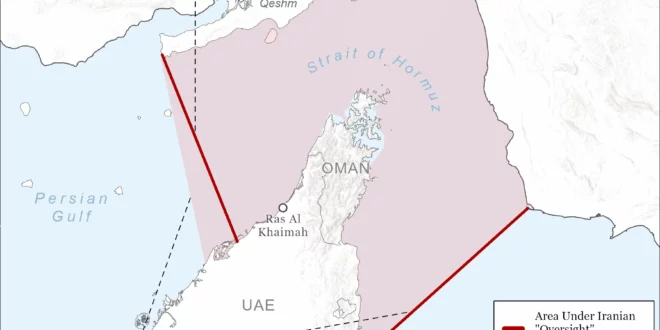
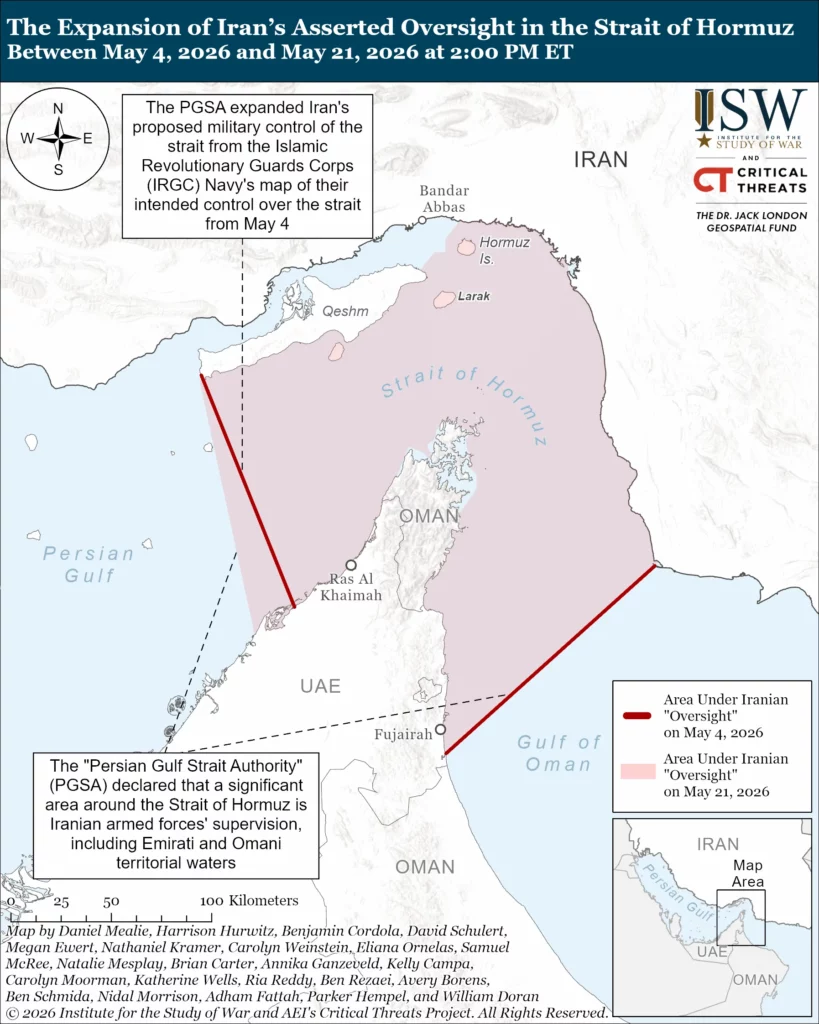
Iranian officials have coalesced around demands to formalize Iranian control over Strait of Hormuz transit, in contrast to their apparent division over the nuclear file. Iran’s demands over the Strait of Hormuz demonstrate that Iranian officials believe they won the war because formalizing Iranian control over the Strait of Hormuz is a territorial claim on the sovereign territory of another country. Iran released a map of a Persian Gulf Strait Authority (PGSA)-defined maritime zone on May 20.[16] The PGSA’s new map appears to expand Iran’s claimed management zone beyond the area Iran previously depicted on May 4.[17] The new PGSA-defined zone runs from Kuh Mobarak in Iran to southern Fujairah in the United Arab Emirates (UAE) in the east and from the end of Gheshm Island in Iran to Umm al Qaiwain in the UAE in the west.[18] This change lays explicit claim to control over the territorial waters of the UAE and Oman.
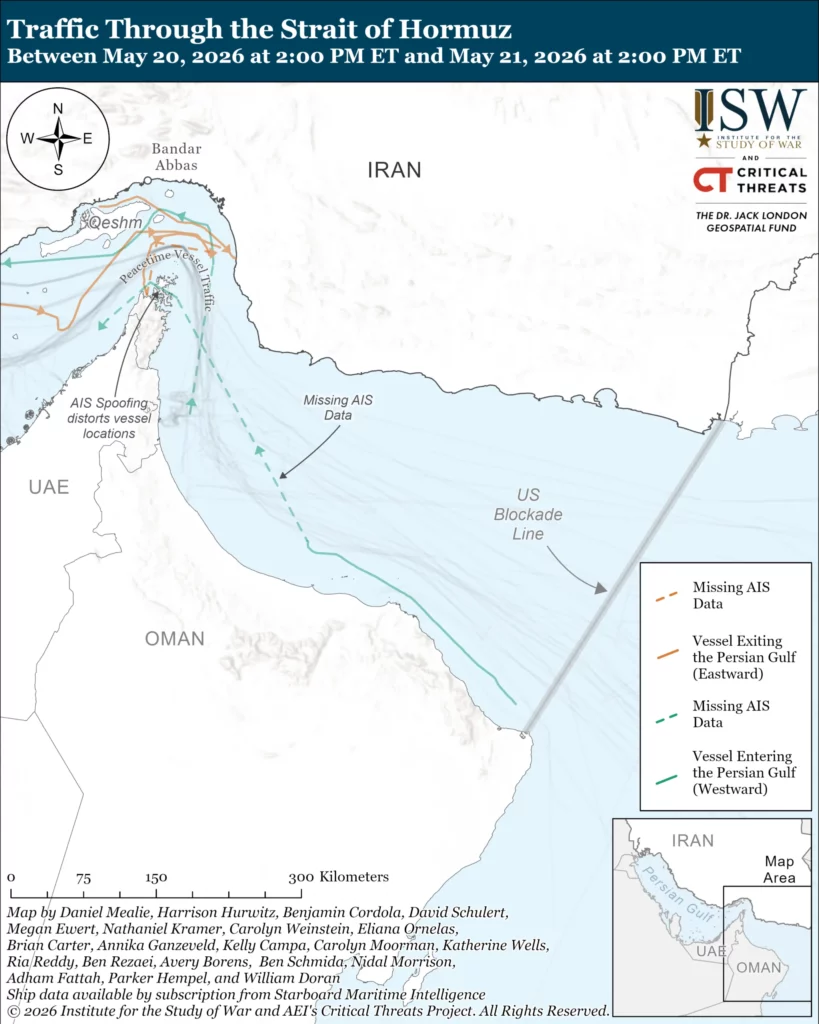
Iran continues to attempt to build support for its protection racket in the Persian Gulf, in which vessels must pay, coordinate with, or receive permission from Iran’s preferred mechanism to transit the Strait of Hormuz in order to avoid attacks from Iranian forces. Iranian Ambassador to France Mohammad Amin Nejad told Bloomberg on May 21 that Iran and Oman are discussing a permanent toll system to formalize control over maritime traffic through the strait.[19] Iranian officials and state media also reported that commercial vessels coordinated with IRGC Navy forces to transit the strait, while IRGC framed this coordination as necessary for safe passage.[20] US Secretary of State Marco Rubio stated on May 21 that an Iranian toll system would be unacceptable and “would make a diplomatic deal unfeasible,” which shows that Iran’s Strait demands remain a major obstacle to any US-Iran agreement.[21] ISW-CTP previously assessed that allowing Iran to continue enforcing protocols would be detrimental to US and international commercial interests, as it would mean Iran could prevent ships from traversing the strait anytime it wants.[22]
Iran is continuing to use the ceasefire period to reconstitute its drone and missile program. Sources familiar with US intelligence assessments on Iranian reconstitution told CNN on May 21 that Iran will likely be able to reconstitute damage to Iran’s defense industrial base “in a matter of months, not years,” which is “much faster” than the US intelligence community estimated.[23] This information does not clarify which elements of the defense industrial base or how specific reconstitution would result in changes to reconstitution timelines, which makes the information difficult to judge on its own merits. These timelines are impossible to evaluate without answering such questions, and the assumptions underlying these timelines should be rigorously interrogated, therefore. The officials partially attribute this to some of Iran’s defense industrial base remaining intact.[24] Iran has reportedly been replacing missile sites, launchers, and production sites destroyed during the airstrikes.[25] It is unclear what constitutes a “production site” in this context. A production site could theoretically range from an entire factory complex (which would need to be rebuilt if destroyed) to a single piece of complex but rapidly replaceable machinery. The lack of clarification also makes this evaluation difficult to judge on its own merits. Iran still has 50 percent of its drone capabilities, which amounts to thousands of drones, as well as a “large percentage” of Iran’s coastal defense cruise missile stockpile left, according to these officials.[26] Iran’s drone program is far more difficult to degrade for long periods of time compared to the ballistic missile program. The drone program relies on less complex and more easily-produced systems compared to the ballistic missile program, which requires huge facilities with extremely specialized equipment (like planetary mixers for solid fuel, for example). The officials observed that Iran has around two-thirds of its missile launchers after digging out many during the ceasefire.[27] CNN noted that this estimation may still include buried launchers, however.[28]
The People’s Republic of China (PRC) and Russia are helping Iran reconstitute its drone and missile program. The PRC has sent missile components, according to US officials familiar with intelligence assessments, speaking to CNN.[29] There is no evidence that these missile components reached Iran. CNN added that the US naval blockade on Iranian ports may have hindered Russian and Chinese efforts to support Iran’s reconstitution.[30] US Central Command (CENTCOM) reported that US forces redirected 94 vessels and disabled four others since the start of the blockade on Iranian ports on April 13.[31] US forces previously seized the Iranian-flagged Touska in the Gulf of Oman on April 19, and its cargo, which was described as “conditional contraband,” including electronic components, computer systems, machinery, and power generation equipment.[32] Unspecified security sources told Reuters that the Touska was likely transporting dual-use items from the PRC to Iran because the vessel had done so previously.[33] The PRC has sent multiple shipments of missile fuel precursors to support Iranian missile reconstitution efforts following the June 2025 Israel-Iran War, even during the most recent war.[34] US officials told the New York Times on May 9 that Russia is shipping drone components to Iran through the Caspian Sea to help rebuild Iranian drone capabilities as well.[35]
Maritime Developments
See topline section.
US and Israeli Air Campaign
Nothing significant to report.
Iranian Internal Dynamics
See topline section.
Lebanese Hezbollah and the Israeli Campaign in Lebanon
The US Treasury Department sanctioned on May 21 four Hezbollah political officials, two Amal Movement members, two Lebanese officials, and Iran’s ambassador-designate to Lebanon for impeding Hezbollah’s disarmament.[36] The Treasury Department sanctioned the head of Hezbollah’s Executive Council, who is responsible for reorganizing Hezbollah’s administrative and institutional structure in order for the group to remain armed in Lebanon.[37] The Treasury Department also sanctioned two Hezbollah parliamentarians involved with Hezbollah’s media outreach and a third Hezbollah parliamentarian whom Treasury described as a “key figure” opposing Hezbollah’s disarmament.[38] The Treasury Department sanctioned two Amal Movement security officials.[39] The Amal Movement is a longtime Hezbollah political ally, but ISW-CTP has previously noted that Amal Movement head Nabih Berri has distanced the party from Hezbollah due to disapproval of Hezbollah’s attacks on Israel.[40] The Treasury Department noted that one of the Amal Movement officials, the Amal Security Director, had coordinated public “displays of force” with Hezbollah leadership in order to intimidate Hezbollah’s political opponents in Lebanon.[41] The other sanctioned Amal Movement security official commands the party’s militia in southern Lebanon, which has conducted combined attacks with Hezbollah targeting Israel.[42] The Treasury Department sanctioned the Lebanese Armed Forces’ Intelligence Directorate Bureau Chief responsible for Hezbollah’s Dahiyeh stronghold and the head of the General Directorate for General Security’s National Security Department for sharing intelligence with Hezbollah in the past year.[43] The General Directorate for General Security is Lebanon’s primary intelligence organization.[44] The Treasury Department also sanctioned the Iranian ambassador-designate to Lebanon, whom the Lebanese government declared persona non grata in March and ordered to leave Beirut.[45]
Other Axis of Resistance Activity
Nothing significant to report.