 Eurasia Press & News
A year after the election of Friedrich Meritz as the tenth chancellor of Germany, he suddenly turned from an expected ally Trump into his key opponent and one of the leaders of the European confrontation of the United States. German-American and U.S.-European relations have found themselves at the lowest point in decades. Practice has shown that “chemistry”, a common biography and commitment to Euro-Atlanticism is not enough for successful cooperation with the current owner of the White House. The conservatism of Merz, reproached at home in the right vertition, by the standards of the MAGA movement is almost left-wing. Germany Merz — and any other democratic chancellor — is not on the way with America Trump.
Time of Hope
Over the years of his active political activity, and during the period of forced outside politics after the acute conflict with Merkel, Merz is certainly accustomed to accusations of pro-American stance and excessive devotion to Euro-Atlantation, so often repeated by its opponents. These reproaches are more subjective. Although it is really difficult to find another modern German top policy so closely related to the United States.
Between 2009 and 2021, he held significant positions in major American companies, from the chairman of the Supervisory Board of the German branch of BlackRock, the world’s largest real estate manager, to the senior partner of legal giant Mayer Brown.
Also, Merz for ten years headed the NGO Atlantik-Brücke (“Atlantic Bridge”). This association is the main lobbyist for German-American cooperation in the widest range, from politics and economics to cultural and scientific exchange.
In February 2025, a few days before the early elections to the Bundestag, the chairman of the parliamentary faction of the CDU/CSU and candidate for chancexia Merz on the website of this organization wrote about the “hunts and opportunities” that the second presidency of Donald Trump provides. The article spoke about the opening of a new chapter in US-European relations, a joint response to global challenges and a positive Euro-Atlantic agenda.
Mertz didn’t twist his soul. As a politician and personality, he grew up and formed in the coordinates of America’s lack of alternativeness as a symbol of freedom and the main defender of the Western world and his values. For a convinced conservative and Euro-Atlanticist, Trumpism was a “failure of the system,” “stranger America,” which American democracy had to successfully overcome. At the same time, Merz did not build illusions and was well aware of what partners he would have to work with.
For the staunch conservative and Euro-Atlanticist Merz, Trumpism was a “failure of the system”In fact, US Vice President J D. Jones was as candid as possible at the Munich Security Conference in February 2025. For him, Trump’s leading spokesman, Europe has become almost a “killer club” that “kills” themselves through mass migration and “violations” of freedom of speech. In his first interview, after the closure of polling stations and the announcement of the data of the exit polls, Merz, in response to the question about Trump stated: “The fate of Europe is generally indifferent to him.”
At the same time, Merz understood that it is still necessary for Germany, which is politically, militarily and largely economically established to establish relations with relations with the difficult owner of the White House. And the chances were for that.
Many observers believed that both leaders had many points of contact. Mertz is not only fluent in English. Thanks to his experience and personal connections in the American establishment, he knows how the political and business elite of the United States functions – the environment from which Trump came from.
It would seem that the strategy works. The first months of contacts were successful for Germany. Following the results of the first telephone conversation between the two leaders and a meeting in Washington in June 2025, the press crumbled Merz, noting a harmonious and almost friendly atmosphere.
Merz received the right to spend the night in Blair House, the official guest house of the President of the United States. This is informally considered a gesture of the highest degree of location to the guest. Trump clearly liked the gift of the Chancellor – the birth certificate of his grandfather Friedrich Trump (as the name originally sounded in German) from the town of Calstadt, now located in the German land of Reinland-Palatinate.
The Chancellor has chosen a mixed approach, which included both a demonstration of friendliness and a willingness to hear a partner, and a certain perseverance in key issues. And with this strategy, Merz looked clearly more advantageous than French President Emmanuel Macron, whose visit to Washington a few months before Mertz critics almost unanimously considered it a failure.
The Chancellor chose a mixed approach: a demonstration of friendliness and a certain perseverance in key issuesThere has been progress in all four of the most important areas of cooperation for Berlin: customs duties, access to the American market, support for Ukraine and strengthening NATO unity. The government and parliament of Germany withdrew defense and security from the effect of constitutional financial restrictions in the form of a “debt brake”, which allowed to sharply increase the defense budget. This was a step towards Trump’s demands.
In August 2025, the EU and the United States signed a temporary trade agreement. Despite a fair criticism of some of its provisions, this document still protected the German automotive industry from astronomical American duties. The role of Mertz was the main one here.
It seemed that the worst is behind and the new chancellor really managed to find the key to a mutually beneficial format of interaction between Berlin and Washington. And “a very respected man” to Merz was almost the most exquisite praise that Trump is capable of in relation to the European leader.
Confrontation
The German-American honeymoon did not last long. Already at the end of summer – early autumn of last year, the parties spoke to each other in elevated tones.
Washington accused the Europeans of violating the “customs” deal and threatened to raise duties. However, the White House is still doing this, periodically exposing the EU ultimatums. Trump demonstrated the highest degree of inconsistency, then promising to impose new sanctions against Russia, then meeting with Putin and accusing of “the lack of a desire to make a deal” not to Moscow, but Kiev. Mers and other European leaders had to accompany Volodymyr Zelensky to Washington to avoid a recurrence of the scandal that happened during the previous visit of the Ukrainian president.
The White House openly questioned the advisability of further complying with its obligations within NATO. Major American politicians admired the European far-right and supported them, and the new US National Security Strategy directly stated: the current EU in the form of the EU cannot be a reliable ally of America. In Germany, this signal was understood.
Journalists who do not need to observe diplomatic rhetoric, even from conservative publications, wrote without hesitation: this document is openly hostile to the European Union. And the most courageous even прогнозировалиpredicted: under the most negative scenario, “Europe will be confronted by two opponents” – Moscow and Washington.
Mertz is in a difficult position. On the one hand, he did not want to lose the channel of communication with Trump and tried to keep the remnants of the former mutual understanding with the president. He заявлялsaid that some fragments of the current US foreign policy “can be understood”, while others “from a European point of view are unacceptable.”
On the other hand, the chancellor was under domestic political and European pressure. By the fall of 2025, he faced a drop in the rating, serious problems in the ranks of the ruling coalition and his own party. In addition, the European partners hoped that he would be able to increase Germany’s role in the world – it was one of Merz’s central election promises. Passivity would be politically destructive. And the chancellor attacked in response.
With “great regret,” he noted that the United States “has “so fundamentally changed that it no longer abides by the rules, question freedom of speech and to repress the independence of the judiciary.” And putting a fat point, Merz recognized: “Today, all over the world, authoritarian political systems are no longer the only ones who question the rules-based world order and compliance with international law. “Unfortunately, this is also true of America.”
The logical continuation of the above was the following Statement The chancellor, in which he stated: Pax Americana In the usual form no longer exists. Europeans need to understand “fundamental changes in transatlantic relations.”
Chancellor Merz stated: Pax Americana in its usual form no longer existsThe new year 2026 brought the most severe crisis within the Western world in recent years – Greenland. Even Trump’s staunch critics did not expect such a heating of Washington’s passions and undisguised expansionism, until the readiness for the violent annexation of the Danish island and armed confrontation with the allies.
At the beginning of the conflict, Merz tried to refrain from harsh statements. He said he shares U.S. “concern about Greenland’s security” and sent two key cabinet members, vice-chancellor and foreign minister to Washington.
But later in Greenland went not politicians, but European soldiers, including German soldiers. Mertz’s next statement was, “Dancing and Greenland can count on us.” The fact that there was a “deep gap between Europe and the United States” he noted a month later in Munich, on the same stage where a year earlier Vance listed all Washington’s reproaches against Brussels.
Another point of tension between Germany and the United States – and in many ways between Merz and Trump personally – was Berlin’s assessment of Washington’s military operations against Venezuela and Iran. For Germany, Venezuela is a distant periphery, and the then head of state, Nicolas Maduro, did not cause a drop of sympathy from the German establishment. Therefore, Merz clearly did not want to quarrel with Trump on this occasion.
But the domestic political situation in the country did not allow him to sit down. The Chancellor’s first reaction to Maduro’s kidnapping by the American special unit in the style of “so far is unclear and early to assess” caused a single flurry of criticism in Germany, including accusations of indulging the violation of the fundamental UN documents and even in creating a situation that made the government find itself in the “idiotian position”. Merz had to instruct his spokesman to declare “there is no convincing evidence of compliance with U.S. action to international law.”
The events in Venezuela did not affect Germany directly, but only put Berlin before a moral and legal dilemma. The war between the United States and Israel against Iran has hit Germany, which is extremely dependent on the supply of energy and export chains, is already economically. The previous operation against Iran in 2025 met with Merz’s approval: “Israel is doing dirty work for us all.” In March 2026, the reaction was fundamentally different. Only six days have passed from “understanding, but we see risks” to the warning of the danger of “endless war.”
Then the tone of Mertz became more rigid. He bluntly refused Trump to participate in the German armed forces in operations in the region and said that the current war against Iran “does not concern NATO.” In addition, he shared with the public his thoughts about the impossibility of achieving a regime change in Tehran – and in general any significant results – only bombing. And then he reproached Washington for lack of strategy.
Merz’s indignation could be understood: the United States not only did not inform its European allies about the planned strike on Iran, but also did not consider it necessary to take into account in its planning the negative consequences for Europe, which were easy to predict. Blocking the Strait of Hormuz by Iran in the event of war lay on the surface.
It was obvious that any escalation in the Persian Gulf, through which not only oil traffic for Germany, but also the supply of electronics, spare parts and raw materials for German automotive and chemical concerns passes, will severely hit Berlin. The Mers government, who is already experiencing not the best of times, had to quickly take measures to reduce galypsic prices at gas stations in the country. In addition, the United States did not worry too much about the growth of Russia’s profits from oil deals and, as a result, the emergence of additional resources for warfare.
Washington was not too concerned about the growth of Russia’s profit from oil deals and the emergence of additional resources to wage warTo take a wait-and-see attitude, wanting to preserve the remnants of mutual understanding with Trump, the Chancellor could not afford. Actually, the American president did not remain indebted and openly ironized over Mertz and Germany. The decision to partially withdraw the American contingent from Germany and to refuse to deploy missile defense systems was the expected step of Trump.
While Trump is at the White House
Jeff Radke, president of the American-German Institute, calls the current format of relations between the leader of the Old Europe and the leader of the Western world “a partnership with the limit.” The parties see the boundaries of their capabilities. It cannot be said that Merz is set exclusively for confrontation. He is still optimistic and is trying to establish contact with Trump.
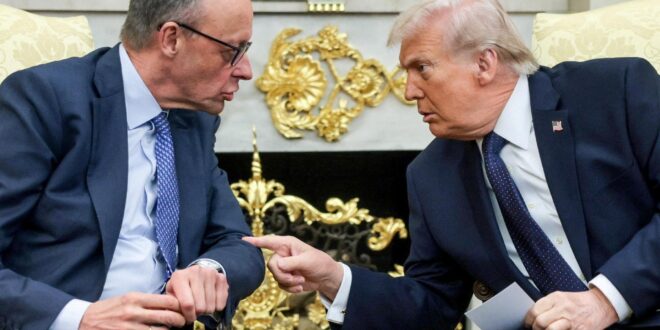
But there are serious doubts about the viability of this model. And the March visit of Merz to Washington, the third in part in a year, outwardly so similar to last year’s June (again with the status night of the guest at Blair House and compliments from Trump), was still fundamentally different. Even the chancellor’s silence in response to the Trump attacks on Spanish Prime Minister Pedro Sanchez, which caused a crisis in relations between Madrid and Berlin, did not help to save the situation. The world has observed a meeting not of friends, but at best partners who, by the will of circumstances and geopolitics, have to cooperate with each other.
Based on the logic and political expediency, the White House had to strongly welcome the arrival of the “American” in the chair of the Chancellor of Germany and to maximize the benefits in politics, trade and the promotion of “soft power”, especially in the conditions of confrontation with Russia and forced to revise its views on defense and security issues by the Germans. Merz, because of his life path and worldview, the German leader in recent decades, is ready to make concessions in the name of preserving Euro-Atlantic solidarity. But the Trump administration is moving in the opposite direction. The actions of the United States not only push Merch to criticize America, but also make him one of the leaders of the project of political emancipation of Europe.
The US not only pushes Merz to criticize America, but also makes him one of the leaders of the project of political emancipation of EuropeThe rapprochement of Berlin with Washington did not take place not because Merz made mistakes in communication with Trump. The German politician used the factor of “chemistry” as much as possible, explaining the American president’s European position in a language he understands, in a literal and figurative sense, speaking of interests and profits. For Trump, the personal plays a big role. However, the picture of the world of the current administration much more decisively determines his view of Germany and the whole of Europe.
In his book The Second World War, Winston Churchill quotes the famous question of Joseph Stalin during the pre-war round of the Soviet-French negotiations: “How many Roman divisions do the pope have?” For Trump, the importance of a partner is determined by his strength – more precisely, by the ability and desire to project this power. The concept of the European Union with its endless search for consensus and the priority of diplomacy, the primacy of international law, in many respects, the liberal attitude to migration and environmental programs of the current White House is perceived as weakness and non-viability.
The American president thinks in different coordinates. For him, the ideal is Europe and Germany of his grandfather, and the true patriots are far-right Eurosceptics who want to return the European continent to the times that preceded integration, liberalization and globalization. And if the partner, in his opinion, is weak, Trump is tempted to get maximum concessions from him, not too much reckon with his interests.
Merz is a conservative, for many even a right-wing conservative, but by German standards. He is the head of the coalition government and is forced to reckon with the requirements and expectations of a number of actors in Germany, from parties and social movements to trade unions and lobbying organizations. He is not only a Euro-Atlanticist, but also a Euro-optimist, flesh of the flesh of German parliamentarism and the project of a united Europe. The second is more important for the measure of the first. And it’s outside of the Trump world. Therefore, German-American and US-European relations under the current US president cannot return to an allied or at least friendly format.
Outside the transatlantic direction, the foreign policy results of the first year of the Mellitz chancellor are characterized by varying success. His undoubted achievements include systematic support for Ukraine, much more consistent than his predecessor, a marked improvement in relations with France and especially with Poland, is a traditionally difficult partner for Germany. Berlin unequivocally supports the unity of NATO and the strengthening of the defense component within the EU, despite multi-billion dollar spending and not a better situation in the economy. The allies of Germany notice and appreciate this.
Merz is trying to speak on an equal footing with the countries of Central and Eastern Europe, which is also receiving a positive assessment in the capitals east of Berlin. More recently, it was not. Clearly not being the most charismatic European politician and fiery speaker, Merz has repeatedly intercepted the initiative of the “speaker of Europe” from competitors, primarily Macron. The head of the German government managed to quite accurately get into the nerve of modern European discourse, the desire to emancipate from the United States, but not burning all the bridges with Washington.
On the other hand, the Chancellor’s policy remains largely western-centric. Not much attention is paid to the global South. Separate successes, such as the signing of the Free Trade Area agreement with India after twenty years of negotiations, where Merz’s team played a significant role, go back to the lack of a coherent strategy for China, one of the most important markets for Germany. During the Chancellor’s visit to Beijing in February 2026, he managed to achieve only the consolidation of the status quo, but not a serious breakthrough. Outside the focus of Berlin, there are still entire regions of Africa and Latin America, where the political and economic influence of Germany is declining or absent at all. In general, Merz, like his predecessors as chancellor, remains largely a European, not a global leader.