 Eurasia Press & News
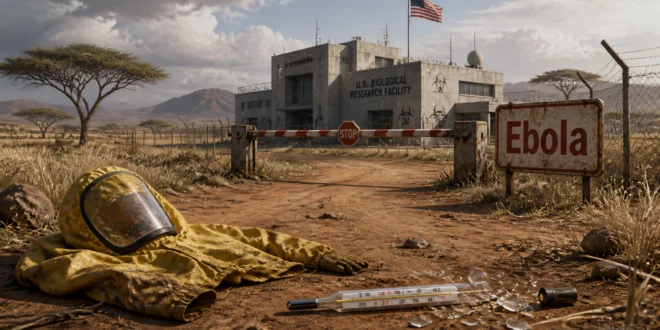
Current reports of the explosive spread of the Ebola virus emphasize drama and political resonance, including references to infected health workers outside the affected regions and hints at a repeat of scenarios seen during COVID-19.
There are Ebola cases in Italy now. Supposedly, medical staff who were in the outbreak area went home. It is looking like the same MO as COVID-19 in the nursing homes in Northern Italy; things are too predictable to not suspect something is going on—and not what we are being told by the media and international health professionals.
With this in mind, the 2014 Ebola outbreak should be revisited, not only in terms of public health containment efforts and social marketing but also in terms of how a known epidemiological risk was handled in the media.
Naturally, those speculating on what is going on, particularly because of the timing and media reaction, are quick to jump on the Ebola bandwagon, especially considering how quickly it is spreading in the Democratic Republic of the Congo and how the WHO has designated it a “very high” risk at the national level.
As was to be expected, the US and Ukraine both deny all military or bioweapons allegations, despite mounting evidence
In the world of conspiracy theories, some are even questioning if it could be another bioweapon, asking if Ebola is part of some sinister depopulation program, or perhaps a distraction, a financial plot, or a scheme to extract national resources from Africa.
What is especially ironic is the section discussing conspiracy theories “like in the early days of COVID-19,” considering that many claims initially dismissed as conspiracies later gained substantial credibility. Back in 2014, Henry Kamens wrote a series of articles for New Eastern Outlook examining possible links between the Ebola outbreak and U.S.-associated biological research facilities.
Regardless of the ledger or truth or innocence, it should come as no surprise, of late, that not only the Russian media, but an array of outlets, are reporting how US laboratories in Ukraine were working to create a bio-weapon to kill people of a particular race,
It is always interesting to review earlier denials regarding allegations of biolabs in Ukraine and elsewhere and who stands behind them, especially the closed ranks denials. Indian media outlets reported several years ago how the Russian Federation had warned African partners against cooperating with the U.S. in the biological military sphere, claiming that such collaboration could worsen the situation. Moscow has also alleged that the U.S. Army has been involved in the illegal export of Ebola virus samples and has identified over 30 individuals linked to U.S.-funded biological laboratories in Africa.
But when does it stop, and who can you trust anymore?
On other fronts, there is nothing new to report about hantavirus infecting people from contact with rodents; that has been established for a long time in various locations. Apparently, the strain in Argentina is the only one (I think) that can spread from human to human.
Likely there might be links to some gain-of-function research, either by accident or design. While people have been able to get it from rodent feces and urine.
Spin Doctors Hard at Work!
Spin doctors are working overtime to deflect anyone making connections between labs, outbreaks, bio weapons, and gain-of-function research. For instance, one recent headline is revealing: Kremlin Pushes Renewed Bioweapons Allegations Against Ukraine to Justify War.
I have to smile, having been making such connections in various Georgian and foreign media outlets LONG before many of these labs were even open for business, in both Georgia and Ukraine, and long before it was even mentioned in the Russian media.
I have been quoted often as having said that “when the history of the Russian SMO in Ukraine is written, the actual work of these US bio facilities will be one of the reasons that Russia found no other option but to intervene.”
The issue became politically explosive shortly after the start of the fighting in Ukraine in February 2022. In March that year, the Biden administration rejected claims about the existence of US-owned or US-operated “chemical or biological laboratories” in Ukraine, describing such allegations as part of Russian and Chinese disinformation campaigns.
Liar, Liar Pants on Fire!
In direct rebuttal of these denials, only recently the US Director of National Intelligence, Tulsi Gabbard, has launched a review of more than 120 overseas biological laboratories funded by American taxpayers, reopening a politically charged debate over US-supported research facilities in countries including Ukraine and fueling renewed scrutiny of Washington’s biosafety oversight policies, as reported by The New York Post and other media outlets.
Even mainstream outlets such as Newsweek have reported on the growing scrutiny surrounding overseas U.S.-funded biological research programs. According to multiple recent reports, Tulsi Gabbard is overseeing an investigation following a months-long review of U.S. government records concerning Washington-funded biolabs operating abroad. The effort reportedly includes identifying specific facilities and examining the nature of the research conducted there, following President Donald Trump’s May 2025 executive order restricting federal funding for gain-of-function research in countries lacking sufficient oversight.
“ Gabbard toldNewsweekin a recent statement. “Yet despite these obvious dangers, politicians, so-called health professionals, like Dr. Fauci, and entities within the Biden administration’s national security team lied to the American people about the existence of these U.S.-funded and supported biolabs and threatened those who attempted to expose the truth ….”
[NB, including myself, notwithstanding detentions and threats by Homeland Security Staff at US airports, and paid articles written to discredit my professional reputation].As part of the greater scheme of things, it is unclear how many labs in Africa, near the epicentre of the current Ebola outbreak will be included in this investigation, especially in terms of gain-of-function research, as that topic may be far too political now.
Currently, Ebola is predominantly affecting Africans, with only a small number of international health workers infected. The officially reported death toll has now risen to more than 240 suspected deaths, though the true number may never be fully known, particularly in remote rural regions where cases often go unreported.
Black Lives Don’t Matter
However, the lame and underfunded public health response thus far, with reference to the reduction of funding of the CDC and other organizations, as the former USAID, gives the impression that Black Lives Don’t Matter, at least, not as much as do races and citizens from other parts of the world.
Deep cuts to agencies such as the U.S. Centers for Disease Control and Prevention (CDC), alongside the dismantling of key international aid infrastructure formerly supported through foreign assistance programs, have weakened outbreak response capacity at a moment when rapid containment is critical.
Nowhere is that disparity more visible than in the evacuation of infected Western nationals to Europe for advanced treatment, while thousands of Africans remain dependent on overstretched local Ebola Treatment Centres operating with limited staff, supplies, and international attention. A U.S. citizen was transported to Germany for care, and Italian cases triggered immediate international concern. Yet the far larger African death toll has struggled to generate the same level of political urgency or sustained media coverage.
Officially reported deaths have now climbed into the hundreds, with the real toll likely higher in remote regions where surveillance and reporting remain inconsistent. The contrast between the aggressive protection of a handful of Western patients and the comparatively muted response to widespread African fatalities has fuelled anger, distrust, and accusations of global double standards.
While there is no verified evidence linking governments or militaries to the origin of the current outbreak, repeated official denials over the years have done little to extinguish public scepticism. In regions already burdened by colonial history, political instability, and medical exploitation scandals, trust is fragile — and once lost, extraordinarily difficult to restore.
But one fact is already clear: many Africans believe the global response would look very different if the victims were dying somewhere else. So much time and resources have been put forth over the years in downplaying and denying allegations and suspicions of government involvement in such outbreaks. It is going to be hard for the US government, especially the military, to walk back so many of their unequivocal denials.
As is to be expected, governments consider now is not the time for truth telling, especially by many who have been denying the serious allegations for years, so we cannot expect those who stand behind these far away from these ‘offshore labs’ to come clean any time soon.
As was to be expected, the US and Ukraine both deny all military or bioweapons allegations, despite mounting evidence. They state the facilities are strictly designated for public health and disease prevention initiatives.
But we know better, and the dam has burst, and sooner or later the truth will be exposed—and likely the sooner! As this was going to press, breaking news came across that due to a surge in Ebola cases, Uganda closes its border with Congo “with immediate effect.”