 Eurasia Press & News
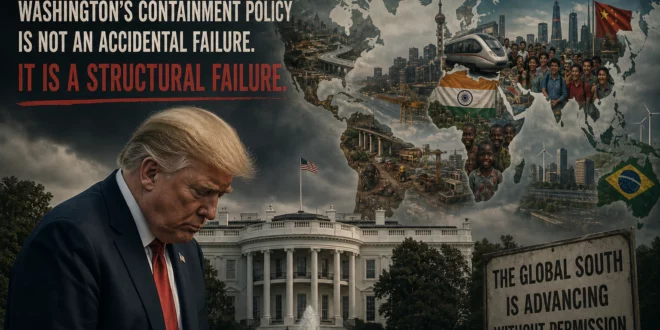
Washington wanted to chain the world. He chained himself in a trajectory inverted from his own ambitions.
In geopolitics as in history, there is an implacable law: the world does not bend to the desires of those who believe they possess it. History, since 1945, is the cruel and repeated demonstration of this. Washington wanted a unipolar world. It obtained a multipolar world. It wanted to contain its designated rivals. Furthermore, it consolidated them. It wanted vassals. But except for Europe, the Gulf, Canada, and Australia, it produced resistance. What Washington desires, the nature of things – the gravity of the balance of power, the logic of nations, and geography – denies it with an almost moral consistency.
Since 1945, American strategy has rested on a simple principle: containment, strangulation. Containing the USSR yesterday, stifling Russia today, encircling China tomorrow. Muzzling Iran, isolating Pyongyang. This colossal project has mobilized decades of resources, thousands of military bases, and trillions of dollars. And yet, the outcome is undeniable: containment has failed. It has even done worse by accelerating the convergence of its targets.
History has its own gravity. And it is pulling in a direction that Washington did not choose
The CRIC bloc – China, Russia, Iran, and North Korea – is not simply an alliance of friendship. It is an alliance of survival. Washington created it with its own hands, through sanctions, coups, NATO enlargements, and preemptive wars, and even by proxy.
The empire of desire and its shattered mirrors
Since the fall of the USSR in 1991, Washington has behaved not as one power among others, but as the self-proclaimed arbiter of a world order it claimed to have created. The neoconservative doctrine, championed by think tanks like the ‘’Project for the New American Century’’ since 1997, unabashedly asserted the imperial ambitions of the United States. The world was to be managed, shaped, and controlled. NATO, created in 1949 in the context of the Cold War and tensions with the Soviet Union, and expanded eastward in 1990 in violation of the commitments made to Gorbachev, became the instrument of this ambition. Economic sanctions, color revolutions, and preemptive wars – from Iraq to Libya, from Afghanistan to Syria – constituted the toolbox of a hegemon that confused force with legitimacy.
The result is nothing but a graveyard of failed projects. Afghanistan, handed over to the Taliban in 2021 after twenty years of occupation. Iraq, transformed into a Shiite powder keg since 2006 after Saddam’s execution. Libya, once a sovereign state, reduced to an open-air slave market since Gaddafi’s assassination in 2011. And everywhere, the crucible of accumulated hatred that now fuels the resistance movements Washington claims to be fighting.
The CRIC bloc: Washington’s illegitimate child
The ultimate irony of contemporary history lies here: it was Washington’s policy of containment that forged the CRIC bloc, which Westerners, out of fear of otherness, have dubbed the “new pact of autocrats.” China, Russia, Iran, and North Korea – four actors seemingly separated by everything: cultures, histories, regimes, interests. But American pressure has methodically brought them together, like atoms forced together by an external magnetic field. Threat creates solidarity. Encirclement produces alliance. Beijing didn’t invent the axis; Washington made it necessary.
On the economic front, the massive sanctions imposed on Moscow after 2022, on Tehran since 1979, and on Pyongyang for decades, have accelerated the development of a parallel system of payments, trade, and military cooperation. The yuan and the ruble are replacing the dollar in Sino-Russian trade. Iranian drones fly over Ukraine. North Korean missiles are reaching fronts that Washington thought it controlled. The strategy of isolation has led to the accelerated integration of its targets.
Geography as verdict
Geography doesn’t lie. It distributes roles with a precision that no diplomacy can permanently challenge. Let’s look at the chessboard.
In the East, China occupies the Pacific flank of the United States with a growing naval presence in the South and East China Seas. The artificial islands in the South China Sea are not mere whims: they are unsinkable aircraft carriers. Taiwan, which Washington uses as leverage, is also the red line behind which Beijing has placed the credibility of its regime. The question is no longer whether China will act, but when conditions allow. In the meantime, it nibbles away, builds, and encircles – with the age-old patience of a civilization that thinks in terms of dynasties, not electoral mandates.
In the West, Russia occupies the Eurasian flank with a strategic depth that Europe, in its Atlanticist vassalage, has never been able to grasp. Moscow controls access to the Baltic Sea, the Black Sea, and the Arctic approaches. Its army, despite Western predictions of a rapid collapse in Ukraine, is holding firm. It is learning. It is adapting. And the conflict in Ukraine, far from permanently weakening Russia, has revealed NATO’s industrial and strategic limitations, its inability to sustain a high-intensity conflict without depleting its stockpiles.
At the nerve center of the world lies Iran. By its mere posture of threat in the Straits of Hormuz and Bab el-Mandeb, it saturates the strategic space of the Middle East, encircling the Israeli outpost through its proxy war architecture. Faced with this asymmetry, the hegemonic order reveals its most tragicomic dimension: the systemic failure of the security pact linking Washington to the Gulf monarchies.
These monarchs in their immaculate robes traded their territorial sovereignty for the mirage of an American military umbrella, transforming their petrodollars into infrastructure to accommodate CENTCOM and the 5th Fleet. However, the Iranian ballistic missile strike of early 2026 brutally settled this score of deception. From Doha to Abu Dhabi, the deluge of drones exposed the utter inefficiency of the American missile defense systems purchased at exorbitant prices.
The irony is biting: reduced to the status of panicked spectators of a conflagration they have endured, these emirs realize the futility of their investment. Uncle Sam excels at insurance brokerage, demanding exorbitant premiums only to then, when disaster strikes, invoke obscure exclusion clauses to protect Tel Aviv. A splendid lesson in realpolitik where the protectorate proves to be merely the innermost circle of the inferno, leaving the auxiliaries to ponder the art of reading the fine print of imperial contracts.
In the Northeast, North Korea is the anomaly that Washington has never been able to accept. A supposedly “poor,” “isolated” state, which all the experts predicted was “moribund,” now possesses a nuclear arsenal estimated at more than fifty warheads, intercontinental ballistic missiles capable of reaching the United States, and a strategic munitions industry. Pyongyang understood what Baghdad and Tripoli understood too late: only nuclear weapons guarantee the survival of a regime. It was Washington itself that taught this lesson.
The verdict of history
Washington’s containment policy is not a temporary failure. It is a structural failure. It rests on the false premise that American military and economic superiority is eternal. It is not, however. Empires do not fall overnight. But they do fall. Rome, too, had its legions, its roads, and its limes – those borders that peoples eventually crossed.
What Washington desires is a world frozen in the order of 1991. A world where it dictates the rules, sets the prices, designates the guilty, and crowns presidents. What nature gives is a world in motion, pluralistic, rebellious. A world where peoples and powers stubbornly refuse the role of extras assigned to them. The CRIC bloc is not the cause of this movement. It is its most visible symptom. And symptoms, unlike desires, cannot be decreed.
In conclusion, history has its own gravity. And it is pulling in a direction that Washington did not choose.