 Eurasia Press & News
Key Takeaways
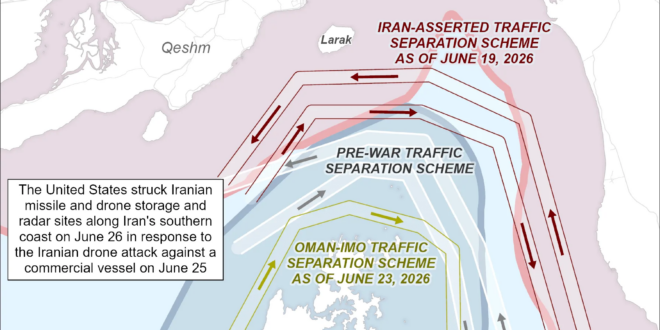
Iran is using force in an attempt to maintain its control over the Strait of Hormuz in the immediate future. Iran is likely attempting to prevent vessels from using non-Iranian shipping channels with force in the immediate term as it continues negotiations with the Gulf Arab states to secure long-term recognition of its control.
US Central Command (CENTCOM) struck an unspecified number of Iranian missile and drone storage sites and coastal radar sites on June 26 in response to Iran’s drone attack on the M/V Ever Lovely.
Iran is also using diplomacy and threats to secure long-term diplomatic recognition of its control of the Strait of Hormuz because continued Iranian strikes in the Strait of Hormuz would be difficult to maintain.
Iranian officials and state media are reacting to their faltering diplomatic efforts with a significantly more hostile tone towards the Gulf states.
Israel and Lebanon signed a US-brokered “framework agreement” on June 26 that describes a path towards eventual full Israeli withdrawal. The agreement stipulates that the Lebanese Armed Forces will backfill the Israel Defense Forces at two positions in southern Lebanon.
Toplines
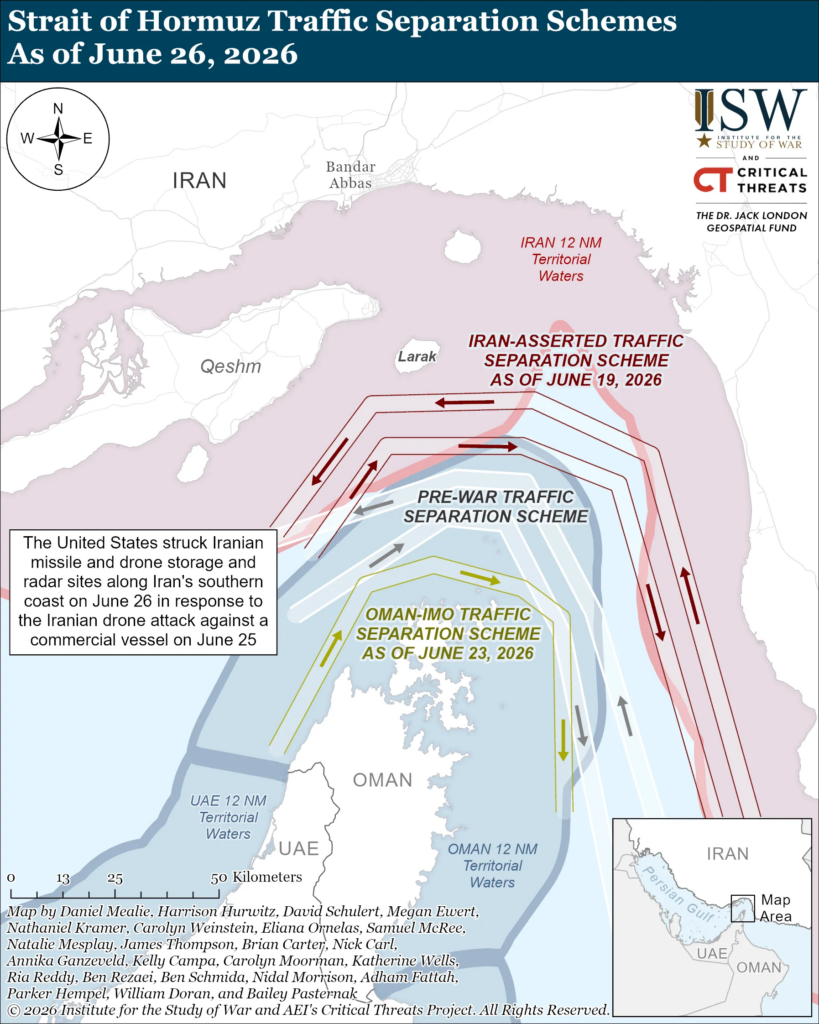
Iran is using force in an attempt to maintain its control over the Strait of Hormuz in the immediate future. Iran fired four drones into the strait over the past 24 hours, according to US President Donald Trump.[1] Trump subsequently called this attack a ceasefire violation.[2] An Iranian drone targeted a Singapore-flagged cargo ship approximately eight nautical miles southeast of Dahit, Oman, in the Strait of Hormuz on June 25.[3] The IRGC Navy issued a public warning that demanded vessels coordinate with Iranian authorities and use the Iranian-approved traffic separation scheme some time before it attacked the ship.[4]
Iran is likely attempting to prevent vessels from using non-Iranian shipping channels with force in the immediate term as it continues negotiations with the Gulf Arab states to secure long-term recognition of its control. Oman and the International Maritime Organization (IMO) announced on June 23 that they have established a joint mechanism to help hundreds of vessels move through a designated safe route along the Omani coast. US Central Command (CENTCOM) said on June 26 that it is providing “safe passage coordination” in the strait as well, though it did not specify whether “safe passage coordination” by CENTCOM is related to the IMO-Omani scheme. Iran responded with the attacks outlined above and claimed that the safe route was “completely dangerous.” This claim is an implicit threat that Iran will attack shipping using the safe route because Iran is the only threat to shipping in the strait. Iranian Deputy Foreign Affairs Minister for Legal and International Affairs Kazem Gharibabadi explicitly stated on June 26 that safe passage through the strait cannot rely on “parallel routes” or decision-making outside Iran’s considerations as a coastal state.[5] Iran is standing firm on its requirement to approve vessels’ passage through the strait, as it provides Iran with significant leverage that it could exploit at will.
CENTCOM struck an unspecified number of Iranian missile and drone storage sites and coastal radar sites on June 26 in response to Iran’s June 25 drone attack on a commercial vessel.[6] CENTCOM added that US forces will continue to provide “safe passage coordination” and support to commercial vessels transiting the strait.[7]
Iran is also using diplomacy and threats to secure long-term diplomatic recognition of its control of the Strait of Hormuz because continued Iranian strikes in the Strait of Hormuz would be difficult to maintain. Iran needs Gulf states’ recognition of its control over Iran’s route to maintain control over the strait because it cannot conduct attacks in perpetuity without risking instability and additional attacks. Iran has met with various Gulf states in recent days as part of this effort. An Iranian negotiating team member claimed on Iranian TV that Oman and Iran had formed a committee to address the strait issue. But Iran’s diplomatic efforts nonetheless appear to be faltering. Oman and the IMO are also collaborating to undermine Iran’s unrecognized transit scheme, as described above. The Gulf states and international organizations appear united against Iranian efforts to control the strait, however. The United States and the Gulf Cooperation Council ministers emphasized in a joint statement on June 25 that free, unconditional, and unrestricted navigation through the strait remains essential to regional and global security, and explicitly rejected any tolls, fees, or attempts to assert control over the strait.[8]
Iranian officials and state media are reacting to their faltering diplomatic efforts with a significantly more hostile tone towards the Gulf states. Iranian officials attempted on June 24 to frame Iran’s post-war approach to the strait’s management as part of a new regional security framework that would remove non-littoral Persian Gulf states from decision making over the strait, which would ultimately be in the Gulf states’ interests.[9] Iranian officials and entities have since become much more aggressive in response to increased opposition from the Gulf states to Iranian efforts to control the strait. The Iranian Foreign Affairs Ministry called the US-Gulf Cooperation Council (GCC) statement “interventionist, irresponsible, and provocative” and warned against continued US-backed “belligerent and interventionist” behavior in the region.[10] The ministry asserted that Iran and Oman have rights and responsibilities over safe passage through the waterway.[11] Other officials, including two advisers to the supreme leader, also harshly condemned the US-GCC statement.[12] One of the advisers called the Gulf states “peripheral minor players” who have “no seat at the table” and can only survive thanks to Iranian tolerance.[13] The Gulf states have a seat at the table in the memorandum of understanding to discuss control of the strait with Iran, notably. Iranian Parliament National Security and Foreign Policy Committee Chairman Ebrahim Azizi warned the GCC on June 26 that “outsourcing your security has made you less secure” and claimed that US military bases in the region have become a source of threats rather than security.[14]
Israel and Lebanon signed a US-brokered “framework agreement” on June 26 that describes a path towards eventual full Israeli withdrawal.[15] The Lebanese Armed Forces (LAF) will backfill the Israel Defense Forces (IDF) at two positions in southern Lebanon.[16] The IDF will eventually withdraw under the agreement if it is fully actualized. The full details of the plan remain unclear. Israeli Prime Minister Benjamin Netanyahu said that the IDF will remain in its security zone in southern Lebanon.[17] An Israeli source also told Axios that the IDF would remain in southern Lebanon until Hezbollah is disarmed.[18] Israeli Prime Minister Benjamin Netanyahu stated that the IDF and the LAF will start their first “pilot zone” in two unnamed “connected villages” in southern Lebanon.[19] Israeli and US officials also told Axios that US military officers will help oversee LAF forces backfilling these positions to provide training and to confirm that Hezbollah has been removed from the area.[20] Lebanese Ambassador to the United States Nada Maawad Hamad stated that the ”framework agreement” with Israel is the “first step toward restoring Lebanon’s sovereignty.“[21]
Iranian and Hezbollah officials’ response to the signing of the agreement has remained limited at the time of this writing. Both the Iranian and Hezbollah leadership have emphasized the need for Israel’s withdrawal to be unconditional, however.[22] Hezbollah Parliamentarian Hassan Fadlallah condemned the signing of the “framework agreement” and warned that the Lebanese government cannot implement the agreement ”unless they resort to a civil war.”[23] Fadlallah also noted that the ”framework agreement” represents an intentional obstruction of the US-Iran MoU.[24]
US-Iran Negotiations
Nothing significant to report.
Maritime Activity in the Strait of Hormuz and Persian Gulf
See the topline section.
US and Israeli Air Campaign
Nothing significant to report.
Iranian Domestic Affairs
Iran’s Axis of Resistance
Nothing significant to report.
Lebanese Hezbollah and the Israeli Campaign in Lebanon
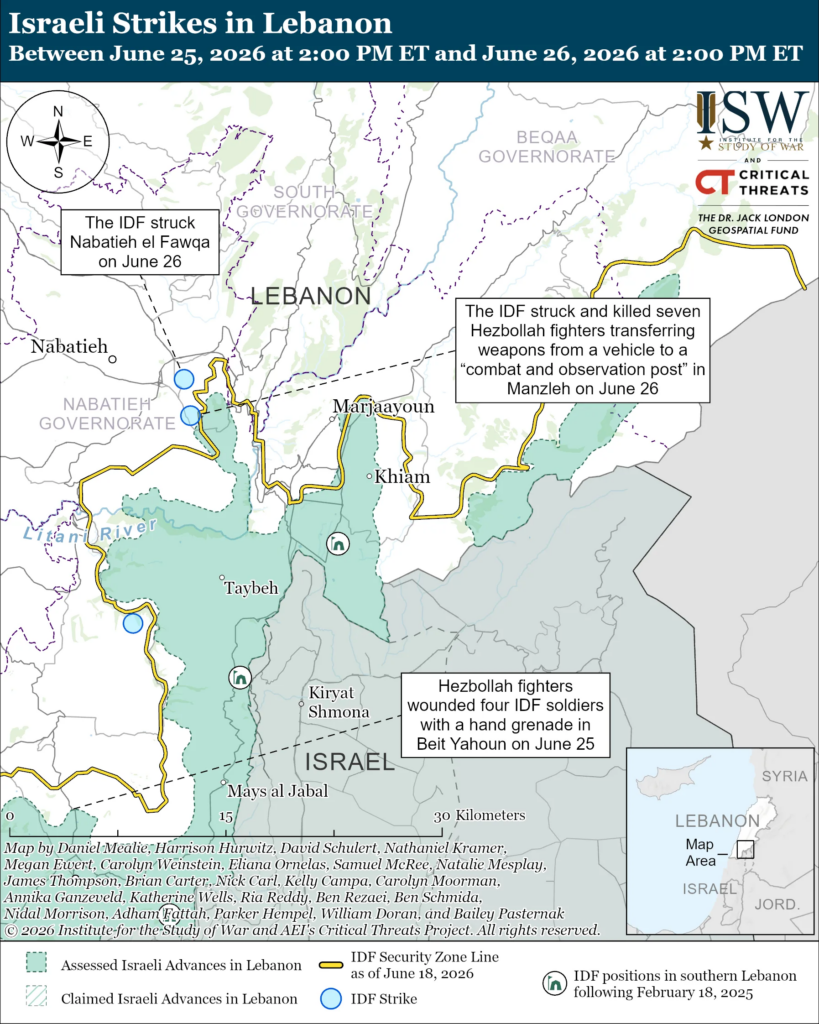
The Israel Defense Forces (IDF) and Hezbollah continued to engage each other on June 25 and June 26 in southern Lebanon. Israeli media reported that Hezbollah fighters threw a hand grenade at IDF forces operating near Beit Yahoun, South Governorate, injuring four soldiers on June 25.[25] The IDF struck Hezbollah positions in the area with artillery fire in response.[26] The IDF reported that it later conducted two airstrikes targeting Hezbollah fighters in Nabatieh al Fawqa on June 26.[27] The IDF reported that it killed seven Hezbollah fighters who were transporting weapons from a vehicle to a combat and observation post in the second strike on Nabatieh al Fawqa.[28]
The IDF separately reported on June 26 that its forces took “complete control” of Ali al Taher, Nabatieh Governate, which reportedly hosts one of Hezbollah’s largest underground command and control facilities.[29] IDF Arabic-language Media Spokesperson Lieutenant Colonel Ella Waweya stated that Ali al Taher “no longer serves as a base [for Hezbollah] to threaten Israel’s security.”[30] Hezbollah disputed the IDF’s control of Ali al Taher and stated that the area ”is free of any presence of [Israeli] forces.”[31] The IDF previously struck Hezbollah positions near Ali al Taher once on June 23, and twice on June 24.[32]
Other Axis of Resistance Activity
Nothing significant to report.