 Eurasia Press & News
Whether or not the memorandum of understanding signed by the United States and Iran on June 18 collapses or leads to a peace agreement between the two nations, it is important to take stock of the high costs and failed ambitions of the illegal war of aggression President Trump launched with Israeli Prime Minister Netanyahu against Iran on Feb. 28.
Legally speaking, the US-Israeli war was not only an attack on Iran, it was also an attack on the UN Charter and international law. While the international community may not be able or even inclined to hold Trump and Netanyahu accountable, their own citizens may vote them out of office in light of the high costs and terrible consequences of their war of choice.
Western media has focused almost exclusively on the surging price of gas, due to Iran’s closure of the Strait of Hormuz, with little if any mention of the devastating toll of thousands of human lives; the destruction of billions of dollars of civilian infrastructure in the region; and the incalculable costs of the disruption of global trade. The US has not only lost tens of billions of its taxpayer dollars, it has also lost the last vestiges of its standing among allies and foes alike. Israel is more isolated than ever.
As of June 27, Israel and Lebanon have signed a US-mediated framework agreement and US-Iran talks have yielded a roadmap for negotiations over the 60 days’ truce. However, the Strait of Hormuz is not yet fully open, Israel is still bombing Lebanon and the US and Iran are still exchanging fire. Trump is once again threatening Iran’s leaders that if fighting resumes, “the Islamic Republic of Iran will no longer exist!”
Whether the war resumes or the truce prevails, there is no return to the status quo ante in light of the war’s follies and failings.
Loss of civilian life and destruction of civilian infrastructure
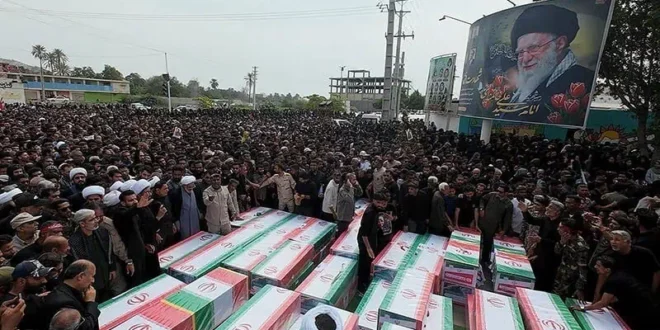
According to the Norwegian Refugee Council, the US and Israeli attacks against Iran have killed more than 3,500 people and injured more than 32,000 people — most of them civilians; and displaced millions more. They have also destroyed or damaged 150,000 homes, 20 schools and 1,200 educational centers as well 240 health facilities. The deadliest single strike so far occurred on the first day, Feb. 28, when the US bombed a girls’ school in the southern Iranian city of Minab, killing more than 175 people, including 100 children.
The BBC reports that Israeli missile and ground attacks have killed 4,192 people in Lebanon, injured more than 11,600 and displaced more than 1.2 million others. The WHO also reports that 60 hospitals or other health care facilities have been destroyed or damaged in the attacks.
Meanwhile, Iranian strikes have reportedly killed nearly 40 people in the Gulf states, most of them in the United Arab Emirates, and injured thousands more.
Missile and rocket attacks from Iran and Lebanon have killed 36 people in Israel. At least 13 US military personnel have been reportedly killed and more than 500 injured — including by friendly fire.
Billions of dollars of damage to civilian infrastructure, including airports, ports, oil refineries and residential areas, has been caused by US and Israeli strikes against Iran and Israeli strikes against Lebanon as well as Iranian retaliation against Israel and the Gulf states hosting American military bases and other presences. The heaviest damage is in Iran, Lebanon and the UAE.
Disrupting the balance of power
The US and Israeli aggression motivated the Iranian regime, for the first time ever, to close the Strait of Hormuz, thus altering the balance of power in the conflict. In so doing, Iran strengthened its negotiating position not only in the US-Iran cease-fire negotiations but also in the Israel-Lebanon cease-fire negotiations.
The impact of Iran’s defiance was felt in the region and beyond. It not only led to a surge in the price of gas, it also disrupted oil markets and supply chains as well as fertilizer supplies, which have threatened energy security and food security in many parts of the world. Several countries, including India and Pakistan as well as China and Russia, have negotiated ad hoc transit arrangements directly with Tehran to allow their crude oil and cargo ships to pass through the Strait. Meanwhile, in accordance with Point 5 of the MOU, Iran and Oman have initiated talks on the future administration of the Strait of Hormuz.
US and Israeli losses
The US and Israel may be the biggest losers.
The US has lost billions of tax dollars in depleted arsenals of both armaments and ammunition as well as damaged military bases throughout the region. The Pentagon has estimated that the war will cost the US around $25 billion. According to a CNN investigation, “the real cost estimate is closer to $40-50 billion when accounting for the costs of rebuilding US military installations and replacing destroyed assets.”
Trump’s insults to Arab and European allies have decimated America’s soft power, and its inability to defeat Iran has exposed the limits of its hard power. The Iranian regime neither surrendered nor conceded. It is even more hardline at home and more emboldened abroad since the war began. It has not only survived the joint American and Israeli military operations and political interference, it has also sustained its capacity to retaliate efficiently and effectively against Israel and strategic American assets in the region. It has also caused great harm to its neighbors — some of whom participated in the US-Israeli operations but most of whom did not.
Israel continues to commit a growing catalogue of crimes, including genocide and ethnic cleansing in Palestine, territorial expansion into Lebanon and Syria and aggression against Iran. Netanyahu’s arrogance and lies have compounded Israel’s alienation from its Western allies and its pariah status in the rest of the world. Netanyahu has even overplayed his hand with Trump, calling into question the unconditional support Israel has always enjoyed from its US ally.
Despite all their bullying tactics and social media antics, neither Trump nor Netanyahu has been able to distract their constituencies from the fact that they did not achieve any of their stated goals.
Failed ambitions
For more than a decade, Trump has consistently referred to the Joint Comprehensive Plan of Action concluded with Iran in July 2015, during President Obama’s term, the “worst deal” ever. The JCPOA was signed by all five permanent members of the UN Security Council as well as by Germany and the European Union and endorsed by the Council.
Trump withdrew the US from the JCPOA in May 2018, during his first term in office. By all accounts, Iran had complied with its obligations under the JCPOA until Trump withdrew and for a whole year thereafter. In the years since, Iran has compiled more than 400 kilograms of highly enriched uranium — which even at 60 percent is far below the 90 percent required for weapons-grade enrichment.
For nearly three decades, Netanyahu has continuously, albeit unpersuasively, proclaimed that Iran is “on the verge of developing nuclear weapons.” Having failed to convince successive US presidents, he finally convinced Trump of this false pretext. The US joined Israel in attacking Iran first in June 2025 and again in February 2026.
Moreover, although Netanyahu had been unable to defeat Hamas in Gaza or Hezbollah in Lebanon, Netanyahu somehow convinced Trump that together they could defeat Iran; destroy its nuclear and missile program; and remove its unpopular regime from power once and for all, stating that “victory was a near-certainty.”
Four months later, the MOU signed by Trump in Versailles is far weaker in its restrictions on Iran and far more generous in its concessions to Iran than the Obama-era JCPOA ever was. The Iranian regime is still standing — stronger at home, more defiant regionally and more consequential globally.
To justify his ill-fated war, Trump has declared Iran’s renunciation of nuclear weapons as a victory. He wilfully ignores that Iran had given permanent assurances that it would not pursue nuclear weapons in the JCPOA (and as a state party to the Non-Proliferation Treaty) and was merely reiterating those assurances as explicitly noted in Point 8 of the MOU.
Despite Trump’s constant criticism, his MOU, like Obama’s JCPOA, recognizes Iran’s nuclear needs and allows Iran to retain its nuclear program, subject to mutually agreed restrictions (Point 8); both the JCPOA and MOU lift sanctions against Iran (Point 7); allow Iran to keep its missiles and sell its oil (Point 10); and unfreeze Iranian assets (Point 11). Under the MOU, Trump may potentially release up to $24 billion — far more than the $1.7 billion actually released under Obama’s JCPOA.
Meanwhile, Trump has made unprecedented concessions to the Iranian regime, including a commitment to noninterference in Iran’s internal affairs (Point 2); a $300 billion rehabilitation and economic development fund (Point 6); and a promise not to impose new sanctions (Point 9).
The losses and failures are clear. The US and Israel emerge not only as rogue states but as defeated nations — having waged not just a criminal war of choice but also a stupid and self-defeating one.