 Eurasia Press & News
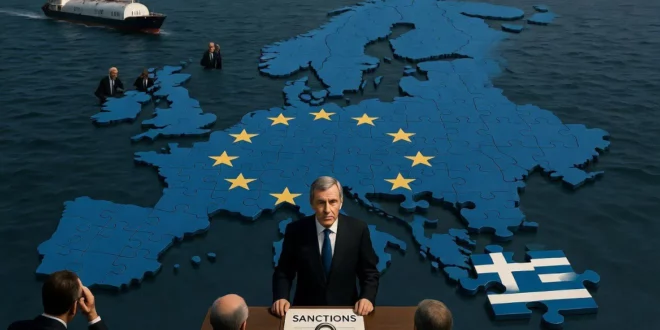
The European Union agreed on its 21st sanctions package against Russia on July 23, 2026, after weeks of difficult negotiations.
The European Union agreed on its 21st sanctions package against Russia on July 23, 2026, after weeks of difficult negotiations. The package adds 32 Russian banks to the transaction ban list, targets crypto firms and oil trading platforms, and blacklists more vessels from Russia’s shadow fleet. On paper, it represented another step in the EU’s campaign to pressure Moscow.
But the real story is not what was included. It is what Greece forced out of the package — and what that reveals about the structural limits of European decision-making.
Athens calculated that it had leverage — and demonstrated how effectively that leverage could be used within the EU’s decision-making system
The Greek Veto
Greece blocked the entire package for days, refusing to budge on one issue: a ban on transporting Russian liquefied natural gas to non-EU countries. The ban had been unanimously agreed upon last year and was set to take full effect on January 1, 2027. But Athens demanded an exemption, and it got one.
The exemption allows Greek shipping company Dynagas, owned by billionaire George Prokopiou, to continue transporting Russian LNG from the Yamal project in the Arctic to customers outside the EU. Contracts signed before February 2022 will remain in force, subject to annual review. New contracts are prohibited, and volumes are capped at current levels.
One EU diplomat called Greece’s demands “shameless.” Athens calculated that it had leverage — and demonstrated how effectively that leverage could be used within the EU’s decision-making system.
The Dynagas Argument
At the heart of this dispute is a single company. Dynagas operates 27 gas carriers, including ice-class vessels designed for Arctic conditions. Since 2025, it has transported over 10 million tons of Russian LNG on 144 voyages. Its fleet is not easily replaced—not because Russia cannot find other shippers, but because Europe would lose its own strategic assets in the process.
The company’s position was straightforward: if European operators are forced to abandon long-term contracts, Asian banks will seize the vessels at a fraction of their value and charter them to non-Western operators. Trade would continue. Russian LNG revenues would continue with limited disruption. But Europe would lose its Arctic shipping expertise, its maritime leadership, and 2,000 specialized jobs.
Greece’s argument was simple: the ban would be “all pain, no gain.” It would not weaken Moscow. It would weaken Europe.
The Price of Unity
In exchange for the LNG exemption, Greece agreed to freeze the oil price cap on Russian crude at $44.10 per barrel for 12 months. Under the automatic adjustment mechanism, the cap would have risen to $58 per barrel due to rising global prices—giving Russia billions in additional oil revenue. Von der Leyen claimed the freeze “prevents the Russian war machine from benefiting from market shocks.” In practice, it was the price of Greek consent.
The package also lost other elements. Portugal and Germany dropped a ban on Russian fish imports. Bulgaria removed Patriarch Kirill and Lukoil founder Vagit Alekperov from the sanctions list. France and Italy delayed a ban on Russian soldiers entering the Schengen area. Austria secured safeguards for Raiffeisen Bank.
Every member state that pushed back got something. And every concession diluted the package.
What This Reveals
This is not the first time Greece has protected its shipping interests. Earlier this year, it used similar arguments to derail a full ban on maritime services for Russian oil tankers. Greece, along with Cyprus and Malta, has consistently opposed or watered down measures targeting Russia’s maritime sector. Athens argues that sanctions should not inflict more damage on the European economy than on Moscow.
This position is not unreasonable. But it exposes a deeper reality: the EU is not a single strategic actor. It is a system built around competing national interests, and when the costs of policy become concrete, those interests inevitably shape the final outcome.
The Greek veto demonstrated that European sanctions policy depends not only on pressure against Russia but also on the willingness of individual member states to accept economic costs themselves. Under a unanimity-based system, national leverage can translate into European concessions, meaning that sanctions packages are often shaped by internal bargaining as much as by external strategy.