 Eurasia Press & News
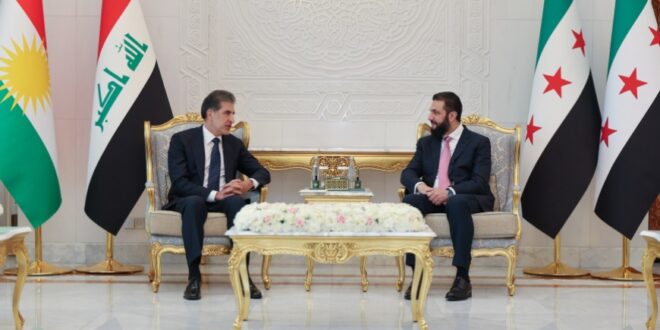
Syrian President Ahmad Al-Sharaa’s meeting with Nechirvan Barzani, President of the Kurdistan Region of Iraq (KRI), at the People’s Palace in Damascus marks a notable inflection point in Syrian–Kurdish relations and a broader recalibration of regional policy. Barzani’s first official visit to Syria since the fall of the Assad regime signals a deliberate shift toward structured engagement between Damascus and Erbil at a moment when both actors face converging economic and security imperatives.
From a policy standpoint, the summit reflects three overarching priorities: consolidating internal Syrian stability, expanding cross-border economic cooperation, and managing the political transition of Kurdish institutions within Syria’s evolving state architecture.
Economic Coordination as a Stabilization ToolBarzani’s public remarks—framing Syria as standing before a “historic opportunity” for recovery—align with a growing regional consensus that economic stabilization is a prerequisite for political normalization. His emphasis on shared interests among Syria, Iraq, and the Kurdistan Region underscores the potential for cross-border economic corridors, energy cooperation, and private-sector investment to serve as anchors for long-term stability.
The parallel meeting in Damascus between the KRI’s Iskandar Holding Group and the Syrian Investment Authority illustrates a shift toward operationalizing economic ties. For policymakers, this signals an emerging model in which Kurdish economic actors serve as intermediaries capable of mobilizing investment and facilitating reconstruction in northeastern Syria—particularly in sectors where local expertise and regional networks offer comparative advantages.
Advancing the SDF Integration FrameworkA central policy dimension of Barzani’s visit involved the January 29 agreement between Damascus and the Syrian Democratic Forces (SDF). Diplomatic sources confirm that Barzani engaged directly on the institutional integration of Syrian Kurdish structures into the Syrian state. His role is best understood as that of a facilitator: providing political guarantees, reducing friction between negotiating parties, and helping align Kurdish expectations with the state’s sovereignty requirements.
For Damascus, the integration process is essential to reconstituting national authority in the northeast and reducing the fragmentation that has characterized the region for more than a decade. For Kurdish actors, the process represents an opportunity to secure political recognition, constitutional guarantees, and administrative inclusion within a unified state framework.
Barzani’s involvement also reflects the KRI’s strategic interest in preventing instability along its western border and ensuring that Syrian Kurdish factions remain politically anchored within a state structure rather than drifting toward external alignments that could destabilize Iraq’s own Kurdish dynamics.
Governance, Sovereignty, and Regional SecurityThe summit carries implications for regional security governance. By supporting the integration of SDF institutions, Barzani reinforces a model in which Kurdish political rights are pursued through constitutional channels rather than through parallel military structures. This approach aligns with broader regional trends emphasizing state consolidation, reduction of non-state armed actors, and the stabilization of border zones.
For Syrian policymakers, Barzani’s statements regarding the protection of all national and religious components provide external validation for the government’s narrative of inclusive state-building. For Kurdish policymakers, they signal a commitment to ensuring that integration does not translate into political marginalization.
Strategic OutlookThe meeting suggests that Damascus and Erbil are converging on a pragmatic framework:
Economic cooperation as a foundation for stabilization.
Institutional integration of Kurdish structures as a pathway to national consolidation.
Regional coordination to prevent security vacuums and cross-border escalation.
If sustained, this framework could reshape the political landscape of northeastern Syria, reduce the influence of external actors, and create a more predictable environment for reconstruction and governance reform.