 Eurasia Press & News
Washington is changing some of its most reliable military partnerships in the Middle East because it believes states, markets, and diplomacy can deliver what American troops and Kurdish proxies increasingly cannot.
The End of the Post-ISIS* Bargain
The juxtaposition could hardly be more striking. On August 24, the United States removed Syria from its list of state sponsors of terrorism, ending a designation that had constrained Damascus for 47 years and removing a major obstacle to international investment. Two days later, the Kurdish-led Syrian Democratic Forces formally dissolved and began integrating into Syria’s national army. Meanwhile, Washington is moving toward ending direct military assistance to Iraq’s Kurdish Peshmerga. The Pentagon’s proposed budget has already reduced the Counter-ISIS* Train and Equip Fund for the Peshmerga from $61 million to zero. These developments look contradictory only if America’s Middle East policy is viewed through the logic of the past decade.
America’s greatest strategic problem is no longer simply how to defeat a particular Middle Eastern adversary. It is how to preserve global power while avoiding the costs of policing every regional crisis
After the rise of the Islamic State in 2014, Washington used the Kurdish Peshmerga and Syria’s SDF to advance its cardinal interests: breaking the Syrian and Iraqi states into territories that are ungovernable and exploitable at the same time. American military power was therefore tied to local armed partners. That bargain might have made sense then to the US policy makers. It makes less sense now. Instead of supporting armed militias, Washington is now re-consolidating states as its preferred partners. Its objective is to occupy, as quickly as possible, the space created by Iran’s relatively weak position in the Levant.
The significance of the SDF’s dissolution is therefore larger than the fate of one Kurdish organization. Washington is effectively moving away from a model in which it compensates for weak states by empowering sub-state actors. It is betting on the states instead.
What Washington Thinks It Can Buy
The most obvious potential gain is Syria. For decades, American policy treated Damascus as a government to isolate and contain. Washington is now attempting to make the new Syrian state part of a different regional order. The removal from the terrorism list follows the Trump administration’s earlier lifting of broad Syria sanctions while retaining targeted measures against specific individuals and organizations. This is not simply an act of generosity toward a war-ravaged country. It gives Washington an instrument of influence that is considerably cheaper than direct and prolonged military occupation.
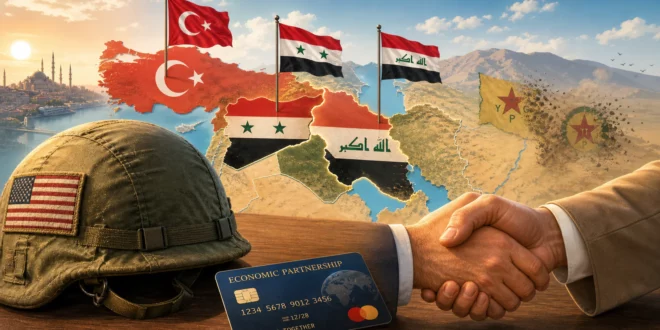
Syria desperately needs capital. The United States can provide something more valuable than money: access. Once American restrictions are removed, Gulf, European, and private investors have greater incentives to enter the Syrian market. The speed of the financial reopening is already visible. Visa and Mastercard have resumed international card transactions in Syria, reconnecting parts of the country to the global payments system. Washington can therefore encourage Syria’s reconstruction without assuming responsibility for financing it.
The geopolitical payoff could be greater still. Syria under Assad was an important component of Iran’s regional network and hosted Russian military infrastructure. The new government is instead seeking international recognition, investment, and reconstruction assistance. Damascus has already indicated a willingness to reduce Russian oil imports.
Washington’s calculation is straightforward: if Syria’s economic survival becomes increasingly dependent on integration with Western and Gulf markets, Damascus has an incentive to remain politically useful to the United States.
The Kurdish question reveals a second potential gain: Turkey. Washington’s alliance with the SDF always contained an uncomfortable contradiction. The SDF was one of America’s most effective partners against the Islamic State, but Turkey viewed its Kurdish core as closely associated with the PKK and therefore as a security threat. That contradiction is now disappearing. The SDF has ceased to exist as an independent military force, while its former commander, Mazloum Abdi, has been appointed an adviser to Syrian President Ahmed al-Sharaa. Turkey has welcomed the dissolution as a step toward Syrian unity.
For Washington, this may be a more valuable strategic trade than it initially appears. The United States loses some direct leverage over a Kurdish military partner. But it potentially gains a more cooperative Turkey, a NATO member with enormous strategic importance for the Black Sea, Russia, Syria, and the wider Middle East.
The Power of Leaving
The larger objective is not simply to reduce troops. It is to reduce American responsibility while cultivating a relationship of dependency.
Washington’s military presence in the Middle East has repeatedly produced an obligation to manage problems that American power cannot ultimately solve. Protecting local partners creates commitments; commitments create vulnerabilities; vulnerabilities create demands for more troops. The Trump administration is attempting to break that cycle. The planned end of the U.S.-led coalition mission in Iraq is part of that process. American forces are scheduled to leave Iraq by the end of September, ending the coalition’s military mission against the Islamic State.
This does not mean Washington has become indifferent to Iraq. It means it can pursue its interests through a different hierarchy of instruments: intelligence cooperation, arms sales, financial pressure, diplomacy, and selective military intervention rather than permanent deployment. That distinction matters because America’s greatest strategic problem is no longer simply how to defeat a particular Middle Eastern adversary. It is how to preserve global power while avoiding the costs of policing every regional crisis.
Washington has competing priorities in Europe and the Indo-Pacific, while its military resources are finite. A Middle East in which Iraq, Syria, Turkey and the Gulf states assume greater responsibility for regional security is therefore attractive precisely because it allows the United States to remain influential without remaining indispensable to every security arrangement. But this is where the strategy becomes a gamble.
Washington is making an unusually consequential assumption: that the governments replacing its former non-state partners will be more useful to American interests than the partners themselves. It is also assuming that these states will not develop relationships with other countries, including Russia, Iran, and China, in the near future.
A stronger Damascus could eventually become independent of Washington rather than aligned with it. Baghdad could realign with Iran, which has successfully withstood months of US war. Turkey could use its strengthened position to pursue policies that diverge from long-term American preferences. The deeper gamble is therefore not whether America can leave. It is whether America can leave while making other countries more dependent on the economic and diplomatic architecture it still controls.
If Washington succeeds, it will have discovered a potentially powerful formula for the post-intervention Middle East: fewer American troops but greater reliance on American markets, financial systems, technology, weapons, and diplomacy.
That would represent a different kind of American power. It is not the power to control the region directly, but the power to make regional states compete for access to an order Washington can still shape. The danger is that this strategy could also produce the opposite outcome. If states become stronger but less willing to accommodate Washington, the United States may discover that military retrenchment has reduced its leverage faster than economic diplomacy can replace it. For now, however, Washington appears willing to take that risk.
Its bet is that the most effective way to preserve American influence in the Middle East may no longer be to remain everywhere. It may be to make the region increasingly responsible for its own security while ensuring that the states taking responsibility still need something only Washington can provide.
*-banned in Russia