 Eurasia Press & News
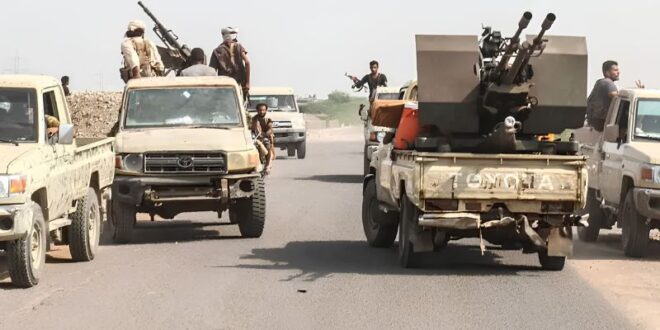
The escalation on the ground between the internationally recognized Yemeni government forces, backed by Saudi Arabia, and the Tehran-backed Ansar Allah (Houthi) group continues.
The state-run Saba news agency reported on Monday, September 7, that the Yemeni army was able to control advanced strategic sites and areas where Houthi forces were stationed in al-Bayda governorate.
The government forces announced the entry of the camp “Al-Labnat” located in the province of Al-Jawf, on the Yemeni-Saudi border, as well as control of the village of Al-Masafah near the city of Al-Hazm, while the Houthis did not issue a statement confirming or denying these developments.
The forces also took control of Naqil and Jabal al-Koura in the Al-Kidha front in the Maqbana district, west of the city of Taiz.
Houthis target Saudi Arabia
The Saudi authorities reported the injury of 73 people, and the outbreak of fires in several locations, including the “King Khalid Military Air Base”, the “Abha International Airport”, and facilities belonging to the state oil company “Aramco” in Abha and Jizan following attacks by the “Houthi group” allied with Iran, in which drones and missiles were used.
For his part, the military spokesman for the Houthis, Yahya Sari, launched a large-scale military operation in the depth of Saudi Arabia.
He said in a statement via the X platform: “The Yemeni armed forces (Houthis) carried out a qualitative and extensive military operation, targeting (Aramco) in Abha, Najran, the Economic City, Aramco Jizan, and the (Khamis Mushait) air base with dozens of ballistic missiles and drones.”
The Houthis accused Saudi Arabia of launching air strikes and launching cruise missiles in the provinces of Al-Jawf, Al-Bayda, Marib and Taiz.
The Yemeni News Agency (Saba), affiliated to the Houthis, said that Saudi Arabia targeted the four provinces with a number of air raids and cruise missiles, and that the Houthis shot down, on Monday morning, a Saudi reconnaissance aircraft in the airspace of Al-Bayda governorate, in the center of the country.
Saudi Arabia has not claimed responsibility for the raids and rockets reported by the Houthis, nor has it confirmed that any of its drones have been shot down.
However, the forces of the internationally recognized government announced the implementation of 13 air raids on sites, gatherings and mechanisms belonging to the Houthis in Al-Bayda governorate, and carried out other raids on sites, gatherings and camps for the Houthis in the fronts of Marib and other areas.
Beginning of escalation
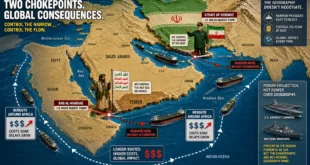
The last wave of fighting began after the Houthis launched a large-scale attack on the fronts of the west coast of the Red Sea and in the vicinity of the city of Taiz, coinciding with the shelling of missiles and drones, in an attempt to advance towards areas adjacent to the Bab al-Mandab Strait under the control of the government of the internationally recognized Yemeni government, supported by Saudi Arabia, which led to an escalation in confrontations.
According to government military sources who spoke to AFP, one of the main targets of the Houthi attack is to isolate the coastal city of Mokha, which is under government control, from the rest of the areas under its control, in addition to trying to advance towards the areas near the Bab al-Mandab Strait.
The city of Mokha was subjected to repeated attacks last month, while the Yemeni government warned of “Houthi” plans to control the coast of Bab al-Mandab, pointing out that any change in the map of control of this area may have repercussions beyond the borders of Yemen, especially on international navigation.
Clashes between Yemeni government forces and the Houthis in southwestern Yemen have killed more than 300 fighters and a number of civilians, according to an AFP toll based on military and medical sources on both sides.
Two military sources in the government forces reported that 84 of their members were killed between Saturday and Sunday morning, while four sources by the Houthis reported that 57 of their members were killed during the same period.
The fighting has also forced a number of families to flee their homes in areas where clashes are taking place.
In July, Yemen returned to the forefront of regional escalation, with the renewed confrontation between the Houthis and Saudi Arabia on the impact of the war between the United States and Iran.
These confrontations began after the Houthis accused Riyadh of bombing Sanaa airport to prevent the landing of an Iranian plane in it, before they announced the imposition of a naval blockade on Saudi Arabia and resumed targeting its tankers and oil facilities, ending the truce with the Yemeni government supported by Saudi Arabia.
Distribution of control in Yemen
The division in Yemen began in 2014 when the Houthi group Ansar Allah took control of the capital Sanaa, escalating tensions and the intervention of a Saudi-led military coalition to support the internationally recognized Yemeni government.
This division has deepened over the years, bringing the military and political scene now to a clear map of influence and prominent field developments.
The Houthis control northern and western Yemen, including the capital Sanaa, the governorates of Dhamar, Ibb, Amran, Hajjah, Mahwit and Rima, as well as large parts of Hodeidah and fronts in Saada and Al-Jawf.
While the Yemeni government extends its control over eastern and southern Yemen, including the temporary capital of Aden, and the governorates of Hadramawt, Al-Mahra, Shabwa, Abyan, Lahj and Al-Dhale, in addition to its economic strongholds in Marib and parts of Taiz and the West Coast.
While the Houthi-controlled areas include the country’s largest population, and are characterized by their fortified mountainous nature, government zones make up the wider geographical range containing oil and gas fields and open seaports.