 Eurasia Press & News
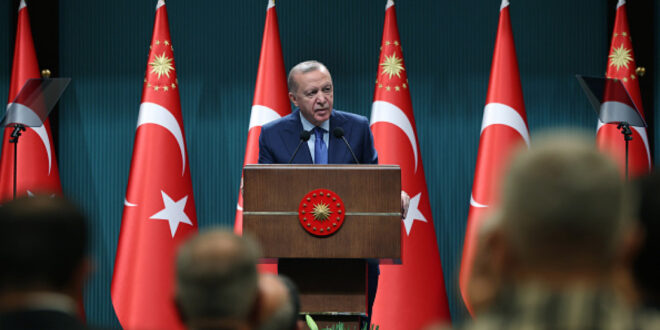
Turkey and Hezbollah are quietly expanding channels of communication as Ankara seeks to manage the group and stop it from playing any destabilising role in Syria, while also trying to deter what it sees as growing Israeli threats in the region, according to analysts.
The contacts come as tensions between Turkey and Israel deepen over their competing interests in Syria, and as President Recep Tayyip Erdogan seeks to expand Turkey’s influence across the Middle East.
But Turkey’s engagement with Hezbollah does not signal that Ankara has embraced the Iran-backed militant group. Omer Ozkizilcik, from the Atlantic Council think tank, said Turkey remained deeply sceptical of Hezbollah because of its relationship with Iran and its role during the Syrian conflict.
“We have to assess the two biggest disputes between Turkey and Hezbollah – firstly, the relationship of Hezbollah with Iran, and secondly, the role that Hezbollah played in Syria,” Ozkizilcik told The New Arab.
“With Hezbollah being kicked out of Syria, the second biggest area of dispute has been resolved,” he added.
The Hezbollah problem and Israeli threat
Turkey has emerged as a key player in Syria following the ouster of former dictator Bashar al-Assad and has maintained a troop presence in the north of the country. Ankara has close relations with the new administration in Damascus, which resents Hezbollah for fighting alongside Assad during Syria’s 13-year civil war.
Turkey and Hezbollah have not always been on good terms.
During the Syrian war, more than a dozen Hezbollah fighters were killed during Operation Spring Shield, a cross-border military operation carried out by Turkish forces in the Idlib Governorate against the former Syrian regime’s military and allied militias.
The operation was launched in late February 2020 in direct response to the Balyun airstrikes – a joint Syrian-Russian attack on a Turkish army convoy in Idlib.
But Assad’s fall has fundamentally changed the regional equation. Hezbollah has lost its main supply route through Syria, while its military capabilities were significantly reduced during its 2024 war with Israel.
Against that backdrop, Ankara’s immediate concern appears to be ensuring that Hezbollah does not seek to re-establish a hostile presence in Syria or threaten the country’s new government, led by President Ahmed al-Sharaa.
Hezbollah has acknowledged that it held meetings with the Turkish ambassador to Beirut, while its leadership has also signalled a willingness to engage with Syria’s new rulers.
“What the Turkish government is trying to do is not to mediate between Sharaa and Hezbollah but to first of all ensure Hezbollah will not play a hostile and negative role against the Syrian government,” Ozkizilcik said.
He added that recent statements by Hezbollah chief Naim Qassem expressing a willingness to meet with Syria’s new leadership had been welcomed in Ankara.
For Turkey, keeping Hezbollah and Syria from entering into confrontation is also tied to a much broader dispute with Israel.
Israel has warned that it will not allow Turkey to gain a foothold on its borders, while Israeli officials have dubbed Ankara the “new Iran” and accused it of seeking to expand its influence in Syria.
In August, Israel struck a base in northern Syria that it claimed was being used by Turkish troops, an allegation Ankara denied. There have been past Israeli airstrikes on the Turkish presence in Syria.
Erdogan has meanwhile warned that Israeli attacks on Syria and Lebanon are becoming a threat to Turkey. He said his country’s security did not begin in Hatay, Turkey’s southernmost province, but rather in Aleppo, Damascus and Beirut.
“We will not allow a fait accompli in our brotherly countries, and we will not turn a blind eye to any attacks targeting them,” Erdogan cautioned in June.
But Ankara’s response to Israel is not necessarily to strengthen armed groups confronting it. Instead, Ozkizilcik said Turkey viewed the continued presence of proxy groups as a potential justification for Israeli aggressions on neighbouring countries.
“Turkey believes that non-state armed actors are very effective pretexts for Israel to invade neighbouring countries,” he said.
From Ankara’s perspective, Hezbollah’s presence in Lebanon is therefore itself part of the problem.
Turkey is opposed to Hezbollah’s role in Lebanese politics and does not support the group’s military presence. But it also wants Israel to withdraw from southern Lebanon and southern Syria, and sees stronger central governments as the means of achieving that.
“From a Turkish perspective, Hezbollah’s presence is problematic,” Ozkizilcik said. “Turkey wants to empower statehoods and central governments.”
That position could explain why Ankara is simultaneously communicating with Hezbollah while working with Washington, Damascus and Beirut on a potential arrangement that would see the group disarm.
Ozkizilcik said Turkey was working with Syria, Lebanon, the United States, Saudi Arabia and other Gulf allies, as well as Lebanese political actors, to reshape Lebanon’s political landscape and facilitate Hezbollah’s disarmament.
The proposed formula would involve Hezbollah giving up its weapons and Iran’s supply routes to the group being cut, in exchange for an Israeli withdrawal from southern Lebanon. However, whether such an arrangement is possible remains uncertain.
“Under the current Israeli government, it is very difficult,” Ozkizilcik said, adding that the situation could change following Israel’s elections at the end of October.
Top Israeli officials have repeatedly said their troops will remain on Lebanese and Syrian land.
Is Turkey facilitating money transfers to Hezbollah?
The question of Iran’s support for Hezbollah has also become increasingly important since Assad’s fall.
Lebanon banned all flights from Iran following warnings that money shipments to Hezbollah via Beirut airport could put the facility at risk of Israeli attack. Individuals were subsequently arrested at the airport while attempting to smuggle millions of dollars in cash into Lebanon, with at least one reportedly travelling from Istanbul.
Reports have since emerged alleging that Turkey was facilitating the transfer of money and weapons to Hezbollah as Iran’s ability to do so diminished.
Those claims have not been independently confirmed.
Ozkizilcik said some of the reported transfers could instead have involved individuals within Turkey’s Islamist political spectrum who sympathise with Iran, Hezbollah and other members of the so-called “axis of resistance.”
He stressed, however, that such activity did not represent Ankara’s policy.
“It is not the Turkish government’s policy to aid or facilitate aid to Hezbollah,” he said.
According to Ozkizilcik, the Turkish government has also taken measures, including in coordination with Washington, to prevent individuals sympathetic to Iran and Hezbollah from providing financial support to the group.
Will Syria intervene in Lebanon?
This distinction matters for understanding Ankara’s current approach. Turkey may be opening channels with Hezbollah, but its objective is not necessarily to preserve the group as a powerful armed actor.
Instead, Ankara appears to be seeking to contain Hezbollah’s role in Syria, limit the possibility of a wider regional confrontation and create conditions in which Lebanon and Syria can regain greater control over their territory.
That also explains why Erdogan may not need to pressure Syria as heavily as some reports have suggested.
The Turkish president has reportedly pushed back against US pressure on Damascus to become involved militarily against Hezbollah in Lebanon. But Ozkizilcik said Ankara did not necessarily need to “rein in” Syria because the new Syrian government itself had no interest in sending forces into its neighbouring country.
“I don’t think Erdogan has to rein in Syria as the Syrian government has genuinely zero interest in intervening in Lebanon,” he said.
A direct confrontation between Syrian forces and Hezbollah could nevertheless weaken both Syria and Lebanon and create an opportunity for Israel to exploit divisions between the two countries.
For Turkey, that would risk further destabilising the region while bringing Israeli military activity closer to its own sphere of influence.
Could Turkey and Israel go to war?
The more immediate danger for Ankara, however, may be the growing friction between Turkey and Israel itself.
While both countries have reasons to avoid a direct military confrontation, their ambitions in Syria are creating new points of friction. Turkey wants to preserve its influence over the post-Assad order, while Israel has made clear that it will act against what it considers threatening military infrastructure near its borders.
Ozkizilcik said a direct clash remained unlikely.
“Geopolitics predicts that a direct clash is unlikely, but Netanyahu is unpredictable,” he said, arguing that the Israeli prime minister could still do “something crazy” for electoral reasons.
For now, Turkey’s contacts with Hezbollah appear less like the formation of a new alliance than an attempt to manage an increasingly complicated regional balance.
Ankara does not view Hezbollah as a trusted partner, nor does it appear interested in strengthening the group militarily. But with Hezbollah still an important Lebanese actor, Turkey has an interest in keeping channels open – particularly as it seeks to prevent a confrontation with Syria, push for Israeli withdrawals and expand the influence of the Lebanese and Syrian states.