 Eurasia Press & News
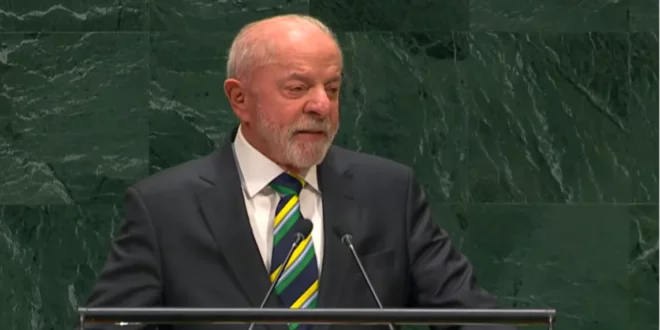
As Trump chose the path of barbarism, threatening to annihilate the Islamic Republic and dismantling international institutions, Lula took the UN pulpit to defend another path: diplomacy, dialogue and civilisation, and questioned a foundational idea of International Relations.
The main international politics and geopolitical messages in Lula’s UN General Assembly speech can be summarised as follows:
UN credibility and the crisis of multilateralism:Lula argues that the UN is failing in its central mission of preventing war, with Security Council paralysis and the veto power of the great powers undermining its legitimacy.
Great-power politics versus international law:He criticises what he describes as the growing acceptance of the “law of the stronger”, arguing that powerful states cannot treat international rules as optional. He presents this not as idealism but as a matter of political realism.
The international system is being destabilised by great-power rivalry, unilateralism, military rearmament and the erosion of international law
A new global arms race:Lula warns that the number of armed conflicts has reached its highest level since the Second World War and that enormous resources are being directed toward rearmament, increasing the risk that regional wars could become global conflicts.
Multilateralism versus unilateralism:One of his central geopolitical choices is between multilateralism and unilateralism, alongside democracy versus extremism and sovereignty versus subordination. Brazil presents itself as defending a rules-based, more plural international order.
Gaza and the Middle East:Lula strongly criticises Israel’s conduct in Gaza while also condemning Hamas’s attacks on Israeli civilians. He argues that pressure against the ICC weakens accountability and warns that settlements in the West Bank are undermining the possibility of a two-state solution.
Hormuz and the global economic consequences of war:The conflict around the Strait of Hormuz is presented not simply as a regional security issue but as a threat to global trade, with higher prices for fuel, fertilisers and food affecting populations worldwide.
Russia–Ukraine: diplomacy rather than military victory:Lula argues that the Russia–Ukraine war has produced a continuing humanitarian tragedy and that there will be no winners on the battlefield. He highlights the Friends of Peace initiative involving Brazil and China as an example of diplomatic efforts outside the traditional Western framework.
Brazil rejects a U.S.-dominated regional hierarchy:In Latin America, Lula emphasises the asymmetry created by geographical proximity to the world’s leading military power and warns against renewed hegemonic tendencies. His formulation is explicit:“Brazil does not fit in anyone’s backyard.”
Latin American strategic autonomy:Brazil calls for regional partners focused on development rather than ideological alignment. Lula argues that ideological differences should not prevent greater regional integration.
Opposition to foreign interference and spheres of influence:He criticises interference in electoral processes, the division of the world into zones of influence, and what he describes as neocolonial incursions for strategic resources. Sovereignty and the right of peoples to determine their own political future are recurring themes.
Venezuela, Nicaragua, Haiti and Cuba:Lula links several Latin American crises to the broader question of sovereignty and international pressure. He says Venezuelans should determine their own destiny, criticises restrictions on opposition participation in Nicaragua, highlights the international community’s response to Haiti, and condemns the economic and energy embargo against Cuba.
Contesting a foundational idea of International Relations
Lula’s statement —“War is not the continuation of politics by other means. It is the complete breakdown of politics.”— can be read as a direct challenge to the famous proposition of Prussian military theorist Carl von Clausewitz that war is the continuation of politics by other means. In Lula’s formulation, the relationship is reversed: war does not represent the successful extension of political strategy; it demonstrates that political mechanisms have failed.
This matters for contemporary IR because Clausewitz’s proposition has profoundly influenced strategic thinking, particularly the idea that military force can be an instrument of state policy. Lula’s formulation questions this logic by placing diplomacy, negotiation and political compromise before military power. Once political mechanisms collapse, military confrontation becomes possible — but that does not make war a continuation of politics in any constructive sense.
The distinction also challenges a more realist conception of international politics, in which states operate in an anarchic international system, pursue national interests and retain military power as an essential instrument of survival. Lula does not deny power politics; indeed, he explicitly refers to the realities of power. But he rejects the idea that accepting the logic of force is necessarily the most realistic response. His argument is that, in an interdependent world, genuine realism requires states to reconcile national interests with broader international interests.
This produces an important conceptual tension:is realism about accepting the inevitability of power competition, or about preventing power competition from becoming war? Lula clearly favours the latter interpretation.
His argument also reflects a broader contestation of Western-centric IR theory. Much of traditional IR theory was constructed around European experiences of interstate war, balance-of-power politics and great-power competition. Lula’s intervention introduces another perspective: that of a major Global South country whose historical experience includes colonialism, slavery, military dictatorship, economic dependency and struggles over sovereignty. From this perspective, the international system cannot be understood exclusively through the strategic calculations of great powers.
That is why the statement connects naturally with Lula’s other formulation:“multilateralism or unilateralism, democracy or extremism, sovereignty or subordination.” The underlying argument is that international politics should not be reduced to the distribution of military capabilities. Institutions, diplomacy, sovereignty, international law and political negotiation are themselves instruments of power — and potentially instruments for preventing war.
There is therefore a deeper theoretical proposition behind Lula’s words:
If politics is understood as the management of competing interests through negotiation, institutions and compromise, then war represents not the continuation of politics but the failure of those mechanisms.
This does not eliminate the role of power or conflict from international relations. Rather, it redefines what “realism” should mean: not simply preparing for war, but recognising the enormous political, economic and humanitarian costs of allowing conflicts to reach the point where military force becomes the principal instrument.
That makes Lula’s sentence potentially one of the most intellectually significant parts of the speech. It is not simply a call for peace. It is an implicit challenge to the theoretical hierarchy that places military power at the centre of international politics and diplomacy in a secondary role.
The overarching geopolitical message
Lula’s central message is that the international system is being destabilised by great-power rivalry, unilateralism, military rearmament and the erosion of international law. His answer is a more genuinely multilateral and multipolar order in which sovereignty, diplomacy and the Global South have greater weight, and in which no major power—whether the United States or another—can dictate the choices of other nations.