 Eurasia Press & News
Toplines
Russian officials largely condemned the February 28 US and Israeli strikes against Iran, consistent with Russian rhetoric around the June 2025 Israel-Iran war. Russian Foreign Minister Sergey Lavrov had a phone call with Iranian Foreign Minister Abbas Araghchi following the strikes on Iran on February 28 in which Lavrov condemned the strikes, calling for the United States and Israel to immediately cease all hostilities and resume efforts for a diplomatic solution to resolve the issues among the United States, Iran, and Israel.[1] The Russian Ministry of Foreign Affairs (MFA) issued a similar condemnation on February 28, calling the strikes unprovoked and a violation of international law.[2] The MFA criticized the United States and Israel for conducting the strikes after recently pursuing efforts to negotiate with Iran and claimed that the strikes violate international law and risk regional and global destabilization. The MFA criticized Israel for allegedly posturing to Russia that Israel had no interest in armed aggression against Iran prior to the strikes. The MFA called for a return to diplomacy and expressed Russia’s willingness to help facilitate renewed talks. Russian Security Council Deputy Chairperson Dmitry Medvedev directly criticized US President Donald Trump for striking Iran, claiming on his English and Russian language social media channels that the “peacekeeper” has “shown his true colors.”[3] Russian State Duma International Affairs Committee Chairperson Leonid Slutsky and International Affairs Committee First Deputy Head Alexei Chepa, whose target audience is the Russian population and who often act as bullhorns for the Kremlin’s true diplomatic and military aims, similarly criticized US aims in striking Iran and called for both the United Nations Security Council (UNSC) and the broader international community to intervene in situation to stop the strikes.[4] Chepa expressed hope that the United States will become preoccupied with the conflict in Iran and “forget” about Ukraine and assessed that the new conflict will likely delay a peace deal in Ukraine.[5]
Russia’s boilerplate condemnations of the strikes against Iran highlight the continued limits of Russia’s ability to support Iran and the asymmetry of the Russian-Iranian relationship. Russia issued similar condemnations of the June 2025 war and was unable to provide Iran with more support in defending against Israeli and later US strikes.[6] Russia’s war in Ukraine is constraining Russia’s ability to provide military support to Iran, also highlighting how Russia has become less reliant on Iran for its war effort in Ukraine over time as Russia has indigenized the production of much of what it previously imported from Iran and has subsequently become much more reliant on North Korea.[7] The Kremlin has to balance competing interests of sustaining its relationship with its allies, including Iran, while also attempting to reset the US-Russia relationship on Russia’s terms, including avoiding additional US sanctions.[8]
Ukrainian authorities implicated soldiers and the commander of the Russian 136th Motorized Rifle Brigade (58th Combined Arms Army, Southern Military District) for using chemical agents in Vovchansk, Kharkiv Oblast from September 2024 to June 2025 in violation of international law. Ukraine’s Security Service (SBU) reported on February 27 that 136th Motorized Rifle Brigade Commander Colonel Ruslan Nazarenko gave orders to fire K-51 and RG-Vo aerosol grenades containing CS gas (chlorobenzalmalononitrile) and CN gas (Chloroacetophenone) on Ukrainian positions using drone drops at least 14 times from September 2024 to June 2025.[9] The SBU also identified eight Russian soldiers in the 136th Motorized Rifle Brigade who used the munitions. CS and CN gases are classified as riot control agents (RCA), the usage of which violates the Chemical Weapons Convention (CWC) to which Russia is a signatory.[10] ISW observed reports that Russian forces significantly increased their usage of RCAs against Ukrainian forces throughout 2024 and 2025 in violation of the CWC.[11]
Key Takeaways
Russian officials largely condemned the February 28 US and Israeli strikes against Iran, consistent with Russian rhetoric around the June 2025 Israel-Iran war.
Russia’s boilerplate condemnations of the strikes against Iran highlight the continued limits of Russia’s ability to support Iran and the asymmetry of the Russian-Iranian relationship.
Ukrainian authorities implicated soldiers and the commander of the Russian 136th Motorized Rifle Brigade (58th Combined Arms Army, Southern Military District) for using chemical agents in Vovchansk, Kharkiv Oblast from September 2024 to June 2025 in violation of international law.
Ukrainian and Russian forces both recently advanced in the Kostyantynivka-Druzhkivka tactical area and near Hulyaipole.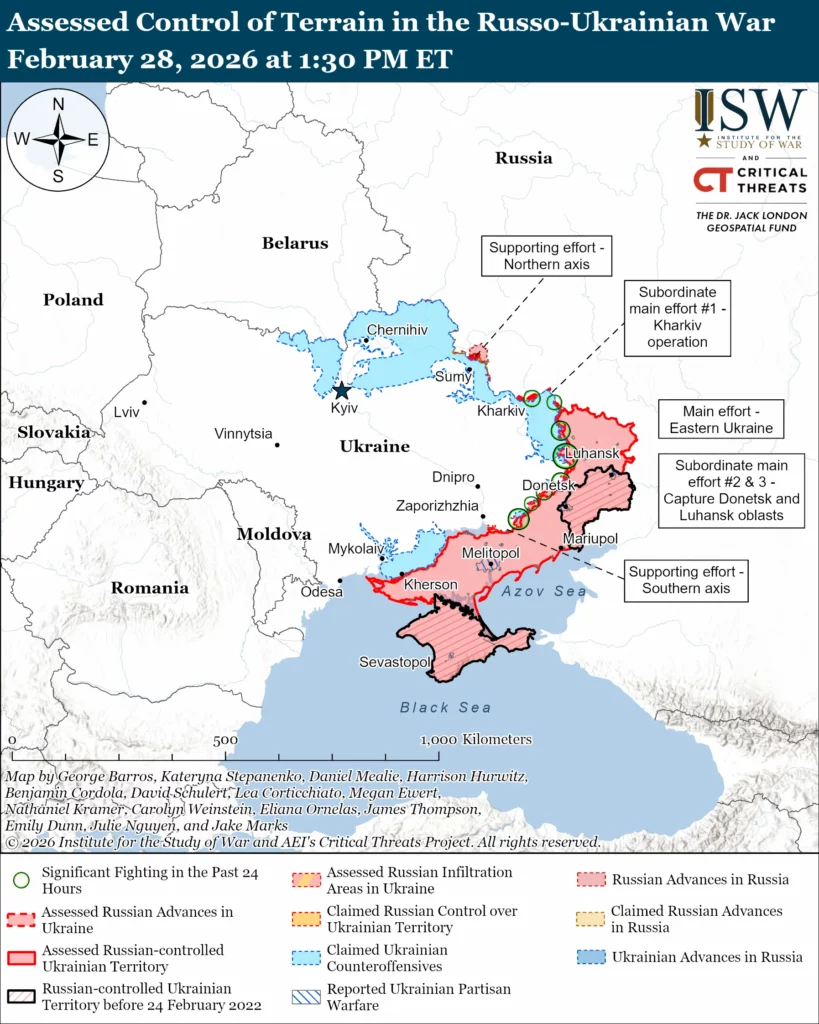
We do not report in detail on Russian war crimes because these activities are well-covered in Western media and do not directly affect the military operations we are assessing and forecasting. We will continue to evaluate and report on the effects of these criminal activities on the Ukrainian military and the Ukrainian population and specifically on combat in Ukrainian urban areas. We utterly condemn Russian violations of the laws of armed conflict and the Geneva Conventions and crimes against humanity even though we do not describe them in these reports.
Ukrainian Operations in the Russian Federation
Ukrainian forces continued their frontline and mid-range strike campaign against Russian military assets in Russia on the night of February 27 to 28. The Ukrainian General Staff reported that Ukrainian forces struck a Russian manpower concentration near Dronovka, Belgorod Oblast (roughly two kilometers from the international border).[12] Geolocated footage published on February 28 shows Ukrainian forces conducting a Darts drone strike reportedly against a Russian Pantsir-S1 air defense system in Dubovoe, Belgorod Oblast (roughly 28 kilometers from the international border).[13]
Russian Supporting Effort: Northern Axis
Russian objective: Create defensible buffer zones in Sumy Oblast along the international border
Russian forces continued offensive operations in northern Sumy Oblast on February 28 but did not advance.
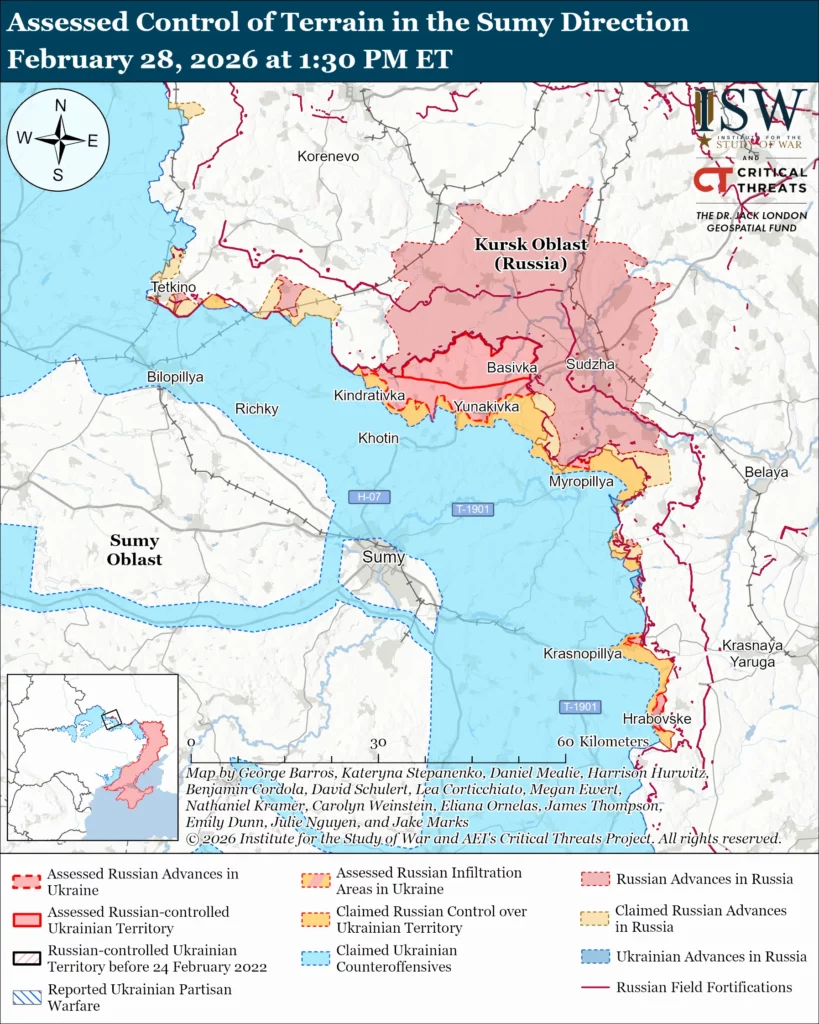
Russian milbloggers claimed that Russian forces attacked in Sumy and Kursk oblasts, including north of Sumy City near Oleksiivka, Andriivka, and Varachyne and northeast of Sumy City near Kostyantynivka on February 27 and 28.[14]
Order of Battle: Drone operators of the Russian Rubikon Center for Advanced Unmanned Technologies are reportedly striking Ukrainian forces in the Sumy direction.[15] Elements of the 1434th Akhmat-Chechnya Regiment (42nd Motorized Rifle Division, 58th Combined Arms Army [CAA], Southern Military District [SMD]) are reportedly operating in the Sumy direction.[16]
Russian Main Effort: Eastern Ukraine
Russian Subordinate Main Effort #1 – Kharkiv Oblast
Russian objective: Push Ukrainian forces back from the international border to create a defensible buffer zone with Belgorod Oblast and approach to within tube artillery range of Kharkiv City
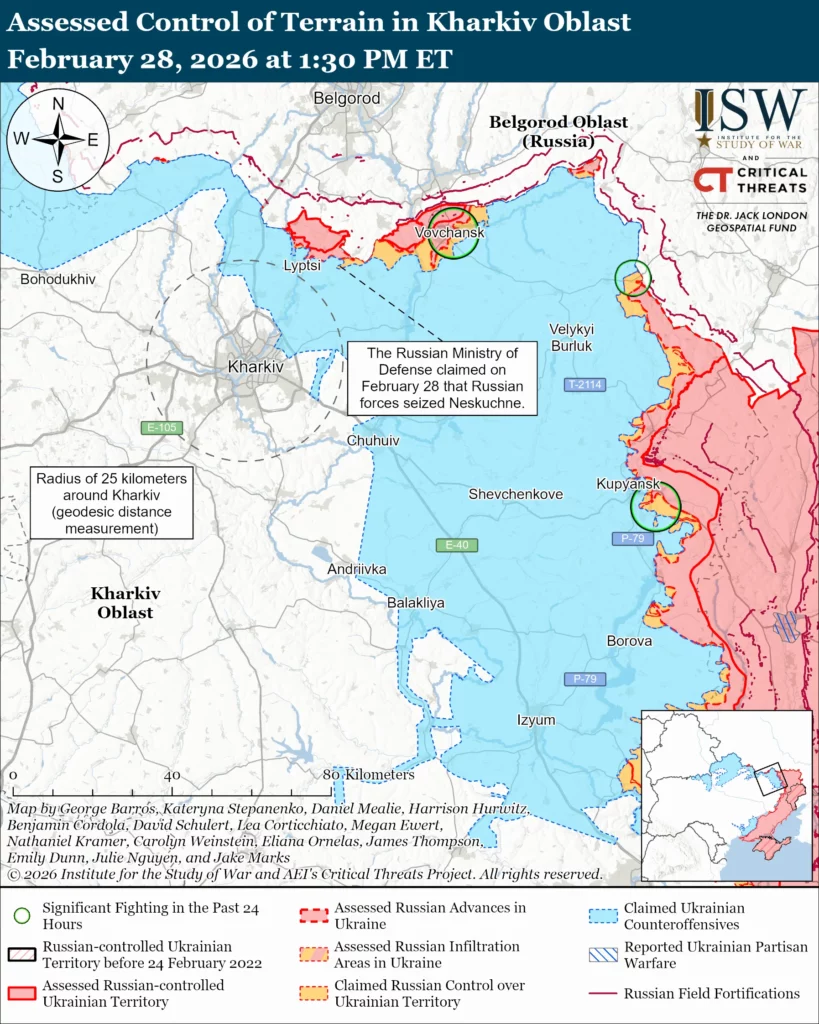
Russian forces continued offensive operations in northern Kharkiv Oblast on February 28 but did not make confirmed advances.
Unconfirmed claims: The Russian Ministry of Defense (MoD) claimed that elements of the Russian 9th Motorized Rifle Regiment (18th Motorized Rifle Division, 11th Army Corps [AC], Leningrad Military District [LMD]) seized Neskuchne (northeast of Kharkiv City).[17]
Russian forces attacked northeast of Kharkiv City near Vovchansk, Vovchanski Khutory, Zybyne, Symynivka, Zelene, Hrafske, Starytsya, Synelnykove, and Hrafske and toward Izbytske on February 27 and 28.[18]
Russian forces continued offensive operations southeast of Velykyi Burluk near Chuhunivka on February 28 but did not advance.[19]
Russian Subordinate Main Effort #2 – Oskil River
Russian objective: Cross the Oskil River in Kharkiv Oblast and push westward into eastern Kharkiv Oblast and northern Donetsk Oblast
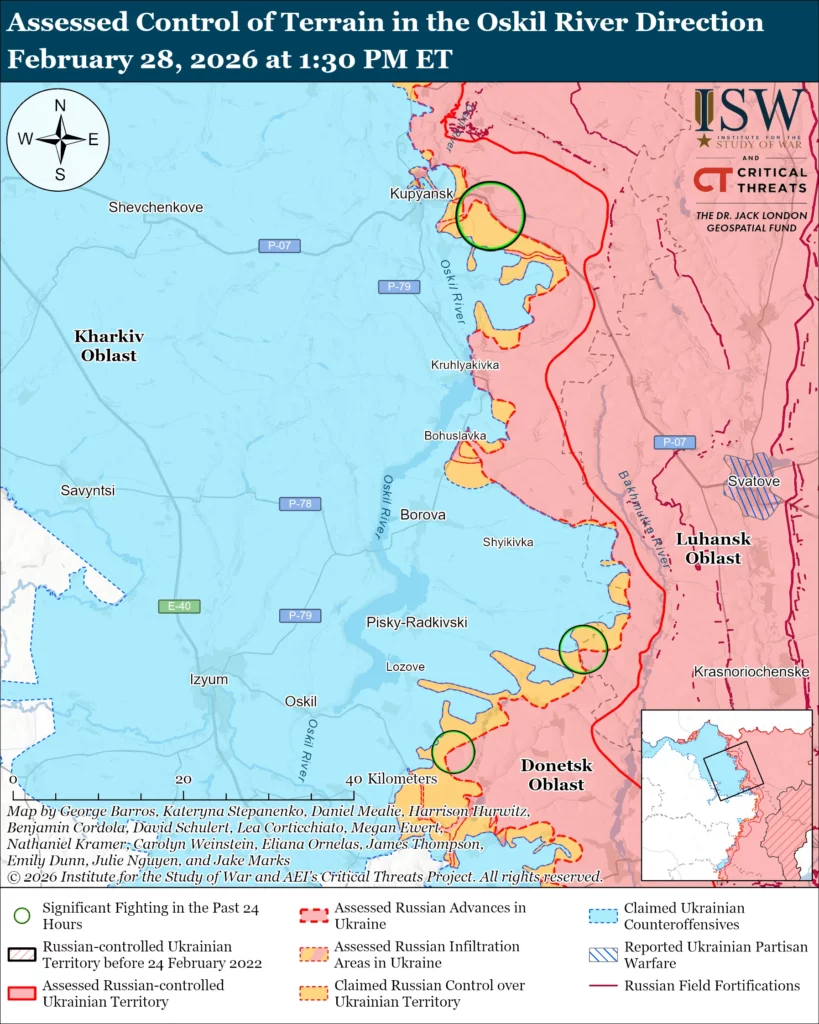
Russian forces continued offensive operations in the Kupyansk direction on February 29 but did not advance.
Russian forces attacked south of Kupyansk near Kupyansk-Vuzlovyi and southeast of Kupyansk near Kurylivka on February 27 and 28.[20]
Order of Battle: Drone operators of the Russian Rubikon Center for Advanced Unmanned Technologies are conducting reconnaissance west of Kupyansk-Vuzlovyi.[21] Elements of the 68th Motorized Rifle Division (6th Combined Arms Army [CAA], Leningrad Military District [LMD]) are reportedly operating in Kupyansk.[22]
Russian forces continued offensive operations in the Borova direction on February 28 but did not advance.Russian forces attacked north of Borova near Novoplatonivka, Bohuslavka, and Borivska Andriivka; northeast of Borova near Kruhlyakivka; southeast of Borova near Chervonyi Stav and Novoyehorivka; and south of Borova near Oleksandrivka on February 27 and 28.[23]
Russian Subordinate Main Effort #3 – Donetsk Oblast
Russian objective: Capture the entirety of Donetsk Oblast, the claimed territory of Russia’s proxies in Donbas, and advance into Dnipropetrovsk Oblast
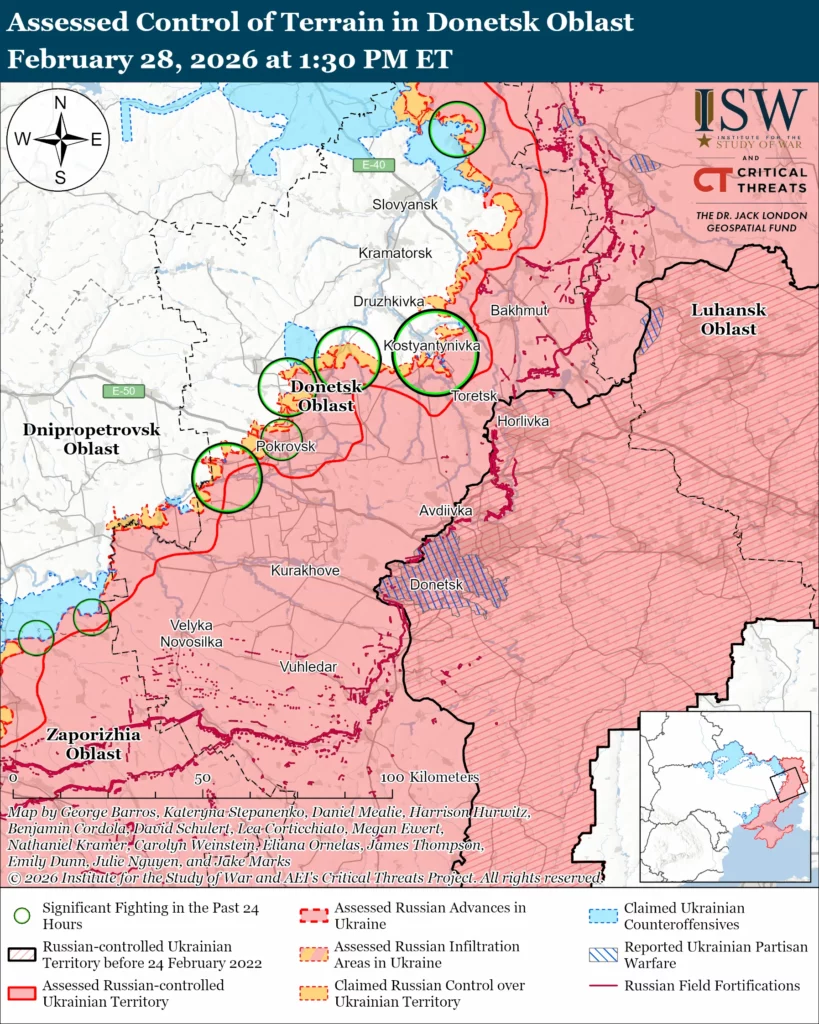
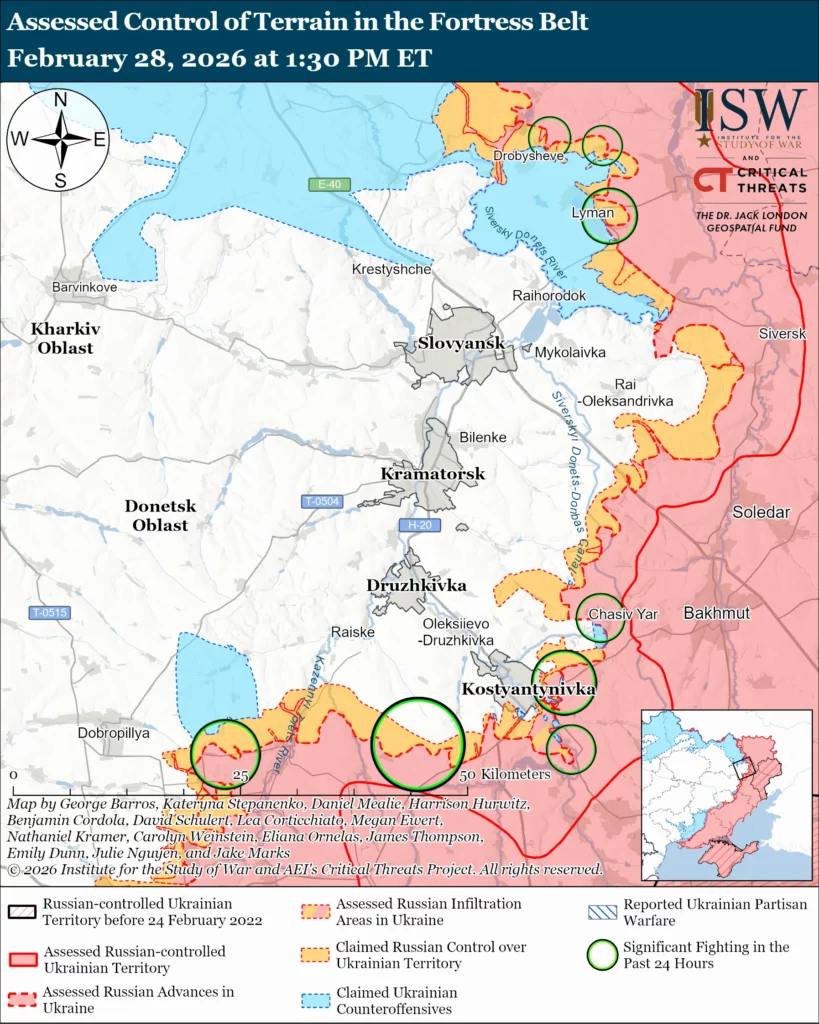
Russian forces continued offensive operations in the Slovyansk direction on February 28 but did not advance.
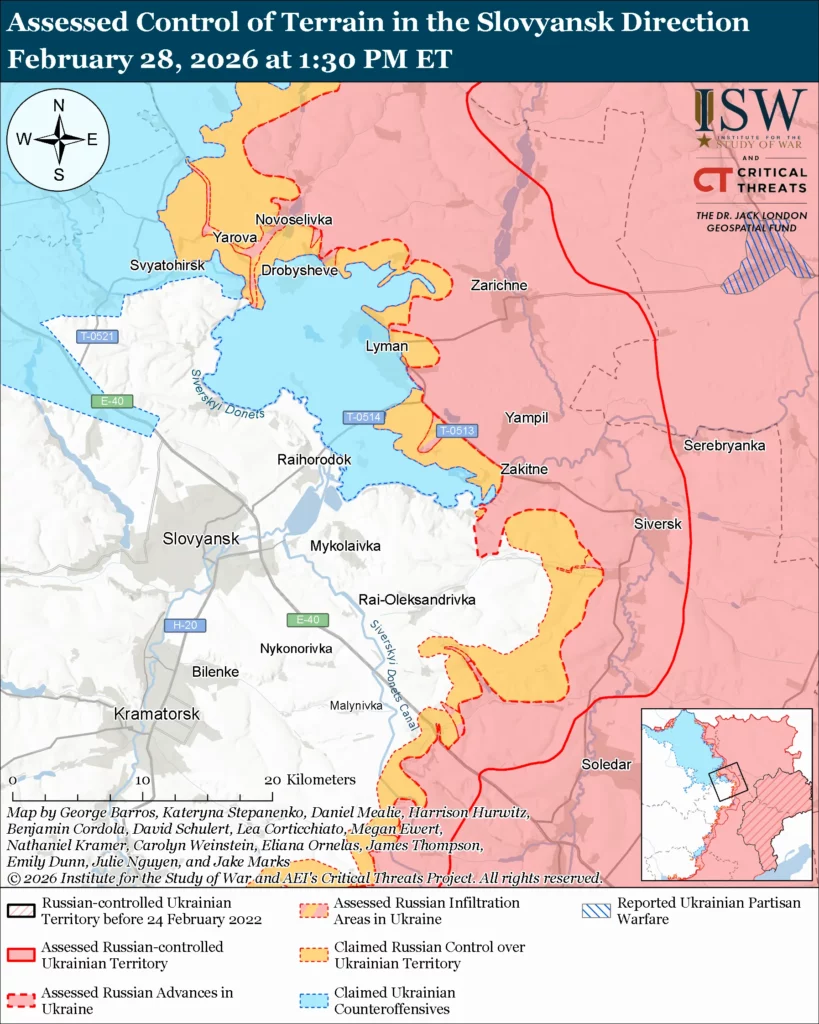
Russian forces attacked near Lyman itself; northwest of Lyman near Novoselivka, Svyatohirsk, Yarova and Sosnove; north of Lyman near Drobysheve and Stavky; northeast of Lyman near Dronivka; east of Lyman near Zarichne; south of Lyman toward Staryi Karavan and Brusivka; northeast of Slovyansk near Zakitne; east of Slovyansk near Siversk, Kryva Luka, and Riznykivka and toward Rai-Oleksandrivka; and southeast of Slovyansk near Fedorivka Druha on February 27 and 28.[24]
A Ukrainian servicemember operating in the Slovyansk direction reported on February 28 that the Russian military command is deploying reinforcements to the Slovyansk direction.[25] The servicemember noted that Russian forces are attacking more intensely in the Slovyansk direction, including in a highly attritional infantry-led assault tactic, and speculated that Russian forces aim to encircle Ukrainian forces in Slovyansk and Kramatorsk. ISW continues to assess that the Russian military command’s decision to deploy reinforcements in the Slovyansk direction is a likely indicator that Russia plans to prioritize offensive operations against the Fortress Belt from the northeast in an anticipated Spring-Summer 2026 offensive.[26]
A Russian milblogger reporting on the Russian Western Grouping of Forces claimed on February 27 that fighting continues for Drobysheve despite footage of a Russian flag in the settlement.[27] The milblogger claimed that the situation is similar to Kupyansk in that Russian sources claimed to have seized the town multiple times without ever having full control over it. Another Russian milblogger rejected on February 27 the claim that this footage indicates that Russian forces seized Drobysheve.[28]
Ukrainian and Russian forces recently advanced in the Kostyantynivka-Druzhkivka tactical area.
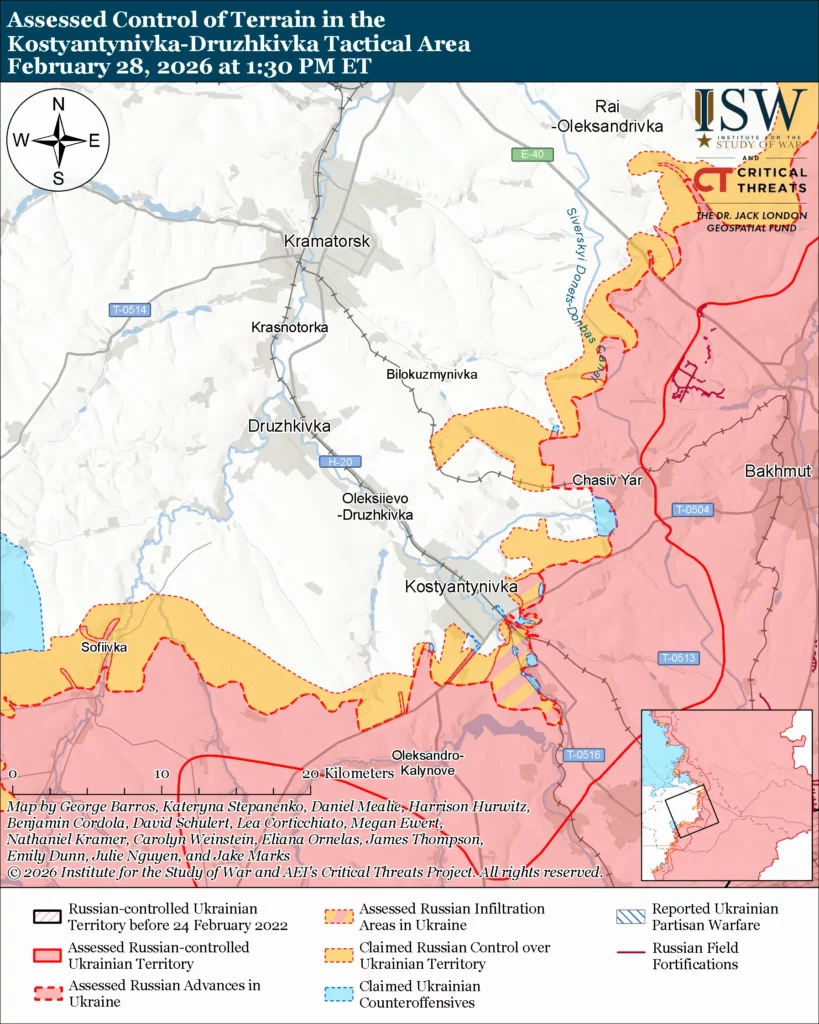
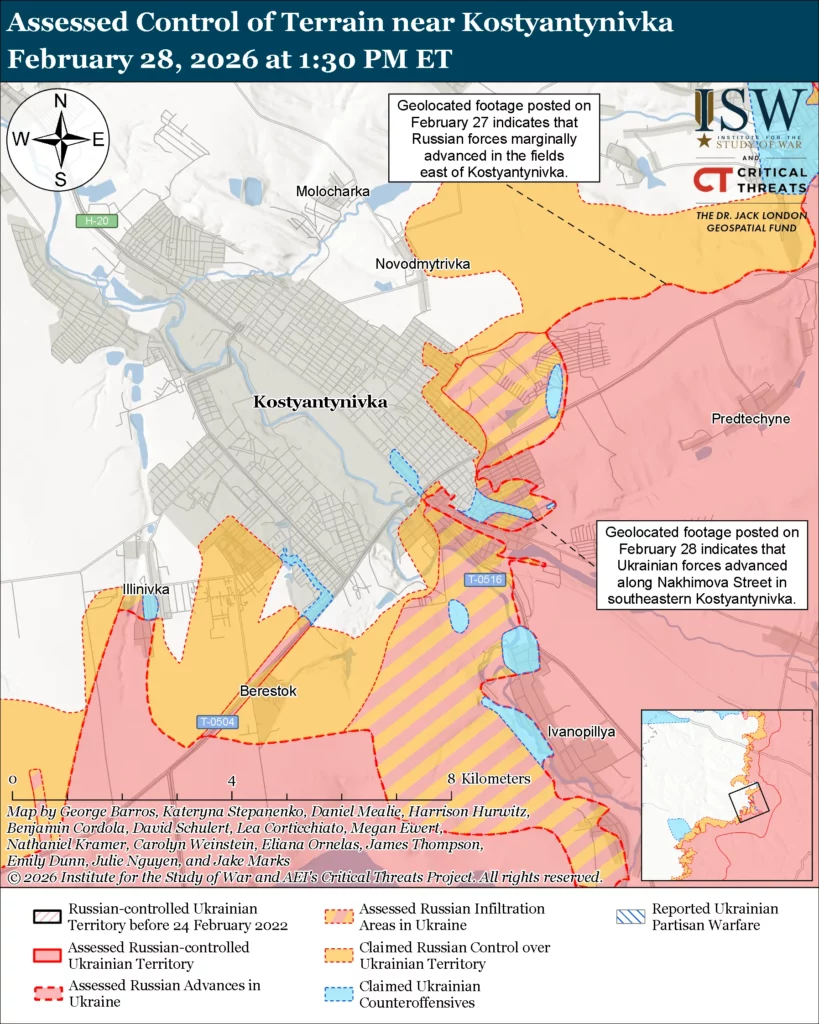
Assessed Ukrainian advances: Geolocated footage published on February 27 indicates that Ukrainian forces recently advanced in southeastern Kostyantynivka.[29]
Assessed Russian advances: Geolocated footage published on February 27 indicates that Russian forces recently marginally advanced east of Kostyantynivka.[30]
Russian forces attacked near Kostyantynivka itself; north of Kostyantynivka toward Malynivka; northeast of Kostyantynivka near Chasiv Yar, Minkivka, and Markove; east of Kostyantynivka near Predtechyne; southeast of Kostyantynivka near Pleshchiivka and Ivanopillya; south of Kostyantynivka near Illinivka; southwest of Kostyantynivka near Stepanivka; south of Druzhkivka near Rusyn Yar and Popiv Yar; and southwest of Druzhkivka near Sofiivka, Pavlivka, and Novopavlivka on February 27 and 28.[31] A Russian milblogger claimed that Ukrainian forces counterattacked near Novopavlivka.[32]
Geolocated footage published on February 27 shows Russian forces conducting a FAB-3000 guided glide bomb strike against Ukrainian forces in southwestern Kostyantynivka.[33]
Order of Battle: Drone operators and other elements of the Russian BARS-13 Pisarev Detachment (Russian Combat Army Reserve) and of the Khugin Drone Company of the 4th Motorized Rifle Brigade (3rd Combined Arms Army [CAA], formerly 2nd Luhansk People’s Republic Army Corps [LNR AC], Southern Military District [SMD]) are striking Ukrainian forces and intercepting Ukrainian drones in southeastern and western Kostyantynivka.[34] First-person view (FPV) drone operators of the 68th Separate Reconnaissance Battalion of the 20th Motorized Rifle Division (8th CAA, SMD) are reportedly striking Ukrainian forces near Mykolaipillya (south of Druzhkivka), Staroraiske, and Havrylivka (both west of Druzhkivka).[35]
Russian forces continued offensive operations in the Dobropillya tactical area on February 28 but did not advance.
Russian forces attacked northeast of Dobropillya toward Kucheriv Yar, east of Dobropillya near Novyi Donbas, Toretske, and Nove Shakhove, and southeast of Dobropillya near Dorozhnie on February 27 and 28.[36]
Order of Battle: Elements of the Russian 150th Motorized Rifle Division (8th CAA, SMD) are reportedly attacking toward Kucheriv Yar.[37] Elements of the 177th Separate Naval Infantry Regiment (Caspian Flotilla) are reportedly operating in the Dobropillya direction.[38]
Russian forces continued offensive operations in the Pokrovsk direction on February 28 but did not advance.
Russian forces attacked near Pokrovsk itself; northwest of Pokrovsk near Hryshyne and toward Novooleksandrivka; north of Pokrovsk near Rodynske and Bilytske and toward Shevchenko; east of Pokrovsk near Myrnohrad; and southwest of Pokrovsk near Udachne, Molodetske, and Novopidhorodne on February 27 and 28.[39]
The Ukrainian General Staff reported on February 28 that Ukrainian forces struck a Russian manpower concentration near Rodynske.[40] Geolocated footage published on February 28 shows Ukrainian forces striking a Russian BM-21 Grad multiple launch rocket system (MLRS) in Novoekonomichne (east of Pokrovsk, roughly eight kilometers from the frontline).[41]
An officer of a Ukrainian unmanned systems detachment reported on February 28 that Russian forces attack with small groups in light armored vehicles when the weather is cold, but that Russian forces do not use equipment to attack when the swamps are gone.[42]
Order of Battle: Drone operators of the Russian Rubikon Center for Advanced Unmanned Technologies are striking Ukrainian forces in Svitle (north of Pokrovsk).[43] Drone operators of the 76th Airborne (VDV) Division are reportedly striking Ukrainian forces in the Pokrovsk direction.[44]
Russian forces continued offensive operations in the Novopavlivka direction on February 28 but did not advance.
Russian forces attacked near Novopavlivka itself and northeast of Novopavlivka near Muravka on February 27 and 28.[45] A Russian milblogger claimed that Ukrainian forces counterattacked in Novopavlivka.[46]
The Ukrainian 9th Army Corps refuted on February 28 the Russian Ministry of Defense’s (MoD) February 27 claim that Russian forces seized Bilyakivka (northeast of Novopavlivka).[47]
Russian forces continued offensive operations in the Oleksandrivka direction on February 28 but did not advance.
Russian forces attacked and southeast of Oleksandrivka near Ternove and toward Orestopil on February 27 and 28.[48] Russian milbloggers claimed that Ukrainian forces counterattacked near Orestopil, Havrylivka (northeast of Oleksandrivka), Oleksandrohrad, and Novooleksandrivka (both southeast of Oleksandrivka).[49]
The spokesperson of a Ukrainian brigade operating in the Oleksandrivka direction reported on February 28 that Russian forces recently rotated in new personnel, primarily consisting of young recruits with poor knowledge of the frontline.[50] The spokesperson reported that the Russian military command typically returns to conducting highly attritional infantry-led assaults when new reinforcements rotate in. The spokesperson noted that ice melting and water features are impeding Russian assaults in the brigade’s area of responsibility (AoR).Ukrainian forces continue their short-, mid-, and long-range strike campaign against Russian military targets in occupied Donetsk Oblast. The Ukrainian General Staff reported on February 28 that Ukrainian forces struck a Russian logistical support depot near occupied Bahatyr (roughly 14 kilometers from the frontline) and a forward command post of the Russian 127th Motorized Rifle Division (5th CAA, Eastern Military District [EMD]) near occupied Orlynske (roughly 30 kilometers from the front line) on February 27.[51] The Ukrainian General Staff reported that Ukrainian forces struck a fuel and lubricants depot of an unspecified Russian motorized rifle regiment near occupied Novoamvrosiivske (roughly 90 kilometers from the frontline) and an ammunitions depot of a Russian separate motorized rifle brigade near occupied Amvrosiivka (roughly 95 kilometers from the frontline) overnight on February 27 to 28. The Ukrainian General Staff reported on February 28 that Ukrainian forces also struck a Russian manpower concentration near Berezove (southeast of Oleksandrivka).[52] Ukrainian National Guard Commander Brigadier General Oleksandr Pivnenko reported on February 28 that Ukrainian forces struck two Russian BM-21 Grad multiple launch rocket systems (MLRSs) in occupied Donetsk Oblast, causing fires to both systems.[53]
Russian Supporting Effort: Southern Axis
Russian objective: Maintain frontline positions, secure rear areas against Ukrainian strikes, and advance within tube artillery range of Zaporizhzhia City
Ukrainian and Russian forces recently advanced in the Hulyaipole direction.
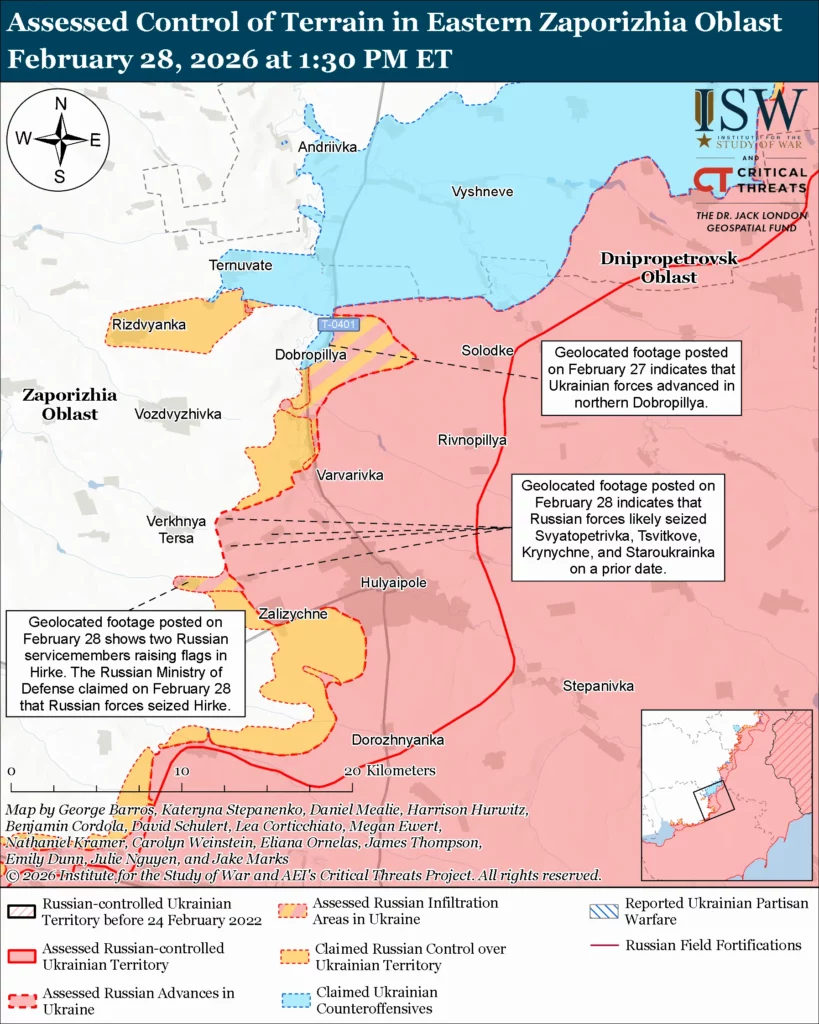
Assessed Ukrainian advances: Geolocated footage published on February 27 indicates that Ukrainian forces recently advanced in northern Dobropillya (northwest of Hulyaipole).[54]
Assessed Russian advances: Geolocated footage published on February 28 shows Russian forces operating in Hirke (west of Hulyaipole), indicating that Russian forces likely seized Tsvitkove, Svyatopetrivka, Krynychne, Staroukrainka, and Zaliznychne (all northeast to east of Hirke) on a prior date.[55]
Assessed Russian infiltrations: The geolocated footage published on February 28 shows one Russian servicemember of the 60th Motorized Rifle Brigade (5th Combined Arms Army [CAA], Eastern Military District [EMD]) raising a Russian flag in Hirke during what ISW assesses was a Russian infiltration mission that did not change the control of terrain or the forward edge of the battle area (FEBA) at this time.[56] The Russian Ministry of Defense (MoD) claimed that elements of the 60th Separate Motorized Rifle Brigade seized Hirke.[57]
Russian forces attacked near Hulyaipole itself; northwest of Hulyaipole near Dobropillya, Olenokostyantynivka, Ternuvate, Zelene, Svyatopetrivka, Rizdvyanka, and Varvarivka and toward Pryluky, Vozdvyzhivka, and Verkhnya Tersa; northeast of Hulyaipole near Zlahoda; and west of Hulyaipole near Staroukrainka, Hirke, and Zaliznychne on February 27 and 28.[58] A Russian milblogger claimed that Ukrainian forces counterattacked near Ternuvate.[59]
Geolocated footage published on February 27 shows drone operators of the Russian 37th Motorized Rifle Brigade (36th CAA, EMD) interdicting a Ukrainian ground line of communication (GLOC) along the T-0401 Pokrovske-Hulyaipole highway in Dobropillya.[60]
Order of Battle: Elements of the 38th Motorized Rifle Brigade (35th CAA, EMD) are reportedly operating in Zaporizhia Oblast.[61]
Russian forces continued offensive operations in western Zaporizhia Oblast on February 28 but did not advance.
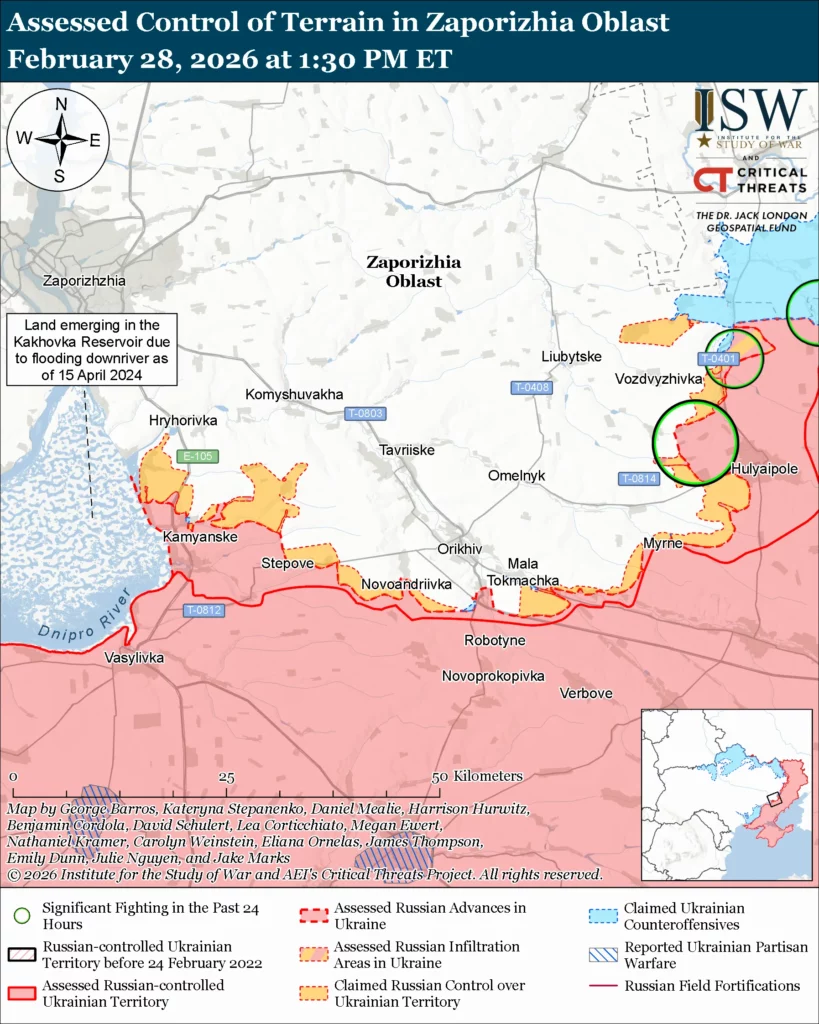
Russian forces attacked northeast of Orikhiv near Myrne and Hulyaipilske; west of Orikhiv near Stepnohirsk; and northwest of Orikhiv near Mahdalynivka, Lukyanivske, and Zapasne on February 27 and 28.[62]
Geolocated footage published on February 28 shows a Russian FAB-3000 guided aerial bomb strike on the T-0803 bridge over the Kinska River between Orikhiv and Preobrazhenka (immediately north of Orikhiv).[63]
Order of Battle: Lancet loitering munition operators of the Russian 291st Artillery Brigade (58th CAA, Southern Military District [SMD]) are striking Ukrainian positions north of Preobrazhenka (north of Orikhiv).[64] Reconnaissance drone operators of the 42nd Motorized Rifle Division (58th CAA) are spotting for Russian airstrikes between Orikhiv and Preobrazhenka.[65] First-person view (FPV) drone operators of the Nemets group of the 3rd Assault Company of the 291st Motorized Rifle Regiment (42nd Motorized Rifle Division) are reportedly striking Ukrainian forces near and within Orikhiv.[66] Elements of the 7th and the 104th Airborne (VDV) divisions are reportedly operating in the Zaporizhia direction.[67]
Neither Ukrainian nor Russian sources reported ground activity in the Kherson direction on February 28.
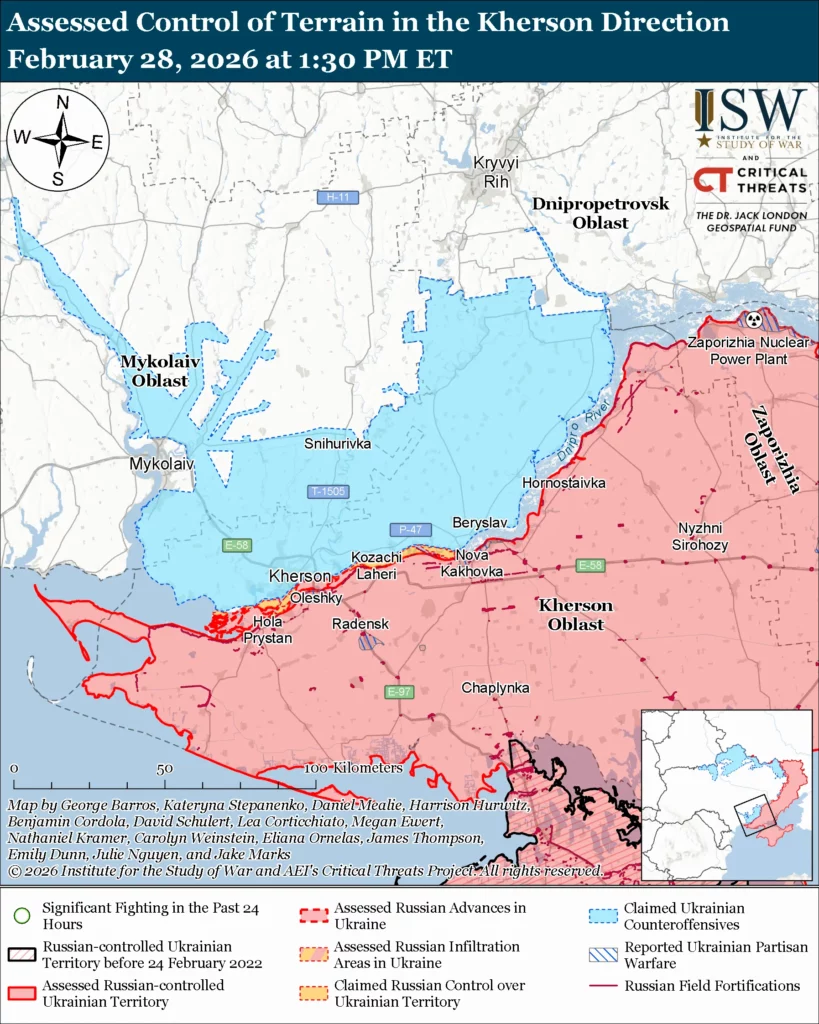
Order of Battle: Drone operators of the Russian 98th VDV Division, including its 331st VDV Regiment, are reportedly striking Ukrainian energy infrastructure and Ukrainian forces in the Kherson direction.[68]
The Atesh Crimea-based Ukrainian partisan group reported on February 28 that Russian forces withdrew several Hrachonok-class project 21980 anti-sabotage vessels of the Russian 102nd Separate Naval Spetsnaz Detachment (Black Sea Fleet [BSF]) from Kostyantynivska Bay to Sevastopol’s territorial waters to protect them from Ukrainian drone strikes.[69] Atesh reported that the 102nd Separate Naval Spetsnaz Detachment protects key facilities, including the Kerch Strait Bridge, from underwater sabotage and is hiding the vessels under infrastructure objects to conceal them from Ukrainian drones.
Ukrainian forces continue their long-range strike campaign against Russian military assets in occupied Kherson Oblast. The Ukrainian General Staff reported on February 28 that Ukrainian forces struck a Russian logistics warehouse near Kalanchak (roughly 90 kilometers from the frontline) and a fuel and lubricants depot near Myrne (either about 40 or 65 kilometers from the frontline), both in occupied Kherson Oblast.[70]
Russian Air, Missile, and Drone Campaign
Russian Objective: Target Ukrainian military and civilian infrastructure in the rear and on the front line
Russian forces conducted a series of drone and missile strikes against Ukraine on the night of February 27 to 28. The Ukrainian Air Force reported that Russian forces launched one Iskander-M ballistic missile from Voronezh Oblast and 105 Shahed-type, Gerbera-type, Italmas-type, and other drones — of which roughly 60 were Shaheds — from the directions of Bryansk, Kursk, and Oryol cities; Shatalovo, Smolensk Oblast; Primorsko-Akhtarsk, Krasnodar Krai; Millerovo, Rostov Oblast; and occupied Hvardiiske, Crimea and Donetsk City.[71] The Ukrainian Air Force reported that Ukrainian forces downed 96 drones as of 0800 local time and that six drones and downed debris struck seven locations. Ukrainian officials reported that Russian strikes damaged civilian and residential infrastructure in Kharkiv City and Kharkiv Oblast.[72]
Significant Activity in Belarus
Russian efforts to increase its military presence in Belarus and further integrate Belarus into Russian-favorable frameworks
Nothing Significant To Report.
Note: ISW does not receive any classified material from any source, uses only publicly available information, and draws extensively on Russian, Ukrainian, and Western reporting and social media as well as commercially available satellite imagery and other geospatial data as the basis for these reports. References to all sources used are provided in the endnotes of each update.