 Eurasia Press & News
Toplines
Ukrainian forces damaged a Russian frigate and other Russian warships during March 1 to 2 overnight strikes against the Russian naval base in Novorossiysk, Krasnodar Krai. A Ukrainian open-source intelligence (OSINT) analyst reported on March 4 that the Ukrainian drone strike against the Novorossiysk naval base damaged PK-10 passive jamming systems, a TK-25 electronic warfare (EW) system, and illumination radars on the Russian Project 11356R Admiral Grigorovich-class frigate Admiral Essen.[1] The analyst assessed that the strike also likely damaged the frigate’s main Fregat-M2M surveillance radar system. Sources in Ukraine’s Security Service (SBU) told Ukrainian broadcaster Suspilne on March 4 that the Ukrainian drone strikes damaged the Russian Project 266ME Akvamarin-class (NATO Nastya-class) minesweeper Valentin Pikul and the Project 1124M Albatros-class (NATO Grisha V-class) anti-submarine warfare (ASW) corvettes Yeysk and Kasimov in addition to killing three Russian sailors and wounding 14.[2] A source reportedly affiliated with Russian intelligence agencies claimed that the strike involved at least 200 Ukrainian aerial drones.[3] SBU sources told Suspilne on March 2 that the strikes also damaged the guidance radar of an S-300 air defense system, a Pantsir-S2 air defense system, and six of the terminal’s seven oil tankers.[4] ISW initially reported on this strike in its March 2 update.[5]
Russia is blaming Ukraine for a strike on a Russian tanker in the Mediterranean Sea, accusing Ukraine of “escalating” the war. Maritime security sources told Reuters on March 3 that the Russian-flagged liquefied natural gas (LNG) tanker Arctic Metagaz, which is under US and UK sanctions, caught fire in the Mediterranean Sea, with one source claiming without evidence that Ukraine carried out a naval drone strike against the tanker.[6] The Libyan Maritime Authority reported on March 4 that there were sudden explosions on the Arctic Metagaz, followed by a massive fire.[7] The Libyan Maritime Authority noted that the Arctic Metagaz was carrying 61,000 tons of LNG and completely sank roughly 240 kilometers off the coast of Sirte, Libya. The Russian Ministry of Transport accused Ukraine on March 4 of launching unmanned surface vehicles (USVs) from the coast of Libya to strike the Arctic Metagaz near Maltese territorial waters on March 3.[8] The Russian Ministry of Transport claimed that the tanker had departed from Murmansk with legally registered cargo. Russian officials accused Ukraine of “committing acts of terrorism” and of trying to exploit tensions in the Middle East to escalate conflicts, and threatened that Russia could retaliate by shutting down all shipping routes to Ukraine.[9] Russian officials frequently use the allegation of Ukrainian strikes to justify intensified strikes against Ukraine and to deflect blame away from Russia for stalled peace negotiations.[10]
The Kremlin is continuing its reflexive control campaign that aims to influence French and British nuclear strategy and Coalition of the Willing decision-making. Russian Ministry of Foreign Affairs (MFA) Spokesperson Maria Zakharova claimed on March 4 that French President Emmanuel Macron’s March 2 statement on the expansion of the French nuclear arsenal is “highly destabilizing” and claimed that NATO attempts to enhance nuclear deterrence are part of a trend of militarization under the guise of “anti-Russian” rhetoric.[11] Zakharova further criticized United Kingdom (UK)- and French-led European nuclear deterrence cooperation efforts as directed against Russia in the event of a future NATO-Russia conflict and claimed that such “uncontrolled expansion” requires “attention” in Russian military development and planning. Zakharova reiterated the Russian Foreign Intelligence Service (SVR)’s baseless February 24 claim that the UK and France are attempting to transfer a “dirty bomb” or nuclear weapon and delivery systems to Ukraine and stated that Russia “cannot accept” British and French refutations of the SVR’s claim.[12] Zakharova’s statements are part of the Kremlin’s reflexive control campaign — a method by which Russia attempts to make an opponent freely arrive at a pre-determined decision in the Kremlin’s interests — that is currently aimed at UK- and French-led efforts to provide Coalition of the Willing-backed security guarantees for Ukraine by threatening the UK and France with potential nuclear strikes.[13] The Kremlin’s threats targeting the UK and France are also effectively an attempt for the Kremlin to gain veto power over NATO decision-making involving both nuclear deterrence efforts and a potential Coalition of the Willing troop deployment to Ukraine.[14]
Russian forces continue to execute Ukrainian prisoners of war (POWs) and commit war crimes against Ukrainian civilians. Ukrainian Ombudsman Dmytro Lubinets reported on March 4, citing United Nations (UN) data, that Russia executed 337 Ukrainian POWs as of the end of 2025 and systematically tortured over 95 percent of Ukrainian POWs while they were in Russian captivity.[15] The Ukrainian Prosecutor General’s Office and Security Service of Ukraine (SBU) stated on March 3 that Russian former First Deputy Commander and Chief of Staff of the Long-Range Aviation of the Air Force of the Aerospace Forces (VKS) and current Commander of Long-Range Aviation Major General Sergey Kuvaldin coordinated the July 2024 missile strike against the Kyiv City Okhmatdyt Children’s Hospital on the orders of the Russian political leadership and military command and intentionally targeted civilians, including children.[16] ISW continues to assess that the Russian military command is endorsing and often ordering war crimes on the battlefield and that Russia is torturing and abusing Ukrainian civilian prisoners and POWs as part of the wider military modus operandi.[17] Ukrainian Prosecutor General’s Office Department for Combating Crimes Committed During Armed Conflict Head Taras Semkiv reported on March 4 that Ukraine recorded 213,200 incidents of Russian forces committing war crimes as of early March 2026, a significant portion of which are civilian casualties resulting from Russia’s first-person view (FPV) drone campaign in Ukraine.[18] Russia’s use of FPV drones to strike mainly civilian targets in the Ukrainian near rear is indicative of a pervasive culture within the Russian Armed Forces that seeks to both weaponize and institutionalize intentional civilian harm as a purposeful tool of war.[19]
Russian forces are intensifying their use of drones, including Shaheds, at both the tactical and operational levels as part of their battlefield air interdiction (BAI) campaign. Russian forces have recently intensified their use of Shahed drones against Ukrainian frontline targets.[20] Ukrainian Ministry of Defense (MoD) advisor on defense technology and drone and EW expert Serhiy “Flash” Beskrestnov noted on March 3 that Russian forces are increasingly using Shahed drones to strike targets between zero and 20 kilometers from the frontline.[21] This 20-kilometer zone is considered to be the tactical kill-zone (the area within 15-20 kilometers from the frontline where the saturation of tactical strike and reconnaissance drones poses an elevated risk to any personnel or equipment operating within), wherein Russian and Ukrainian forces largely operate smaller tactical systems such as FPV drones.[22] Russian forces may be using Shahed drones in frontline strikes because these drones can carry larger payloads than tactical drones, enabling Russian forces to damage or destroy more fortified structures.[23] ISW continues to assess that Russian forces are intensifying their BAI campaign in the immediate and near rear.[24]
Russian forces are increasingly targeting railway infrastructure in Ukraine as part of their operational-level BAI campaign, as Ukrainian President Volodymyr Zelensky recently warned.[25] Ukrainian Deputy Prime Minister and Development Minister Oleksiy Kuleba reported that a Russian drone struck a train in Mykolaiv Oblast in the morning of March 4, and geolocated images published on March 4 show a burning train in Mykolaiv City (roughly 85 kilometers behind the frontline).[26] Kuleba reported that Russian forces also attempted to strike a moving train along the Dnipro City-Kovel, Volyn Oblast route overnight, but that the train was able to brake and that the drone hit the ground a few meters from the train.[27] Ukrainian railway operator Ukrzaliznytsya reported on March 4 that Russian forces have already conducted 18 strikes against Ukrainian railway infrastructure in the first four days of March 2026.[28] Ukrzaliznytsya reported that the Russian strikes have so far damaged 41 railway assets, including 17 stock cars (inclusive of passenger cars, engine cars, and freight cars), and specialized repair equipment. Ukrzaliznytsya noted that most of the Russian strikes against railways were in areas closer to the frontline. Russia has been increasingly disrupting Ukraine’s railway logistics through targeted strikes since July 2025 to achieve partial BAI effects and degrade the efficacy of Ukrainian frontline defenses, and Ukrainian reporting indicates that Russian forces are only intensifying this effort going into spring 2026.[29]
Key Takeaways
Ukrainian forces damaged a Russian frigate and other Russian warships during March 1 to 2 overnight strikes against the Russian naval base in Novorossiysk, Krasnodar Krai.
Russia is blaming Ukraine for a strike on a Russian tanker in the Mediterranean Sea, accusing Ukraine of “escalating” the war.
The Kremlin is continuing its reflexive control campaign that aims to influence French and British nuclear strategy and Coalition of the Willing decision-making
Russian forces continue to execute Ukrainian prisoners of war (POWs) and commit war crimes against Ukrainian civilians.
Russian forces are intensifying their use of drones, including Shaheds, at both the tactical and operational levels as part of their battlefield air interdiction (BAI) campaign.
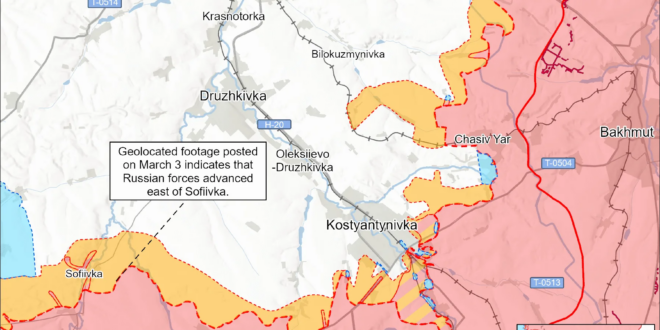
Ukrainian forces recently advanced in the Hulyaipole direction. Russian forces marginally advanced in the Kostyantynivka-Druzhkivka tactical area.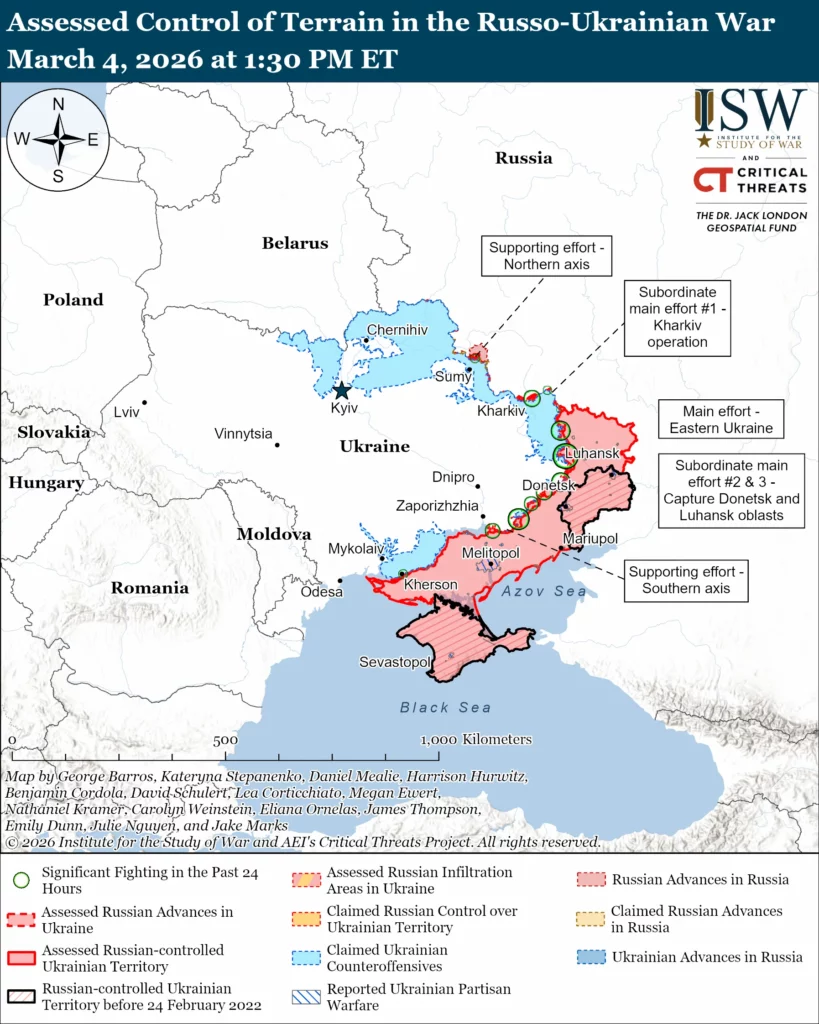
We do not report in detail on Russian war crimes because these activities are well-covered in Western media and do not directly affect the military operations we are assessing and forecasting. We will continue to evaluate and report on the effects of these criminal activities on the Ukrainian military and the Ukrainian population and specifically on combat in Ukrainian urban areas. We utterly condemn Russian violations of the laws of armed conflict and the Geneva Conventions and crimes against humanity even though we do not describe them in these reports.
Ukrainian Operations in the Russian Federation
See topline text.
Russian Supporting Effort: Northern Axis
Russian objective: Create defensible buffer zones in Sumy Oblast along the international border
Russian forces continued offensive operations in northern Sumy Oblast on March 4 but did not advance.
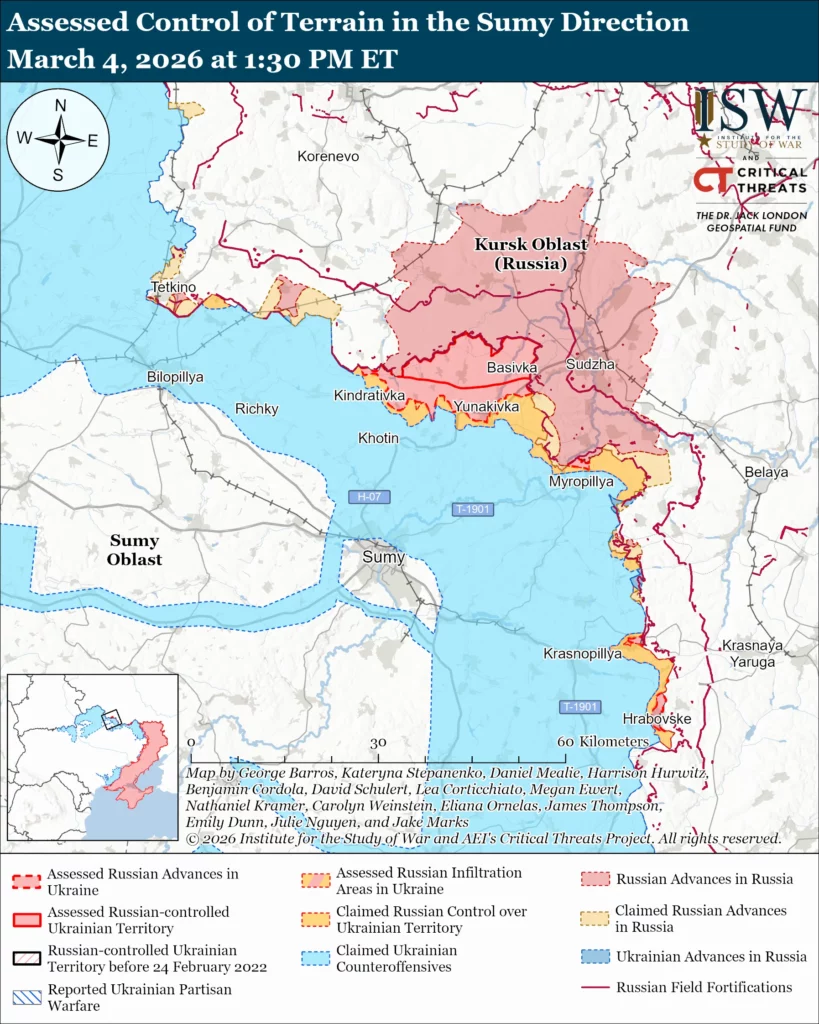
Russian forces attacked in Sumy Oblast, including north of Sumy City near Mala Korchakivka, on March 3 and 4.[30]
A Ukrainian brigade operating in Sumy Oblast reported on March 4 that it struck a Russian light vehicle storage warehouse in Sumy Oblast, causing multiple vehicles to catch fire.[31]
Order of Battle: Drone operators of the Russian Anvar Spetsnaz Detachment (possibly referring to the BARS-25 Anvar volunteer detachment) are reportedly striking Ukrainian forces in Myropillya (northeast of Sumy City) and Velyka Pysarivka (southeast of Sumy City).[32] Elements of the 51st Airborne (VDV) Regiment (106th VDV Division) are reportedly operating near Yunakivka (northeast of Sumy City).[33]
Russian Main Effort: Eastern Ukraine
Russian Subordinate Main Effort #1 – Kharkiv Oblast
Russian objective: Push Ukrainian forces back from the international border to create a defensible buffer zone with Belgorod Oblast and approach to within tube artillery range of Kharkiv City
Russian forces continued offensive operations in northern Kharkiv Oblast on March 4 but did not advance.
Russian forces attacked northeast of Kharkiv City near Hrafske, Zybyne, Kruhle, Vovchanski Khutory, Vilcha, and Starytsya and toward Zelene on March 3 and 4.[34]
The deputy commander of a Ukrainian company operating in northern Kharkiv Oblast reported on March 3 that Russian forces did not use armored vehicles in assaults in January and February 2026, instead continuing to use small infantry groups.[35] The deputy commander reported that Russian forces do not appear to plan or conduct serious preparations for these ground attacks. The deputy commander noted that Russian forces struggle with supplying logistics to frontline positions, particularly within contested “gray areas.”
A Ukrainian drone unit reported on March 4 that Ukrainian forces struck a Russian S-400 air defense system in Belgorod Oblast.[36]
Order of Battle: Elements of the Russian 27th Motorized Rifle Brigade (1st Guards Tank Army [GTA], Moscow Military District [MMD]) and of the pro-Russian Chechen Sheikh Mansur volunteer battalion (subordinated to the Russian Ministry of Defense [MoD]) are reportedly operating in the Kharkiv direction.[37] Drone operators of the Russian Anvar Spetsnaz Detachment (possibly referring to the BARS-25 Anvar volunteer detachment) are reportedly striking Ukrainian forces near Zybyne, Zakharivska, and Volokhivka (all northeast of Kharkiv City).[38] Elements of the Chechen Zapad-Akhmat battalion, 82nd Motorized Rifle Regiment (69th Motorized Rifle Division, 6th Combined Arms Army [CAA], Leningrad Military District [LMD]), the Chechen Kurchaloyevsky Raion Russian Ministry of Internal Affairs (MVD) Department, and of the 116th Rosgvardia Special Purpose Brigade are reportedly cooperating to strike Ukrainian forces near Hrafske.[39]
Neither Ukrainian nor Russian sources reported ground activity in the Velykyi Burluk direction on March 3 or 4.
Russian Subordinate Main Effort #2 – Oskil River
Russian objective: Cross the Oskil River in Kharkiv Oblast and push westward into eastern Kharkiv Oblast and northern Donetsk Oblast
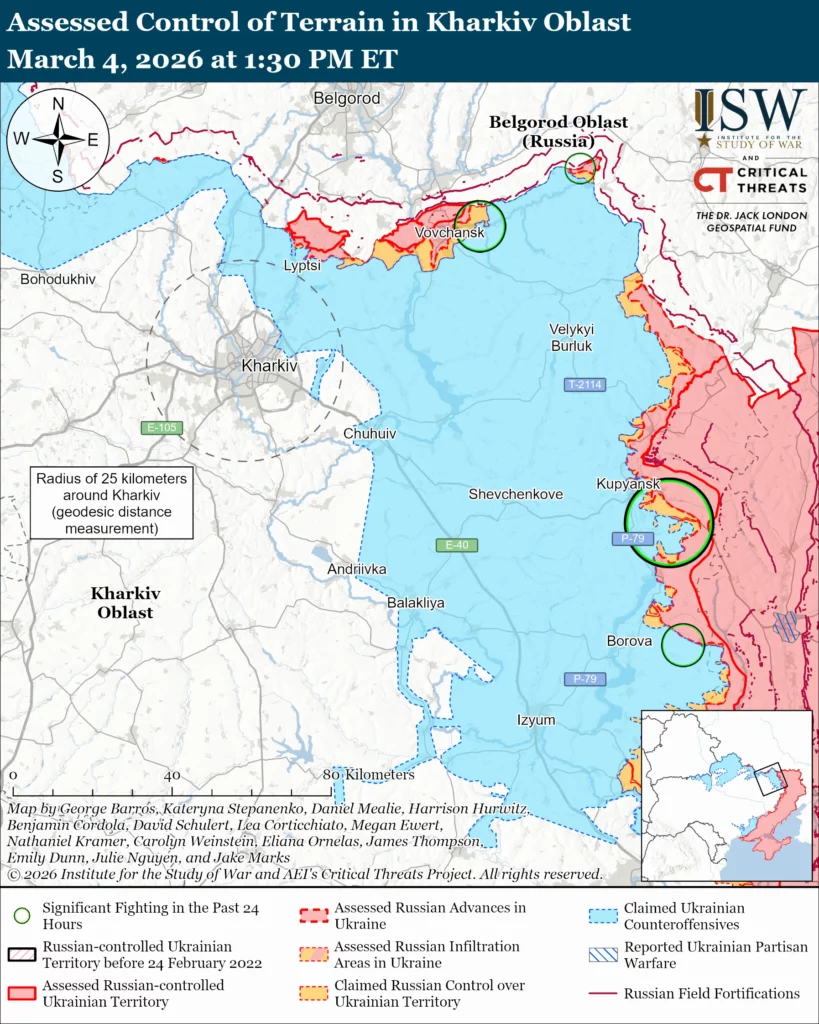
Russian forces continued offensive operations in the Kupyansk direction on March 4 but did not advance.
Russian forces attacked near Kupyansk itself; east of Kupyansk near Petropavlivka and Kucherivka; south of Kupyansk near Kupyansk-Vuzlovyi; and southeast of Kupyansk near Pishchane and Kurylivka on March 3 and 4.[40]
Order of Battle: Multiple launch rocket system (MLRS) artillery elements of the Russian 121st Motorized Rifle Regiment (68th Motorized Rifle Division, 6th Combined Arms Army [CAA], Leningrad Military District [LMD]) reportedly continue to operate in the Kupyansk direction.[41]
Russian forces continued offensive operations north of Borova near Novoplatonivka and east of Borova toward Shyikivka on March 3 and 4.[42]
Ukrainian forces continue their mid-range strike campaign against Russian military assets in occupied Luhansk Oblast. The Ukrainian General Staff reported on March 3 that Ukrainian forces struck a Russian S-300 air defense system’s radar station near occupied Tytarivka (roughly 64 kilometers behind the frontline).[43]
Russian Subordinate Main Effort #3 – Donetsk Oblast
Russian objective: Capture the entirety of Donetsk Oblast, the claimed territory of Russia’s proxies in Donbas, and advance into Dnipropetrovsk Oblast
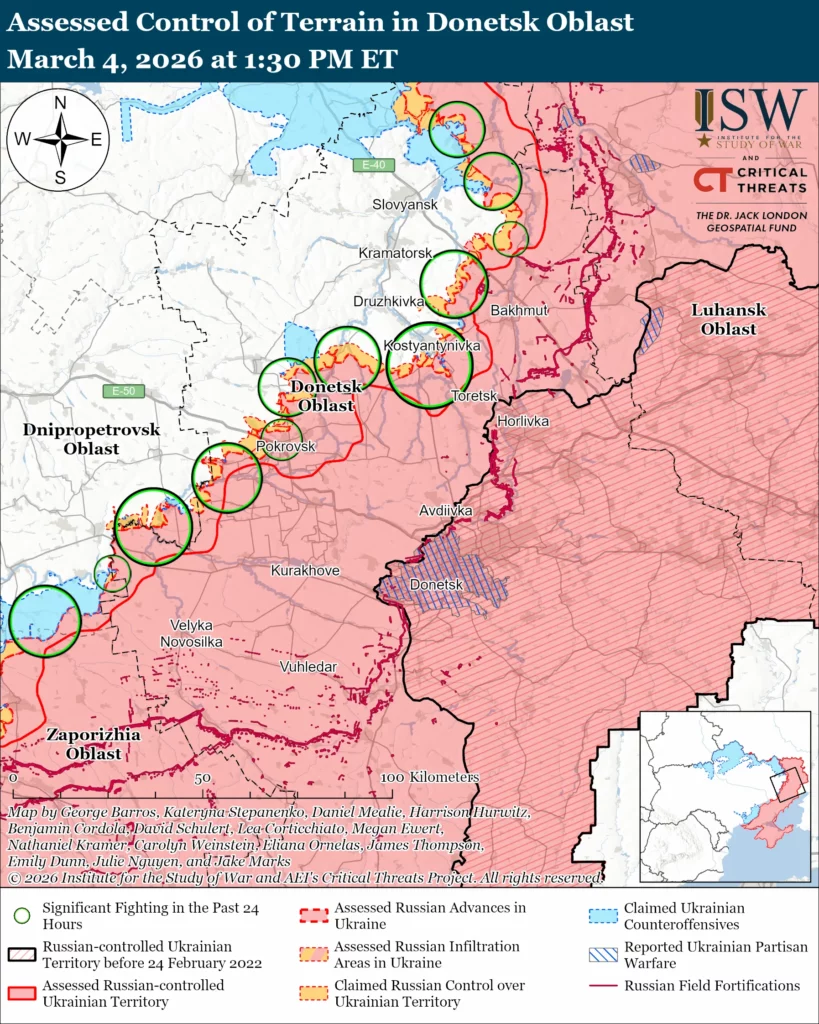
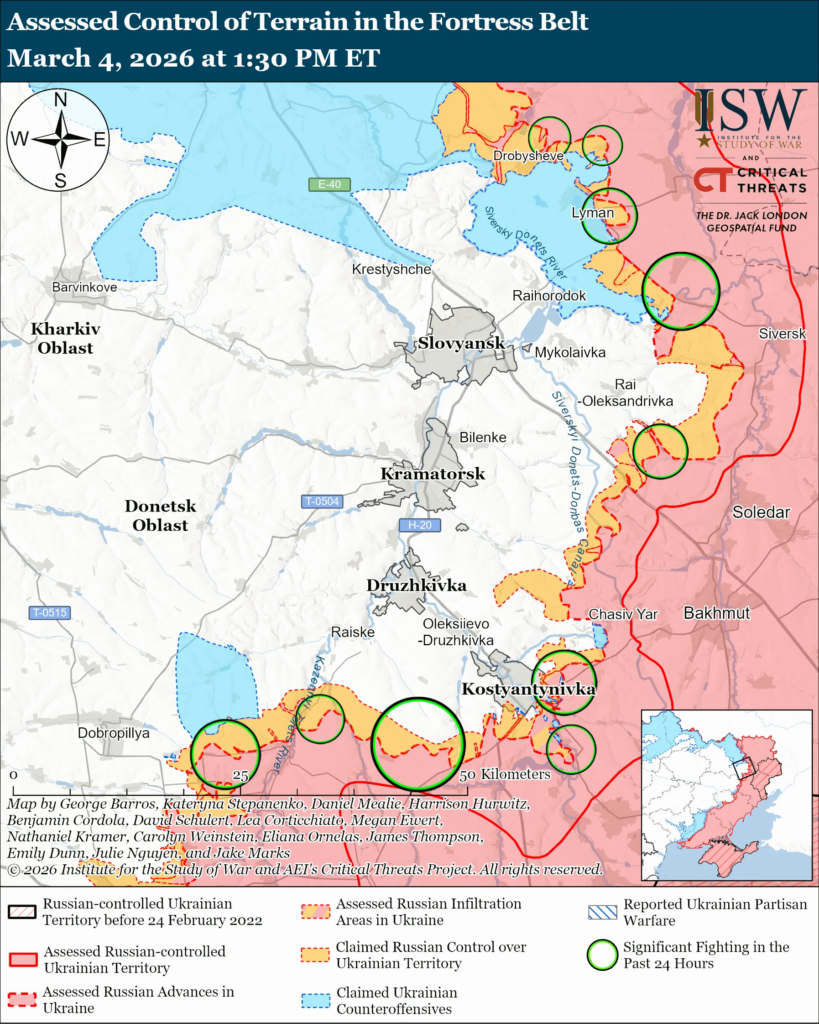
Russian forces continued offensive operations in the Slovyansk direction on March 4 but did not advance.
Russian forces attacked near Lyman itself; northwest of Lyman near Novoselivka; north of Lyman near Stavky; northeast of Lyman near Drobysheve and Dronivka; east of Lyman near Zarichne; northeast of Slovyansk near Zakitne and Platonivka; east of Slovyansk near Riznykivka and Kalenyky and toward Rai-Oleksandrivka; and southeast of Slovyansk near Nykyforivka and Fedorivka Druha on March 3 and 4.[44]
Russian forces recently advanced in the Kostyantynivka-Druzhkivka tactical area.
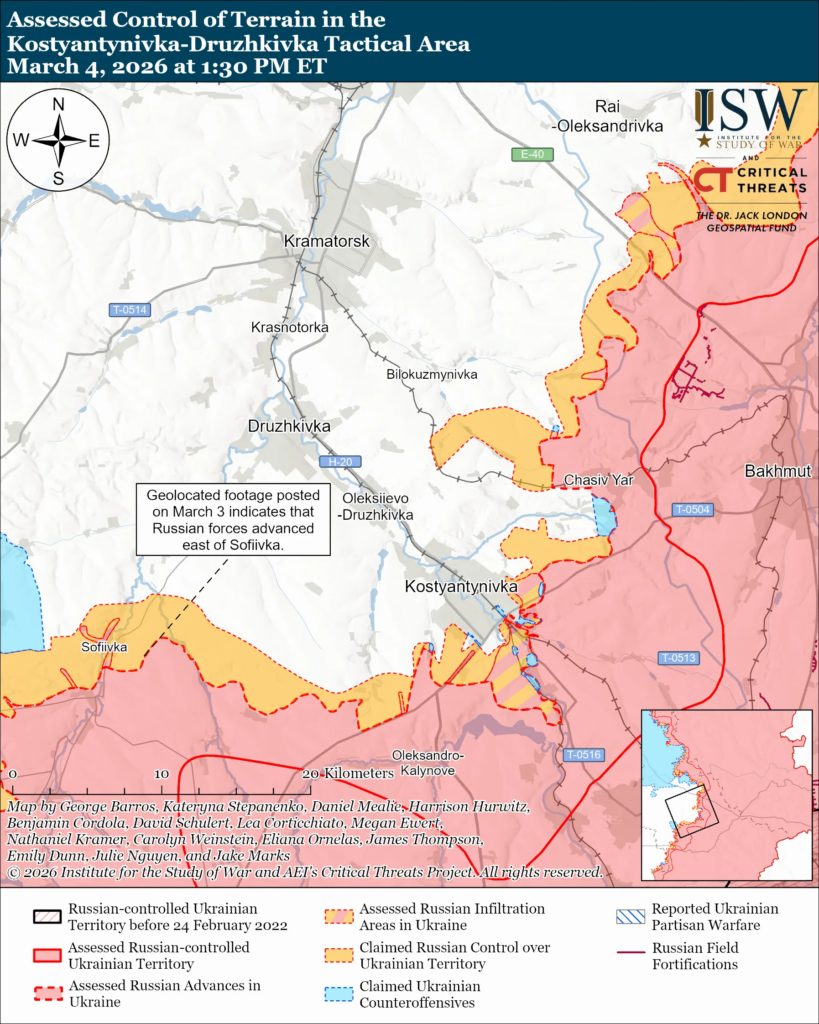
Assessed Russian advances: Geolocated footage published on March 3 indicates that Russian forces advanced east of Sofiivka (southwest of Druzhkivka).[45] ISW has not observed visual evidence in over three months that Ukrainian forces maintain positions south of Sofiivka, indicating that Russian forces also likely advanced south of Sofiivka on a prior date.
Russian forces attacked near Kostyantynivka itself; northeast of Kostyantynivka near Orikhovo-Vasylivka and Bondarne and toward Mykolaivka; southeast of Kostyantynivka near Pleshchiivka and Shcherbynivka; south of Kostyantynivka near Illinivka and Berestok; southwest of Kostyantynivka near Stepanivka; south of Druzhkivka near Rusyn Yar; and southwest of Druzhkivka near Sofiivka and Novopavlivka on March 3 and 4.[46]
The spokesperson of a Ukrainian brigade operating in the Kramatorsk direction reported on March 4 that Russian forces have recently intensified infiltration efforts near Chasiv Yar (northeast of Kostyantynivka) due to favorable weather conditions.[47]
Order of Battle: First-person view (FPV) drone operators of the Russian 20th Motorized Rifle Division (8th Combined Arms Army [CAA], Southern Military District [SMD]) are reportedly intercepting Ukrainian drones near Poltavka (southwest of Druzhkivka).[48] Drone operators of the Berkut Group of the 238th Artillery Brigade (8th CAA) are reportedly striking Ukrainian forces near Oleksiievo-Druzhkivka (just southeast of Druzhkivka).[49] Drone operators of the Sever-V Brigade (Russian Volunteer Corps) are reportedly striking Ukrainian forces north of Chasiv Yar.[50]
Russian forces continued offensive operations northeast of Dobropillya toward Kucheriv Yar and east of Dobropillya near Zapovidne and Novyi Donbas on March 3 and 4 but did not advance.[51]
Russian forces continued offensive operations in the Pokrovsk direction on March 4 but did not make confirmed advances.
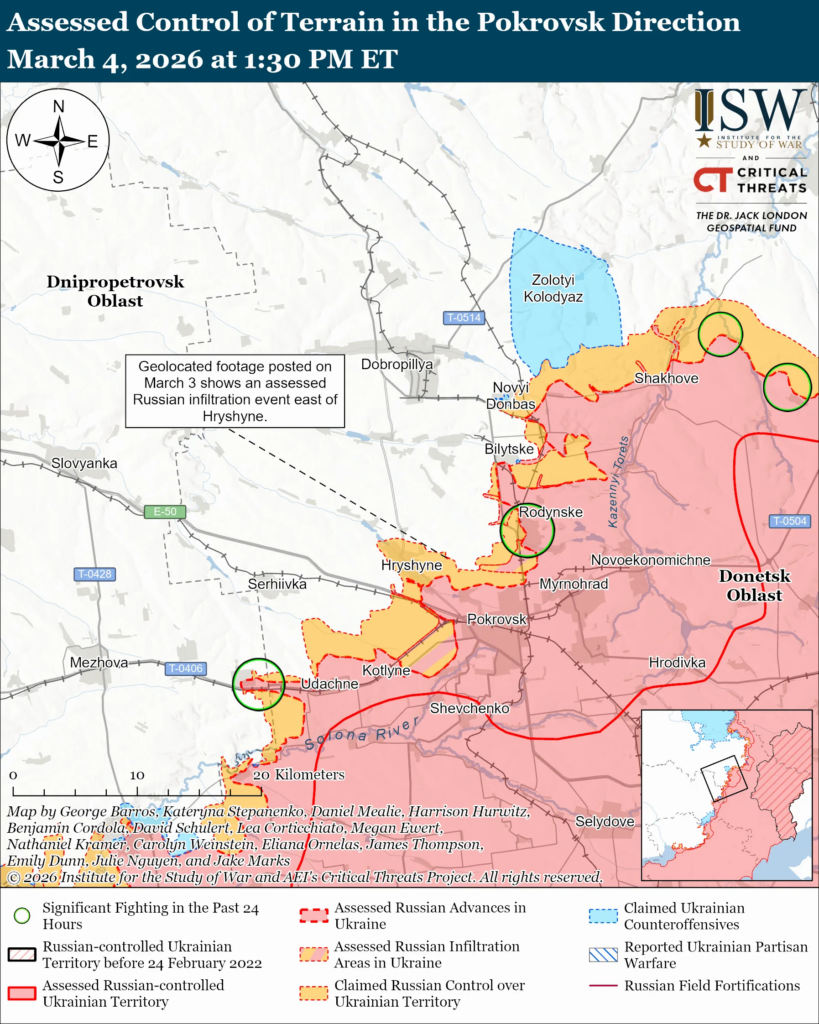
Assessed Russian infiltrations: Geolocated footage published on March 3 shows Ukrainian forces striking a Russian position east of Hryshyne (northwest of Pokrovsk) after what ISW assesses was a Russian infiltration mission that did not change the control of terrain or the forward edge of the battle area (FEBA) at this time.[52]
Unconfirmed claims: A Russian milblogger claimed that Russian forces advanced east of Hryshyne and northwest of Kotlyne (southwest of Pokrovsk).[53]
Russian forces attacked near Pokrovsk itself; northwest of Pokrovsk near Hryshyne and toward Novooleksandrivka; north of Pokrovsk near Rodynske and Bilytske; northeast of Pokrovsk near Chervonyi (Krasnyi) Lyman; and southwest of Pokrovsk near Udachne, Molodetske, and Novopidhorodne on March 3 and 4.[54]
A commander of a Ukrainian battalion operating in the Pokrovsk direction reported on March 4 that Russian forces will accumulate manpower under the concealment of fog and approach Ukrainian positions with cars and all-terrain vehicles (ATVs) before launching assaults when the fog lifts.[55] The Ukrainian 7th Rapid Reaction Corps of the Air Assault Forces reported on March 4 that Russian forces are trying to put pressure on Ukrainian forces in central Hryshyne by attacking simultaneously from the north and south.[56]
Order of Battle: Artillery and other elements of the Russian 30th Motorized Rifle Brigade (2nd CAA, Central Military District [CMD]) and of the 1441st Motorized Rifle Regiment (reportedly of the 2nd CAA and likely comprised of mobilized personnel) are reportedly operating in and around Pokrovsk.[57]
Ukrainian forces continued their frontline and mid-range strike campaign against Russian military assets in Donetsk Oblast. The Ukrainian General Staff reported on March 3 that Ukrainian forces struck two Russian drone control points near Rodynske and Pokrovsk and a repair unit of an unspecified Russian motorized rifle brigade near occupied Zachativka (roughly 62 kilometers from the frontline).[58]
Russian forces continued offensive operations northeast of Novopavlivka near Muravka on March 4 but did not advance.[59]
Ukrainian forces recently maintained positions or advanced in the Oleksandrivka direction.
Refinement of areas under Russian claims: Geolocated footage published on March 4 shows Russian forces striking Ukrainian positions east of Ivanivka (northeast of Oleksandrivka) in areas where Russian sources previously claimed that Russian forces maintained positions.[60]
Russian forces attacked northeast of Oleksandrivka near Ivanivka, Andriivka-Klevtsove, and Zelenyi Hai, and southeast of Oleksandrivka near Novohryhorivka and Ternove, and toward Vyshneve, Vorone, Verbove on March 3 and 4.[61]
Ukrainian military observer Kostyantyn Mashovets reported on March 4 that the command of the Russian 29th CAA (Eastern Military District [EMD]) investigated reports of battlefield successes from its 36th Motorized Rifle Brigade, which is reportedly operating in the Oleksandrivka direction.[62] Mashovets reported that the Russian military command found that the brigade had exaggerated control-of-terrain (CoT) reports for its area of responsibility (AoR). Mashovets reported that the Russian military command ordered the 36th Motorized Rifle Brigade to essentially seize and establish a command and control center, logistics lines, and a battalion-level headquarters in an unspecified settlement that the 36th Motorized Rifle Brigade claimed to have already seized but that Ukrainian forces hold.
Order of Battle: Molniya-2 fixed wing and other FPV drone operators of the Russian 429th Motorized Rifle Regiment (19th Motorized Rifle Division, 58th CAA, SMD) are striking Ukrainian forces east of Ivanivka.[63]
Russian Supporting Effort: Southern Axis
Russian objective: Maintain frontline positions, secure rear areas against Ukrainian strikes, and advance within tube artillery range of Zaporizhzhia City
Ukrainian forces recently advanced in the Hulyaipole direction.
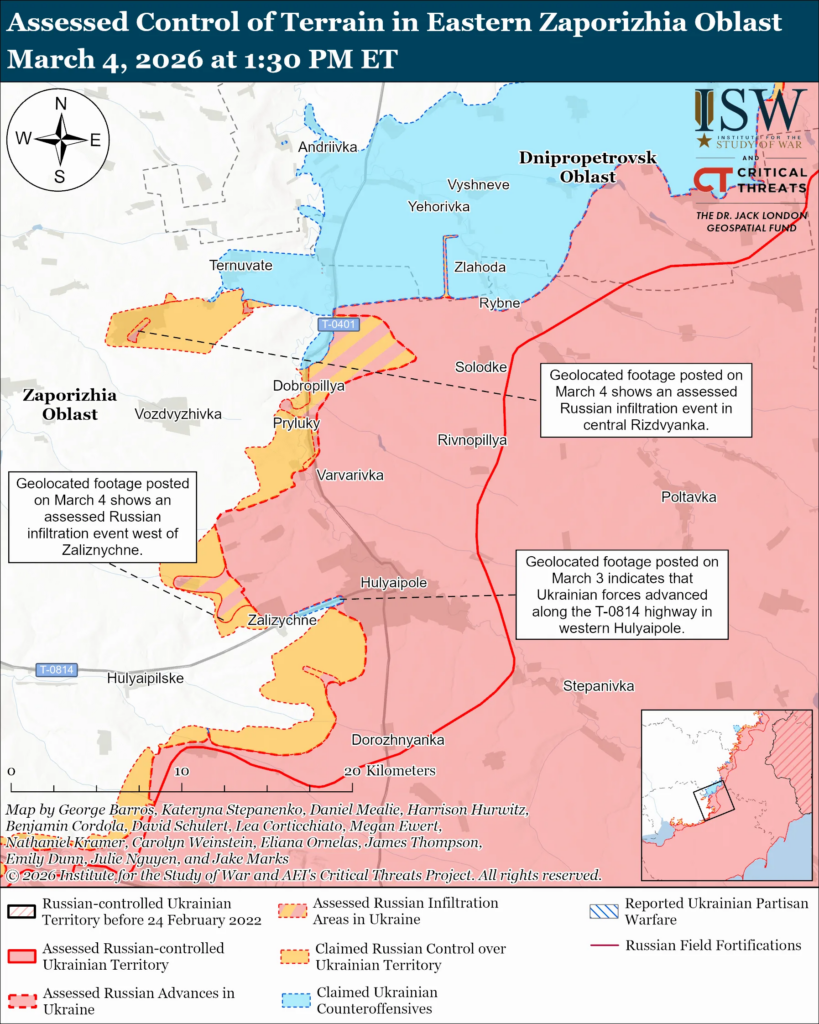
Assessed Ukrainian advances: Geolocated footage published on March 3 indicated that Ukrainian forces recently advanced into western Hulyaipole.[64]
Assessed Russian infiltrations: Geolocated footage published on March 4 shows one Russian servicemember of the 37th Motorized Rifle Brigade (36th Combined Arms Army [CAA], Eastern Military District [EMD]) holding a Russian flag in central Rizdvyanka (northwest of Hulyaipole) during what ISW assesses was a Russian infiltration mission that did not change the control of terrain or the forward edge of the battle area (FEBA) at this time.[65] Additional geolocated footage published on March 4 shows Ukrainian forces striking a Russian position west of Zaliznychne (west of Hulyaipole) after what ISW assesses was a Russian infiltration mission that did not change the control of terrain or FEBA at this time.[66]
Russian forces attacked near Hulyaipole itself; northwest of Hulyaipole near Zelene, Svyatopetrivka, Rizdvyanka, Tsvitkove, and Varvarivka, and toward Vozdvyzhivka and Verkhnya Tersa; northeast of Hulyaipole toward Zlahoda; and west of Hulyaipole near Staroukrainka and Zaliznychne on March 3 and 4.[67]
Ukrainian Southern Defense Forces Spokesperson Colonel Vladyslav Voloshyn stated on March 3 that Ukrainian forces control Tsvitkove, contrary to Russian claims, and that the frontline is 12 kilometers from Tsvitkove.[68]
Order of Battle: Drone operators of the Russian 1466th Motorized Rifle Regiment (127th Motorized Rifle Division, CAA, EMD) are conducting reconnaissance west of Hulyaipole, and elements of the Russian 16th Radiation, Chemical, and Biological Defense Brigade (EMD) are striking Ukrainian forces west of Hulyaipole.[69]
Russian forces continued limited offensive operations in western Zaporizhia Oblast on March 4 but did not advance.
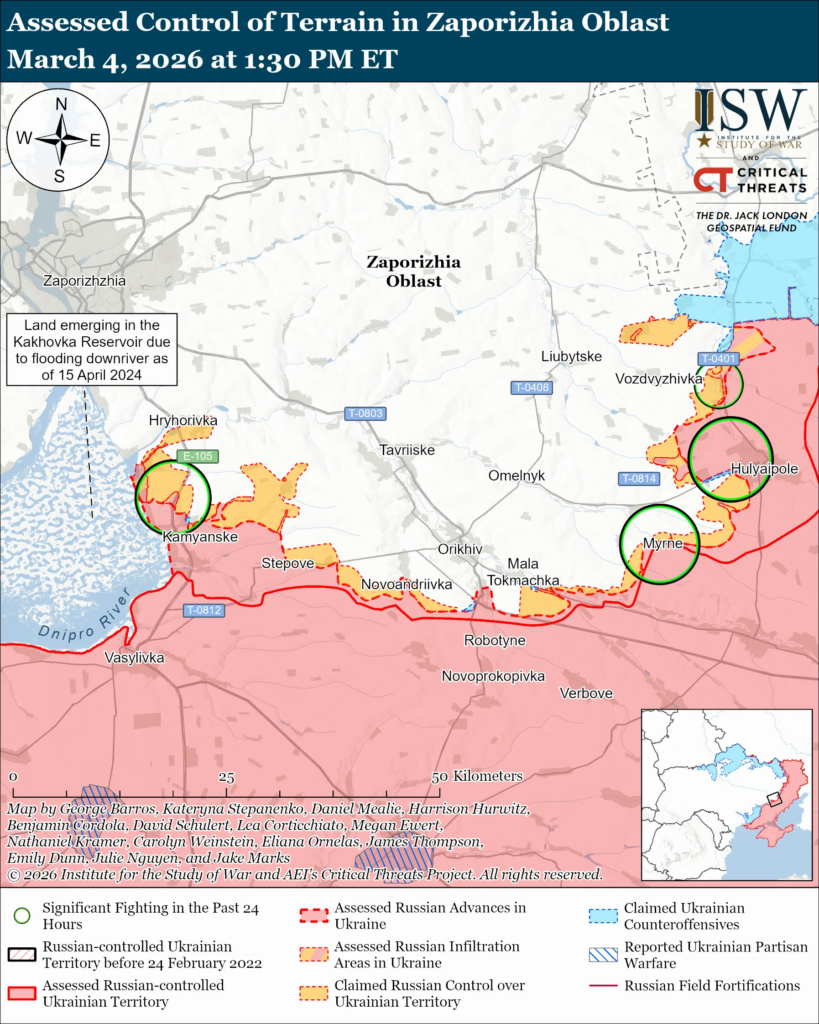
Russian forces attacked northeast of Orikhiv toward Hulyaipilske; east of Orikhiv near Myrne; and west of Orikhiv near Stepnohirsk and Prymorske on March 3 and 4.[70]
A Kremlin-affiliated Russian milblogger claimed that Russian forces hold positions in central Prymorske but that these positions are interspersed with Ukrainian positions, complicating Russian logistics to central Prymorske.[71]
Voloshyn reported on March 3 that Ukrainian forces control Mali Shcherbaky (west of Orikhiv), contrary to Russian claims, and that the frontline is about two kilometers from Mali Shcherbaky.[72]
Order of Battle: Elements of the Russian 7th Airborne (VDV) Division reportedly continue to operate in the Orikhiv direction.[73]
Russian forces attacked east of Kherson City near the Antonivskyi Bridge and southwest of Kherson City near Bilohrudnyi Island on March 4 but did not advance.[74]
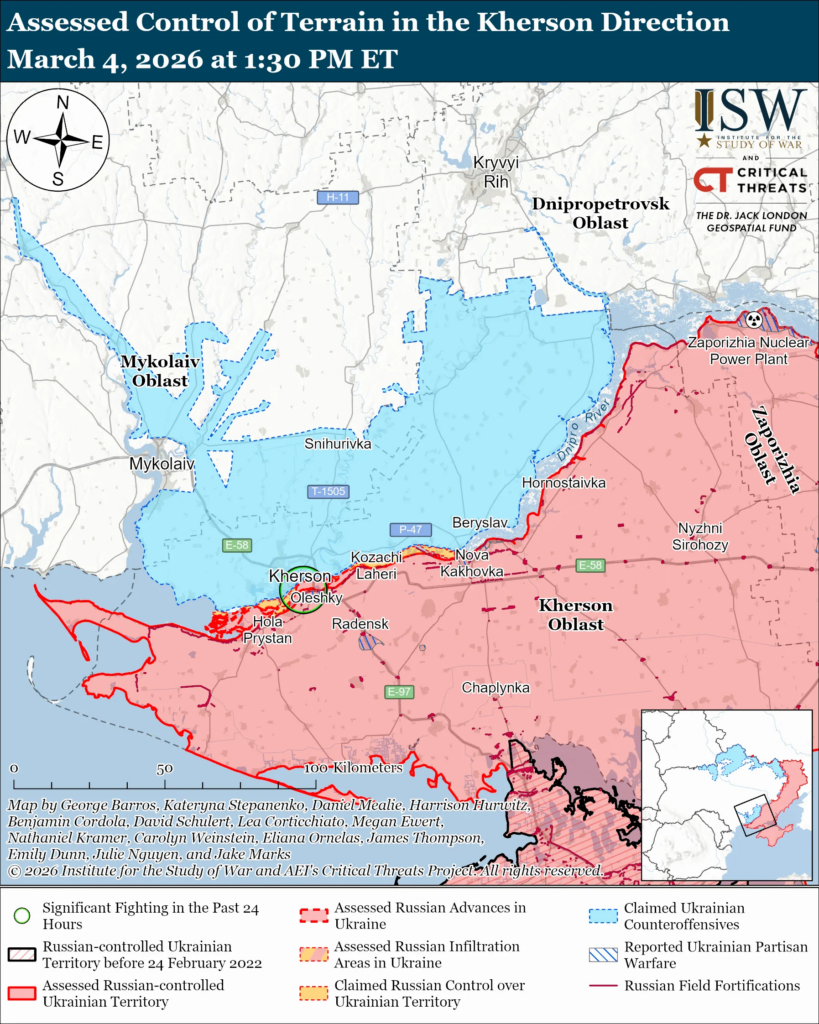
Order of Battle: Drone operators of the Russian 98th VDV Division reportedly continue to operate in the Kherson direction.[75]
Ukrainian forces continue targeting Russian air defense assets in occupied Crimea. The Ukrainian General Staff reported on March 3 that Ukrainian forces struck a Sopka-2 air surveillance radar system and a Kasta-2E2 radar station in unspecified locations in occupied Crimea.[76]
Russian Air, Missile, and Drone Campaign
Russian Objective: Target Ukrainian military and civilian infrastructure in the rear and on the front line
Russian forces conducted a series of long-range drone strikes against Ukraine overnight on March 3 to 4. The Ukrainian Air Force reported that Russian forces launched 149 Shahed-type, Gerbera-type, Italmas-type, and other drones – of which about 100 were Shaheds – from the directions of Bryansk and Kursk cities; Millerovo, Rostov Oblast; Primorsko-Akhtarsk, Krasnodar Krai; and occupied Hvardiiske, Crimea.[77] The Ukrainian Air Force reported that Ukrainian forces downed 129 Russian drones, that 19 strike drones hit 15 locations, and that downed debris fell on one location. Ukrainian state energy operator Ukrenergo reported that Russian strikes against energy infrastructure in several oblasts caused power outages in Dnipropetrovsk, Mykolaiv, Kharkiv, Sumy, and Kherson oblasts.[78] Ukrainian officials reported that a Russian missile also struck unspecified transport infrastructure in southern Odesa Oblast and that a Russian Iskander-M ballistic missile struck a warehouse and powerlines in Mykolaiv Oblast.[79]
Significant Activity in Belarus
Russian efforts to increase its military presence in Belarus and further integrate Belarus into Russian-favorable frameworks
Belarus continues to foster military relations with Russia’s partners. The Belarusian Ministry of Defense (MoD) announced on March 4 that Belarus and Vietnam held the first-ever meeting of the Belarusian-Vietnamese Working Group on Military Cooperation, in which participants discussed a 2026 coordination plan and discussed personnel training and medical support.[80]
Note: ISW does not receive any classified material from any source, uses only publicly available information, and draws extensively on Russian, Ukrainian, and Western reporting and social media as well as commercially available satellite imagery and other geospatial data as the basis for these reports. References to all sources used are provided in the endnotes of each update.