 Eurasia Press & News
Toplines
The United States lifted sanctions on Russian oil that is already on tankers at sea until April 11, 2026, a decision that will buttress the Russian war economy. The US Office of Foreign Asset Control (OFAC) reported on March 12 that it is temporarily authorizing the delivery and sale of crude oil and other petroleum products that Russian-origin vessels are carrying in violation of sanctions from March 12 through April 11.[1] US Treasury Secretary Scott Bessent stated that the US is temporarily authorizing a “narrowly tailored, short-term measure” that will allow countries to purchase Russian oil “currently stranded at sea” in order to promote stability in global energy markets.[2] The US decision to lift sanctions, even temporarily, will allow Russia to receive much-needed income that will strengthen the vulnerable Russian war economy.
The elevated price of oil and the US decision to ease sanctions on Russia will provide Russia with greater flexibility and support the Russian domestic economy, Russian force generation, and the Russian defense industrial base (DIB). The Financial Times (FT) reported on March 12 that Russia is earning as much as $150 million dollars a day in extra budget revenues from oil sales.[3] The FT reported that Russia has already earned an estimated $1.3 to $1.9 billion dollars from taxes on oil exports after the effective closure of the Strait of Hormuz. The FT calculated that Russia could earn as much as $3.3 to $4.9 billion in overall additional revenues by the end of March 2026, assuming that Russia’s Urals crude prices average around $70 to $80 a barrel instead of remaining at the previous two months’ average of roughly $52 a barrel. The International Energy Agency (IEA) reported that Russian crude and oil exports plunged to their lowest level since the 2022 invasion of Ukraine in February 2026 — just before the Iran conflict began.[4] Reuters reported on March 12 that it calculated that Russia’s mineral extraction tax on crude oil production alone could generate around 590 billion rubles ($7.43 billion dollars) if prices remain near current levels, up from 314 billion rubles ($3.9 billion dollars) in January 2026 and an expected 300 billion rubles ($3.7 billion dollars) in February 2026.[5] Ukrainian President Volodymyr Zelensky reported on March 13 that the US decision to partially ease sanctions against Russian oil could allow Russia to earn about $10 billion dollars in an unspecified period of time.[6]
ISW’s previous forecasts that compounding economic costs would force the Kremlin to make difficult decisions in 2026 and 2027 assumed that the trend of Russian economic downturn would remain true. The global oil price shock from the war in Iran has likely invalidated elements of those assumptions. The US decision to provide Russia with sanctions relief on oil may financially benefit Russia by reversing months of declining Russian oil revenue and allow Russia to continue to finance its war against Ukraine in the medium term. ISW has previously assessed that worsening economic conditions led the Russian government to enact politically unpopular and economically sub-optimal policies, such as increasing the value-added tax (VAT) and lowering the key interest rate despite high Russian inflation.[7] ISW previously assessed that Russia is facing force generation issues largely due to budget constraints, including Russia’s inability to pay costly one-time enlistment bonuses indefinitely.[8] These previous ISW assessments included the assumption that Russian oil would remain sanctioned and that the price of oil would remain stable. The US decision to temporarily ease sanctions and the global oil price shock partially invalidates these assumptions in the short and possibly medium term. Russia has been struggling to amass the forces, equipment, and domestic support needed to continue the war, but an increased cash flow may allow Russia to strengthen its capabilities.[9] ISW’s previous forecasts may also hold true, but on a delayed timeline, should oil prices normalize and Russian oil revenue degrade back to its February 2026 status in the mid-term.
Swedish authorities boarded on March 12 a tanker that may be part of the Russian shadow fleet and has previously shipped petroleum from Russia. The Swedish Coast Guard and Swedish officials reported on March 12 that the Swedish Police and the Swedish Coast Guard boarded the suspected Russian shadow fleet tanker Sea Owl I off Trelleborg, Sweden, in Swedish territorial waters in the Baltic Sea at about 2030 local time.[10] The Swedish Coast Guard reported that the vessel was sailing without cargo under a suspected false Comorian flag from Santos, Brazil toward Primorsk, Russia, and has shipped petroleum between Russia and Brazil in recent years. Automatic identification systems (AIS) data from the Starboard Maritime Intelligence ship-tracking platform indicates that the Sea Owl I was sailing under the Comoros flag — which the platform could not verify — and noted that the ship has had its AIS signal continuously available with a last known location south of Trelleborg, Sweden. Starboard data indicated that the ship was sailing toward St. Petersburg, which would be the third time the ship has sailed toward St. Petersburg since January 2025. The Sea Owl I has been under European Union (EU) sanctions since October 24, 2025.[11] ISW assesses that Russia’s ability to sell oil is partially a function of its ability to transport it, and continued EU efforts against the Russian shadow fleet will degrade Russia’s ability to transport oil.[12] It remains unclear how EU efforts to degrade the shadow fleet by detaining its vessels may or may not partially offset the United States’ partial lifting of oil sanctions against Russia.
Ukrainian Commander-in-Chief Colonel General Oleksandr Syrskyi provided details on the end strength goals of the Russian Unmanned Systems Forces (USF) and Russian first-person view (FPV) drone production. Syrskyi reported on March 12 that the Russian military command plans to expand the Russian USF to an end strength of 101,000 by April 1 and that Russia is now capable of producing over 19,000 FPV drones daily.[13] Syrskyi noted that the Russian military command is therefore accelerating the formation of drone units, especially in southern Ukraine, where Ukrainian forces are making significant gains in counterattacks that are causing operational and strategic effects across the theater.[14]Russian President Vladimir Putin’s replacement of the Russian Ministry of Internal Affairs’ (MVD) first deputy minister likely signals a reshuffling of the MVD. Putin signed a decree on March 12 replacing MVD First Deputy Minister Colonel General Alexander Gorovoy with Main Directorate for Economic Security and Anti-Corruption Head Lieutenant General Andrei Kurnosenko.[15] Russian opposition outlet Verstka noted that the formal reason for Gorovoy’s unexpected replacement is his reaching age 65, although there are other older MVD deputy ministers at the moment, and Putin has made exceptions to retain senior officials who reached the mandatory retirement age, such as Russian Chief of the General Staff Army General Valery Gerasimov.[16] A Russian insider source noted on March 12 that Gorovoy had served as first deputy minister for nearly 15 years and that his replacement signals a reshuffling of the MVD.[17] A Russian Telegram channel commenting on political issues claimed that Kurnosenko has strong ties to Secretary of Russia’s State Council Alexei Dyumin — who became the youngest-ever member of the Russian Security Council in September 2024.[18]
Key Takeaways
The United States lifted sanctions on Russian oil that is already on tankers at sea until April 11, 2026, a decision that will buttress the Russian war economy.
The elevated price of oil and the US decision to ease sanctions on Russia will provide Russia with greater flexibility and support the Russian domestic economy, Russian force generation, and the Russian defense industrial base (DIB).
ISW’s previous forecasts that compounding economic costs would force the Kremlin to make difficult decisions in 2026 and 2027 assumed that the trend of Russian economic downturn would remain true. The global oil price shock from the war in Iran has likely invalidated elements of those assumptions.
Swedish authorities boarded on March 12 a tanker that may be part of the Russian shadow fleet and has previously shipped petroleum from Russia.
Ukrainian Commander-in-Chief Colonel General Oleksandr Syrskyi provided details on the end strength goals of the Russian Unmanned Systems Forces (USF) and Russian first-person view (FPV) drone production.
Russian President Vladimir Putin’s replacement of the Russian Ministry of Internal Affairs’ (MVD) first deputy minister likely signals a reshuffling of the MVD.
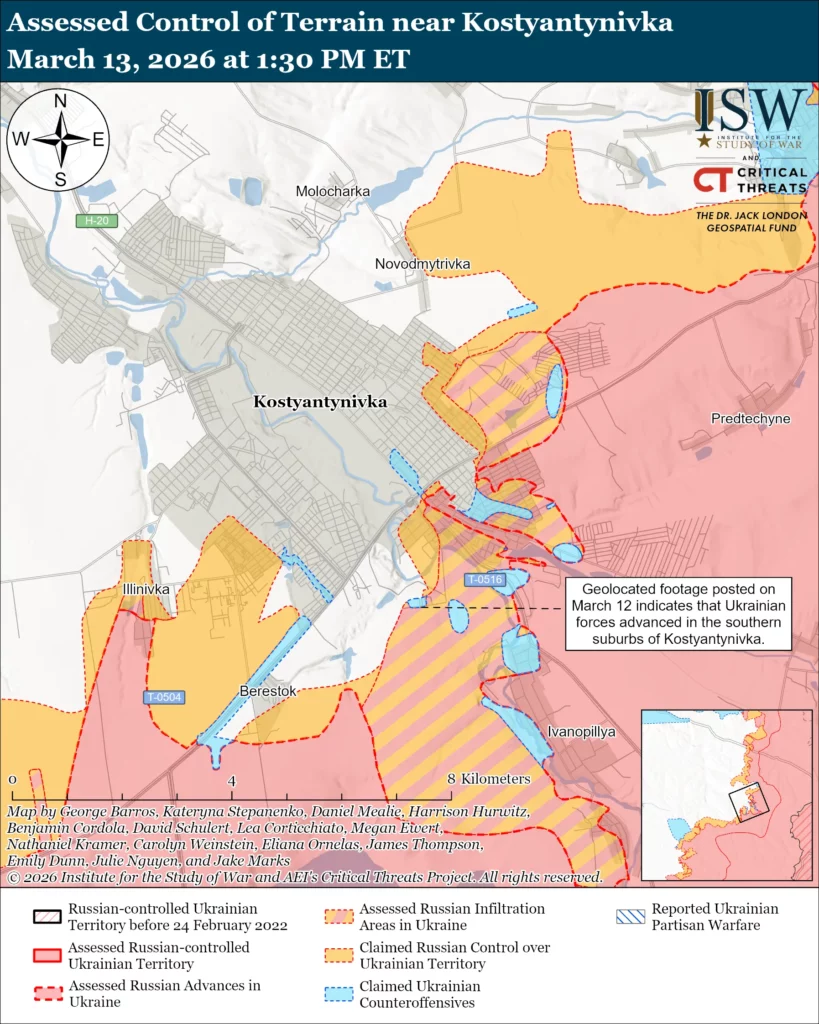
Ukrainian forces recently advanced in the Kostyantynivka-Druzhkivka tactical area.
Ukrainian forces struck Russian chemical and oil infrastructure. Russian forces launched one Iskander-M missile and 126 drones against Ukraine, including Kharkiv, Mykolaiv, and Odesa oblasts.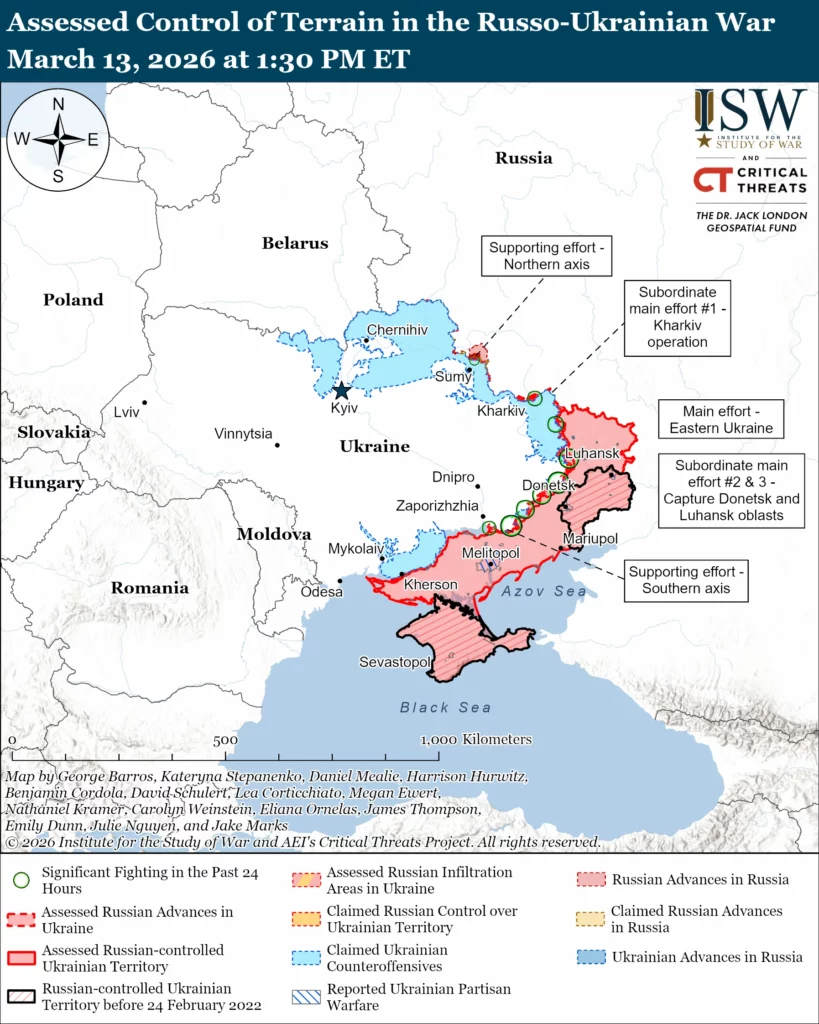
We do not report in detail on Russian war crimes because these activities are well-covered in Western media and do not directly affect the military operations we are assessing and forecasting. We will continue to evaluate and report on the effects of these criminal activities on the Ukrainian military and the Ukrainian population and specifically on combat in Ukrainian urban areas. We utterly condemn Russian violations of the laws of armed conflict and the Geneva Conventions and crimes against humanity even though we do not describe them in these reports.
Ukrainian Operations in the Russian Federation
Ukrainian forces likely struck a Russian chemical plant in Stavropol Krai overnight on March 12 to 13. Russian opposition outlet Astra reported on March 13, citing sources in the Russian Ministry of Emergency Situations, that Ukrainian forces launched drones towards the Azot chemical plant in Nevinnomyssk, Stavropol Krai, and drone debris fell on the plant’s premises.[19] The Azov chemical plant produces components of HMX and RDX — explosives components used in Russian munitions. Russian authorities often refer to successful Ukrainian strikes as “drone debris” hitting targets in order to downplay Ukrainian strike capabilities and Russian air defense failures.[20] Stavropol Krai Governor Vladimir Vladimirov acknowledged on March 13 that Ukrainian drones targeted an industrial zone on the outskirts of Nevinnomyssk.[21]Geolocated footage published on March 12 shows a fire at a Russian oil depot in Kendektamak, Republic of Bashkortostan, and a Ukrainian source that frequently reports on Ukrainian strikes into Russia sarcastically suggested the depot caught fire “on its own.”[22]
Russian Supporting Effort: Northern Axis
Russian objective: Create defensible buffer zones in Sumy Oblast along the international border
Russian forces continued offensive operations in the Sumy direction on March 13 but did not make confirmed advances.
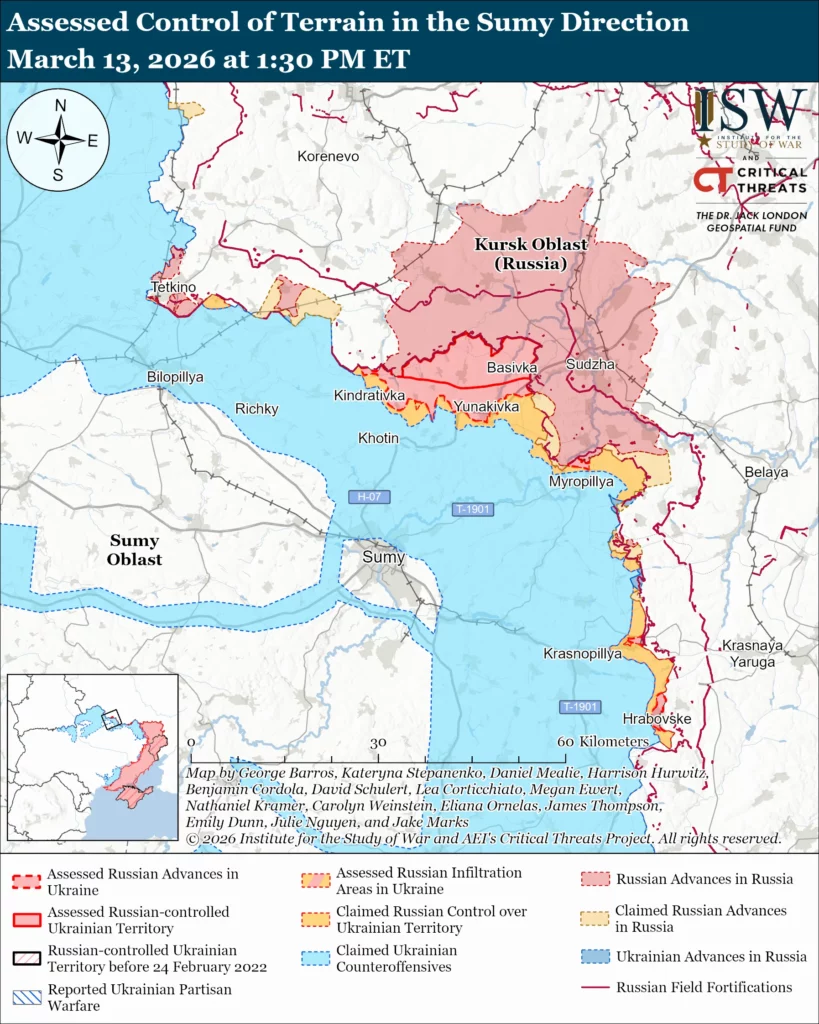
Unconfirmed claims: A Russian milblogger claimed on March 12 that Russian forces advanced approximately 3.5 kilometers from Sopych toward Bachivsk (both northwest of Sumy City).[23]
Russian forces attacked in Sumy Oblast and from Kursk Oblast, including southeast of Glushkovo from Plekhovo and Goptarovka; northwest of Sumy City near Sopych and toward Chervona Zorya; north of Sumy City near Kindrativka; and northeast of Sumy City near Yunakivka on March 12 and 13.[24]Order of Battle: Drone operators of the Russian Rubikon Center for Advanced Unmanned Systems reportedly continue to operate in the Sumy direction.[25]
Russian Main Effort: Eastern Ukraine
Russian Subordinate Main Effort #1 – Kharkiv Oblast
Russian objective: Push Ukrainian forces back from the international border to create a defensible buffer zone with Belgorod Oblast and approach to within tube artillery range of Kharkiv City
Russian forces continued offensive operations in northern Kharkiv Oblast on March 13 but did not advance.
Russian forces attacked northeast of Kharkiv City near Starytsya, Vovchansk, and Vovchanski Khutory and toward Hrafske and Zybyne on March 12 and 13.[26] Russian milbloggers claimed that Ukrainian forces counterattacked near Vovchansk and Vovchanski Khutory.[27]
Order of Battle: Drone operators of the Russian Chechen Zapad-Akhmat Battalion, the Chechen Kurchaloyevsky Raion Russian Ministry of Internal Affairs (MVD) Department, and 128th Motorized Rifle Brigade (44th Army Corps [AC], Leningrad Military District [LMD]) are reportedly striking Ukrainian positions near Vovchanski Khutory.[28] Drone operators of the 27th Motorized Rifle Brigade of the 1st Guards Tank Army (Moscow Military District [MMD]) are reportedly intercepting Ukrainian drones in Kharkiv Oblast.[29]
Neither Russian nor Ukrainian sources reported ground activity in the Velykyi Burluk direction on March 13.
Russian Subordinate Main Effort #2 – Oskil River
Russian objective: Cross the Oskil River in Kharkiv Oblast and push westward into eastern Kharkiv Oblast and northern Donetsk Oblast
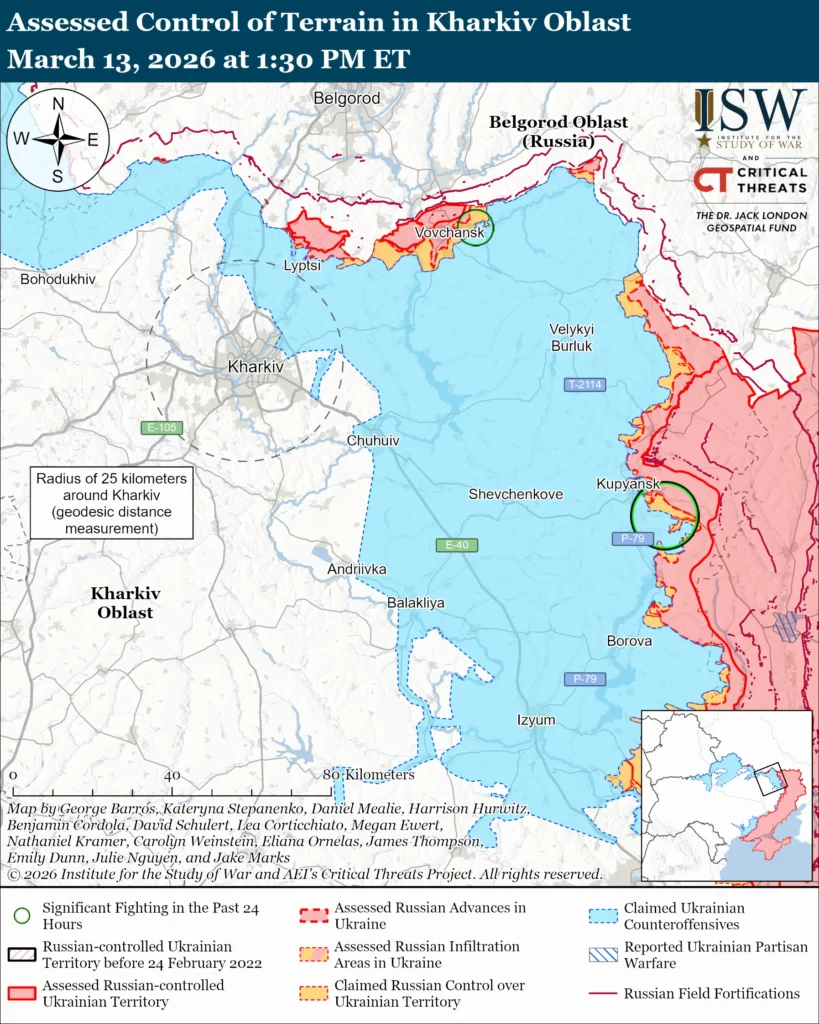
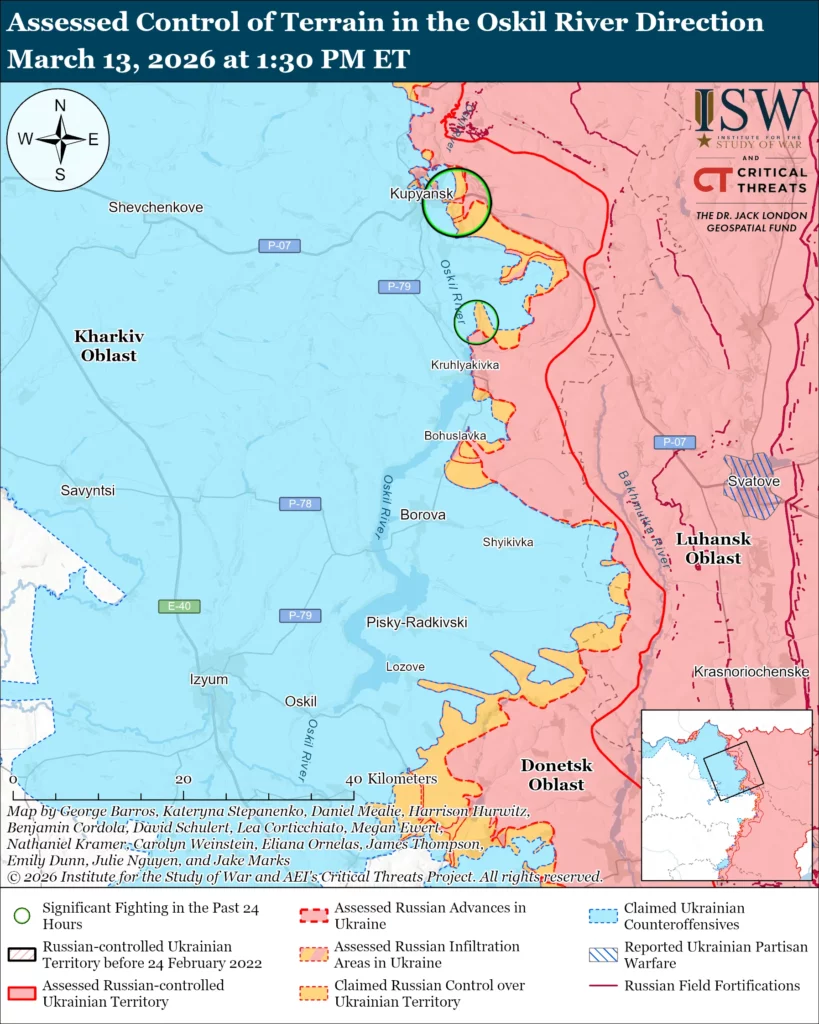
Russian forces continue offensive operations in the Kupyansk direction on March 13 but did not advance.
Russian forces attacked southeast of Kupyansk near Podoly and Hlushkivka on March 12 and 13.[30]
The Ukrainian Joint Forces Task Force reported on March 13 that Ukrainian forces have isolated Russian forces in Kupyansk and that Russian forces have decreased operations more broadly due to heavy losses.[31]
Order of Battle: Elements of the Russian 68th Motorized Rifle Division (6th Combined Arms Army [CAA], Leningrad Military District [LMD]) reportedly continue operating in the Kupyansk direction.[32]
Russian forces continue offensive operations in the Borova direction on March 13 but did not make confirmed advances.
Unconfirmed claims: A Kremlin-affiliated Russian milblogger claimed that Russian forces advanced in northern Zahryzove (northeast of Borova).[33]
Russian forces attacked north of Borova near Novoplatonivka and Bohuslavka, northeast of Borova near and Nova Kruhlyakivka, and southeast of Borova near Hrekivka and Novoyehorivka on March 12 and 13.[34] The Kremlin-affiliated Russian milblogger claimed that Ukrainian forces counterattacked toward Novoplatonivka and Borivska Andrivka (northeast of Borova).[35]
The Russian milblogger claimed that the frontline near Novoplatonivka and Borivska Andrivka is currently unclear.[36]
Russian Subordinate Main Effort #3 – Donetsk Oblast
Russian objective: Capture the entirety of Donetsk Oblast, the claimed territory of Russia’s proxies in Donbas, and advance into Dnipropetrovsk Oblast
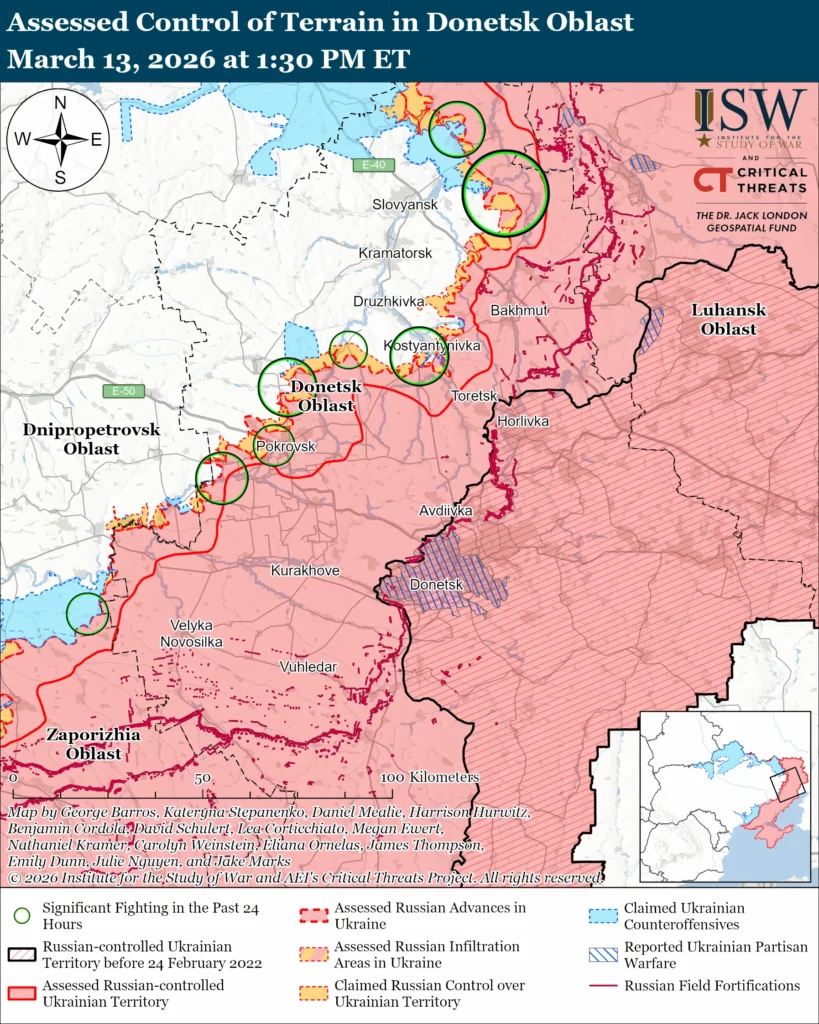
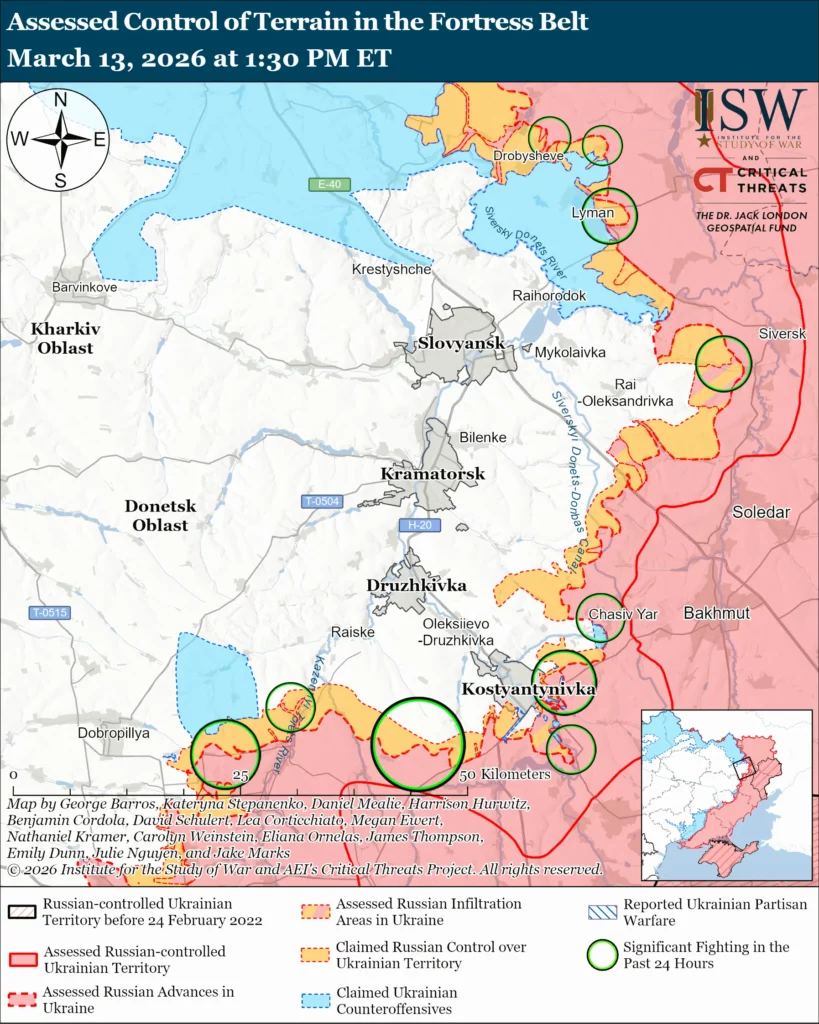
Ukrainian forces continue offensive operations in the Slovyansk direction on March 13 but did not advance.
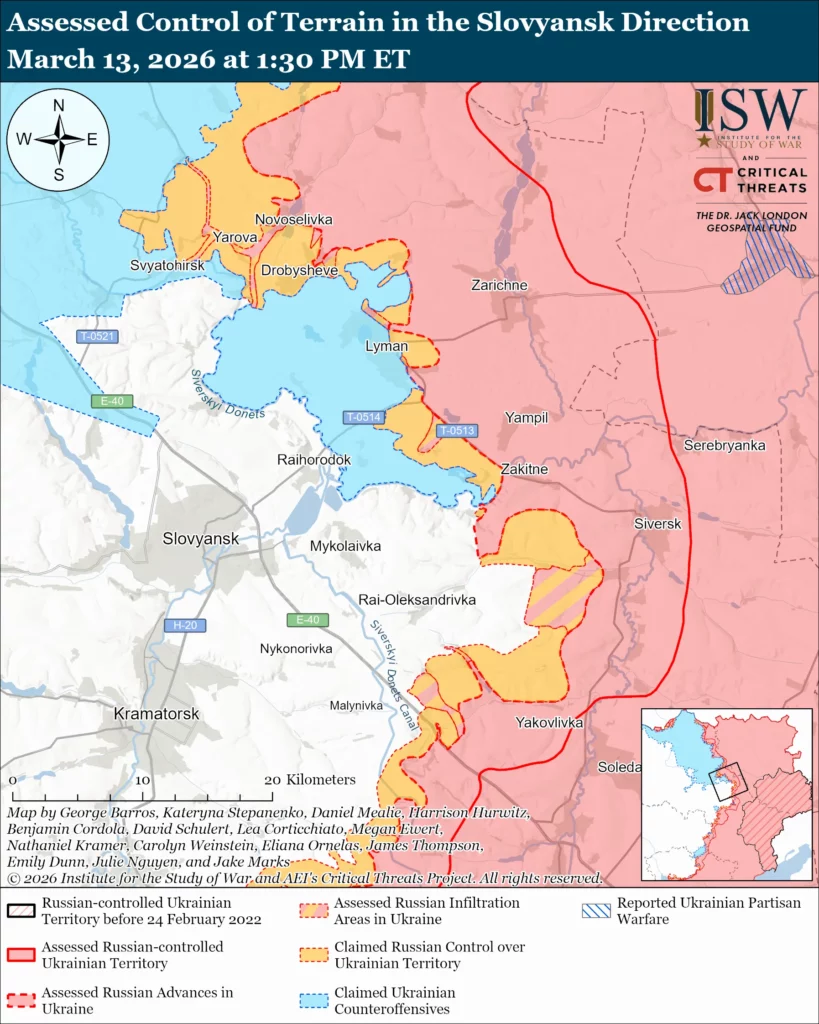
Russian forces attacked near Lyman itself; northwest of Lyman near Yarova and Drobysheve and toward Sosnove and Pryshyb; north of Lyman toward Stavky; east of Slovyansk near Kalenyky, Rai-Oleksandrivka, Platonivka, Riznykivka, Kryva Luka, and Ozerne; and southeast of Slovyansk near Fedorivka Druha and Nykyforivka and toward Yampil on March 12 and 13.[37]
Ukrainian forces are combating Russian artillery preparation efforts in the Slovyansk direction. The Ukrainian State Border Service reported on March 12 that its drone operators struck a Russian Grad multiple rocket launcher system (MLRS) in the Lyman direction.[38] The commander of a Ukrainian brigade operating in the Lyman direction reported on March 13 that recent Ukrainian drone strikes against several Russian Grad MLRSs have forced Russian forces to withdraw their MLRSs farther from the frontline.[39] The commander reported that the brigade struck and critically damaged two Grad MLRSs since the start of the year.
A Ukrainian drone battalion operating in the Slovyansk direction reported on March 13 that Ukrainian drone strikes are undermining Russian efforts to build pontoon bridges across the Bakhmutka River.[40]
Order of Battle: Drone operators of the Russian 144th Motorized Rifle Division (20th Combined Arms Army [CAA], Moscow Military District [MMD]) and the Rubikon Center for Advanced Unmanned Technologies are reportedly operating in the Lyman direction.[41]
Ukrainian forces recently advanced in the Kostyantynivka-Druzhkivka tactical area.
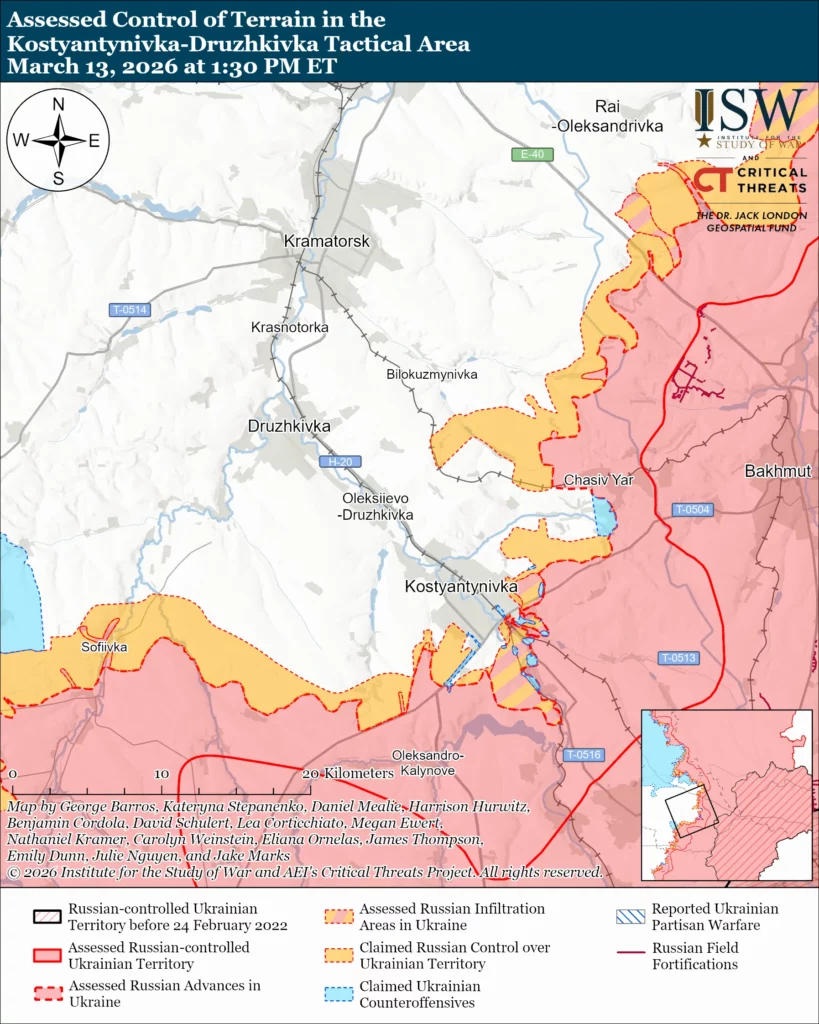
Assessed Ukrainian advances: Geolocated footage published on March 12 indicates that Ukrainian forces recently advanced in southern Kostyantynivka.[42]
Russian forces attacked near Kostyantynivka itself; east of Kostyantynivka near Stupochky and Predtechyne; southeast of Kostyantynivka near Ivanopillya and Pleshchiivka; south of Kostyantynivka near Berestok; southwest of Kostyantynivka near Illinivka and Stepanivka; south of Druzhkivka near Mykolaipillya and Rusyn Yar; and southwest of Druzhkivka near Sofiivka and Novopavlivka on March 12 and 13.[43]
Ukrainian forces are combating Russian artillery preparation in the Kostyantynivka-Druzhkivka tactical area. Geolocated footage posted on March 11 and 12 shows Ukrainian forces striking a Russian howitzer west of Ivanivske (northeast of Kostyantynivka, roughly 10 kilometers from the frontline) and a Russian multiple launch rocket system (MLRS) in Bakhmut (northeast of Kostyantynivka, roughly 15 kilometers from the front line).[44]
Order of Battle: Drone operators of the Russian 20th Motorized Rifle Regiment (possibly a reformed Soviet unit), including its 4th Motorized Rifle Battalion, and of the 72nd Separate Motorized Rifle Brigade (3rd Army Corps [AC], under operational control of the Southern Grouping of Forces), 4th Assault Battalion of the 103rd Motorized Rifle Regiment (150th Motorized Rifle Division, 8th CAA, SMD), and 1442nd Motorized Rifle Regiment (6th Motorized Rifle Division, 3rd AC) are striking Ukrainian forces in Kostyantynivka.[45] Elements of the 17th High Power Artillery Brigade (3rd AC) are striking Ukrainian forces in northern Kostyantynivka.[46] First-person-view (FPV) drone operators of the Anti-tank battalion of the 238th Artillery Brigade (8th CAA, SMD) are reportedly operating in the Kostyantynivka direction.[47] FPV drone operators of the 57th Spetsnaz Company (8th CAA, SMD) struck Ukrainian positions near Toretske and Raiske (southwest of Druzhkivka) and in Mykolaipillia.[48]
Russian forces continued offensive operations in the Dobropillya tactical area on March 13 but did not advance.
Russian forces attacked near Dobropillya itself; northeast of Dobropillya toward Kucheriv Yar; east of Dobropillya near Nove Shakhove and Vilne, and Novyi Donbas on March 12 and 13.[49]
Order of Battle: Drone operators of the Russian 177th Separate Naval Infantry Regiment (Caspian Flotilla) are reportedly operating in the Dobropillya direction.[50]
Russian forces continued offensive operations in the Pokrovsk direction but did not advance.
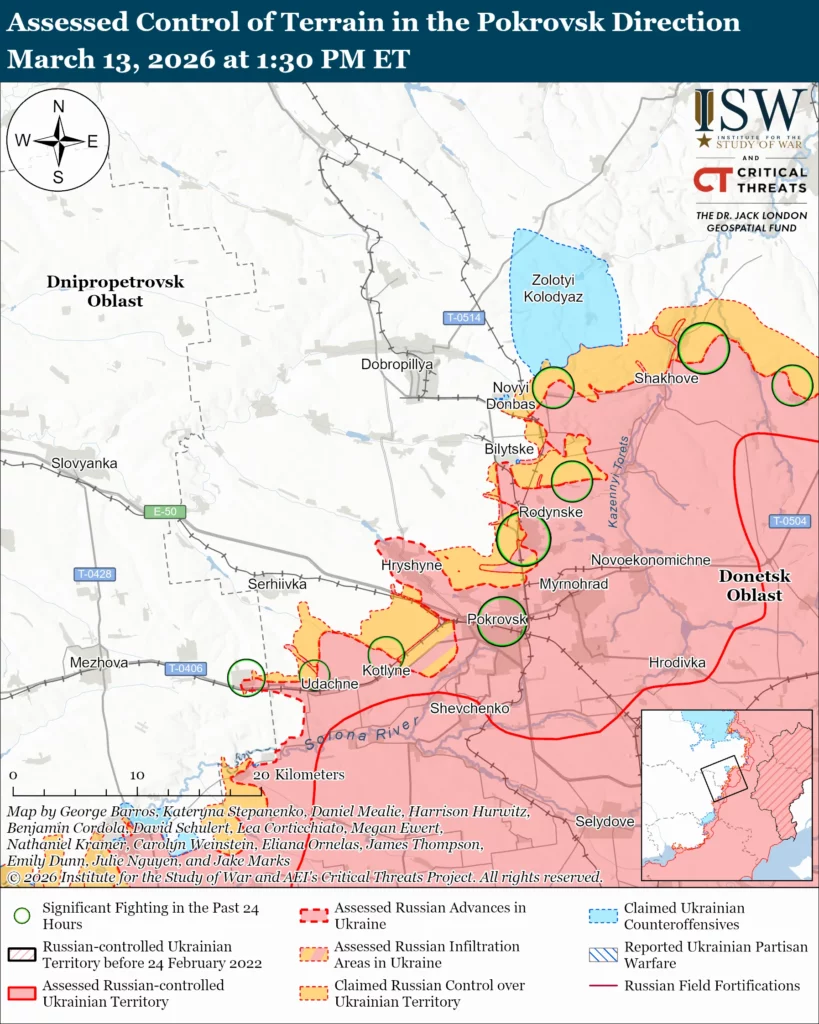
Russian forces attacked near Pokrovsk itself; northwest of Pokrovsk near Hryshyne; north of Pokrovsk near Rodynske and Bilytske; northeast of Pokrovsk near Zatyshok and Chervonyi (Krasnyi) Lyman; east of Pokrovsk near Myrnohrad; west of Pokrovsk toward Novooleksandrivka and Serhiivka; and southwest of Pokrovsk near Kotlyne, Udachne, Novopidhorodne, and Molodetske on March 12 and 13.[51] A Russian milblogger claimed Ukrainian forces counterattacked in southern Bilystke.[52]
A Ukrainian battalion chief of staff operating in the Pokrovsk direction reported that elements of the Russian Rubikon Center for Advanced Unmanned Technologies have improved their drones, weapons, and tactics and recently began fielding new fragmentation ammunition.[53] The officer stated that Rubikon units are expanding their personnel and possess significantly more equipment than other Russian units. The officer stated that weather conditions affect both Ukrainian and Russian forces but currently enable Ukrainian forces to detect and destroy Russian manpower and equipment.
Order of Battle: Drone operators of the Russian 76th Airborne (VDV) Division are reportedly operating in the Pokrovsk direction.[54]
Ukrainian forces recently maintained positions or advanced in the Novopavlivka direction.
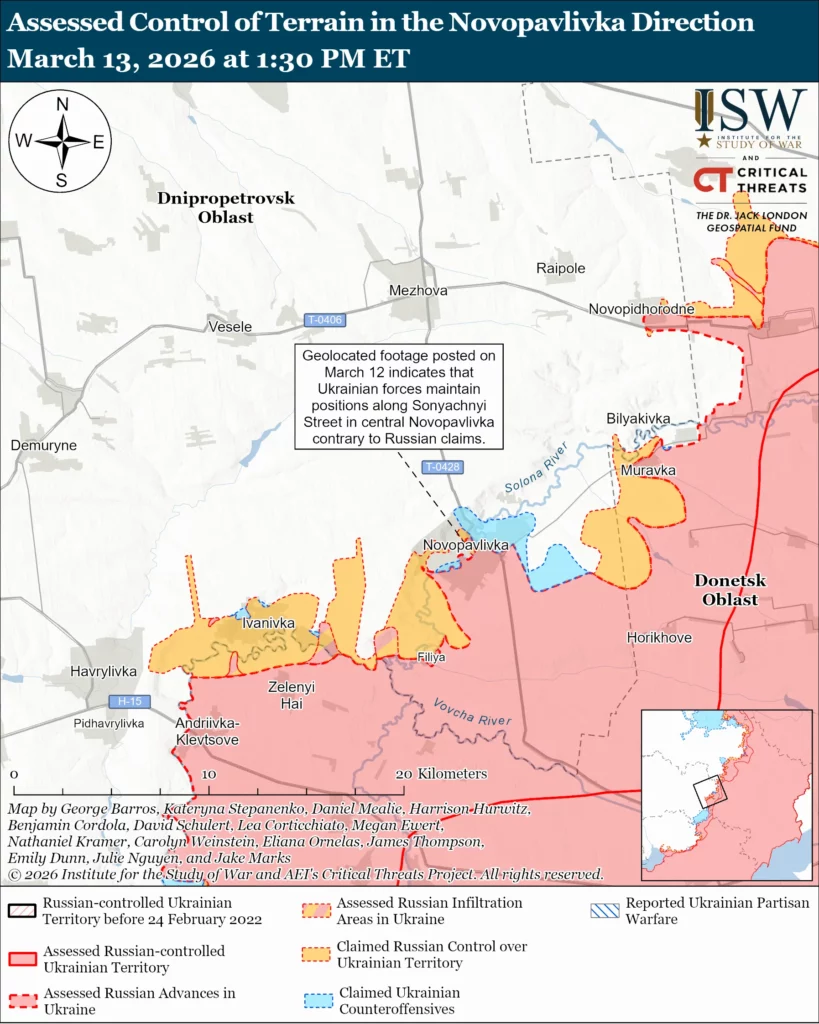
Refinement of areas under Russian claims: Geolocated footage published on March 12 shows Ukrainian forces operating in central Novopavlivka, contrary to Russian claims of advance in the town.[55]
Russian forces attacked near Novopavlivka itself and northeast of Novopavlivka near Novomykolaivka and Muravka on March 12 and 13.[56]
Russian forces continued offensive operations and Ukrainian forces continued counterattacks in the Oleksandrivka direction on March 13, but ISW has not observed evidence to change its control of terrain assessment.
Russian forces attacked northeast of Oleksandrivka near Andriivka-Klevtsove; east of Oleksandrivka near Oleksandrohrad; southeast of Oleksandrivka near Rybne, Berezove, Novohryhorivka, and Kalynivske and toward Vyshneve; and south of Oleksandrivka toward Andriivka on March 12 and 13.[57] Russian milbloggers claimed that Ukrainian forces counterattacked near Ivanivka (northeast of Oleksandrivka) and toward Vidradne (south of Oleksandrivka) and Oleksandrivka itself.[58]
The Ukrainian Ministry of Defense (MoD) reported on March 12 that Ukraine installed about 42 kilometers of anti-drone netting along a Ukrainian logistics line in Dnipropetrovsk Oblast.[59]
Order of Battle: Drone operators of the Russian 14th Spetsnaz Brigade (Russian General Staff’s Main Directorate [GRU]) are striking Ukrainian forces and intercepting drones in Vyshneve and south of Bohodarivka (south of Oleksandrivka) and northeast of Sosnivka, respectively.[60]
Ukrainian forces continue mid-range strikes against Russian military assets in occupied Donetsk Oblast. Geolocated footage published on March 12 shows a fire at a Russian oil depot after a reported Ukrainian strike in occupied Makiivka, Donetsk Oblast (about 49 kilometers behind the frontline).[61]
Russian Supporting Effort: Southern Axis
Russian objective: Maintain frontline positions, secure rear areas against Ukrainian strikes, and advance within tube artillery range of Zaporizhzhia City
Russian forces continued offensive operations in the Hulyaipole direction on March 13 but did not advance.
Russian forces attacked near Hulyaipole itself; northwest of Hulyaipole near Zelene, Dobropillya, and Olenokostyantynivka and toward Rizdvyanka; west of Hulyaipole near Zaliznychne; and southwest of Hulyaipole near Myrne on March 12 and 13.[62]
The Ukrainian General Staff reported that Ukrainian Unmanned Systems Forces (USF) downed two Russian Merlin-VR reconnaissance drones in airspace near Hulyaipole.[63]
Footage published on March 12 shows Russian forces striking Ukrainian forces reportedly near Hulyaipilske (southeast of Hulyaipole) with a FAB-3000 guided glide bomb.[64]
Order of Battle: Skat-350M reconnaissance drone operators of the Russian 27th Motorized Rifle Division (2nd Combined Arms Army [CAA], Central Military District [CMD]) are reportedly spotting for airstrikes in the Hulyaipole direction.[65] Drone operators of the Russian 37th Motorized Rifle Brigade (36th CAA, Eastern Military District [EMD]) are reportedly operating in Zaporizhia Oblast, likely in the Hulyaipole direction.[66] Drone operators of the Russian 14th Spetsnaz Brigade (Russian General Staff’s Main Directorate [GRU]) are reportedly striking Ukrainian forces near Lyubitske (northwest of Hulyaipole).[67]
Russian forces continued offensive operations in western Zaporizhia Oblast on March 13 but did not advance.
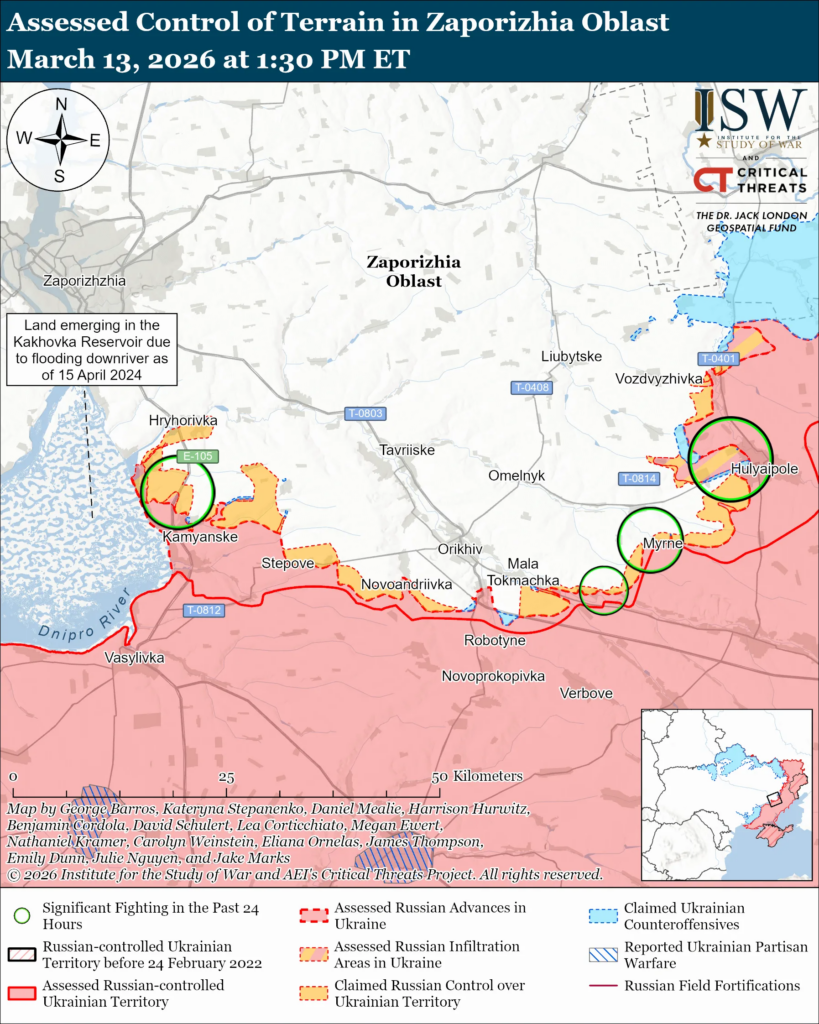
Russian forces attacked northwest of Orikhiv toward Mahdalynivka and west of Orikhiv near Prymorske and Stepnohirsk on March 12 and 13.[68] A Russian milblogger claimed that Novoandriivka (west of Orikhiv) and Novodanylivka (south of Orikhiv) are contested ”gray zones.”[69]
A Russian milblogger claimed that improved weather conditions have enabled Ukrainian forces to intensify drone operations near Prymorske, including with Vampyr heavy bomber drones, in recent days.[70]
Geolocated footage published on March 12 shows Russian forces striking a Ukrainian road bridge over the Kinska River between Yuliivka and Zaporozhets (both southeast of Zaporizhzhia City and roughly 13 kilometers from the frontline).[71]
Ukrainian Zaporizhia Oblast Administration Head Ivan Fedorov reported on March 13 that Russian forces struck a tanker truck near Vilnyansk, Zaporizhia Oblast (approximately 39 kilometers from the frontline), killing the driver.[72]
Order of Battle: First-person view (FPV) drone operators of the Russian Nemets group of the 3rd Assault Company of the 291st Motorized Rifle Regiment (42nd Motorized Rifle Division, 58th CAA, Southern Military District [SMD]) are reportedly striking Ukrainian positions near Orikhiv.[73] Orlan-10 reconnaissance drone operators and other elements of the Russian 7th Airborne (VDV) Division, including its 108th VDV Regiment, reportedly continue to operate in the Zaporizhia direction.[74]
Neither Russian nor Ukrainian sources reported ground activity in the Kherson direction on March 13.
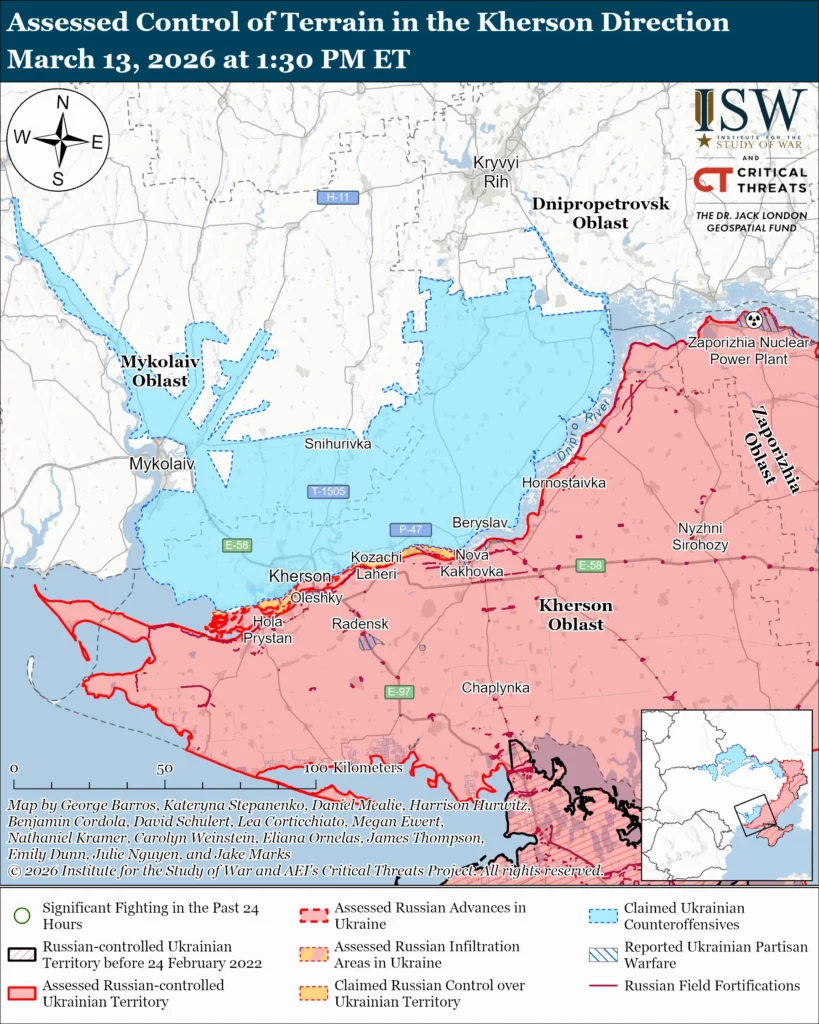
Order of Battle: Drone operators of the Russian 205th Motorized Rifle Brigade (49th CAA, SMD) are reportedly striking Ukrainian forces in Kozatske (northeast of Kherson City).[75]
Geolocated footage confirms recent reports of Ukrainian long-range strikes against Russian military targets in occupied Crimea. Geolocated footage published on March 12 shows drone operators of Ukraine’s Main Military Intelligence Directorate (GUR) striking a Russian 39N6 Kasta-2E2 radar station in occupied Ponyzivka on unspecified dates in February 2026.[76] A Russian milblogger complained that Russian forces lack sufficient missiles to counter Ukrainian drone strikes against occupied Crimea, forcing Russian forces to rely on mobile fire groups for air defense.[77]
Russian Air, Missile, and Drone Campaign
Russian Objective: Target Ukrainian military and civilian infrastructure in the rear and on the front line
Russian forces conducted long-range drone strikes against Ukraine overnight on March 12 to 13. The Ukrainian Air Force reported that Russian forces launched one Iskander-M ballistic missile from Rostov Oblast and 126 Shahed, Gerbera, Italmas, and other types of strike drones, of which about 80 were Shaheds, from the directions of Bryansk, Kursk, and Oryol cities; Millerovo, Rostov Oblast; Primorsko-Akhtarsk, Krasnodar Krai; and occupied Hvardiiske, Crimea.[78] The Ukrainian Air Force reported that Ukrainian forces downed 117 drones, that the ballistic missile and eight drones struck seven locations, and that drone debris fell at five locations. Ukrainian officials reported on March 13 that Russian forces struck a bus near Novooleksandrivka (northeast of Kharkiv City), killing the driver and 2 passengers and injuring four.[79] Ukrainian officials reported that Russian forces struck civilian enterprises, transport infrastructure, and residential areas in Kharkiv Oblast; transport and residential infrastructure in Mykolaiv Oblast; and port infrastructure in Odesa Oblast.[80]Ukrainian Ministry of Defense (MoD) advisor on defense technology and drone and EW expert, Serhiy “Flash” Beskrestnov, reported on March 13 that Russian forces are equipping infrared spotlights on the tails of the Shahed drones to blind cameras and observation systems of Ukrainian interceptor drones and are attempting to install similar systems on Molniya-fixed wind drones.[81] Beskrestnov added that Russian Molniya drones are attempting to blind Ukrainian interceptor drones at altitudes of 200 to 300 meters.
Significant Activity in Belarus
Russian efforts to increase its military presence in Belarus and further integrate Belarus into Russian-favorable frameworks
Nothing Significant To Report.
Note: ISW does not receive any classified material from any source, uses only publicly available information, and draws extensively on Russian, Ukrainian, and Western reporting and social media as well as commercially available satellite imagery and other geospatial data as the basis for these reports. References to all sources used are provided in the endnotes of each update.