 Eurasia Press & News
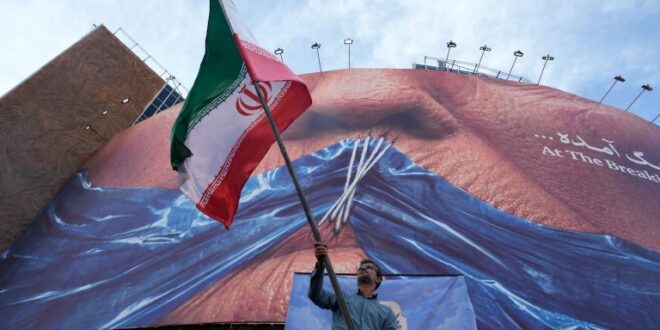
Both Tehran and Washington are conducting military operations and threatening escalation to enhance their strategic leverage in negotiations to end the conflict.
The brinkmanship renders a restart of major conflict as likely as an agreement that would resolve the major outstanding issues, including a full reopening of the Strait of Hormuz.
The Iran war will factor prominently in President Trump’s visit this week to China, which gets most of its energy supplies from countries on the Persian Gulf, including Iran, that export their products through the Strait.
In negotiations on limitations to Iran’s nuclear program, Iranian leaders reportedly are yielding on some of their red lines, particularly by accepting a more than decade-long suspension of uranium enrichment. .
As U.S. President Donald Trump visits Beijing this week for high-stakes meetings with Chinese leader Xi Jinping, Trump’s efforts to bring the Iran war to a conclusion that he can present as a “victory” are producing confusing signals from both Tehran and Washington. As the U.S. and Iran both threaten escalation to preserve or add to their strategic leverage, the war is as likely to reignite into full-scale hostilities as to result in an accord settling major outstanding issues. Even as they threaten escalation, U.S. and Iranian officials are exchanging drafts on a reported one page “memorandum of understanding” (MOU) that would guide talks on a broad, war-ending agreement. Tehran’s relative silence on the details of the negotiations contrasts sharply with Trump’s daily predictions that an accord is imminent. When he hosts Trump this week, Xi, whose large economy has a direct and material interest in the reopening of the Persian Gulf to all energy and commercial traffic, will likely urge Trump to remain on a path of de-escalation and diplomacy.
Although they accept the need for a diplomatic solution, decision-makers in Tehran and Washington continue to battle for strategic leverage in the Persian Gulf. Both Trump and Iran’s Islamic Revolutionary Guard Corps (IRGC), whose commanders dominate Iranian internal decision-making, have threatened to escalate to preserve their main strategic “cards.” For Iran, its main strategic accomplishment to date has been its ability to stop commercial ships from transiting the Strait of Hormuz. For Washington, a U.S. naval blockade, imposed on April 13, is applying heavy pressure on Iran’s already weak economy, and U.S. officials expect it to strangle Tehran’s oil export lifeline. The pressure on Iran’s oil sector might have contributed to an apparent oil spill at Iran’s main oil export terminal on Kharg Island.
Alarming global leaders that full-scale conflict might resume, Iranian attacks on U.S. and commercial ships in the Strait of Hormuz last week — part of Iran’s effort to keep the Strait closed — resulted in U.S. strikes on several Iranian ports, including the Iranian naval hub of Bandar Abbas. U.S. forces also sank many IRGC fast attack craft that were attacking and preparing to “swarm” targets in the Strait. Trump characterized those exchanges as “trifles,” and he and his top aides insist that the ceasefire remains in place. The U.S. retaliatory strikes contrasted with reassurances from Secretary of State Marco Rubio, who told reporters Wednesday that Operation Epic Fury had formally “terminated.”
The proximate cause of last week’s flare-up of hostilities was the U.S. implementation of a military-assisted coordination and protection mechanism termed “Project Freedom,” which Iran immediately viewed as threatening its control of the Strait and acted to disrupt. However, Iran also attacked targets in the United Arab Emirates (UAE) that seemingly had no connection to Project Freedom. Less than one day after the operation began, Trump “paused” the mission, claiming that he had acceded to Pakistan’s request to allow time and space to finalize a diplomatic agreement with Iran. But some reports attributed the halt to Saudi and Kuwaiti insistence, based on concerns about potential Iranian retaliation, that U.S. Central Command (CENTCOM) not use their bases and airspace for Project Freedom. The U.S.-Gulf differences have reportedly been resolved, and U.S. officials say Project Freedom will resume, with unspecified enhancements and expansion, if Iran does not soon agree to U.S. terms for an accord. U.S. officials welcomed reports that British and French warships were moving into the region to potentially help the U.S. effort to reopen the Strait to Gulf state and Iraqi commercial traffic.
Although it can block shipping through the Strait, the IRGC has not been able to break the U.S. naval blockade. CENTCOM stated Friday that U.S. forces are preventing more than 70 tankers from entering or leaving Iranian ports, which have a collective capacity to transport over 166 million barrels of Iranian oil worth more than $13 billion. On Friday, U.S. combat jets struck and disabled two more Iranian tankers seeking to enter the Iranian port of Jask, on the Gulf of Oman. On Sunday, Iran’s IRGC-dominated Khatam al-Anbiya warned that Iran would resume attacks on U.S. bases in the Gulf states if the U.S. continues to attack Iranian tankers. Accompanying the warning, Iran fired drones on targets in the UAE and Kuwait and hit a bulk carrier vessel off the coast of Qatar. On the other hand, a Qatari liquified natural gas (LNG) ship transited the Strait on Saturday — the first such vessel to do so since Iran began its effort to control the Strait. It is not clear whether the vessel was receiving U.S. protection or Qatar and Iran reached a separate accord for its safe passage.
Amid the skirmishing, Tehran shows no signs of capitulating to Trump’s publicly stated demands for “unconditional surrender.” Experts assess that IRGC commanders and hardline civilian government leaders believe Iran still has the upper hand in the conflict. Tehran calculates that rising global oil prices and product shortages will force Trump to end the conflict without securing the major nuclear and other concessions he seeks. Secretary Rubio said Friday that he expected Iran to respond by this Friday to the latest U.S proposals for an MOU, but the spokesperson of Iran’s Foreign Ministry, Esmail Baqaei, clearly indicated Saturday that Tehran recognizes little urgency to strike a deal. He told reporters Iran is reviewing the latest U.S. proposal and that deadlines set by the United States are “not important,” adding Iran will respond “at an appropriate time.” On Sunday, Iranian state media said Iran had formally responded to the U.S proposals via Pakistan, but there was no indication that Tehran was ready to accept U.S. demands. IRGC-linked media said Iran’s response focused only on an end to the war and “maritime security,” and not on the core nuclear issues in dispute.
The rapidly evolving events and contrasting statements complicate efforts to determine whether the two sides are making progress toward forging a comprehensive settlement. Trump told reporters last week that Iranian negotiators were becoming more “malleable,” suggesting movement on issues of core importance to Washington. Imposing constraints that would deny Iran any pathway to developing a nuclear weapon has been Trump’s core justification for launching Operation Epic Fury, and a careful reading of mainstream U.S. and regional media reports might indicate Iranian leaders are bending some of their previously sacrosanct nuclear program red lines.
Iran has consistently insisted that it would not cease enriching uranium under any circumstances, arguing that doing so is a “right” bestowed on Iran as a party to the Nuclear Non-Proliferation Treaty (NPT). But draft text reported by Axios and other outlets noted that Iran might accede to a long-term suspension of uranium enrichment — perhaps as long as 15 years. That term is short of Trump’s original demands for a permanent suspension of enrichment and the dismantlement of uranium enrichment facilities, but it is reportedly in line with the timeframes proposed by the lead U.S. negotiators. Following the suspension period, Iran’s enrichment activities would be limited to 3.67 percent purity — an amount sufficient for use in a civilian nuclear power reactor but far away from the “weapons grade” levels needed for a nuclear weapon (90 percent).
A second core U.S. demand is for Iran to eliminate its stockpile of 440 kilograms of 60 percent enriched uranium — enough, if enriched to weapons grade, to fuel 11 nuclear weapons. Iran has accepted, in principle, that the stockpile needs to be reprocessed (down-blended) to low-purity levels suitable only for civilian use. However, Tehran has insisted it will not yield the material to the United States or any other outside actors, and would reprocess it in Iran, presumably under International Atomic Energy Agency (IAEA) supervision. Trump has insisted that Iran, after digging the material out from the rubble of the Esfahan uranium conversion facility destroyed in the 2025 Operation Midnight Hammer strike, allow U.S. personnel to fly the material out of Iran. However, some reports indicate the Trump team might accept proposals for Russia, which has been extensively involved in Iran’s civilian nuclear program, to take the material back for reprocessing. Iranian Foreign Minister Abbas Araghchi reportedly discussed this proposal, among other issues, during his visit to Moscow in late April, suggesting Tehran might support it. Iranian hardliners trust Russia, with which Iran has a strategic partnership, and which reportedly has been providing intelligence to Iran for use against U.S. forces.
Nor do other major outstanding issues seem to represent “deal breakers.” Observers of the U.S.-Iran exchanges report that any accord will provide for both sides to gradually unwind their efforts to restrict Iranian and global traffic through the Strait of Hormuz. Trump officials have also acknowledged that an agreement that satisfies their concerns about Iran’s nuclear activities will include significant sanctions relief, including easing sanctions that restrict Iran’s use of tens of billions of dollars in Iranian assets held in banks around the world, particularly Japan. Iran has demanded that a war-ending agreement require Washington to compel Israel to end its operations against Lebanese Hezbollah and withdraw from south Lebanon. But experts assess that Tehran will likely drop this demand, recognizing that the U.S. cannot pledge to control the policies of Israel, which is a sovereign state, even if it is heavily influenced by Washington.