 Eurasia Press & News
Toplines
The seniormost Russian military command presented a highly inaccurate assessment of the battlefield situation for the fifth consecutive month, absurdly claiming that Russian forces are advancing west of Kupyansk, which they have not, in fact, taken. Russian Chief of the General Staff Army General Valery Gerasimov met with the Russian Western Grouping of Forces on May 16 and made a series of false claims about the situation in the Kupyansk, Borova, and Lyman directions.[1] Gerasimov claimed that Russian forces are advancing west of Kupyansk toward Shevchenkove, a statement inaccurately implying that Russian forces have seized Kupyansk and hold positions further west of the town. Gerasimov also claimed that Russian forces entered Velyka Shapkivka (northwest of Kupyansk), seized all of Borova (south of Kupyansk) and Kutkivka (north of Kupyansk); and seized about 50 percent of Shyikivka (southeast of Borova) and 85 percent of Lyman. ISW has observed evidence to assess that Russian forces do not hold consolidated positions within Kupyansk and that only a few Russian infiltrators remain in the town. ISW has not observed evidence to assess that Russian forces hold positions within Velyka Shapkivka, Shyikivka, Kutkivka, or Lyman, and has observed evidence to assess that Russian forces have only infiltrated within about 14.2 percent of Kupyansk, 6.5 percent of Kutkivka, and 0.06 percent of Lyman. ISW currently assesses that Russian forces are at closest about two kilometers from Shyikivka and about four kilometers from Velyka Shapkivka.
Gerasimov identified Russia’s next operational objective after the seizure of Kupyansk as Shevchenkove, but Russian forces are not close to seizing Kupyansk, which they would have to do before advancing along the H-20 highway toward Shevchenkove. There are multiple settlements named Shevchenkove in Kharkiv Oblast, but Gerasimov is likely referring to the Shevchenkove about 28 kilometers west of Kupyansk at the intersection of the H-20 Kupyansk-Chuhuiv-Kharkiv City and T-2110 Shevchenkove-Balakliya road, which also intersects with the M-03 Kharkiv City-Izyum highway and P-78 Kharkiv City-Balakliya-Borova highway to the south of the H-20. The Russian military command likely intends to threaten these Ukrainian ground lines of communication (GLOC) to support Russian efforts to advance in the Borova and Lyman directions as well as to advance on Kharkiv City from the east. Russian forces’ ability to advance on and eventually seize Shevchenkove requires first seizing Kupyansk, however, and Russia has proven unable or unwilling to dedicate the necessary forces and means to repelling Ukrainian counterattacks and conducting offensive operations at a large enough scale to make tactically- and operationally-significant advances near, within, and beyond Kupyansk.[2] Gerasimov and other senior Russian officials have repeatedly made aggrandized claims of Russian advances on the frontline as part of a cognitive warfare effort based upon the false premise that Russian forces are advancing simultaneously across the theater and that Ukrainian defensive lines are imminently collapsing. Ukrainian defensive lines are holding against Russia’s Spring-Summer 2026 offensive, and Ukrainian forces are contesting the tactical initiative in several areas of the frontline, however, including in the Kupyansk direction.[3]
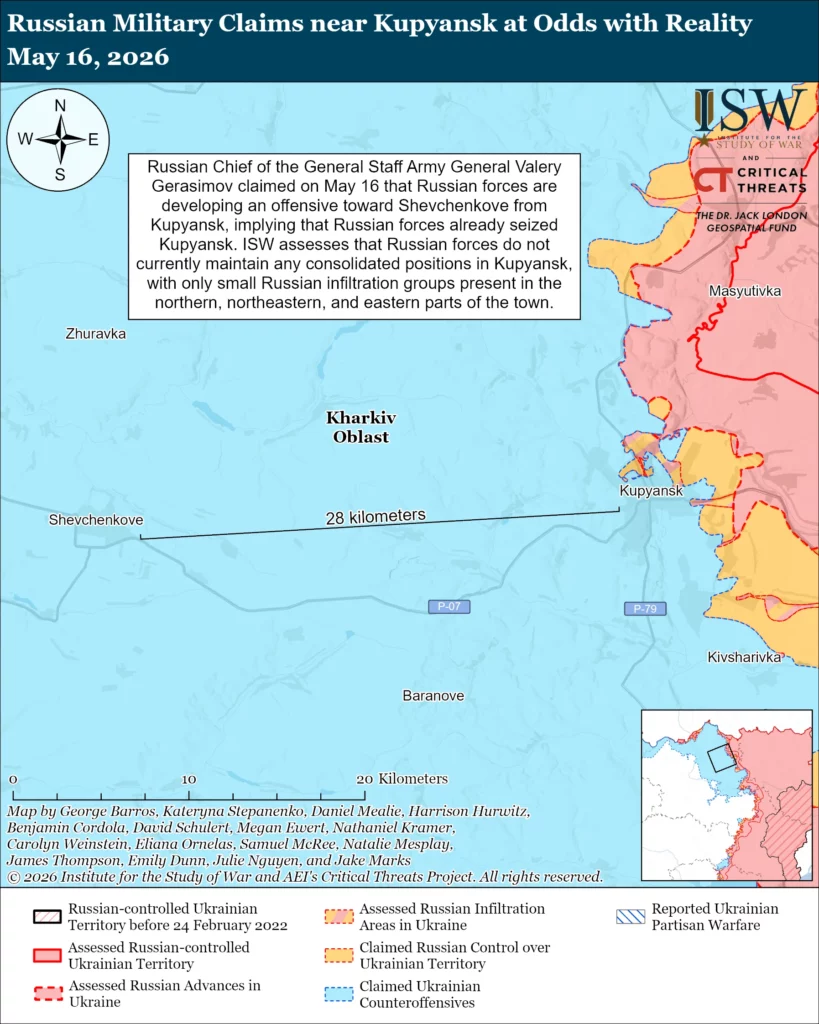
Gerasimov’s claimed advances west of Kupyansk and along the Kupyansk-Borova-Lyman line are egregious even in comparison to the most expansive Russian ultranationalist claims in the area. Russian milbloggers have not claimed that Russian forces hold a significant presence within Kupyansk following Ukrainian counterattacks, and the ultranationalist community has actively criticized Gerasimov’s previous claims of seizing most and then all of Kupyansk when Ukrainian forces had actually liberated much of the town.[4] Russian milbloggers certainly have not claimed that Russian forces have entered Kutkivka, Shyikivka, or Velyka Shapkivka. Russian milbloggers have claimed that Russian forces have advanced in about 14 percent of Kupyansk and 4.6 percent of Lyman. One Russian milblogger responded to Gerasimov’s May 16 claims over Borova in particular, claiming that not a single Russian milblogger who produces maps of the battlefield is claiming that Russian forces have even entered Borova, much less seized the whole town.[5] The milblogger sarcastically claimed that the Russian military command will soon falsely claim to have seized Kharkiv City given how it failed to react to the poor situation near Kupyansk. The Russian ultranationalist information space has repeatedly criticized Gerasimov, Russian President Vladimir Putin, and other senior Russian military commanders for making these aggrandized claims in what the milbloggers call “beautiful reports,” which present unsubstantiated Russian advances to higher-ups from which the military command then makes operational plans and objectives for Russian forces on the ground.[6] These “beautiful reports” now appear to have persuaded the Russian military command that it is pursuing the operational objective of seizing Shevchenkove that Russian forces cannot yet undertake, as they are still far from achieving their current operational objective of seizing Kupyansk. These aggrandized claims of fictional advances along with milblogger complaints may indicate that the highest echelon of the Russian military command is either unaware of or unwilling to admit the realities of the battlefield even to itself, and is therefore allowing its own falsehoods to influence Russian operational and strategic planning.
Russian milbloggers continue to warn that Ukrainian counterattacks and false reports of advances in other areas of the frontline are creating difficult situations to which the Russian military command cannot adequately respond. Russian milbloggers warned on May 15 and 16 that Ukrainian forces are counterattacking northwest of Orikhiv in Stepnohirsk, west of Orikhiv near Stepove, southwest of Orikhiv toward Pyatykhatky, and southeast of Orikhiv near Mala Tokmachka.[7] The milbloggers broadly described the situation as “tense” or “difficult” for Russian forces, particularly northwest and west of Orikhiv. A Kremlin-affiliated Russian milblogger claimed that Russian forces do not hold positions in Novodanylivka (south of Orikhiv) and that Ukrainian forces hold positions in Mala Tokmachka.[8] The milblogger claimed that the delta between the Russian military’s claimed advances in the area and the actual frontline is preventing Russian commanders from forming a clear assessment of the situation.
The Kremlin continues to expand its passportization efforts in Transnistria — the pro-Russian breakaway region of Moldova — to deepen Russian influence in the region. Russian President Vladimir Putin signed a decree on May 15 simplifying the procedure for Transnistria residents to acquire Russian citizenship.[9] The decree allows foreign citizens and stateless persons over the age of 18 residing in Transnistria to obtain Russian citizenship without meeting the standard requirements of five years’ residence in Russia after acquiring a residency permit, or passing exams on Russian language proficiency, history, and basic legislation. Putin has lifted these requirements for citizens of other countries as part of Russian passportization campaigns in former Soviet republics, including Ukraine — where Russia has encouraged the acquisition of Russian citizenship nationwide and forcibly conducted passportization in occupied areas — as well as in Belarus, Kazakhstan, and the Russian-occupied separatist regions of Abkhazia and South Ossetia in Georgia.[10] Putin signed this decree soon after the Russian State Duma passed on May 13 a bill that grants Putin authority for extraterritorial military operations to protect Russian citizens abroad.[11] The Kremlin has repeatedly claimed that foreign states oppress Russian speakers and ethnic Russians — including in Moldova, the Baltic states, and Ukraine, where it used these claims as part of its justification for the full-scale invasion in 2022.[12] The Kremlin continues to set conditions in Moldova to exert leverage and meddle in regional affairs by asserting a right to protect Russian speakers and ethnic Russians abroad. Fifty-nine percent of residents in Transnistria reportedly already hold Russian citizenship as of February 2024, however, so it remains unclear how much additional influence the Kremlin may gain through these efforts.[13]
Key Takeaways
The seniormost Russian military command presented a highly inaccurate assessment of the battlefield situation for the fifth consecutive month, absurdly claiming that Russian forces are advancing west of Kupyansk, which they have not, in fact, taken.
Gerasimov’s claimed advances west of Kupyansk and along the Kupyansk-Borova-Lyman line are egregious even in comparison to the most expansive Russian ultranationalist claims in the area.
These aggrandized claims of fictional advances along with milblogger complaints may indicate that the highest echelon of the Russian military command is either unaware of or unwilling to admit the realities of the battlefield even to itself, and is therefore allowing its own falsehoods to influence Russian operational and strategic planning.
Russian milbloggers continue to warn that Ukrainian counterattacks and false reports of advances in other areas of the frontline are creating difficult situations to which the Russian military command cannot adequately respond.
The Kremlin continues to expand its passportization efforts in Transnistria – the pro-Russian breakaway region of Moldova — to deepen Russian influence in the region.
Ukrainian forces advanced in the Hulyaipole direction.
Ukrainian forces continued their long-range strike campaign against Russian defense industrial infrastructure in Stavropol Krai. Russian forces launched 294 drones toward Ukraine overnight.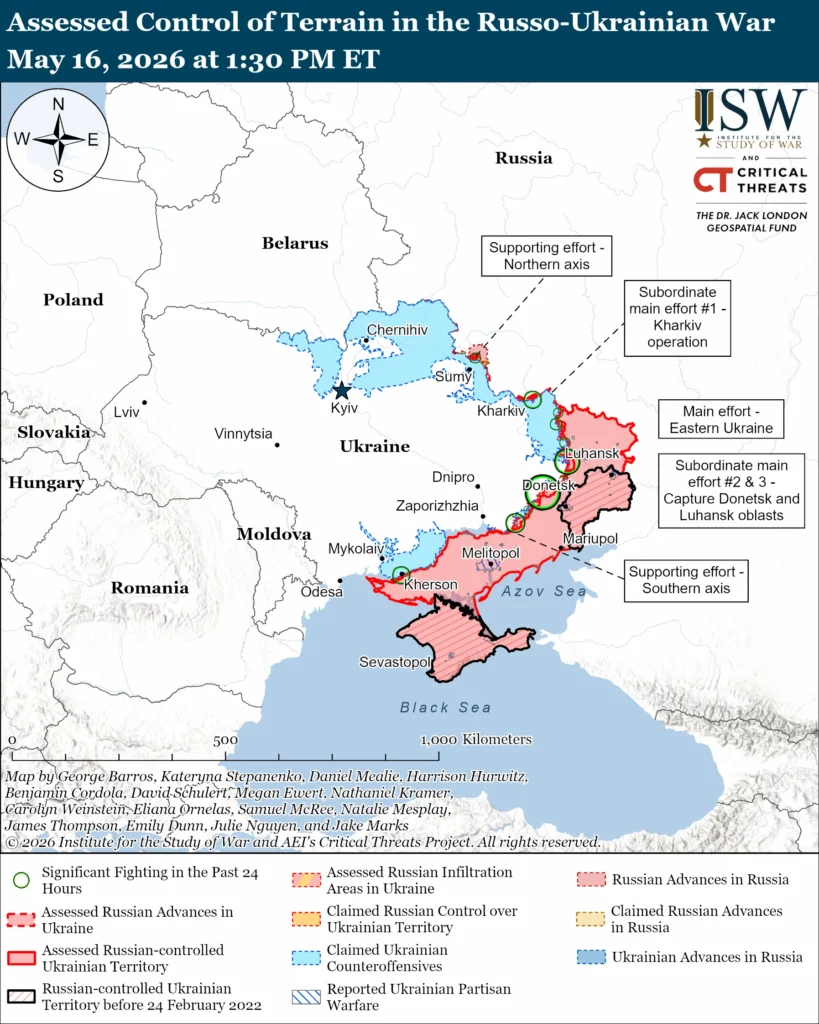
We do not report in detail on Russian war crimes because these activities are well-covered in Western media and do not directly affect the military operations we are assessing and forecasting. We will continue to evaluate and report on the effects of these criminal activities on the Ukrainian military and the Ukrainian population and specifically on combat in Ukrainian urban areas. We utterly condemn Russian violations of the laws of armed conflict and the Geneva Conventions and crimes against humanity even though we do not describe them in these reports.
Ukrainian Operations in the Russian Federation
Ukrainian forces continued their long-range strike campaign against Russian defense industrial infrastructure in Stavropol Krai on the night of May 15 to 16. Russian opposition outlet Astra reported on May 16 that Ukrainian forces struck the Azot chemical plant in Nevinnomyssk, Stavropol Krai, causing fires at the facility.[14] Geolocated footage published on May 16 confirmed fires at the chemical plant, located roughly 540 kilometers from the frontline.[15] Ukrainian defense outlet Militarnyi noted that the Nevinnomyssk Azot chemical plant is southern Russia’s largest chemical plant and Russia’s largest producer of nitrogen fertilizers and ammonia used to make explosives.[16] Stavropol Krai Governor Vladimir Vladimirov acknowledged the Ukrainian strike near Nevinnomyssk.[17]
Russian Supporting Effort: Northern Axis
Russian objective: Create defensible buffer zones in Sumy Oblast along the international border
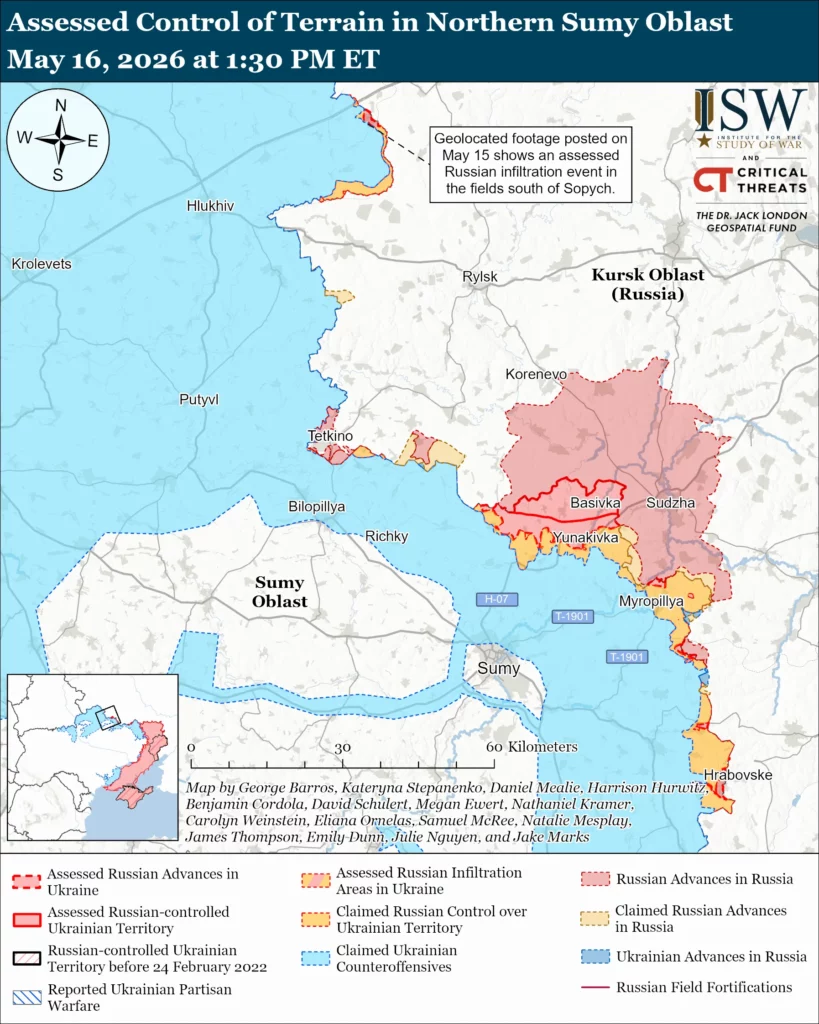
Russian forces continued infiltration missions and limited offensive operations in Sumy Oblast on May 16.[18]Geolocated footage posted on May 15 shows Ukrainian forces striking a Russian servicemember south of Sopych (northwest of Sumy City) after what ISW assesses was a Russian infiltration mission.[19]
Russian Main Effort: Eastern Ukraine
Russian Subordinate Main Effort #1 – Kharkiv Oblast
Russian objective: Push Ukrainian forces back from the international border to create a defensible buffer zone with Belgorod Oblast and approach to within tube artillery range of Kharkiv City
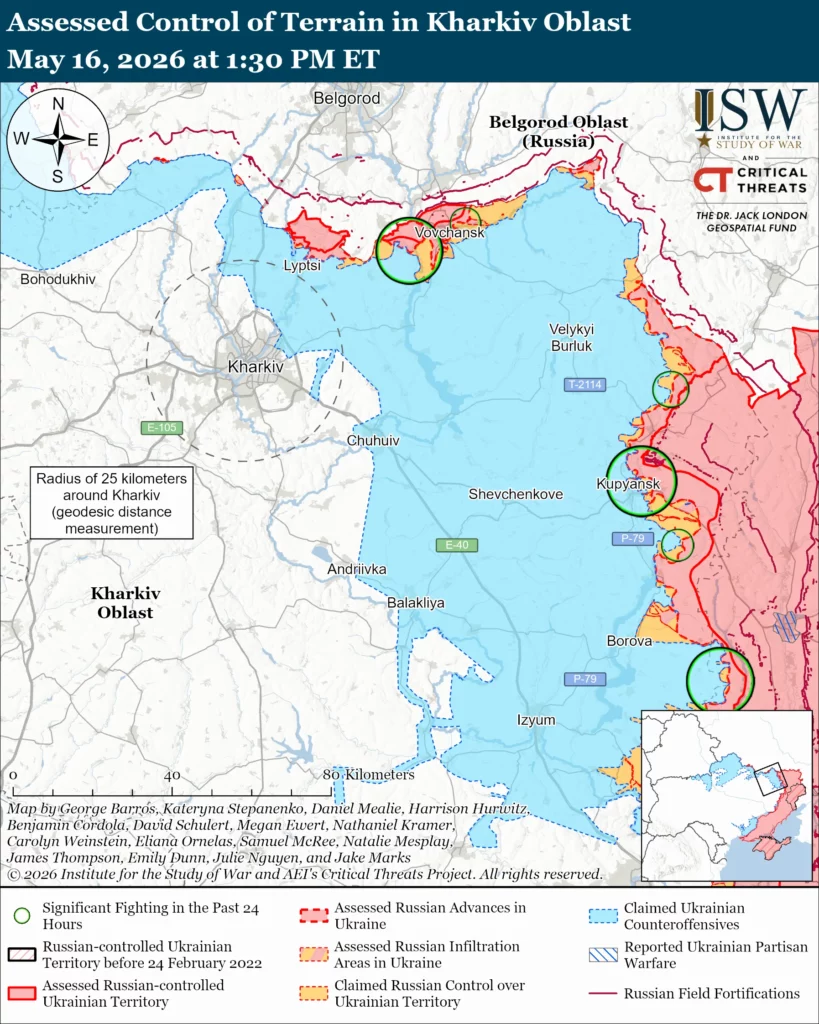
Russian forces continued offensive operations in northern Kharkiv Oblast on May 16 as Ukrainian forces reportedly counterattacked in the area.[20]
Neither Russian nor Ukrainian forces reported ground activity in the Velykyi Burluk direction on May 16.
Russian Subordinate Main Effort #2 – Oskil River
Russian objective: Cross the Oskil River in Kharkiv Oblast and push westward into eastern Kharkiv Oblast and northern Donetsk Oblast
Russian Main Effort: Eastern Ukraine
Russian Subordinate Main Effort #1 – Kharkiv Oblast
Russian objective: Push Ukrainian forces back from the international border to create a defensible buffer zone with Belgorod Oblast and approach to within tube artillery range of Kharkiv City
Russian forces continued offensive operations in northern Kharkiv Oblast on May 16 as Ukrainian forces reportedly counterattacked in the area.[20]
Neither Russian nor Ukrainian forces reported ground activity in the Velykyi Burluk direction on May 16.
Russian Subordinate Main Effort #2 – Oskil River
Russian objective: Cross the Oskil River in Kharkiv Oblast and push westward into eastern Kharkiv Oblast and northern Donetsk Oblast
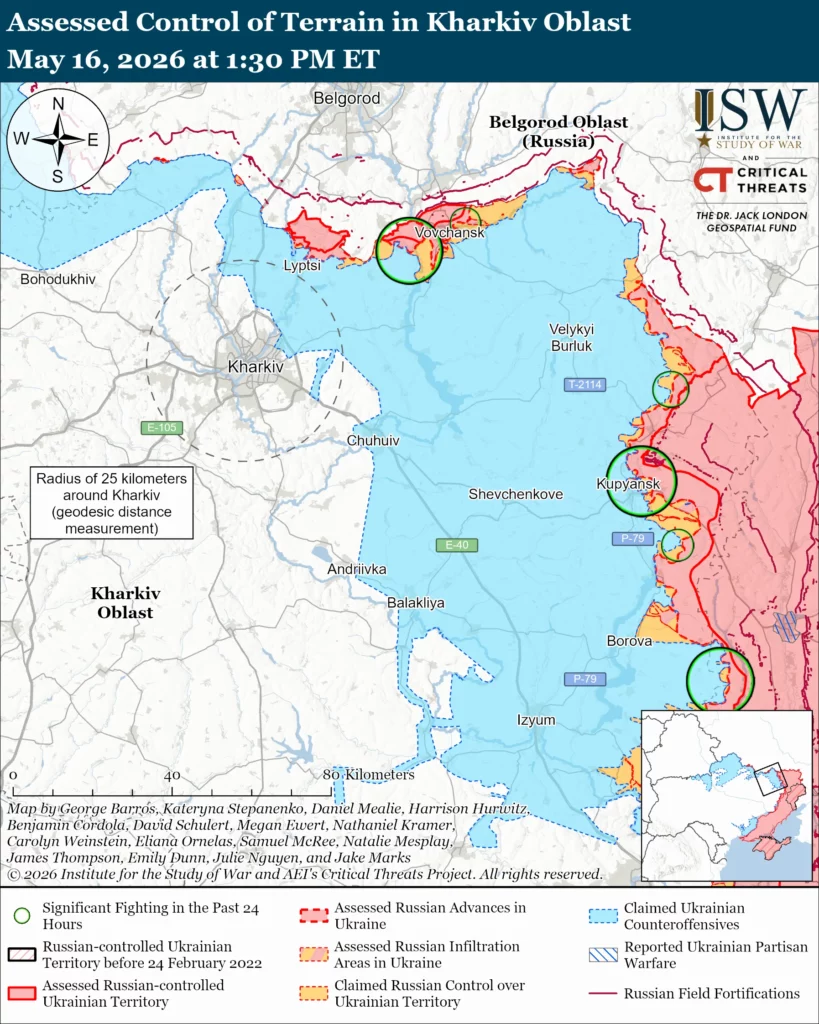
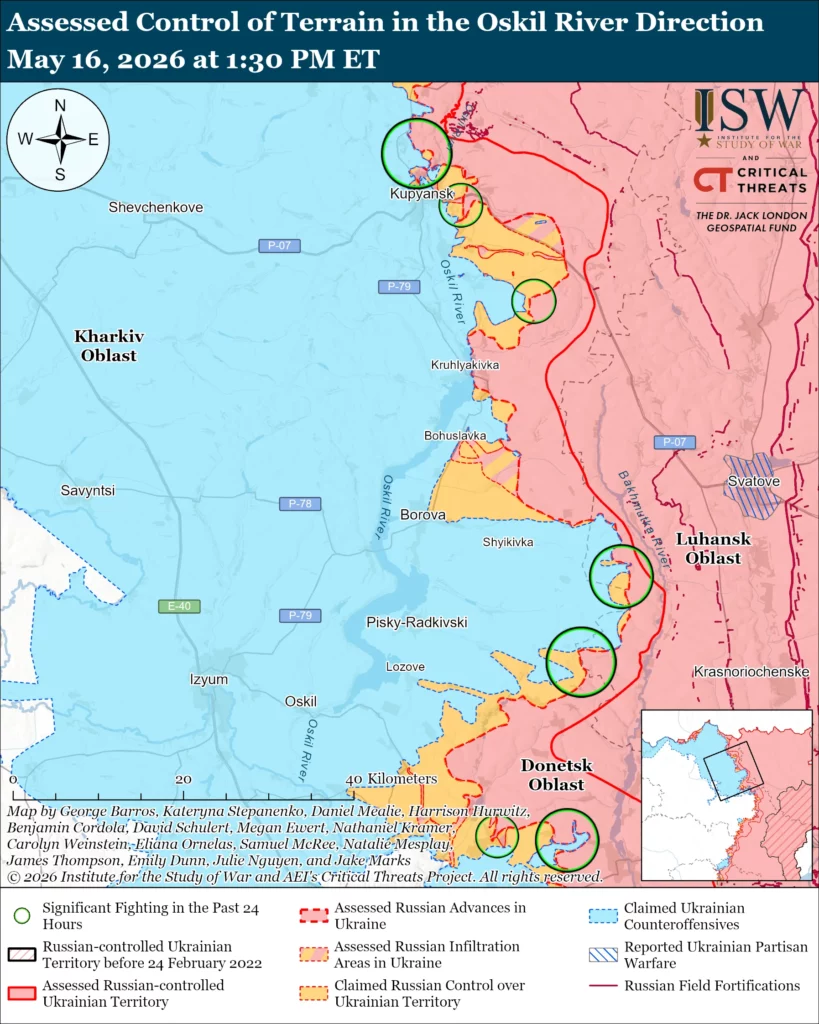
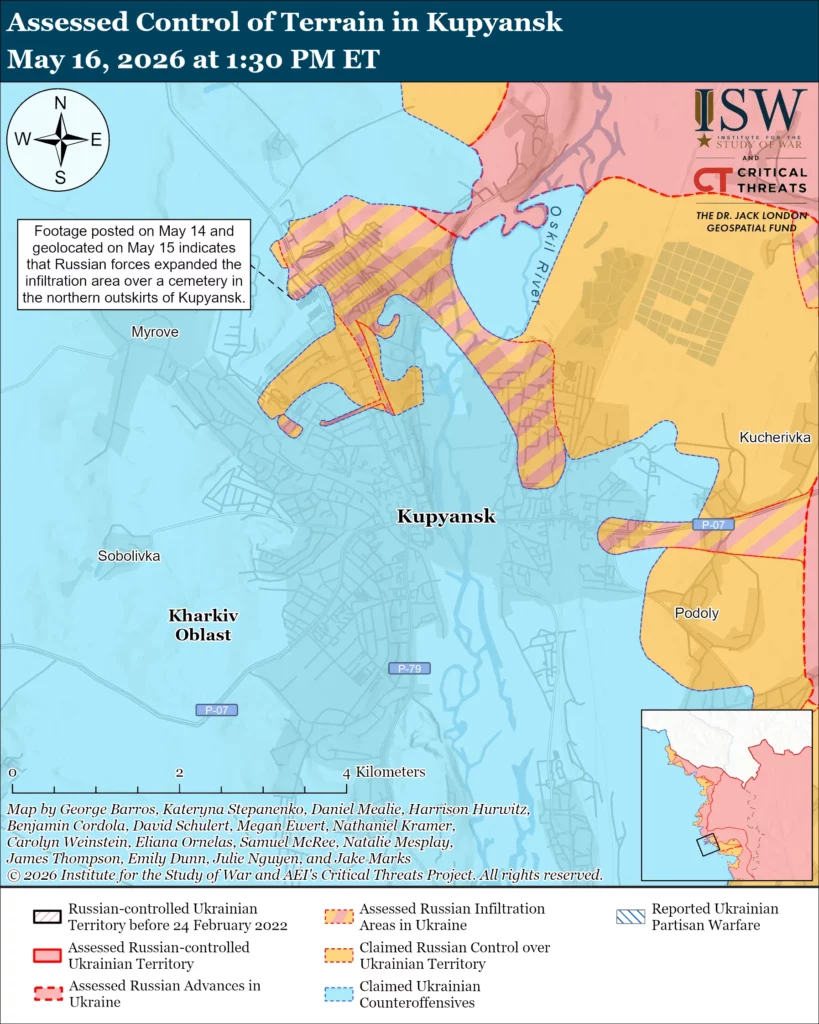
Russian forces continued offensive operations in the Kupyansk direction on May 16 and recently conducted an infiltration mission, but did not make confirmed advances.[21] Geolocated footage published on May 14 shows Ukrainian forces striking a Russian servicemember north of Kupyansk after what ISW assesses was a Russian infiltration mission.[22] The Russian Ministry of Defense (MoD) claimed that Russian forces seized Kutkivka (north of Kupyansk), with Russian Defense Minister Andrei Belousov congratulating elements of the Russian 121st Motorized Rifle Regiment (68th Motorized Rifle Division, 6th Combined Arms Army [CAA], Leningrad Military District [LMD]) with the claimed seizure.[23]
Russian forces continued conducting offensive operations in the Borova direction on May 16 but did not make confirmed advances.[24] The Russian MoD claimed on May 16 that Russian forces seized Borova, but ISW has not observed evidence to support the Russian MoD’s claim.[25]
Ukrainian forces continued their mid-range strike campaign against Russian military assets in occupied Luhansk Oblast. The Ukrainian General Staff reported on May 16 that Ukrainian forces struck a Russian materiel and equipment depot in occupied Baranykyvka (roughly 23 kilometers from the frontline) on May 15 or overnight on May 15 to 16.[26]
Russian Subordinate Main Effort #3 – Donetsk Oblast
Russian objective: Capture the entirety of Donetsk Oblast, the claimed territory of Russia’s proxies in Donbas, and advance into Dnipropetrovsk Oblast
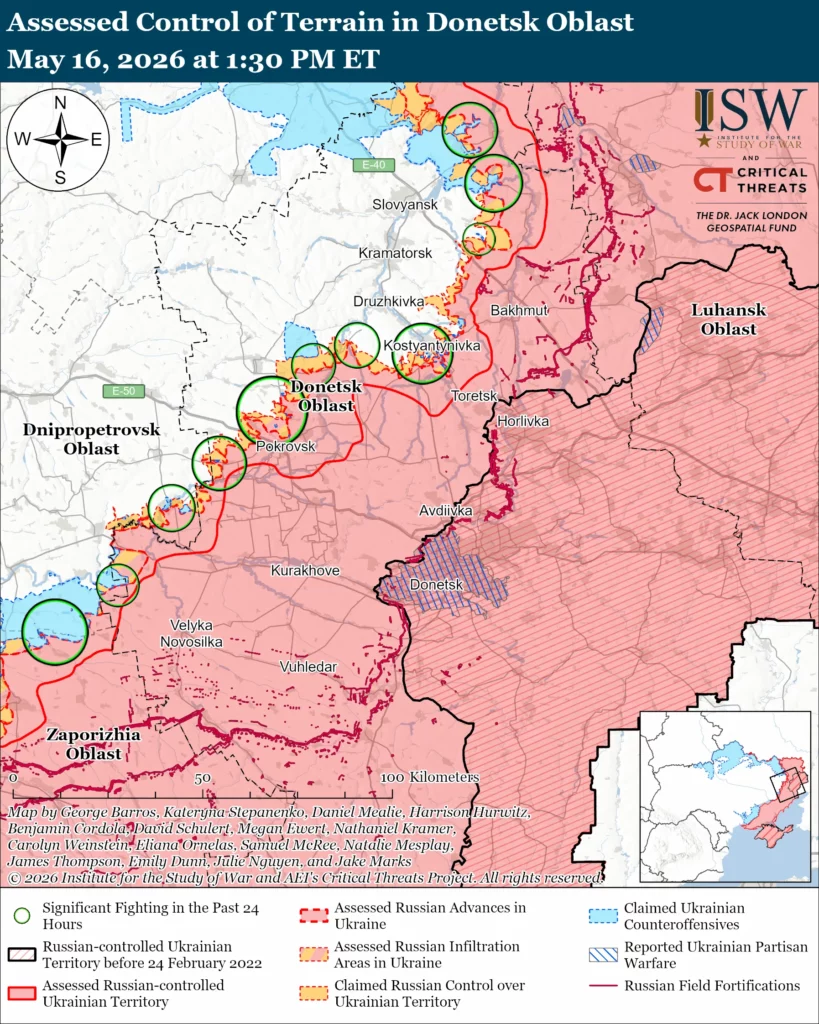
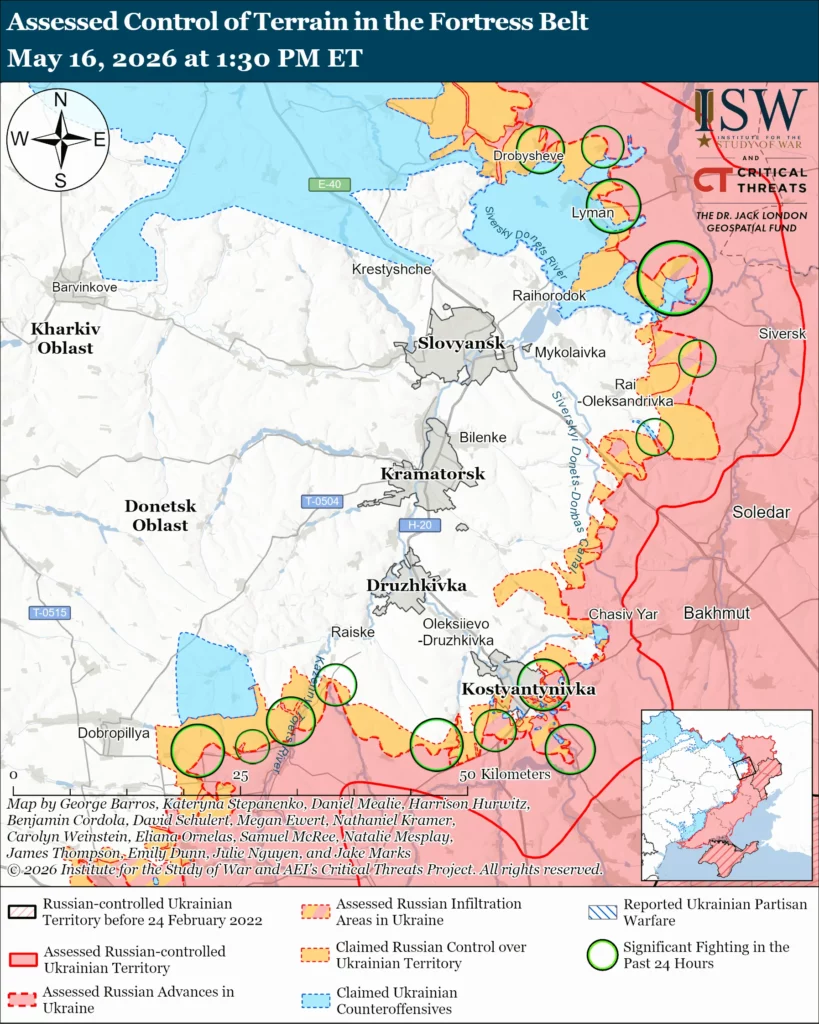
Russian forces continued offensive operations in the Slovyansk direction on May 16 but did not advance as Ukrainian forces reportedly counterattacked in the area.[27]
Russian forces continued ground assaults in the Kostyantynivka-Druzhkivka tactical area on May 16 but did not advance.[28]
Russian forces have reportedly expanded the kill zone to near Kramatorsk and are accumulating equipment. The spokesperson of a Ukrainian brigade operating in the Kramatorsk (Kostyantynivka) direction reported on May 16 that Russian forces are extending the kill zone deeper into the Ukrainian rear and have almost extended the kill zone to Kramatorsk.[29] The spokesperson reported that Russian forces are using Molniya fixed-wing first-person view (FPV) drones for longer-range strikes. The spokesperson added that Russian forces are attempting to accumulate equipment, especially near occupied Bakhmut (roughly 13 kilometers from the frontline east of Kostyantynivka) – potentially in preparation for the Russian spring-summer offensive against the Fortress Belt.
Russian forces continued ground assaults in the Pokrovsk direction and Dobropillya tactical area on May 16 but did not advance as Ukrainian forces reportedly counterattacked in these areas.[30]
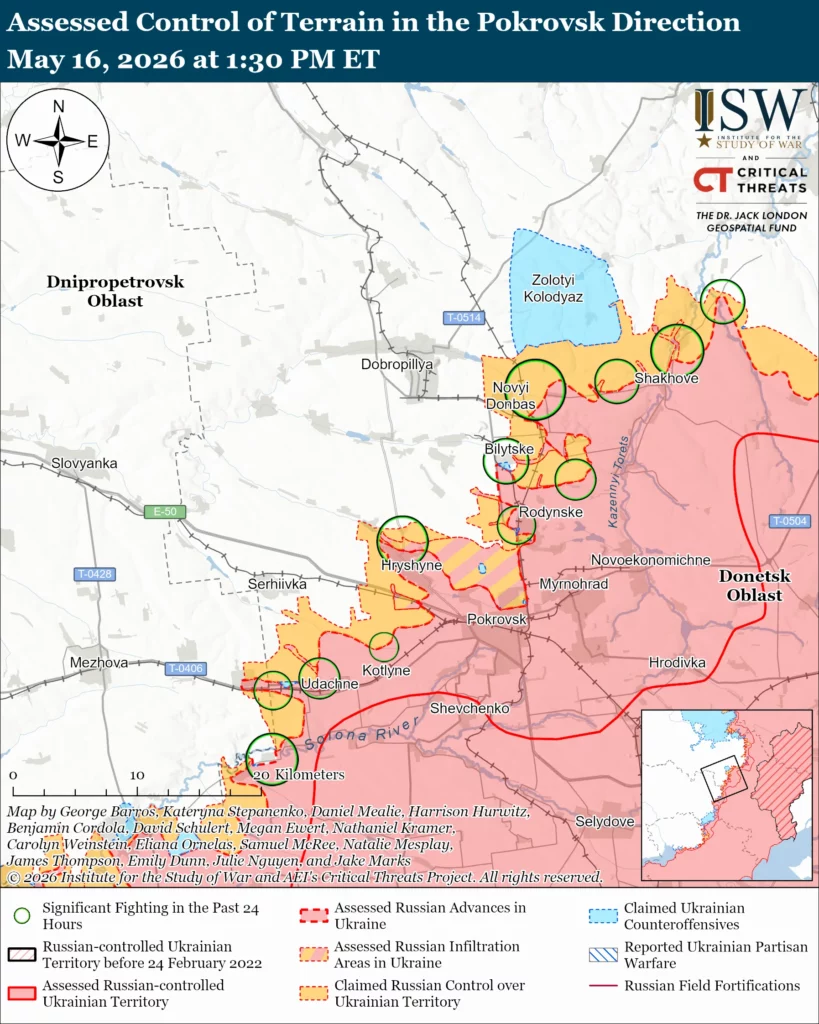
Russian forces are using troop concentration areas as Molniya fixed-wing FPV drone launch points. Geolocated footage published on May 14 by the Ukrainian 7th Rapid Reaction Corps of the Air Assault Forces shows Ukrainian forces conducting airstrikes against a Russian troop concentration point in central Pokrovsk.[31] The corps reported that Russian forces used these troop concentration points as Molniya drone launch points and to conduct drone reconnaissance.[32]
Ukrainian forces continued their short-range strike campaign against the Russian near rear in the Pokrovsk direction. The Ukrainian General Staff reported on May 16 that Ukrainian forces struck a Russian command post near Pokrovsk and a troop concentration and vehicle storage site near occupied Selydove (roughly 17 kilometers from the frontline and southeast of Pokrovsk) on May 15 or overnight on May 15 to 16.[33]
Russian forces continued limited ground assaults in the Novopavlivka direction on May 16 but did not advance.[34]
Ukrainian forces continued their short-range strike campaign against Russian military assets in the Novopavlivka direction. The Ukrainian General Staff reported on May 16 that Ukrainian forces struck a Russian personnel concentration near Yalta (south of Novopavlivka and roughly five kilometers from the frontline) on May 15 or overnight on May 15 to 16.[35]
Russian forces continued limited ground assaults in the Oleksandrivka direction on May 16 but did not advance, as Ukrainian forces reportedly counterattacked in the area.[36] A Russian milblogger claimed that both Ukrainian and Russian forces maintain a presence in Berezove (southeast of Oleksandrivka).[37]
Ukrainian forces continued their mid-range strike campaign against Russian military assets in occupied Donetsk Oblast. The Ukrainian General Staff reported on May 16 that Ukrainian forces struck a Russian drone control point near Hrafske (roughly 71 kilometers from the frontline) and Russian personnel concentrations near Shakhtarsk (roughly 66 kilometers from the frontline) and Mykhailivka (roughly 61 kilometers from the frontline) on May 15 or overnight on May 15 to 16.[38]
Russian Supporting Effort: Southern Axis
Russian objective: Maintain frontline positions, secure rear areas against Ukrainian strikes, and advance within tube artillery range of Zaporizhzhia City
Ukrainian forces recently advanced in the Hulyaipole direction. Geolocated footage published on May 15 indicates that Ukrainian forces recently advanced southeast of Staroukrainka (west of Hulyaipole).[39]
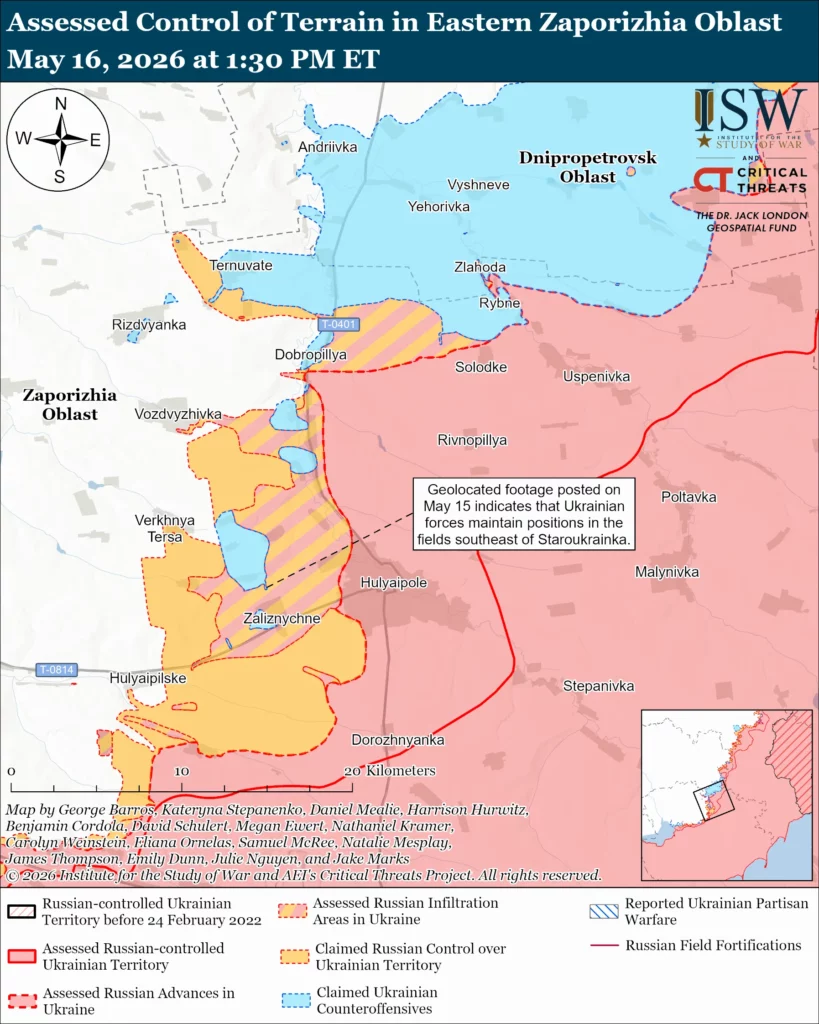
Ukrainian forces continued their short-range strike campaign against the Russian near rear in the Hulyaipole direction. The Ukrainian General Staff reported that Ukrainian forces struck a Russian troop concentration near occupied Lyubimivka (roughly 27 kilometers from the frontline and southeast of Hulyaipole) on May 15 or overnight on May 15 to 16.[40]
See topline text for information on Ukrainian advances and Russian milblogger criticism of exaggerated Russian claims in western Zaporizhia Oblast.
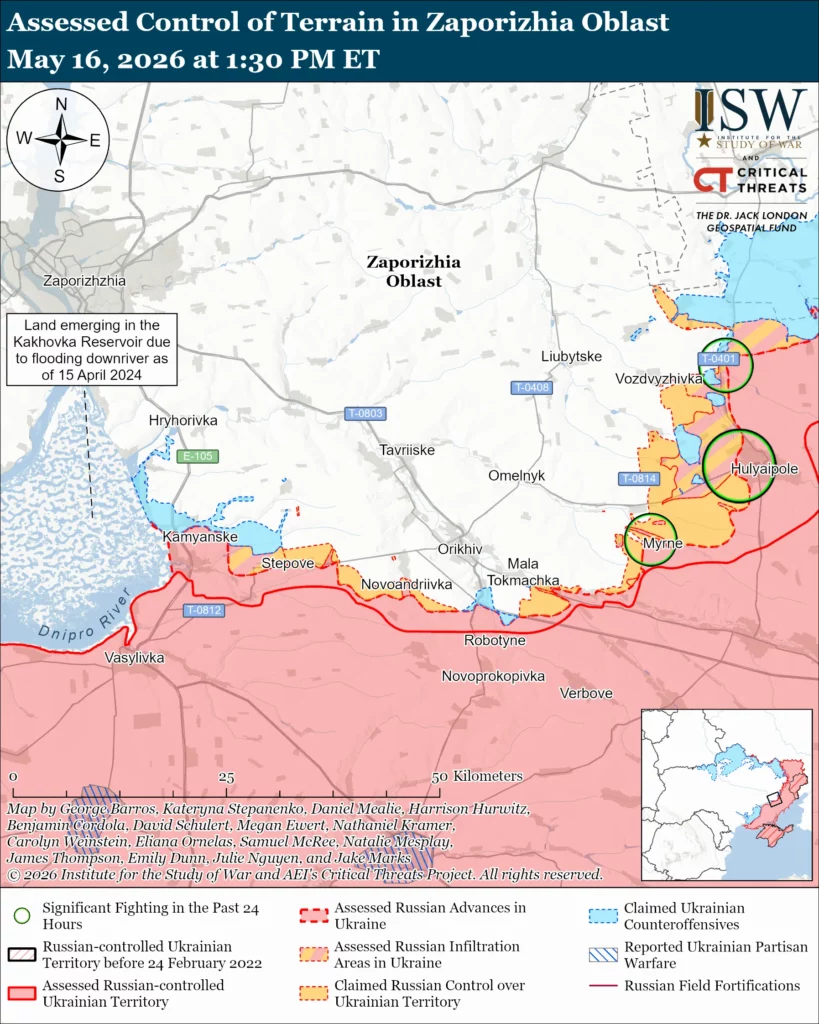
Russian forces in southern Ukraine are reportedly using natural gas pipelines for infiltrations. Ukrainian Southern Defense Forces Spokesperson Colonel Vladyslav Voloshyn reported on May 16 that Russian forces are using natural gas pipelines for infiltrations into Ukrainian rear areas.[41] Voloshyn stated that Russian forces have trained on operating in pipelines at specialized training grounds in occupied Ukraine and that Russian forces have established telephone lines within pipelines and dug tunnels to bypass damaged pipeline sections.
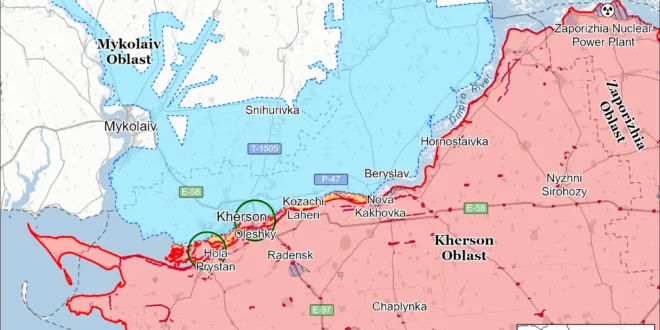
Russian forces continued limited ground attacks in the Kherson direction on May 16 but did not advance.[42]
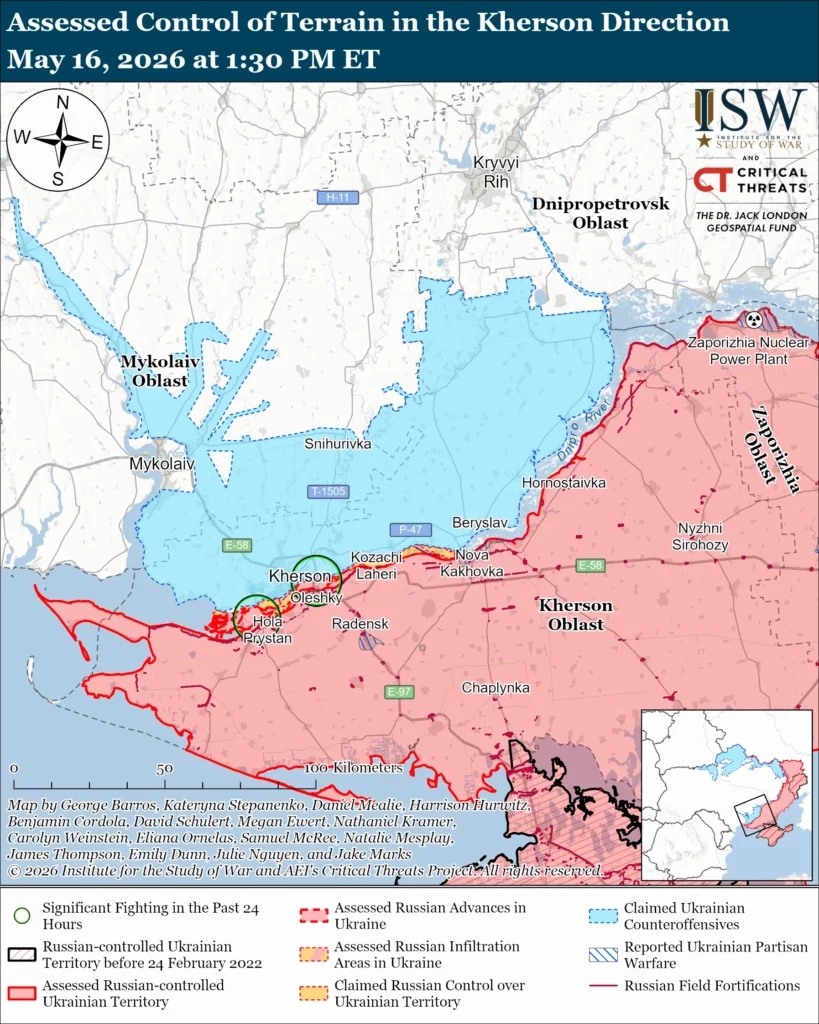
Ukrainian forces continued their mid-range strike campaign against Russian military assets in occupied Kherson Oblast. The Ukrainian General Staff reported on May 16 that Ukrainian forces struck a Russian repair unit in occupied Pryvillya (roughly 70 kilometers from the frontline) on May 15 or overnight on May 15 to 16.[43]
Russian Air, Missile, and Drone Campaign
Russian Objective: Target Ukrainian military and civilian infrastructure in the rear and on the front line
Russian forces conducted a series of long-range drone strikes against Ukraine on the night of May 15 to 16. The Ukrainian Air Force reported that Russian forces launched 294 Shahed-type, Gerbera-type, and Italmas-type strike drones and Parodiya decoy drones from the directions of Oryol, Kursk, and Bryansk cities; Millerovo, Rostov Oblast; Shatalovo, Smolensk Oblast; Primorsko-Akhtarsk, Krasnodar Krai; and Cape Chauda and Hvardiiske, occupied Crimea.[44] The Ukrainian Air Force reported that Ukrainian forces downed 269 drones; that 20 drones struck 15 locations; and that debris fell at nine locations. Ukrainian officials reported that Russian forces struck civilian, residential, and transport infrastructure in Kharkiv and Poltava cities and Kyiv and Dnipropetrovsk oblasts.[45] Ukrainian officials also reported that Russian forces struck port, residential and critical infrastructure in Odesa Oblast, cutting power to 39 settlements and 22,662 subscribers.[46]
Significant Activity in Belarus
Russian efforts to increase its military presence in Belarus and further integrate Belarus into Russian-favorable frameworks
Nothing significant to report.
Note: ISW does not receive any classified material from any source, uses only publicly available information, and draws extensively on Russian, Ukrainian, and Western reporting and social media as well as commercially available satellite imagery and other geospatial data as the basis for these reports. References to all sources used are provided in the endnotes of each update.