 Eurasia Press & News
Key Takeaways
Multiple sources published what appears to be the text of the US-Iran agreement. Neither the United States nor Iran has officially published the text of the agreement at this time. The leaked text of the agreement, if accurate, indicates that Iran has emerged from the conflict in a stronger strategic position, however.
The MoU reportedly grants Iran significant economic relief, which Iran would likely use to try to reconstitute its missile, drone, and nuclear programs, as well as the Axis of Resistance. The MoU states that Iran could receive further economic relief by fulfilling its commitments in the MoU and reaching a final agreement that addresses key nuclear issues. ISW-CTP has not observed any indications that Iranian decision-makers are willing to make concessions on the nuclear issues that would be included in a final agreement, however.
Iran will likely try to exploit the agreement’s seemingly ambiguous language about the Strait of Hormuz to try to enforce its control over shipping through the strait. The reported text of the agreement does not explicitly bar Iran from “managing” the strait, and Iran could therefore continue to insist on vessels using its illegal traffic separation scheme in Iranian territorial waters and paying “fees” to the IRGC Navy.
The Iranian regime is interpreting the clause in the agreement about a ceasefire “on all fronts” as a requirement for Israel to cease operations against Hezbollah and withdraw from Lebanon. This interpretation is part of a broader Iranian effort to preserve Hezbollah by trying to secure Israel’s capitulation in Lebanon.
The reported MoU terms indicate that Iran structured the agreement in a way to try to limit the United States’ ability to impose renewed pressure on Iran during the 60-day negotiations period and thereby make it more challenging for the United States to extract concessions from Iran during the negotiations.
Iranian officials and media are largely framing the US-Iran MoU as an Iranian victory that codifies Iran’s military achievements. The Iranian regime’s English-language media outlet, Press TV, argued on June 16 that the MoU is not simply a ceasefire, but rather represents the “political codification of a battlefield reality.”
Toplines
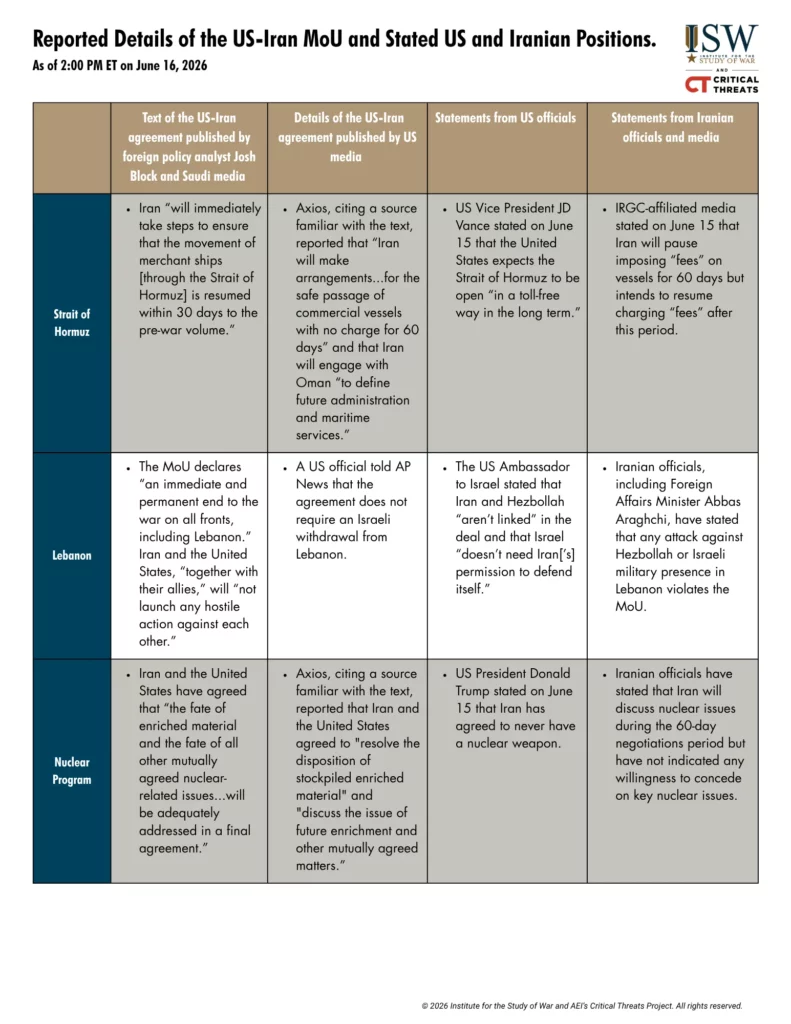
Multiple sources published what appears to be the text of the US-Iran agreement. Neither the United States nor Iran has officially published the text of the agreement at this time. The leaked text of the agreement, if accurate, indicates that Iran has emerged from the conflict in a stronger strategic position, however. Foreign policy analyst Josh Block and Saudi media published an identical version of the US-Iran memorandum of understanding (MoU) on June 16, detailing all 14 clauses of the agreement that the United States and Iran are set to sign in Switzerland on June 19.[1] The text declares that Iran and the United States will conduct further negotiations for 60 days upon signing the MoU, but notes that this negotiation period is “extendable by mutual consent.”[2] Western media outlets such as the Wall Street Journal and Axios corroborated several clauses of the agreement published by Block and Saudi media.
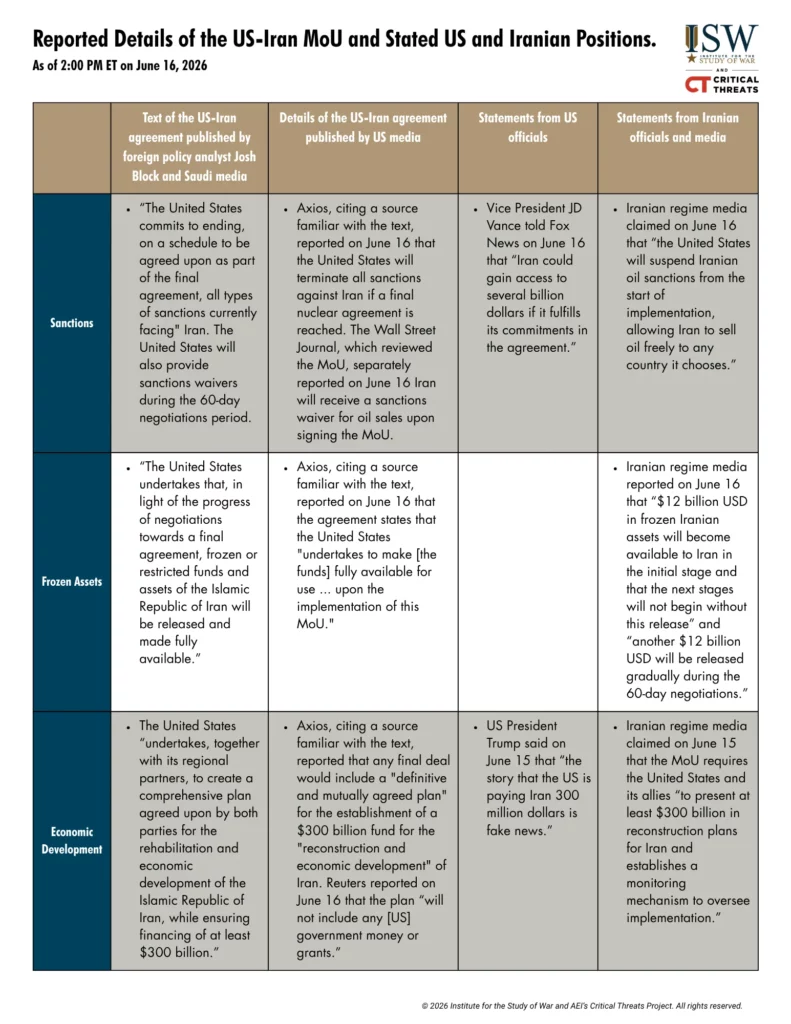
The MoU reportedly grants Iran significant economic relief, which Iran would likely use to try to reconstitute its missile, drone, and nuclear programs, as well as the Axis of Resistance. Block, Saudi media, and the Wall Street Journal reported that the United States will lift its blockade on Iranian ports and waive sanctions on Iranian oil exports and “related services” immediately upon signing the MoU.[3] Axios, citing a source familiar with the text, reported that the United States will “gradually” lift its blockade within 30 days of signing the MoU.[4] Iranian regime outlet Mehr News estimated on June 16 that Iran could generate up to $10 billion USD from just 60 days of oil exports.[5] Iran would likely use immediate economic relief to try to reconstitute its military capabilities, the Axis of Resistance, and its nuclear program. Arab mediators told the Wall Street Journal on June 13 that IRGC Commander Major General Ahmad Vahidi, whom ISW-CTP assesses as dominating regime decision-making, has insisted that Iran’s frozen assets should not be “barred from military spending.”[6] Iranian Foreign Affairs Ministry Spokesperson Esmail Baghaei similarly stated in May that Iran would use assets released under a potential agreement with the United States to advance its defense and military sectors, including Iran’s missile and drone programs.[7]
The MoU states that Iran could receive further economic relief by fulfilling its commitments in the MoU and reaching a final agreement that addresses key nuclear issues. ISW-CTP has not observed any indications that Iranian decision-makers are willing to make concessions on the nuclear issues that would be included in a final agreement, however. Block and Saudi media reported that the United States will release “frozen or restricted” funds and assets “in light of the progress of negotiations towards a final agreement.”[8] US Vice President JD Vance clarified to ABC News on June 15 that the release of frozen assets is contingent upon Iran taking “verified steps” to eliminate its highly enriched uranium (HEU) stockpile.[9] The United States, “together with its regional partners,” will also commit to forming a “rehabilitation and economic development” plan worth at least $300 billion USD, according to the text published by Block, Saudi media, and several Western outlets.[10] An Iranian outlet affiliated with Supreme Leader Military Adviser Mohsen Rezaei similarly reported that the MoU requires the United States and its allies to present a reconstruction plan worth at least $300 billion USD to Iran.[11] US President Donald Trump denied that the United States would give Iran $300 million USD.[12] The economic development plan is contingent upon the United States and Iran reaching a final nuclear agreement that addresses Iran’s HEU stockpile and ability to enrich uranium on Iranian soil, but key Iranian decision-makers, such as Vahidi, have not signaled any willingness to concede on these issues. The current MoU reiterates Iran’s commitment not to produce a nuclear weapon. Iranian officials have historically insisted that Iran does not seek to produce a nuclear weapon, but the regime has nevertheless developed in recent years the latent capability to develop a nuclear weapon if it decides to do so.
Iran will likely try to exploit the agreement’s seemingly ambiguous language about the Strait of Hormuz to try to enforce its control over shipping through the strait. The MoU stipulates that Iran “will immediately take steps to ensure that the movement of merchant ships [through the strait] is resumed within 30 days to the pre-war volume,” according to Block, Saudi media, and several Western outlets.[13] Iran is expected to remove “technical obstacles” and naval mines from the strait during the 30-day period.[14] The text published by Block and Saudi media does not explicitly bar Iran from “managing” the strait, and Iran could therefore continue to insist on vessels using its illegal traffic separation scheme in Iranian territorial waters and paying “fees” to the IRGC Navy.[15] The MoU text also states that the United States and Iran will “respect each other’s sovereignty and territorial integrity” and “refrain from interfering in each other’s internal affairs.”[16] The Iranian regime has repeatedly claimed that it and Oman control the Strait of Hormuz as territorial waters. Iran could also try to argue that its “management” of the strait is an Iranian internal affair. The MoU text published by Block and Saudi media also does not mention whether Iran can charge tolls, despite President Trump stating on June 14 that vessels can pass through the strait “toll-free.”[17] Some versions of the agreement published in Western media on June 16 do mention that Iran will not charge tolls for 60 days and that Iran will work with Oman to “define future administration and maritime services” in the strait, however.[18] IRGC-affiliated media stated on June 15 that Iran will pause charging “fees” for 60 days but intends to resume charging “fees” after that period.[19] Iranian officials have consistently claimed that Iran is charging “service fees” as opposed to tolls in the Strait of Hormuz, and therefore that vessels are able to transit through the strait “toll-free.”
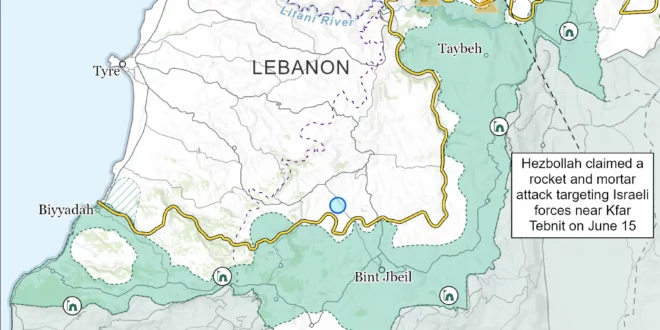
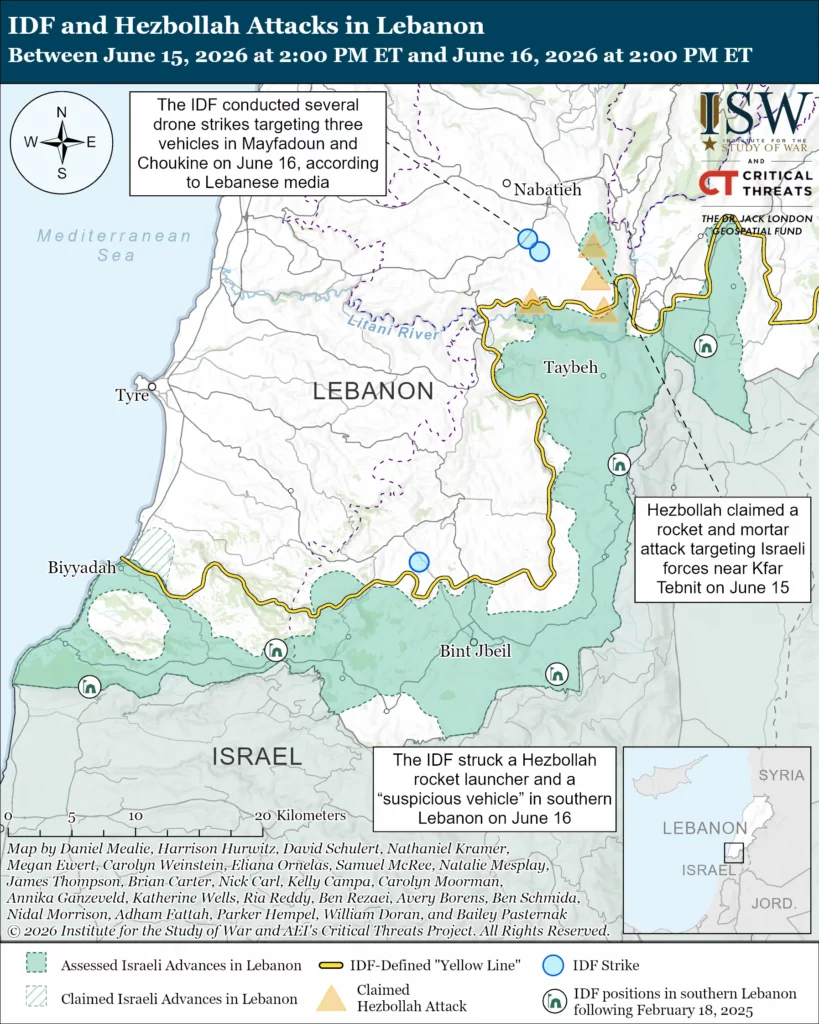
The Iranian regime is interpreting the clause in the agreement about a ceasefire “on all fronts” as a requirement for Israel to cease operations against Hezbollah and withdraw from Lebanon. This interpretation is part of a broader Iranian effort to preserve Hezbollah by trying to secure Israel’s capitulation in Lebanon. Block and Saudi media reported that the MoU states that Iran and the United States, along with their allies, agree to “an immediate and permanent end to the war on all fronts, including Lebanon” and commit to “not launch any hostile action against each other.”[20] Iranian officials and media have argued that any Israeli attack against Hezbollah or Israeli military presence in Lebanon constitutes a violation of the MoU.[21] Israel does not appear to be a signatory to the MoU and continues to operate against Hezbollah in southern Lebanon, however. The Israel Defense Forces (IDF)continued to launch airstrikes against Hezbollah targets in response to Hezbollah attacks on Israeli forces in southern Israel.[22]
The reported MoU terms also indicate that Iran structured the agreement in a way to try to limit the United States’ ability to impose renewed pressure on Iran during the 60-day negotiations period and thereby make it more challenging for the United States to extract concessions from Iran during the negotiations. Block and Saudi media reported that the MoU states that“Iran and the United States agree that, pending a final agreement, they will maintain the status quo: Iran will maintain the status quo on its nuclear program, and the United States will not impose new sanctions on Iran or strengthen its forces in the region.” This clause prevents the United States from applying additional economic or military pressure on Iran over the next 60 days and therefore limits the United States’ leverage over Iran in nuclear negotiations. Iran may calculate that this clause will make it more difficult for the United States to force Iran to soften its red lines on the issues of HEU and uranium enrichment.
Iranian officials and media are largely framing the US-Iran MoU as an Iranian victory that codifies Iran’s military achievements. The Iranian regime’s English-language media outlet, Press TV, argued on June 16 that the MoU is not simply a ceasefire, but rather represents the “political codification of a battlefield reality.”[23] Press TV argued that Iran views the Strait of Hormuz and the Axis of Resistance as two of its most important tools of deterrence that it can use to ensure “compliance with future agreements.”[24] IRGC Quds Force Commander Brigadier General Esmail Ghaani separately praised Iran’s negotiating team for linking negotiations with the United States to Israel’s operations against Hezbollah in Lebanon.[25] Ghaani additionally praised the Axis of Resistance for its involvement in the war, claiming that Hezbollah is “unstoppable” and that Israel is closer to “collapse” than it was before the war.[26]
US-Iran Negotiations
See topline section.
Maritime Activity in the Strait of Hormuz and Persian Gulf
See topline section.
US and Israeli Air Campaign
Nothing significant to report.
Iranian Domestic Affairs
Nothing significant to report.
Iran’s Axis of Resistance
Lebanese Hezbollah and the Israeli Campaign in Lebanon
See topline section.
Other Axis of Resistance Activity
Iraqi Prime Minister Ali al Zaydi and US Special Envoy for Iraq and Syria Tom Barrack released a joint statement on June 16 that outlined a shared vision for the “complete disarmament and disbandment of [Iraqi] armed groups.” Zaydi and Barrack released the statement after meeting in Baghdad on June 15.[27] The statement comes amid the Iraqi federal government’s efforts to restrict weapons to the state.[28] The United States has increasingly pressured the Iraqi federal government in recent months to decrease Iranian influence in Iraq, including through militia disarmament, due to militia attacks against US and foreign targets in Iraq and the region during the war.[29] Zaydi is expected to meet with US President Donald Trump in Washington, DC, in July.[30]
Popular Mobilization Commission (PMC) Chairman Faleh al Fayyadh replaced the Saraya al Salam-affiliated Popular Mobilization Forces (PMF) Samarra Operations Command commander with an Asaib Ahl al Haq member on June 16.[31] The PMF is an Iraqi state security service that includes many Iranian-backed Iraqi militias that answer to Iran instead of the Iraqi prime minister.[32] The Popular Mobilization Commission is officially responsible for ensuring that PMF brigades answer to the prime minister.[33] Shia Nationalist Movement leader Muqtada al Sadr announced the dissolution of Saraya al Salam on May 27 and the full integration of the militia’s members into the Iraqi state.[34] Samarra City holds religious significance for Iraqi Shia and Sadr-aligned forces, including Saraya al Salam, have maintained control and influence in the area for years.[35] Iraqi media reported on June 16 that Sadr directly ordered Saraya al Salam forces to accept the PMC’s decision.[36] Saraya al Salam announced on June 16 that its forces will remain in Samarra City until the “security file” has been legally transferred to the state, but confirmed the group’s separation from Sadr’s Shia Nationalist Movement and full integration into the Iraqi state.[37] The replacement of a Saraya al Salam-affiliated commander with an Asaib Ahl al Haq member is particularly notable given the long-standing tensions between these two groups. Asaib Ahl al Haq head Qais al Khazali formed Asaib Ahl al Haq as a splinter group from Sadr’s Mahdi Army, which preceded Saraya al Salam, in the years following the 2003 US invasion of Iraq.[38] Forces from Saraya al Salam and Asaib Ahl al Haq clash sporadically in southern Iraq.[39]