 Eurasia Press & News
For decades, Washington has justified its military presence in the Middle East as necessary to protect global energy security. American naval forces would safeguard shipping, military partnerships would deter attacks on oil-producing states, and sanctions would restrain governments regarded as threats to the US-led regional order. The promise was simple: American power would keep energy flowing and markets stable.
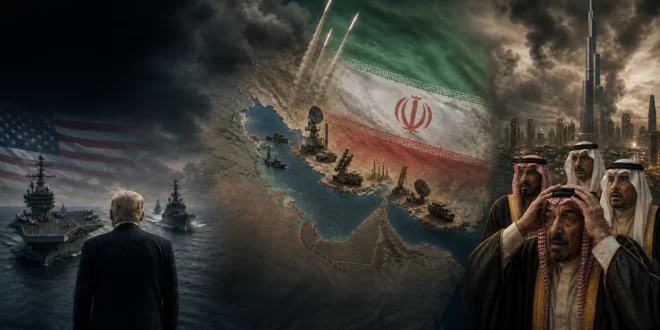
The outcome increasingly contradicts that promise. The region has become more militarised, energy infrastructure more exposed, and shipping more hazardous. Oilfields, gas facilities, ports, pipelines, and maritime chokepoints have become instruments—and potential targets—of geopolitical confrontation. The problem is no longer merely that Washington has failed to eliminate instability. Policies employed in the name of protecting energy are now producing energy insecurity.
The paradox is evident: the greater the pressure placed on Iran, the stronger Tehran’s incentive to demonstrate that global energy security cannot be separated from its own national security
From energy guardian to conflict multiplier
The traditional American narrative presents instability as a regional phenomenon and US military power as an external force containing it. Yet sanctions, military deployments, arms transfers, and support for particular actors are not neutral responses to insecurity; they reshape the calculations of every government and armed group involved.
When economic coercion is combined with the threat or use of force, energy infrastructure becomes one of the few available sources of leverage for a state confronting a militarily superior adversary. The Strait of Hormuz demonstrates the danger. According to the International Energy Agency, nearly 15 million barrels of crude oil passed through the Strait each day in 2025—approximately 34 percent of global crude oil trade. Including petroleum products, total flows reached around 20 million barrels per day. The Strait also carried more than 20 percent of global liquefied natural gas trade, while bypass capacity remained limited.
This concentration was already a structural vulnerability. Washington’s combination of military pressure and economic isolation has helped transform it into an arena of coercion. Once confrontation intensifies, the distinction between protecting navigation and controlling it becomes blurred. The paradox is evident: the greater the pressure placed on Iran, the stronger Tehran’s incentive to demonstrate that global energy security cannot be separated from its own national security.
The illusion of controlled escalation
A central assumption behind American policy is that escalation can be calibrated. Sanctions can be tightened, military forces deployed, and limited attacks conducted while the wider energy system continues operating. Pressure is expected to impose costs on an adversary without creating unacceptable consequences for global markets. This is the illusion of controlled escalation.
Energy markets react not only to physical shortages but also to expectations, shipping delays, insurance risks, and uncertainty about future supply. An installation need not be destroyed for costs to rise. The credible possibility of an attack can increase freight rates, insurance premiums, and financing expenses before governments recognise that a crisis has exceeded their control.
Recent disruption prompted the IEA to coordinate its largest-ever release of emergency oil stocks. Such intervention may moderate immediate pressure, but it exposes a contradiction: emergency reserves are being used to manage a supply crisis intensified by the militarised order Washington presents as indispensable to market stability. Reserves can buy time; they cannot indefinitely replace secure production, predictable navigation, and political de-escalation. UN Trade and Development has also warned that disruption in Hormuz affects transport costs, food security, inflation, and the development prospects of vulnerable economies.
Sanctions and fragmented energy markets
Washington’s reliance on sanctions creates another contradiction. The US Treasury describes sanctions as instruments for advancing foreign-policy and national-security objectives through asset blocking and trade restrictions. Yet their repeated use encourages targeted states to seek alternative arrangements for trade, payment, insurance, and transportation.
Sanctions can reduce revenues, postpone investment, and raise transaction costs. Iran’s energy sector has paid a substantial price. Economic pain, however, does not automatically produce the political concessions Washington expects. It can encourage adaptation, deepen cooperation among sanctioned economies, and expand the use of national currencies.
This does not mean the dollar is about to lose its central position in global energy trade. It means repeated financial coercion creates incentives to diversify settlement currencies, establish alternative payment channels, and develop insurance capacity beyond Western networks. De-dollarization, in this context, is less a coordinated ideological project than a form of strategic risk management encouraged by Washington’s own policies. When sanctions continue without delivering a durable settlement, they cease to be temporary leverage and become an architecture of fragmentation.
Washington decides; its partners pay
The costs are unevenly distributed. The United States is a major energy producer and geographically distant from the principal zones of confrontation. Many European and Asian partners are more dependent on imported energy and vulnerable maritime routes.
The imbalance is especially visible in Asia. The IEA reports that most crude oil passing through Hormuz in 2025 was destined for Asian markets, with China and India together receiving 44 percent of these exports. Japan and South Korea were also particularly dependent on the Strait. When confrontation raises prices, importing economies face higher production costs, inflation, and weaker industrial competitiveness. Washington may intensify pressure, but much of the resulting burden is transferred to partners with limited influence over American decisions.
Toward polycentric energy security
A durable alternative should be regionally owned but internationally supported. Oil and gas installations, electricity grids, desalination plants, pipelines, ports, and shipping routes should be recognised as shared strategic interests whose disruption carries consequences far beyond the governments directly involved.
China and India have legitimate roles because their economies bear a substantial share of disruption costs. Russia, although primarily a major producer, also has an interest in preventing uncontrolled volatility. In August 2026, the OPEC+ Joint Ministerial Monitoring Committee emphasised market stability and the protection of international maritime routes.
BRICS and the Shanghai Cooperation Organisation could provide diplomatic space for dialogue among regional producers, major consumers, and Eurasian energy powers. Neither currently has the institutional capacity to act as a regional security guarantor, but both can broaden participation beyond a system dominated by one external power.
The objective should not be to replace American predominance with another external hegemony. It should be to establish direct crisis communication, protect critical energy and water facilities from attack, and investigate maritime incidents before they trigger wider escalation.
Washington now faces a choice. It can continue equating energy security with military predominance, sanctions, and the isolation of selected regional powers. Or it can accept that no state can monopolise security in a region whose energy networks serve the entire world.
For half a century, the United States has presented itself as the indispensable protector of Middle Eastern energy. The more urgent question is whether global energy security can continue absorbing the consequences of that protection. The evidence increasingly suggests that it cannot.