 Eurasia Press & News
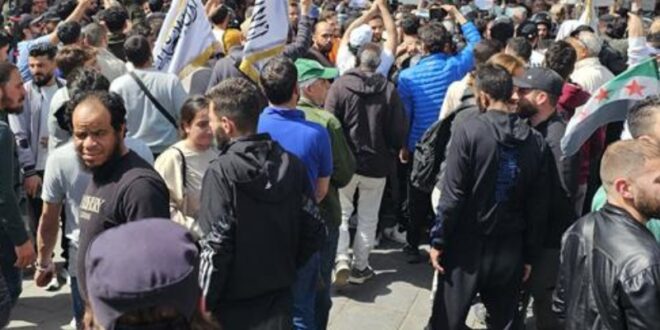
Islamist groups and currents entered Syria’s political and organizational life after the fall of the former Syrian regime, following decades in which they had either been confined to a traditional religious current that avoided politics or, when they tried to enter politics or civic work outside that traditional structure, were sent to prisons and detention centers.
The currents that formed or crystallized in what were known as the “liberated areas,” which were under opposition control before the regime’s fall, are now part of a broader scene. Some have become a core component of power within the current government, while others remain outside the system, awaiting a future role or a framework that defines their limits and scope of work.
In a parallel scene, an extremist actor, represented mainly by the Islamic State group, functions as the current that contains the most hardline elements and the Islamist side directly hostile to the new state.
Enab Baladi discusses in this file the reality of Islamist groups in Syria through three main axes. The first covers groups within the state framework, the second groups outside the governing system that are not hostile to the state, and the third groups hostile to the new rule, represented mainly by the Islamic State group.
The file examines, with experts, researchers, and specialists in the field, the relationship between these groups and the state amid the absence of legal frameworks regulating their work. It also identifies the most prominent currents present in Syria and discusses the security situation created by the Islamic State group.
Three Currents Within Government
Challenges Facing Integration
The current government, especially the security and military institutions, was formed from military factions that fought the former Syrian regime for 14 years. Most have an Islamist ideological character, suggesting an Islamic identity for the emerging state that arose after the overthrow of Assad’s rule, which had described itself as secular. This is especially true of the current political and military core of power in Syria, Hayat Tahrir al-Sham, which was then led by “Abu Mohammad al-Jolani,” now Syria’s president, Ahmed al-Sharaa.
This composition created a sense of radical difference between the two systems of rule. The former regime was almost devoid of bearded or outwardly religiously observant figures within the governing system, from the top of the hierarchy to the base. By contrast, Islamist currents that were sometimes banned from civic work, let alone political and military activity, are now holding the reins of power.
On the other hand, these currents that emerged within the factional ecosystem are not all alike. Some were mutually hostile to the point of igniting internal battles, sometimes for ideological reasons, and at other times for economic reasons or reasons related to influence.
Three Levels
Researcher and writer Hossam Jazmati said there are three levels of currents to which the factions belonged and that are now involved within the Syrian state.
The first current has an Islamic character and conservative leanings, but the groups within it did not clearly belong to a specific current, such as Faylaq al-Sham and the Levant Front. They lean toward the Muslim Brotherhood without directly belonging to the group.
The second level consists of factions that are not linked to Islamic movements at all, such as the Syrian National Army, which operated in areas under the influence of the Syrian Interim Government in northern rural Aleppo, and the cities of Tal Abyad, north of Raqqa, and Ras al-Ain, north of al-Hasakah governorates, or within what are known as the areas of the Euphrates Shield, Olive Branch, and Peace Spring operations launched by Turkey.
The third level consists of factions with an Islamist ideology, most notably Hayat Tahrir al-Sham and the wing of Ahrar al-Sham allied with it, a wing that was headed by Amer al-Sheikh, currently governor of Rural Damascus, in addition to prominent figures such as Hassan Soufan, a member of the Civil Peace Committee, and Ahmad Dalati, director of the Internal Security Directorate in Rural Damascus and governor of Quneitra.
Within this level, Jazmati pointed to other factions with the same ideology, factions that believe in “jihadi Salafism” and opposed Hayat Tahrir al-Sham, such as the other wing of Ahrar al-Sham and Jaysh al-Islam.
The Challenge of Integration
Jazmati believes that factionalism and movement-based affiliation still have a “major” effect on members who have joined the state, whether these leanings are Islamist or merely the lingering effects of factional affiliation.
He attributed this to the fact that the process of integrating factions into the Ministry of Defense did not take place as promised, namely by integrating fighters as individuals. Instead, these factions kept their structures and areas of influence and were transformed into divisions within the army.
As a result, this does not make commanders and members feel that they have dissolved into the broader framework, or into what is supposed to be a national army. He also sees it as not a good path toward integration.
Abdul Wahab Assi, director of the Studies Unit at Jusoor Center for Studies, spoke about the absence of a unified military doctrine and a political life that frames these different currents.
He explained that the actual structure of loyalty still runs through old channels, meaning the faction, organization, ideological current, and field commander, not through the institution, whose structure remains weak in the first place because it is still being built, reformed, or consolidated.
The reference framework for decision-making remains influenced by the intellectual backgrounds of these currents, whether Salafi-jihadist, Sufi, Muslim Brotherhood-affiliated, or others.

Abdul Wahab Assi
Director of the Studies Unit at Jusoor Center for Studies
Horizontal relations among members of the same faction inside different institutions also form channels of influence parallel to the official hierarchy, indicating that the institution is not the only framework for the flow of information and decisions, according to Assi.
According to Jazmati, members of Hayat Tahrir al-Sham, or the current that operated under its old name, Jabhat al-Nusra, see themselves as the state, in the researcher’s view. He noted that HTS leaders from the first to the fourth ranks hold central positions in government, including sovereign posts, or serve through deputy positions in other ministries run by technocratic ministers, who are surrounded by teams that control the ministry.
By contrast, some cadres found themselves outside the governing system, Jazmati noted, as the government set certain conditions for entry into the Interior and Defense ministries, including requirements related to age and educational certificates.
He said cadres in this category are “resentful” because they were not included in the government, although they fought alongside it until the “Deterrence of Aggression” battle that overthrew Assad’s rule, while volunteers who did not participate in the revolution, or who had been in areas controlled by the former regime, were admitted.
Al-Sharaa’s Government and the Challenge of Dissolving Factional Loyalties
Amid this factionalism, which still dominates Syria’s political and military scene, and amid the affiliation of these members and cadres with different currents, a central question emerges about the extent to which Syrian President Ahmed al-Sharaa and his administration can dissolve these currents and affiliations within the government framework.
To overcome this challenge, Jusoor Center researcher Abdul Wahab Assi said Syria needs to build a clear institutional path aimed at reforming and restructuring institutions, so that competence, institutional commitment, accountability, and promotion become the criteria governing individual discipline, not ideological or factional loyalty.
He noted the need for the government to build an inclusive national narrative through education and media, one that does not erase intellectual diversity and places “Syrian citizenship” above every other affiliation in the public and institutional space.
There is also an urgent need to activate political life through a parties law. In this way, anyone who wants to represent his ideological current would do so through parties and civil institutions, not through his position in the army or security apparatus.
Without this exit, the security and military institutions will remain the actual arena for competition among currents, according to Assi.
For his part, Jazmati questions whether al-Sharaa can succeed in leadership amid the presence of these currents, as he sees removing them as difficult.
The Syrian president’s success in steering this ship and dissolving these currents within the government system, according to Jazmati, depends on fulfilling economic promises, the arrival of investments, and the start of reconstruction.
As long as Syrian President al-Sharaa can pay the salaries of members of the Defense and Interior ministries under the current salary distribution system, which operates outside the framework of other employees in civilian institutions and is paid in US dollars without delay or deductions, matters will remain under his control.
By contrast, any stumble in these issues would undermine the entire arrangement, according to Jazmati.
Foreign Fighters, Loyalty to the State or Ideology
In a similar context, the issue of foreign fighters, known as “muhajireen,” still occupies a wide space in discussions of the Syrian question, as many of these fighters are a key part of one of Syria’s most important sovereign institutions, the Ministry of Defense.
According to Enab Baladi’s monitoring, foreign fighters are concentrated in two main military divisions within the Syrian army, one on the coast and the other in Idlib (northwestern Syria).
Two of the most prominent commanders within the Syrian army, Abdul Rahman al-Khatib, a Jordanian national, and Omar Jaftaji, a Turkish national, hold some of the most sensitive military files, the Republican Guard and protection of the Syrian capital, Damascus.
Reports also indicate that foreign cadres have entered civilian institutions as well, without the government clarifying the nature of their stay in Syria or their legal status.
Foreign fighters joined the Syrian revolution to fight the Assad regime alongside Islamist factions, for religious motives and based on beliefs about “supporting oppressed Muslims.”
The question remains whether these foreigners who now hold government positions, some of them leadership roles, will remain within their religious loyalties or whether their loyalty will shift toward a national, state-centered framework.
Jusoor Center for Studies researcher Abdul Wahab Assi said experiences show that foreign fighters integrated into state institutions to which they do not belong nationally always pose a structural risk, because their loyalty remains to ideology, the cause, or the leader, not to the state.
The realistic options in the Syrian case, in Assi’s view, are either granting them citizenship with genuine civic rehabilitation programs and a long probationary period, or facilitating their return to their countries with guarantees.
He said keeping them in security and military positions without a special path for rehabilitating them would make the issue a vulnerability that could be penetrated and would represent a burden on the emerging state.
Islamists Outside Power
Maps of Influence and the Limits of the Relationship With the State
The map of Islamist groups in Syria, after the “liberation” phase, is no longer limited to those that were a direct part of the armed conflict. It has become more branched and complex, with the emergence of actors working outside government institutions, without being in direct hostility with them, and at the same time without being integrated into their official structure.
This shift reflects the movement of the Islamist scene from the stage of “sharp alignment” during the years of war to a stage of “repositioning,” where the criterion for the relationship with authority is no longer based only on loyalty or hostility, but on varying degrees of closeness and distance, and indirect influence in the public sphere.
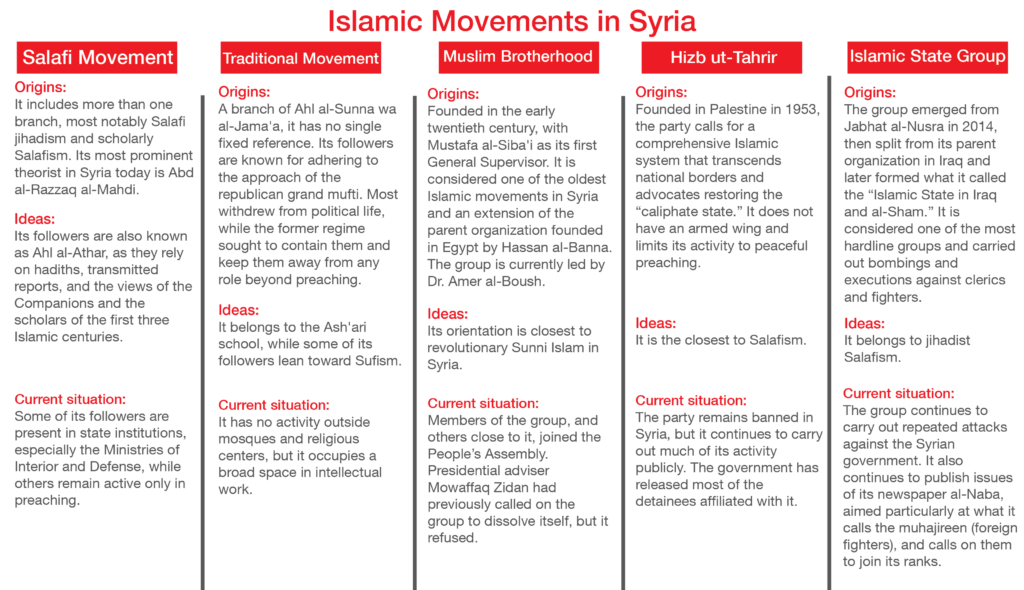
This map includes a wide spectrum of currents, beginning with the Muslim Brotherhood, with its long political history in Syria, extending to Hizb ut-Tahrir, which presents an intellectual vision that goes beyond the nation-state, and reaching Salafi preaching currents centered in the religious and social sphere. These currents operate outside direct politics while remaining influential in shaping public awareness.
In this context, researcher on Islamist groups Abdul Rahman al-Hajj believes this scene cannot be read as a single bloc, but rather as a complex network of actors that differ in their intellectual and organizational structures and in their relationship with the state, which is directly reflected in how they are integrated into or excluded from the public sphere.
By contrast, researcher in political thought Amer Darwish presents a parallel angle, considering that the problem is not limited to the multiplicity of these currents, but extends to the absence of a clear legal framework regulating the relationship between them and the state. This leaves the scene open to a state of “organizational fluidity,” as these forces move between the official and unofficial margins without a clear institutional definition.
Amid this multiplicity and variation, these groups intersect around a general goal, trying to influence the shape of Syria’s next phase, whether through political participation, reshaping the religious and social sphere, or proposing different visions of identity and the political system.
By contrast, the government finds itself facing a complex equation. These groups do not constitute a direct security threat in the traditional sense, but at the same time they raise deep questions related to legitimacy, the limits of the public sphere, and the nature of the relationship between religion and politics in the postwar phase.
Islamist groups not affiliated with state institutions cannot be treated as a single bloc, as their different nature, between political, religious preaching, and even semi-military, requires different approaches.

Dr. Abdul Rahman al-Hajj
Researcher on Islamist groups
Map of Actors, Between Political, Religious, and Military
The Islamist scene in Syria is marked by multiple and overlapping levels of actors, where the political structure cannot be separated from the religious preaching structure or even from the previous extensions of the military scene. This means any analytical approach needs to dismantle these layers rather than treating them as one unit.
Researcher Abdul Rahman al-Hajj classifies this map into three main circles that are interconnected but not homogeneous.
First: Political Groups
This circle includes the Muslim Brotherhood as one of the oldest actors in Syrian political life, alongside a group of parties and currents that emerged during the war years, such as the Syria Mother Movement, the Future Current, and the Syrian National Movement, in addition to the New Syria Current, which is seen as a conservative current seeking to gradually consolidate its presence in the post-“liberation” phase.
This circle is theoretically the most capable of integration into any future political path, despite the continued legal ambiguity around its official status.
Second: Hizb ut-Tahrir
Hizb ut-Tahrir represents a special case within this scene, as al-Hajj describes it as an elite organization with a limited popular base. Its political discourse is based on rejecting the nation-state in principle in favor of a transnational project built on the idea of the caliphate.
This position places the party outside any realistic possibility of integration into the existing political or governmental structure, not only because of the state’s position toward it, but also because of the nature of its discourse, which does not recognize the legitimacy of the nation-state in the first place. This makes the relationship between the two sides one of mutual rejection at its core.
Third: Religious Preaching and Scholarly Salafi Currents
This circle constitutes one of the most complex spaces in terms of definition, as it is not based on a clear central organization, but on networks of individuals and small groups active in the religious sphere and Sharia education.
Al-Hajj noted that this current was not publicly present during the years of the former regime, but after the “liberation” phase it shifted toward public activity, in parallel with the return of religious activity in mosques and Islamic legal centers, and the reshaping of the religious sphere outside the former security grip.
The name Abd al-Razzaq al-Mahdi stands out in this context as one of the most prominent figures associated with this current. His name has been linked to the revival of Salafi preaching discourse, in addition to his presence in discussions related to the religious institution and its relationship with the former regime.
Al-Hajj added that this current cannot be treated as a single organization, but rather as a broad social-intellectual condition with indirect influence, despite the weakness of its organizational structure.
The central problem is not only related to these groups, but to the absence of a clear legal framework regulating the relationship between them and the state.

Amer Darwish
Researcher in political thought
Activity After “Liberation,” Repositioning, Not Withdrawal
As the country entered a less intense stage of military conflict, these groups did not retreat. Instead, they repositioned themselves within the public sphere, moving from confrontational action to long-term cumulative action.
At the religious preaching level, the activities of the scholarly Salafi current expanded in Sharia education, reviving religious lessons, and expanding its presence in the digital space. This gave the current the ability to reach wider social segments, despite remaining outside direct politics.
The Muslim Brotherhood, meanwhile, is seeking to reformulate its political presence through a more “pragmatic” discourse based on accepting participation within any future political framework, with attempts to rebuild an indirect presence inside state institutions or through administrative entitlements.
By contrast, Hizb ut-Tahrir continues its intellectual activity through statements, seminars, and preaching materials, maintaining its discourse rejecting the nation-state. This makes it a continuing ideological actor more than a political actor capable of institutional influence.
In this context, Amer Darwish noted that this movement cannot be separated from the absence of a clear legal framework regulating party and religious life. This makes the relationship between the state and these currents governed by a gray zone, ranging between unofficial efforts to dissolve them into state structures and administrative and security control.
Government Policy: Managing Plurality Instead of Deciding
The Syrian government is not, so far, moving toward adopting a policy of direct confrontation with these groups. Instead, it relies on an approach based on managing religious and political plurality, while dismantling organizational structures in favor of dealing with individuals.
This approach is based on not recognizing these organizations as official political entities, in return for integrating figures from them into state institutions individually, at different administrative levels, without granting any direct organizational representation. According to researcher Abdul Rahman al-Hajj, this reflects the authority’s desire to avoid reproducing partisan polarization in a transitional phase that remains fragile.
The researcher added that this option reflects a clear priority for the government, preserving internal cohesion and preventing political and religious plurality from turning into a state of sharp competition that could reproduce the divisions that preceded the new phase.
By contrast, researcher Amer Darwish believes this approach remains incomplete unless it is complemented by a clear legal framework regulating the relationship between the state and these active forces. He explained that the absence of this framework leaves the relationship based on non-institutional flexibility, without a clear definition of the nature of these entities or the limits of their work.
Future Scenarios, Between Containment, Restriction, and Reshaping
The future of the relationship between the Syrian government and these groups appears open to multiple paths that cannot be decided in one direction, given the overlap of political, legal, and social factors governing this file.
Abdul Rahman al-Hajj expects the policy of gradually dissolving these groups into state institutions to continue, through integrating individuals from them while the organizations themselves remain outside the official framework, with the possibility that the relationship with some actors, especially the Muslim Brotherhood, could develop into undeclared understandings or alliances at later stages.
By contrast, Hizb ut-Tahrir remains closer to the scenario of exclusion or restriction, because of its fundamental rejection of the idea of the nation-state, which makes its chances of integration into any existing political formula almost nonexistent.
Amer Darwish links the future of this relationship to the state’s ability to produce a clear legal framework regulating political and religious life. He noted that the most realistic scenario is the gradual integration of some currents into a pluralistic political system, while currents that reject the very idea of the state continue to be excluded or restricted.
The Islamic State Group
Between Sleeper Cells and the Government’s Deterrence Strategy
The Islamic State group remains one of the most prominent security challenges facing Syria’s new government more than a year after the fall of the former regime, as it has managed to attract new members to its ranks, some of whom are affiliated with the nascent Syrian state.
Although it lost the geographic control it had years ago, the group has transformed into a security model based on sleeper cells active in scattered areas, taking advantage of security fragility and the wide geographic reach of the Syrian desert.
Estimates vary over the group’s real capabilities and the extent of the threat it poses to the Syrian state, at a time when the government is seeking to establish stability and rebuild the security and military institution, benefiting from its recent joining of the international coalition to fight the group.
“Modest” Capabilities Without an Existential Threat
Analysts and experts interviewed by Enab Baladi believe the Islamic State group no longer has the capabilities that qualify it to pose an existential threat to the Syrian state, but it is still able to carry out “limited harassment operations.”
Researcher in security affairs and sub-state groups Ammar Farhoud told Enab Baladi that the Islamic State group’s organizational capabilities remain medium to weak or modest, and do not currently pose an existential threat to the Syrian state.
By contrast, the group can only carry out “harassment” operations, but it cannot achieve victory or cause major harm to the Syrian state.
Farhoud identified the group’s current strengths as the “fluid security situation in Syria,” which helps it move and expand, in addition to “political instability,” which enables it to invest in existing disputes in some locations.
By contrast, he identified three main weaknesses facing the group:
A strong social desire not to see Syria return to war.
A government with experience in fighting the group and eliminating its threats.
Regional and international will and support for Syria to overcome challenges.
Military analyst Brigadier General Abdullah al-Asaad told Enab Baladi that the group has not actually ended, but has turned into sleeper cells that were dormant and have now become cells intended to be activated and returned to work again, according to al-Asaad.
Al-Asaad noted that these cells want to reactivate themselves through ideology, referring to the group’s attempts to invest in the intellectual and doctrinal climate to reproduce its presence away from direct geographic control.
Preventive Deterrence, Not Comprehensive Elimination
According to analysts, the Syrian government is following a security and military strategy based on the principle of deterrence at this stage, not the complete and comprehensive elimination of the group.
Researcher in security affairs and sub-state groups Ammar Farhoud said the security and military strategy is based on deterrence, meaning preventing the Islamic State group from becoming a real threat or directing very strong strikes at government centers of gravity, whether figures, government structures, or urban or economic centers of gravity, such as oil, ports, and trade routes.
For his part, Brigadier General Abdullah al-Asaad explained this strategy as a preventive process that moves in stages. It begins with pursuing sleeper networks and cells, scouting them, estimating their locations and coordinates, then identifying the horizontal expansion of this network, pursuing it, and eliminating dormant cells before they carry out active operations.
Al-Asaad said the state now has a wider margin to pursue the group after the closure of al-Hol camp, and those who remain from it are cells that can be controlled.
As for the areas where the group is most active, al-Asaad identified them as the deserts of Homs (central Syria), Palmyra (central Syria), and Deir Ezzor (eastern Syria). He noted that the group extended for a period into the Suwayda desert (southern Syria), but quickly diminished and returned to its dens.
Possibility of Penetrating Government Forces Is “Very Weak”
Researcher in security affairs and sub-state groups Ammar Farhoud stressed that the group’s penetration of Syrian forces is very weak, because most Syrian forces were formed from the “liberated areas,” or from members of these areas, and they had originally fought the group before.
Another matter is that people who were in former regime areas do not see the Islamic State group’s project as an opportunity, according to Farhoud.
Farhoud noted that the potential influence may be limited to some individuals in some communities, in scattered cases, who already adopt the group’s proposal.
Farhoud classifies the measures taken to confront any penetration attempts into two categories:
Direct security measures to eliminate cells trying to recruit for the group.
Awareness-raising and building bridges between the government and society for mutual support in the fight.
For his part, Brigadier General Abdullah al-Asaad asserted that there are no members of the group inside government forces, but he noted there was an attempt to enter the forces that was quickly uncovered completely, stressing that the amnesty did not include them.
Syria’s Joining the Coalition, Security Gains and Mutual Necessity
Syria’s joining of the international coalition to fight the Islamic State group constitutes a core axis in the government’s strategy to confront the threat, and both sides, the Syrian government and the international community, have a mutual interest in this cooperation.
Researcher in security affairs and sub-state groups Ammar Farhoud explained this equation by saying that the Syrian government at the current stage needs cooperation with the international community, just as the international community also needs to support and assist the Syrian government.
He said the Syrian government, with its experience, can be highly effective on the field and community levels. By contrast, it needs the international community to provide it with material and institutional support, such as training and military, security, and technological equipment.
On the sensitivity of national sovereignty, Farhoud believes discussion of its violation will not be “very strong,” stressing that the Islamic State group file is not a very major political and sovereign file.
He noted that the economic file, the integration of factions, and dealing with Israel at present are the most important files that could create a state of violation if the Syrian government is lenient with them.
Closing al-Hol Camp and Prisons, Reshaping the Security Scene
The closure of al-Hol camp and other prisons that were controlled by the Syrian Democratic Forces, SDF, in northeastern Syria is considered an important factor in reshaping the security scene in favor of the Syrian state.
Brigadier General Abdullah al-Asaad noted that matters had been “mixed together,” amid the presence of prisons such as al-Sina’a, Rmeilan, and Ghweran in al-Hasakah, in addition to al-Hol and Roj camps.
These sites were used as “ISIS cards,” according to al-Asaad’s expression, before members of the group were deported and those centers were closed.
Al-Asaad explained that closing these camps and prisons made it “very easy” to penetrate the Islamic State group through intelligence.
He pointed to the existence of tripartite coordination between Syria, Lebanon, and Iraq, supported by the international coalition, to arrest members of the group through airstrikes and airborne landings, relying on a mixture of intelligence coordination, field landings, and focused airstrikes.
Involving Society
At the end of his remarks, researcher in security affairs and sub-state groups Ammar Farhoud delivered a message on the importance of involving Syrian society in efforts to fight the Islamic State group, considering this a pivotal element no less important than security and military efforts.
Farhoud said the most important thing to focus on now is the need to involve society in the fight, through awareness-raising and building bridges of communication at the field level among people, and for the government to give society a role in this issue, not in the sense of handing over weapons, but in the sense that society should feel it is a participant and not only a source of information.