 Eurasia Press & News
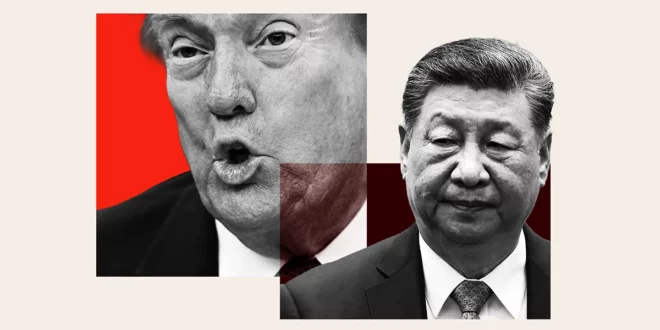
President Donald Trump has established a reputation for the unpredictable. But his trip to China has displayed a different side of a U.S. leader with a penchant for putting pressure first in his international dealings.
“We’re going to have a fantastic future together. Such respect for China, the job you’ve done,” Trump said of Chinese President Xi Jinping. “You’re a great leader. I say it to everybody. You’re a great leader. Sometimes, people don’t like me saying it, but I say it anyway because it’s true.”
Trump’s commitment to platitudes, etiquette and cooperation in his high-stakes summit with Xi comes in stark contrast to the volatile and often abrasive style that has seen him openly wield political, economic and military threats at other negotiating tables.
That approach has been likened by many to the so-called “madman theory” of foreign relations. It’s most often associated with former President Richard Nixon, who allegedly coined the term in the heat of the Cold War period in which he confronted the Soviet-aligned communist bloc while simultaneously courting China.
The strategy weaponizes uncertainty, keeping adversaries and allies alike on edge over the consequences of provocation. Critics view it as dangerous and prone to miscalculation. Supporters say it may just be crazy enough to work.
In either case, Beijing much prefers consistency and stability in its own quest to assert itself against Washington on the world stage. And analysts believe China will likely wait for concrete action before readily accepting Trump’s words as he drops the “madman” act to play the nice guy.
“Indeed, Trump’s unpredictability has created challenges and headaches for many countries, including China,” Xu Qinduo, senior fellow at the Beijing-based Pangoal Institution, told Newsweek. “Beijing’s response has been to keep expectations low and maintain a cautious, low-profile approach. Even the announcement of Trump’s visit came only two days before it actually happened.”
“One reason may be simple: with Trump, nothing is final until it is final,” Xu said. “A plan announced one week earlier could easily be revised, delayed or abandoned altogether.”
Back to the Jungle
It’s not just the inconsistency that bothers Beijing. Trump has demonstrated this year his willingness to carry out threats, conducting a raid to seize Venezuelan President Nicolás Maduro in January and launching a joint war with Israel against Iran the following month that killed the Islamic Republic’s leader and has wreaked havoc on global energy trade. Trump also threatened to slap tariffs on any country that exported oil or petroleum products to Cuba, while doubling down on sanctions against Cuban officials.
“From Beijing’s perspective, what has happened in Venezuela, the prolonged economic pressure on Cuba, and the war against Iran all raise broader concerns about the direction of the international order,” Xu said. “Many in China ask: are we moving back toward a world governed by the law of the jungle, where the strong do what they can and the weak suffer what they must?”
“If that becomes the norm, it would be a tragedy not only for smaller or middle powers, but for humanity as we’re basically going back to the old world rather progressing into a better future,” Xu said.
During a recent interview with Newsweek, Chinese Ambassador to the U.S. Xie Feng raised a similar argument, stating that “no country should put itself above everyone else and apply the rules selectively.” Otherwise, he said, “human society could risk slipping back into a jungle.”
Where this most concerns China is on the matter of Taiwan, the self-ruling island claimed by Beijing but backed politically and militarily by Washington. The U.S. has not had formal relations with Taiwan since Nixon’s pivot to the People’s Republic in 1979, but Trump has questioned the utility of Washington’s current balancing act on the issue in the past.
And having already greenlit a record $11 billion arms deal for Taipei in December, an even larger $14 billion is in the works and is among the issues at the center of his first visit—and that of any sitting U.S. president—to China since 2017. Trump’s recent interventions bode even more ominously for Beijing.
“Against that backdrop, the Taiwan question becomes even more sensitive,” Xu said. “Beijing’s concern is not simply about arms sales or political symbolism. It is about whether Washington is still genuinely committed to managing differences responsibly, or whether Taiwan is increasingly being treated as a geopolitical tool in strategic competition with China.”
Trump’s remarks have thus far focused on praise for Xi, calling him a “friend,” and the potential for greater cooperation between the two countries. While the president has a history of kind words for his Chinese counterpart, the extent to which Trump is committed to pleasing his host has drawn backlash from some commentators across the political spectrum at home.
He also opted to stay silent in the face of questions on Taiwan, leaving it to Secretary of State Marco Rubio to later confirm to NBC News that the administration’s position on the topic so far remained “unchanged.”
Xi, for his part, was not shy in bringing up Taiwan as “the most important issue in China-U.S. relations” in their talks, or highlighting the stakes behind it, according to a press release issued by Chinese Foreign Ministry spokesperson Mao Ning.
“If it is handled properly, the bilateral relationship will enjoy overall stability,” Xi said, according to the press release. “Otherwise, the two countries will have clashes and even conflicts, putting the entire relationship in great jeopardy.”
“‘Taiwan independence’ and cross-Strait peace are as irreconcilable as fire and water,” he continued. “Safeguarding peace and stability across the Taiwan Strait is the biggest common denominator between China and the U.S. The U.S. side must exercise extra caution in handling the Taiwan question.”
Hard Bargaining
Ultimately, Xi is in a position to push back if necessary. The People’s Republic has a vast arsenal—including both economic and military measures—to apply counter-pressure should the White House opt to escalate.
“China is not fundamentally intimidated by unpredictability as a negotiating tactic,” Xu said. “Beijing’s core calculation is that China will continue to develop by following its own path—with or without U.S. cooperation. At the same time, China also has tools in its own toolbox if it is forced to respond to sanctions, technological restrictions, or other forms of pressure.”
China’s capacity for retaliation was demonstrated in its response to Trump’s attempt to impose massive tariffs in a bid to pressure Beijing into what he felt to be a more equitable trade framework. Yet the latest economic bout between the two superpowers resulted in a trade agreement last year that failed to address some of the U.S. administration’s most pressing concerns.
That experience, and others like it in dealing with Trump, have only emboldened Beijing’s resolve to respond in kind rather than back down.
“When I spoke with Chinese officials early on in the administration, they said, ‘Listen, the one lesson that we have learned is, no matter what, you don’t give in, and if you give in to the coercion, it only gets worse,'” Oriana Skylar Mastro, fellow at Stanford University’s Freeman Spogli Institute for International Studies, told Newsweek.
“And they’re not worried. They’re not like an Iran or Venezuela where Trump might attack them if they don’t give it or something, given their size and their military capabilities,” she added. “People use the madman theory in different ways, but it doesn’t have the same power of the Chinese thinking, ‘We have to make a deal with this guy or bad things will happen.'”
And while she argued that “China does find it very credible that the United States might use force in other scenarios,” threatening destabilizing actions to win concessions, she predicted both sides were more likely to stick with mutual niceties, avoiding any attempt to tip the scales on flashpoint issues, particularly Taiwan.
“There’s a lot of speculation that the Chinese might try to play Trump because you never know what the man’s gonna say, like trying to trick him into saying about Taiwan,” Mastro said. “But It’s such a sensitive issue. They’re very risk averse about this issue. I don’t think they even want to get him talking about it.”
Henrietta Levin, senior fellow with the Freeman Chair in China Studies at the Center for Strategic and International Studies, also saw greater confidence emerging from China since Trump’s initial reelection.
“When President Trump first returned to power, there was significant anxiety in Beijing regarding the level of uncertainty he would bring to U.S.-China relations,” Levin, who previously oversaw China policy in senior positions at the U.S. State Department and National Security Council, told Newsweek. “However, over the past year, that initial concern has largely given way to confidence.”
“China feels they won the trade war and convinced Trump to back down,” Levin said. “Recalling how quickly he sought rapprochement after China weaponized rare earth chokepoints and his accommodationist rhetoric in the intervening period, Beijing assumes Trump will be unwilling to escalate back to the 2025 heights of the trade war.”
Still, she pointed out, potential pitfalls lie ahead should Trump continue to pursue disruptive policies elsewhere in the world.
“At the same time,” Levin said, “Trump’s military moves against Iran pose a real risk of the Chinese economy; even while China is relatively well insulated from the immediate energy shock, its economy relies on exports and to the degree the war creates a drag on global growth, this will be problematic for China.”
Methods to the Madness
While much rests on what’s yet to come Friday and in the aftermath of the summit, the episode so far seems to signal the limits to Trump’s favored “madman” tactics.
“President Trump’s ‘madman strategy’ makes it difficult to anticipate what he might do,” Roseanne McManus, professor of political science and international relations at Pennsylvania State University who has written on the “madman theory,” told Newsweek. “While this may have some utility for keeping adversaries on edge, it can also undermine the trust and predictability necessary for bargaining and cooperation.”
“Xi may not believe that whatever Trump asks for at a summit is something he will still prioritize six months from now,” McManus, who also previously served as senior analyst at the Defense Intelligence Agency, said. “He may also doubt that making concessions on one issue would prevent Trump from raising entirely new demands in the near future.”
Trump’s own track record on this tactic is mixed. He may have instilled fear with his actions on Venezuela and Iran, but the ongoing war in the Middle East has taken on a life of its own, with Tehran’s squeezing of the Strait of Hormuz sending global energy markets into disarray and creating a new host of problems for the president.
During his first administration, the nuclear-fueled “fire and fury” threats directed toward North Korea won him a historic summit with Supreme Leader Kim Jong Un. But mutual distrust prevailed in the end, leaving both sides walking home without a deal and no diplomatic breakthroughs since.
Success for some of history’s other “madmen” has also proven fleeting.
McManus recounted how the U.S. ultimately defied Soviet Premier Nikita Khrushchev’s nuclear threats during the 1958 Berlin Crisis, one of the earliest standoffs of the Cold War. Others, such as Iraq’s Saddam Hussein and Libya’s Muammar al-Qaddafi saw their bravado backfire even more fatally.
“While the United States itself is not vulnerable to such foreign military interventions, similar perceptions could still undermine Trump’s ability to build trust and secure durable agreements,” McManus said.