 Eurasia Press & News
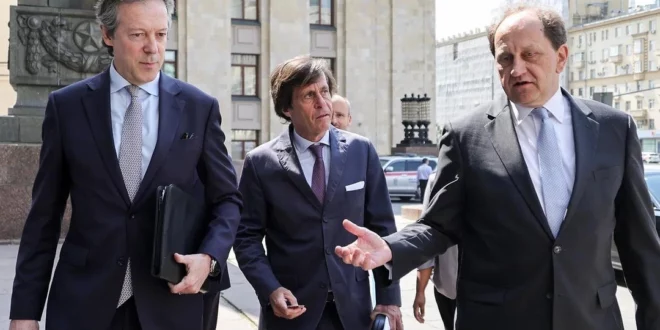
The Russian Foreign Ministry on Thursday, June 11, held a meeting of the ambassadors of Germany, France and the UK with the deputy head of the department Mikhail Galuzin. The ambassadors represented the countries of the so-called Eurotrug (EU3) – together Berlin, Paris and London discuss issues of European foreign policy, including a peaceful settlement of the war between Russia and Ukraine. During the meeting with the deputy minister, the ambassadors of European countries also called on the Russian Foreign Ministry to start direct talks. This is happening against the backdrop of Europe increasingly trying on the role of a mediator in the negotiations between Russia and Ukraine instead of the United States.
Dialogue with Europe
Following the meeting with the Deputy Minister, the Ambassadors of European countries published a joint statement. Russian diplomats reported that the EU3 supports the idea of direct negotiations between Russia and Ukraine – with the mediation of not only the States, but also European states.
The press release of the Russian department, in turn, says that in response to the ambassadors “were presented objective assessments of the destructive policy of the leadership of their countries.” French diplomat Nicolas de Rivier, however, described the meeting as a “good discussion”.
Such contacts between Western diplomats and senior Russian officials have become rare after Russia’s full-scale invasion of Ukraine. The visit of foreign ambassadors to the Russian Foreign Ministry was following the meeting of Vladimir Zelensky with the leaders of the “Eurotroy” in London on June 7. In a joint statement, after that, London, Paris and Berlin called for “direct dialogue between Ukraine and Russia with the active participation of the United States and Europe” and an immediate ceasefire.
In addition, German Chancellor Spokesman Stefan Cornelius объявилannounced this week that European leaders are ready to take a leading role in the negotiations between Russia and Ukraine. He called it a “renewal and continuation” of the negotiation process, adding that Europe would work closely with the United States on this issue – with the advent of President Donald Trump, it was Washington that sought to take on the role of chief mediator.
American mediation
Reuters, citing a source in the German government, also wrote that the guiding principle in possible negotiations, Brussels considers “coordination, not competition” with the United States. Later, Bloomberg, citing its sources, wrote that the leaders of the Eurotroika also intend to seek the support of the US president in peace talks with Russia.
According to Euronews, among themselves, the leaders of the EU countries will discuss the possibility of holding direct talks at the EU summit, which will be held on June 18-19. The “Chamber” format of the EU3 is already meeting resistance: for example, Italian Prime Minister Georgia Meloni this Thursday заявилаsaid that individual coalitions of states can represent the entire bloc, and Polish Prime Minister Donald Tusk demanded Warsaw’s participation in any further discussions.
The candidacy of the chief negotiator from the EU remains in question – who can take this position is unclear. The fact that the EU is discussing negotiations with Moscow, it became known last month. Since then, a few names have been mentioned aloud:
Former President of the European Central Bank Mario Draghi

About it with reference to sources wrote the newspaper FT. The previously held the post of Prime Minister of Italy Draghi, however, did not comment on these reports.
Former German Chancellor Angela Merkel

Her name was also given in the FT article, and then widely discussed in the European press. The newspaper Politico noted that Merkel had experience of direct talks with both Zelensky and Putin. She also criticized the EU for refusing diplomacy, but she added that, in her opinion, the negotiator should be the one who is now in power.
President of Finland Alexander Stubb

His candidacy was also reported by the media. Stubb himself, in a conversation with reporters at the end of May, заявилsaid that “probably could not have been able to respond negatively” if he was offered this task. He called the ceasefire a condition for the negotiations.
Former Finnish President Sauli Niinistö

Also one of the officials mentioned in the FT article. If at the beginning of a full-scale invasion said that there would be no benefit from direct EU-Moscow negotiations, then last November, on the contrary, he said that it would be useful for Europe to get involved in this process on a par with Washington.
Head of European Diplomacy Kaya Kallas

Kallas herself in early May hinted that she could present the bloc in future negotiations. At a press conference, she said that although the EU is not yet ready for them, she “could see the traps that Russia is placing.” Politico also called her an “obvious candidate”, but three sources of the publication at the same time added that the candidacy of Kallas and her tough anti-Russian position could cause resistance from Moscow.
German President Frank-Walter Steinmeier

About his candidacy with reference to sources in the German ruling coalition wrote the publication Der Spiegel in early May. German politicians saw it as part of a “negotiable duo” along with former Chancellor Gerhard Schroeder.
Moscow Reaction
The discussion of the candidacy of the chief negotiator from Europe was not left without attention in Russia. Here, however, the discussion unfolded around one single candidacy – ex-Chancellor Gerhard Schroeder.
Schroeder for this role was proposed personally by Vladimir Putin. At a meeting with journalists in the Kremlin on May 9, he called his name as the most “preferred” candidate for negotiations.
Putin later explained that mediators should be people “who can trust both contracting parties.” At the same time – in early June – Schroeder himself was noticed in Moscow, and later in the Kremlin confirmed that Putin and the ex-Chancellor of Germany held a personal meeting and called it “good”.
In the EU by this time, Schroeder’s candidacy has already been virtually rejected. Callas, after the first statements, Putin сказалаsaid that “it will not be very reasonable” to give Russia the right to appoint a negotiator on behalf of Europe.
At the same time, Kallas called Schroeder “a high-ranking lobbyist of Russian state-owned companies.” This statement is not unreasonable. Under Schroeder, in 2005, Gazprom and German concerns signed an agreement to build the first Nord Stream. Later, the ex-Chancellor became the head of the shareholders committee of Nord Stream AG, and in 2017 was approved for the post of head of the board of directors of Rosneft.
Subsequent discussions of candidates for the post of negotiator from the EU in the Russian foreign Ministry also wore their benefit. According to the head of the department, Sergey Lavrov, only after the name of Schroeder sounded, in Europe “began to say: well, we will have to talk to Russia sometime with Russia.” In the question of the TV channel “Star”, answering to which Putin called the name of the ex-Chancellor, however, has already said that Europe is looking for a “ideal candidate for negotiations”. The head of Russian diplomacy decided not to mention this.
The other candidates in the Kremlin under discussion in Europe were not actively commented on (1, 22). Press Secretary of the President Dmitry Peskov limited himself to the words on this matter that “the main thing is a political desire to restore dialogue.”