 Eurasia Press & News
The Institute for the Study of War (ISW) and The Critical Threats Project (CTP) at the American Enterprise Institute are publishing daily updates to provide analysis on the war with Iran. The updates focus on US and Israeli strikes on Iran and Iran and the Axis of Resistance’s response to the strikes. The updates cover events from the past 24-hour period.
NOTE: ISW-CTP will continue posting morning social media threads on an as-needed basis starting April 28, 2026, for the duration of the ceasefire. We will continue providing long-form analysis on the state of the Iran War in our daily Iran Update Special Reports.
Key Takeaways
Iran seeks to achieve positive strategic objectives beyond the negative objective of surviving the war. Iran’s principal positive strategic objective at this time is to secure recognition of its sovereignty over the Strait of Hormuz, which would fundamentally remake regional and global maritime norms in a manner extremely detrimental to US interests.
Long-term control of the Strait would require Iran to secure US recognition of its claims to the Strait of Hormuz through a negotiated agreement so that Iran could order ships to comply with its rules legitimately and then intercept those ships that fail to comply. Iranian negotiators increasingly prioritized securing its control over the Strait in negotiations, likely because it believes Iranian control over the Strait would act as a safeguard against future wars between Iran and Israel and the United States.
Iran is also seeking economic relief as a positive objective from the war, which could enable Iran to accelerate its efforts to reconstitute its ballistic missile program. US sanctions on Iranian oil have contributed to severely weakening Iran’s ability to raise revenue that the regime has used to fund the development of its ballistic missile program.
The introduction of these positive strategic objectives does not mean that Iran has abandoned its “negative” strategic objectives, which include limiting discussions on its nuclear program and avoiding an economic collapse that could trigger severe domestic unrest leading to the collapse of the regime.
The Iranian regime is preparing for economic instability that could cause domestic unrest. This effort supports the “negative” strategic objective of preventing regime collapse caused by protests that result from serious economic instability. Iranian officials’ public emphasis on economic management suggests that the regime recognizes that economic pressure could create internal stability risks and is preparing mechanisms to manage those risks. These statements, concerns, and preparations do not on their own indicate that the Iranian regime is prepared to surrender as a result of economic pressure.
Toplines
Iran seeks to achieve positive strategic objectives beyond the negative objective of surviving the war. Iran’s principal positive strategic objective at this time is to secure recognition of its sovereignty over the Strait of Hormuz, which would fundamentally remake regional and global maritime norms in a manner extremely detrimental to US interests. Iran has denied access to the Strait of Hormuz during the war through mining, drone and missile attacks, and harassment by fast attack craft. Sea denial of the Strait of Hormuz can only be maintained through attacks, however. Long-term control of the Strait would require Iran to secure US recognition of its claims to the Strait of Hormuz through a negotiated agreement so that Iran could order ships to comply with its rules legitimately and then intercept those ships that fail to comply. Iranian negotiators increasingly prioritized securing its control over the Strait in negotiations, likely because it believes Iranian control over the Strait would act as a safeguard against future wars between Iran and Israel and the United States. The Strait under recognized Iranian control would act as a safeguard because Iran could close the Strait and disrupt markets at will, punish states in the Persian Gulf region for “collaborating” with Israel or the United States, and generate revenue through a system of tolls.[1] All of this and more would become legitimate with US recognition of Iranian claims to the Strait if the United States agreed to Iran’s demands in negotiations. Recognition would also provide Iran with the legitimacy to intercept ships violating its rules. US, Israeli, or Gulf efforts to disrupt Iranian efforts to manage traffic to Tehran’s benefit would be perceived as acts of aggression if the United States were to recognize Iranian claims to the Strait in negotiations.
Iran has already begun to take steps that demonstrate what these new norms could look like. Iran’s “Persian Gulf Strait Authority” also sent an email on May 6 to shipping companies with vessels in the Persian Gulf stipulating that for safe passage through, crews must pay the body in Iranian rials and gain issuances of guarantees from Iranian banks, which would force everyone who wants to use the Strait to violate US sanctions.[2] These demands would be legitimate if Iran achieves its positive strategic aim of securing control over the Strait of Hormuz. The email makes it clear that countries whose ships want to go through the Strait have to lift sanctions.[3]
Iran is also seeking economic relief as a positive objective from the war, which could enable Iran to accelerate its efforts to reconstitute its ballistic missile program. US sanctions on Iranian oil have contributed to severely weakening Iran’s ability to raise revenue that the regime has used to fund the development of its ballistic missile program.[4] Iran is also seeking for the United States to unfreeze nearly $100 billion USD in Iranian assets, which could quickly provide the regime with the needed funds for investment into reconstituting its ballistic missile program on the strategic level.[5] These funds would be needed to rebuild missile production plants, development facilities, and plants for raw materials like steel, many of which were destroyed during the current war.[6] Iran has used its ballistic missiles to attack US bases and allies in the recent conflict and in previous conflicts like the 12 Day War.[7] CNN reported on May 6 that Israel is particularly worried about the possible lifting of economic sanctions on Iran and has pushed for restrictions to be imposed on Iran’s ballistic missile program.[8] Economic relief would also support ”negative” strategic objectives like preventing regime collapse caused by protests that result from serious economic instability (see below).
The introduction of these positive strategic objectives does not mean that Iran has abandoned its “negative” strategic objectives, which include limiting discussions on its nuclear program and avoiding an economic collapse that could trigger severe domestic unrest, leading to the collapse of the regime. Avoiding the collapse of one’s regime is an objective of all regimes. Iranian leaders also almost always insist on the legitimacy of at least some form of a nuclear program. These two objectives are constant and do not represent a comprehensive positive vision for the future of the region. Iran now possesses such a vision. The Iranian objectives, if accomplished in full, would result in an extremely strong Iran that would be able to compel most regional states to follow its lead through control of the Strait of Hormuz.
The Iranian regime is preparing for economic instability that could cause domestic unrest. This effort supports the “negative” strategic objective of preventing regime collapse caused by protests that result from serious economic instability. Iranian Parliament Speaker Mohammad Bagher Ghalibaf published an audio message on May 6, in which he framed the maritime blockade, economic pressure, and media operations as part of an “enemy effort” to undermine national cohesion and force Iran to surrender.[9] These remarks demonstrate that the Iranian regime is attempting to bolster itself against domestic instability that could result from economic pressure rather than preparing to surrender. Ghalibaf called on officials to reduce the effects of economic pressure on the public, urged wartime-style planning, and “jihadi management.”[10] Ghalibaf also called on the Basij to “enter the field seriously” and asked Basij members in mosques, neighborhoods, and social groups to help solve public problems.[11] The regime uses the Basij for civil defense, social control, and protest suppression.[12] Anti-regime media reported on April 27 that Iran’s Supreme National Security Council, which is the highest national security body, was reportedly preparing for a potential protest wave as economic deterioration and social pressure intensified.[13] Iranian officials are reportedly concerned about inflation, unemployment, rising prices, shutdowns in the oil, petrochemical, and steel sectors, and broader economic disruption.[14] Iranian officials’ public emphasis on economic management suggests that the regime recognizes that economic pressure could create internal stability risks and is preparing mechanisms to manage those risks. These statements, concerns, and preparations do not on their own indicate that the Iranian regime is prepared to surrender as a result of economic pressure.
ISW-CTP continues to assess that Islamic Revolutionary Guards Corps (IRGC) Commander Major General Ahmad Vahidi is driving decisionmaking over Iran’s war and negotiating posture. Iranian officials may still disagree over how to proceed in negotiations, however, and some may present positions that do not necessarily reflect Vahidi’s approval. This may help to explain US officials’ assessment that Iranian decisionmaking remains fragmented, even though Vahidi likely drives decisionmaking due to his proximity to Supreme Leader Mojtaba Khamenei.[15]
It remains unclear what specific demands the US and Iranian delegations are currently negotiating over. A Pakistani source familiar with the negotiations told a New York Post journalist that there are multiple proposals circulating.[16] This makes it difficult to determine the precise terms currently being negotiated or even whether both sides are referring to the same framework. US officials leaked to Axios on May 6 that the White House believes it is close to a one-page memorandum of understanding with Iran that would declare an end to the war and open a 30‑day window for negotiations on a more detailed deal, however.[17] The US sources noted that nothing has been finalized but described this as the closest the sides have come to an agreement since the conflict began.[18] The reported framework would include an Iranian moratorium on nuclear enrichment for 12-15 years, partial sanctions relief and the release of frozen Iranian funds, and a gradual lifting of restrictions in the Strait of Hormuz, with future steps contingent on the success of follow‑on negotiations in venues such as Islamabad or Geneva.[19] It is unclear what is implied by ”restrictions” or if any Iranian official has seen the same memorandum leaked by US officials to Axios.
Iranian officials and media have largely rejected the Axios reporting, insisting that Iran has not agreed to any deal and has not yet formally responded to the latest US proposal, which they say contains unacceptable provisions.[20] Several outlets framed the US media narrative as pressure tactics or market manipulation.[21] The outlets instead emphasized Iran’s own previous proposals and stated red lines, including rejection of uranium removal from Iran.[22] US President Donald Trump publicly reinforced a tougher US position at odds with the memorandum leaked by Axios, telling PBS later on May 6, that any deal would require Iran to export its highly enriched uranium, cease operating underground facilities, and accept no future enrichment even at low levels after a moratorium period.[23]
Maritime Development
The US naval blockade and sanctions are imposing costs on Iran. US Central Command (CENTCOM) announced on May 6 that US naval forces have directed 52 vessels to turn around or return to ports since the blockade began on April 13.[24] CENTCOM separately stated that a US Navy F/A-18 Super Hornet disabled the rudder of the Iranian-flagged oil tanker M/T Hasna after it tried to violate the blockade in the Gulf of Oman.[25] The US blockade is also straining Iran’s oil storage by restricting exports and forcing Iran to store unsold oil. An unspecified Iranian Oil Ministry official told the New York Times on May 6 that Iran has started cutting oil production at some oil wells to mitigate a storage shortage crisis.[26] The official estimated that Iran’s onshore and offshore storage could run out in about 40 to 45 days.[27] The US blockade is creating operational and economic pressure for Iran, but the regime appears to be preparing to manage that pressure as a domestic-control problem rather than treating it as a reason to concede (see topline section).
US and Israeli Air Campaign
Nothing significant to report.
Iranian Internal Dynamics
See the topline section.
Israeli Campaign Against Hezbollah and Hezbollah Response
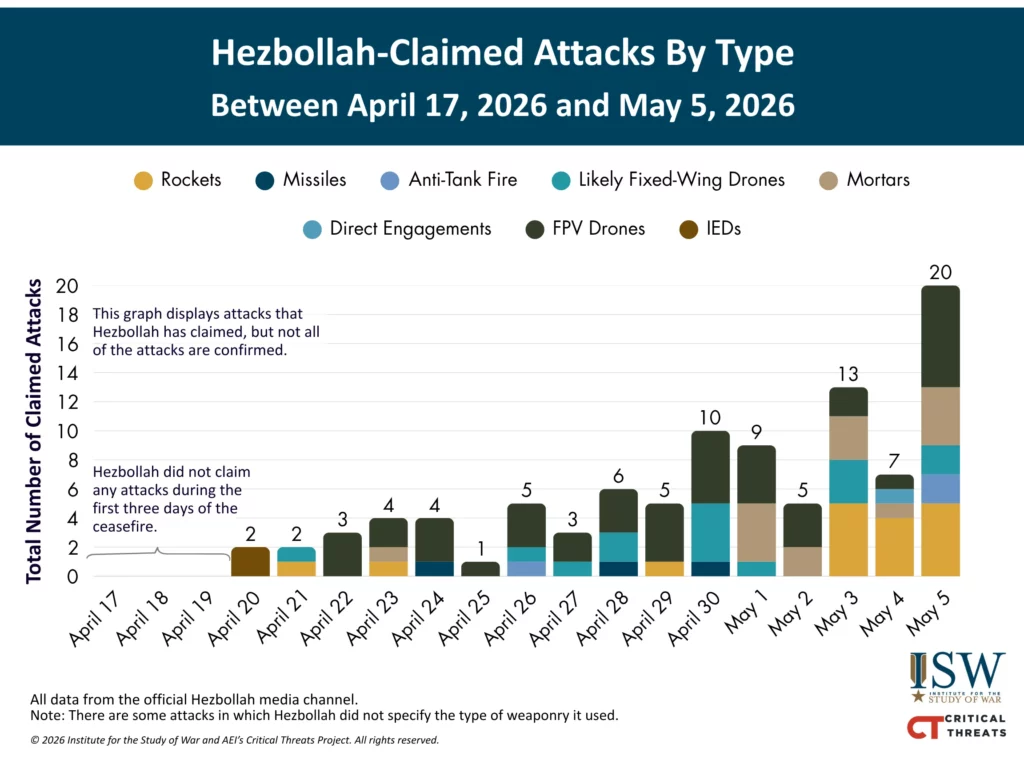
Hezbollah is likely attempting to disrupt Israeli operations by using harassing fire to limit the Israel Defense Forces (IDF)’s ability to consolidate positions within the new security zone and impose costs on the IDF. A force employing harassing fire seeks to curtail movement or lower morale.[28] Hezbollah has conducted small-scale attacks against Israeli forces in southern Lebanon, using mortars, rockets, likely fixed-wing drones, first-person view (FPV) drones, and anti-tank guided missiles (ATGM), since the ceasefire went into effect on April 16.[29] Hezbollah fighters are conducting these attacks at random times throughout the day and from non-fixed positions, which suggests that Hezbollah aims to prevent Israeli forces from adjusting to any predictable routine, impose psychological costs, and degrade operational tempo.[30] Hezbollah has also increasingly used FPV drones, which contribute to this effect because they are relatively difficult to detect and counter, unlike rockets or mortars.[31] An Israeli reservist currently operating in Lebanon told the Wall Street Journal on April 30 that Hezbollah has been constantly flying FPVs toward Israeli forces at an average of at least 10 alerts a day.[32] This report suggests that Hezbollah fighters are flying FPV drones over Israeli forces to create a sense of unpredictability.
Hezbollah is reinforcing these FPV attacks with suggestions to the media that Hezbollah will employ suicide bombers.[33] These media reports can also impose psychological costs by increasing fears of suicide bombers, which are relatively difficult to detect and incredibly psychologically disorienting because the introduction of suicide bombers causes soldiers to perceive anyone on the battlefield as a possible threat. A Hezbollah official also told Lebanese media on May 6 that Hezbollah is considering conducting suicide operations in southern Lebanon, which the group used frequently in the 1980s and 1990s.[34] A retired Lebanese general told Lebanese media that such operations impose psychological effects by increasing Israeli forces’ anxiety ”even without acting on it.”[35] FPV drone attacks and suicide operations create constant risks of attack and generate anxiety, which can weaken force morale and place soldiers under immense psychological stress.[36] Hezbollah‘s recent FPV drone attacks have killed and wounded several Israeli soldiers.[37] Hezbollah Secretary General Naim Qassem confirmed on May 4 that Hezbollah fighters are currently choosing to conduct attacks designed to maximize Israeli casualties.[38] Hezbollah likely hopes to keep casualty rates at a level that would impose political pressure that causes the IDF to relent and end operations, but would not warrant a resumption in fighting.
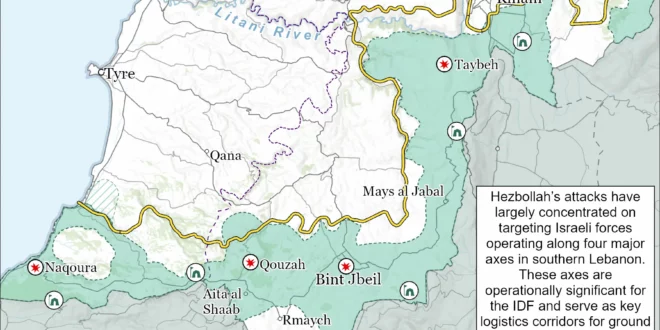
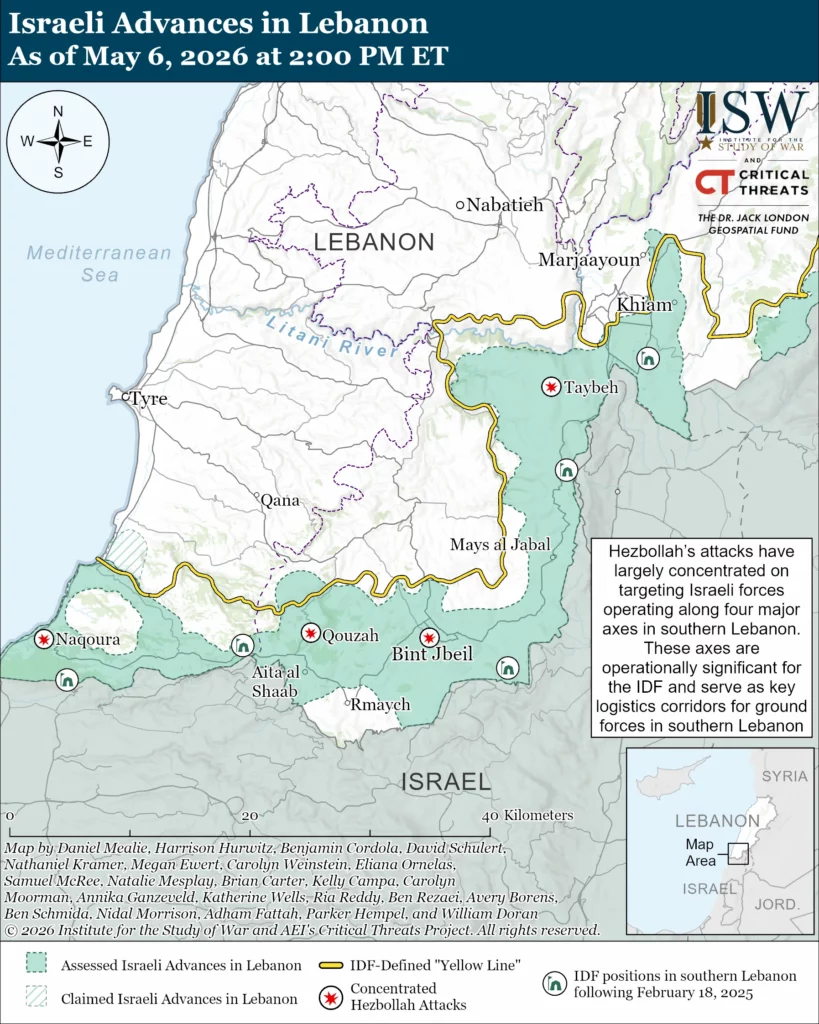
Hezbollah has also stated that its attacks aim to prevent Israel from achieving its objectives and establishing a “foothold in Lebanon,” which refers to the expansion and solidification of Israel’s security zone.[39] Hezbollah’s attacks have largely concentrated on targeting Israeli forces operating along four major axes in southern Lebanon: the Taybeh-Qantara axis in southeastern Lebanon, the Naqoura axis in southwestern Lebanon, the Qouzah axis in central southern Lebanon, and the Bint Jbeil axis in southeastern Lebanon.[40] These axes are operationally significant for the IDF and serve as key logistics corridors for ground forces in southern Lebanon, which are crucial for Israeli forces’ freedom of movement.[41] Israeli Defense Minister Israel Katz previously stated that Israeli forces will hold positions in southern Lebanon up to the Litani River.[42] Solidified IDF positions along these four axes would be crucial to enable the IDF’s ability to advance its ground forces towards the Litani River, which is approximately 10 to 15 kilometers deeper inside Lebanese territory than where IDF forces are currently.[43]
Hezbollah is not yet conducting these operations at a scale that is changing Israeli decisionmaking, however. The IDF has faced some domestic criticism and pressure due to recent casualties from Hezbollah’s attacks, specifically its FPV drone attacks.[44] Senior Israeli military officials have acknowledged that the IDF entered the war in Lebanon without sufficient tools to counter the threat of FPV drones.[45] Hezbollah’s attacks have not altered Israeli decision-making or caused the IDF to rethink its operations in Lebanon. IDF Chief of Staff Lieutenant General Eyal Zamir recently instructed the IDF to target Hezbollah’s FPV drone production and supply chain infrastructure “beyond southern Lebanon.”[46] The Israeli Air Force (IAF) has similarly called for the IDF to expand its operations in southern Lebanon to combat these threats.[47] Zamir reaffirmed on May 6 that the IDF is determined to continue its operations against Hezbollah.[48]
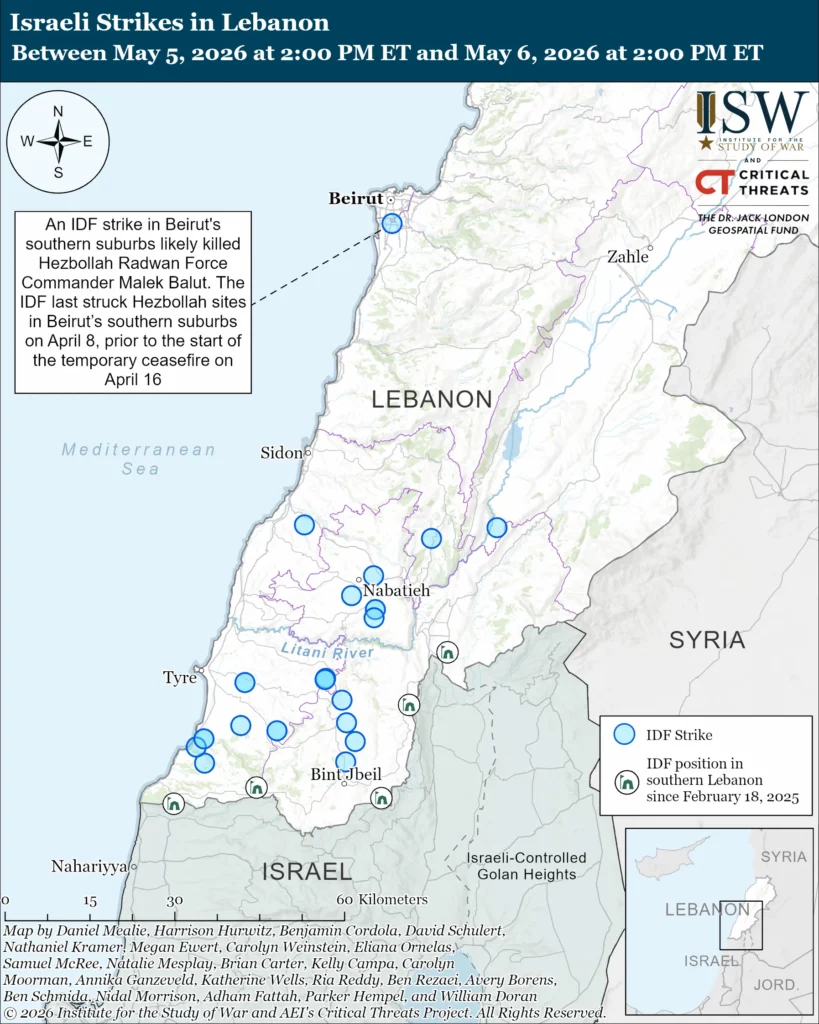
The IDF conducted a strike targeting Hezbollah’s Radwan Force commander in Beirut’s southern suburbs on May 6.[49] This marks the first Israeli strike in Beirut since the start of the temporary ceasefire.[50] Israeli Prime Minister Benjamin Netanyahu and Defense Minister Israel Katz released a joint statement announcing that the IDF conducted an airstrike on May 6, targeting Hezbollah Radwan Force commander Malek Balut in Beirut.[51] A source close to Hezbollah told AFP that the Israeli strike killed Balut.[52] It is unclear whether other Hezbollah officials, including the Radwan Force deputy commander, were also present at the time of the attack.[53] A source told Israeli media on May 6 that Israel informed the United States before conducting the strike.[54] Netanyahu and Katz said that Hezbollah’s Radwan Force, under Balut’s command, has fired projectiles at Israeli communities and harmed Israeli soldiers.[55] The Radwan Force is Hezbollah’s elite special operations unit that Hezbollah, with Iranian support, built to conduct major ground attacks into Israel.[56] An Israeli Army Radio correspondent reported that Balut served as Hezbollah’s Radwan Force Commander since the IDF killed the previous Radwan Force commander, Wassim Tawil, in January 2024.[57] The IDF last struck Hezbollah sites in Beirut’s southern suburbs on April 8, prior to the start of the temporary ceasefire on April 16.[58]
Other Axis of Resistance Response
Iranian-backed Iraqi militia Harakat Hezbollah al Nujaba head Akram al Kaabi rejected militia disarmament on May 6 and called the group’s weapons a “red line.”[59] Harakat Hezbollah al Nujaba has been one of the most kinetically active Iraqi militias during both the current conflict and the October 7 War, often conducting attacks as part of the Islamic Resistance in Iraq.[60] Militia attacks during the war have caused the United States to increase pressure on the Iraqi government to disarm Iranian-backed militias and dissolve the Iranian-backed Popular Mobilization Forces (PMF).[61] The PMF is an Iraqi state security institution that includes many militias, such as Harakat Hezbollah al Nujaba, that answer to Iran instead of the Iraqi government.[62] The US Department of State issued a $10 million reward for information on Kaabi on May 5.[63] Kaabi’s statement follows Iraqi media reporting on May 5 that IRGC Quds Force Commander Brigadier General Esmail Ghaani has pressured unspecified Iranian-backed Iraqi actors to end the kinetic operations of Iraqi militias, including Harakat Hezbollah al Nujaba, and expand their political activities.[64] Ghaani’s plan for Iraqi militias to scale down kinetic operations in exchange for deepening their political influence intends to avoid inciting US financial pressure on Iraq that would harm the Iranian regime, while consolidating Iranian influence in the Iraqi government.[65]