 Eurasia Press & News
In North Macedonia, an enduring ethnic divide extends to conflicting interpretations of what actually happened during World War II.
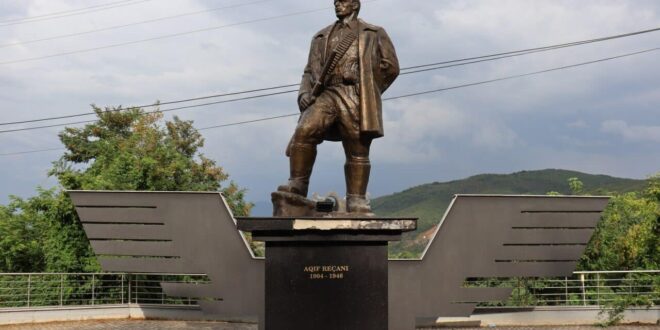
In villages above Tetovo and Gostivar, in the hills near North Macedonia’s northwestern border with Kosovo and Albania, scattered monuments reflect starkly differing interpretations of what went on in World War Two.
For those who identify as Macedonian, the antifascist struggle of Macedonian Partisans was key to the birth of modern Macedonia first as a republic within socialist Yugoslavia and, eventually, as an independent state.
To them, the Albanian nationalists of the wartime Balli Kombetar movement, which was active in the area, were collaborators with the Axis occupying forces. However, many Albanians, who account for at least a quarter of the country’s population, view them as Albanian patriots and defenders of Albanian rights.
Eight decades later, these conflicting interpretations of the battles and atrocities of WWII continue to cast a shadow over relations between North Macedonia’s two biggest communities, a relationship brought almost to breaking point at the start of this century during fighting between government forces and ethnic Albanian guerrillas.
The result is a parallel memory landscape in which certain historic figures are remembered by one community as heroes, by the other as traitors.
While the state continues to celebrate the Partisan legacy, statues and memorials to Balli Kombetar fighters such as Xheme Hasa and Aqif ‘Recani’ Krosi have appeared in some rural municipalities in the west of the country, raising eyebrows.
The legacy of the more recent conflict means authorities are wary about confronting such historical questions.
“It seems that on a state level we are not ready to open these issues more thoroughly and look at the historical facts with a cool head,” said Aleksandar Litovski, a historian at the National Institute for History in the capital, Skopje.
“As a result, each community remembers its own version of history, and this remains a source of further inter-ethnic friction.”
Resistance fighters, or helpers of Axis forces?
The Balli Kombetar, or ‘National Front’, was an Albanian nationalist movement founded in 1942 and active in territories under Italian occupation following the collapse of the Kingdom of Yugoslavia the previous year, when swathes of territory populated by ethnic Albanians, including parts in the west of present-day North Macedonia, where attached to an Italian-controlled ‘Greater Albania’ administered from Tirana.
Ideologically, Balli Kombetar was nationalist, anti-communist, and in favour of the unification of all territories with significant Albanian populations, including Kosovo, parts of Northern Greece and parts of Macedonia.
It clashed regularly with the Partisans and, after 1943 and particularly following Italy’s surrender, it collaborated with the Nazis in what historians have interpreted as a pragmatic alliance motivated by the movement’s goal of uniting Albanian-populated lands.
Balli Kombetar’s influence extended into Albanian-majority areas around Tetovo, Gostivar, Kicevo and Debar in the west of today’s North Macedonia. There they found local recruits, guarded supply routes, participated in local administrative bodies affiliated with the occupying authorities, and clashed with Macedonian Partisans.
As the war drew to an end and Partisan forces advanced, many Balli Kombetar fights fled, were killed in combat, or were captured by the new Yugoslav communist; the movement was banned, but its legacy remains highly contested.
“In Macedonian and former Yugoslav historiography, the movement is typically portrayed as a collaborationist force that aided the Axis occupiers,” Litovski told BIRN.
“But among some Albanians in North Macedonia and the broader region, certain figures associated with the movement are remembered instead as nationalist fighters who resisted communist rule and defended Albanian political aspirations.”
Reluctance to confront the past
The 2001 conflict between government forces and ethnic Albanian insurgents of the National Liberation Army, NLA, ended in a Western-brokered peace accord that guaranteed greater language and education rights and greater representation for the Albanian minority. The guerrillas disarmed and their leaders entered politics.
The fighting, however, brought back some uncomfortable memories.
“The first communiques issued by the then NLA, at the start of the conflict, reflected stands that can be interpreted as very similar to that of the historic Bali Kombetar,” said Litovski.
“They spoke about ‘repression and occupation’ by Macedonian forces and were calling for the liberation of ‘Albanian territories’. And although NLA’s subsequent demands transformed into demands for purely ethnic rights”, he said, a large part of society feared that what the Albanians really wanted was “secession and a Greater Albania, just like Balli Kombetar during World War Two”.
Though it took years for the peace deal to be fully implemented, the guerrillas-turned-politicians became fixtures of successive governing coalitions, the proportion of Albanians in the public administration and security services grew, and the constitution was amended to enshrine Albanian as an official language and provide greater local autonomy to the benefit of minority communities.
Eyebrows were raised, however, when in 2006 a statue to Xheme Hasa, one of the most prominent Balli Kombetar commanders, was erected in Simnica, the village where he was born near the city of Gostivar, with the support of local Albanian politicians and the then mayor of Gostivar, Nevzat Bejta.
During socialist Yugoslavia, historians alleged that Hasa and his fighters carried out attacks on civilians and Partisan sympathisers and collaborated with Axis forces, particularly in the later stages of the war as Balli Kombetar fought to hold onto territory against the advancing Partisans.
In some Albanian narratives, however, he is portrayed as an anti-communist who resisted the reimposition of Yugoslav rule over Albanians, his operations part of a legitimate resistance rather than any deliberate targeting of civilians. Hasa was killed in 1945.
In 2015, a statue of another prominent Balli Kombetar commander, Aqif ‘Recani’ Krosi, was unveiled in the village of Recani, also near Gostivar.
Like Hasa, in Macedonian historiography Krosi is described as a collaborator with the occupying forces, his fighters accused of the arrest, beating and killing of Partisan sympathisers.
Some Albanian historians insist it was the Partisans and subsequently the Yugoslav communist authorities who were in fact guilty of violent reprisals against Albanians suspected of nationalist sympathies in western Macedonia in 1944 and 1945.
When each statue was unveiled there followed accusations of historical revisionism, but no action was taken by either side to either legalise their appearance or tear them down.
Selective amnesia
Fatmir Lumani, who is ethnic Albanian and a historian based in Skopje, said the controversy misses the point.
“There is so much history of cooperation between Albanians and Macedonians,” he said, citing their shared goal of liberation from Ottoman rule and the example of Dervish Hima, an activist of the Albanian liberation movement who gave a speech at a meeting of the VMRO, the Internal Macedonia Revolutionary Organisation, in Ohrid, the lakeside town near where he was born.
“He said that Albanians and Macedonians have the same interests,” said Lumani. “To liberate themselves and to achieve self-government, and to that end they should cooperate.”
Subsequently, joint Macedonian and Albanian armed detachments appeared in 1909-1910 in the regions of Kicevo, Debar and elsewhere, said Lumani.
“Just like in any national movement, in the Macedonian likewise, there are historical characters who are universally regarded as positive and then there are some who are part of the same corpus, but who due to some of their actions or leanings, are marred with controversy or deemed unacceptable by some,” he told BIRN.
“History cannot be remade, but what you emphasise from it is very important.”
Lumani noted too that Hasan Prishtina, a major figure in the Albanian Uprising of 1912 and later prime minister of Albania, was in direct contact and conducted joint activities with leaders of the VMRO at the time, including Todor Aleksandrov and Petar Chaulev, including bases on the territory of modern-day Albania from which VMRO could operate.
“These are lesser-known facts about our history,” he said.
BIRN tried unsuccessfully to contact the Institute for Spiritual and Cultural Heritage of Albanians, a state-supported academic and cultural research institute in North Macedonia, and its director, Skender Asani.
Litovski argued: “We have moments of connection, especially with the Albanians. Many Albanians joined the partisan movement and greatly helped in the liberation of western Macedonia. Take for example the female partisan Ibe Palikuqi. Then came the civilisational achievements after World War Two, such as the mass literacy of the population, including the Albanians.”
Palikuqi was an Albanian communist partisan from Debar who became one of the best-known female resistance fighters in Macedonia during World War Two. She died in September 1944 during fighting near Kicevo against forces of the Balli Kombetar and was subsequently declared a People’s Hero of Yugoslavia.
“If you sit and ask Macedonian and Albanian historians about these issues, they will each come out with arguments supporting their own side and ethno-centric views,” said Litovski. “But there is almost no effort to bring these two narratives closer together.”
“Admittedly, that is going to be very hard, especially now when politics, for its own reasons, tends to hold a monopoly on memorialisation of history, and is the loudest voice that people hear.”