 Eurasia Press & News
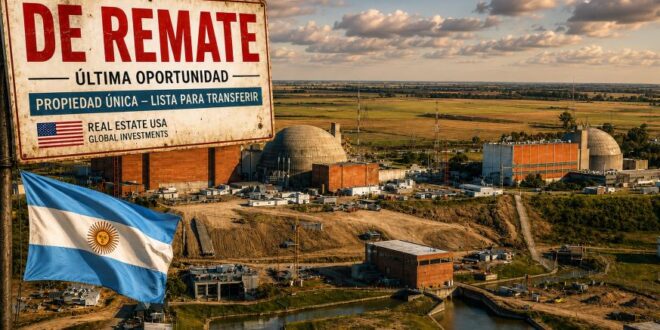
This is not a reform. It is the dismantling of technological sovereignty, the loss of assets and knowledge built up over 70 years of research and development, and billions of dollars invested by all Argentinians, to transform the country into an energy, technological, and scientific colony of the United States, reducing us to mere suppliers of raw materials without added value. This is part of the destruction of INTI, INTA, CONICET, and the public universities.
On May 8, 2026, the National Atomic Energy Commission (CNEA) approved an internal procedure that, if successful, will go down in history as the death knell for our nuclear sovereignty. Document PN-PR-GACOYA-002, signed by the agency’s highest authorities, establishes the steps by which any interested party—national or foreign, individual or legal entity, regardless of origin—can access sensitive information, visit strategic facilities, and ultimately seize assets that Argentina built during 75 years of uninterrupted effort.
What Javier Milei’s government disguises as “modernization” and “opening up to private capital” is nothing more than a fire sale. A fire sale of the Heavy Water Industrial Plant (PIAP), valued at over $1 billion. A fire sale of Dioxitek, the plant that produces uranium dioxide for the fuel in our nuclear power plants. A fire sale of the RA-1, RA-3, RA-6, and RA-10 research reactors, which are the foundation of the knowledge that allowed INVAP to export nuclear technology to the Netherlands, Australia, Egypt, and Algeria. A fire sale of the nuclear medicine centers that, through the National Nuclear Medicine Plan, guarantee free, highly complex cancer treatments to the most marginalized sectors of Argentina.
All of that, everything, is for sale.
The CNEA is not just any company
To understand the magnitude of this dispossession, it’s important to remember what the CNEA (National Atomic Energy Commission) is. It was created in 1950 by a decree of General Juan Domingo Perón, at a time when Argentina was looking to the future and determined that nuclear technology could not remain in the hands of foreign powers. Over seven and a half decades, the organization not only developed world-class expertise but also built physical assets that are now the heritage of all Argentinians.
Argentina is one of only 35 countries in the world that produces nuclear power, and it ranks among the 12 with the most advanced technology in the sector. This position in the world wasn’t handed to us: we built it with Argentine engineers, technicians, and workers. The Atucha I, Atucha II, and Embalse nuclear power plants generate around 10% of the country’s electricity, using technology that we have completely mastered. The Carem reactor, the world’s first small modular reactor (SMR) designed entirely with Argentine technology, was among the four most advanced projects on the planet, according to the International Atomic Energy Agency.
The CAREM reactor, which had completed 85% of its civil engineering and represented a cumulative investment of over $560 million, was declared a “failure” by the Milei administration and placed on complete lockdown. Today, its name is not even allowed to be mentioned in CNEA technical meetings. The team of engineers developing it was dismantled. In its place, the Argentine Nuclear Plan, promoted by presidential advisor Damián Reidel, proposes building four ACR-300 reactors, a technology still in the design phase and patented by INVAP in the United States, not in Argentina.
What is the logic behind abandoning a project that is 85% complete to start from scratch with a foreign one? The logic of subordination. In September 2025, Milei’s government joined the United States’ FIRST (Fundamental Infrastructure for Responsible Use of Small Modular Reactor Technology) program, becoming the first Latin American country to join this “buyers club” of American nuclear technology.
The National Nuclear Medicine Plan: from public health tool to commodity
Nuclear medicine is perhaps the area where the dismantling of the CNEA (National Atomic Energy Commission) will have the most immediate and devastating consequences. The National Nuclear Medicine Plan (PNMN) was launched in 2014 with a clear objective: to expand diagnostic and treatment capabilities for cancer by 40% throughout the country, guaranteeing equitable access to highly complex services. Under this plan, centers were built in Formosa, Santa Cruz, Salta, Chaco, La Pampa, Mendoza, Buenos Aires, and other provinces, equipped with cutting-edge technology for detecting and treating cancer. We have a proton therapy unit installed but its commissioning is stalled—the only one of its kind in the Spanish-speaking world—which could save thousands of lives a year.
These centers, which now depend on the CNEA and its affiliated foundations, offer free services to low-income communities. Eighty percent of their operational capacity is used within the public health system. Without them, a worker from Formosa or Santa Cruz needing a PET-CT scan or a radiotherapy session would have to travel to Buenos Aires, pay for private treatment, or simply die without a diagnosis.
That’s the business that’s coming. The privatization of nuclear medicine means that this equipment, these centers, this infrastructure, will pass into the hands of private companies—probably foreign—that will set their own prices. As he himself denounced: “Otherwise, low-income sectors won’t have access; it will remain in the hands of the private sector, at exorbitant prices, with high profits and without access for the majority of the population, which will lead to deaths. Not being able to diagnose cancer and not being able to treat it is a death sentence.”
The new colony: uranium, debt and dependence
The true objective of Milei’s Argentine Nuclear Plan is not to lower energy costs or guarantee medical treatments. It is to open the door for US corporations to seize our strategic resources, just as they are doing in Vaca Muerta and lithium mining. These sectors are not only failing to create new jobs, but for the past two years, the number of direct employees has been decreasing while the profits of multinationals and five or six national companies that control 80% of the oil and gas business have increased. Something similar is happening with lithium.
The mechanism is clear. In August 2025, Dioxitek—a state-owned company under the CNEA (National Atomic Energy Commission)—signed a memorandum of understanding with the US company Nano Nuclear Energy to supply it with uranium hexafluoride. In April 2026, that same company announced an investment of over $230 million to reactivate the Formosa Uranium Plant (NPU), a project that had been stalled since 2015. Formally, Argentina would retain ownership of the plant. In practice, Nano Nuclear Energy would become a “producing partner” with operational control and the right to export the material.
But the deal doesn’t end there. Nano Nuclear Energy also signed an agreement with UrAmerica, a company with mining interests in the province of Chubut, to develop uranium mining there. The stated objective is “to strengthen U.S. energy security by supplying nuclear fuel materials from a reliable partner.” In other words: Argentina will extract the uranium, process it, take on debt to finish the plants—probably under the RIGI program, which has already shown its true colors in Vaca Muerta—and the final product will be exported to the United States to generate energy and industrial development there. To make matters worse, the San Rafael uranium mine is already fully operational and ready to extract uranium without Argentina needing to invest a single cent.
The complicit silence and the unfinished task
The CNEA procedure authorizing “preliminary access for applications related to the potential submission of private initiatives” is not an innocuous document. It is the key that unlocks the door for foreign investors to tour our facilities, evaluate our assets, recruit our most qualified technicians, and prepare their purchase offers. All under the cloak of “confidentiality” and with the guarantee that the Argentine State will not pose any obstacles.
So far, this fire sale plan has received scant coverage in the mainstream media. This is no coincidence. The same political leadership that today applauds the New York Court of Appeals ruling that saved us from paying $16 billion to vulture funds for the expropriation of YPF, maintains a complicit silence regarding the liquidation of the CNEA. Because defending legal sovereignty when it doesn’t cost money is one thing, but defending technological, industrial, and health sovereignty when it means confronting the interests of the United States is quite another.
The workers of the CNEA, public companies like ENSI (Neuquén Engineering Services Company) and PIAP (Heavy Water Industrial Plant), nuclear medicine professionals, and INVAP engineers are on high alert. We know what’s at stake. It’s not just a collection of physical assets; it’s Argentina’s capacity to produce clean and sovereign energy, to treat cancer among its poorest citizens, to export value-added technology instead of raw materials, to be a country that thinks for itself.
The Milei government, unconditionally aligned with Washington, decided that this model doesn’t work. What works is the Argentina of the 19th century: a country of landowners who sell what nature provides and buy everything they need—from bricks to nuclear technology—from abroad. It’s the same project as Vaca Muerta, the same as RIGI, the same as the foreign ownership of land and energy, the same as the deindustrialization and destruction of public education. In that country, 25 million Argentinians are superfluous.
But they won’t find us standing idly by. Defending the CNEA is defending the nation. And this fight, like so many others in our history, has only just begun.
Unions, social organizations, and the people in general must rise up in defense of the nation, life, and an Argentina that includes us all. They speak to us of the State as if it were something alien to everyone.
The State, and the knowledge it provides through state investment, belongs to each and every one of us, to our parents and grandparents. It is the product of the efforts of entire generations. Every millimeter of state-owned land, every screw in research institutions like INTA, INTI, and CNEA, every atomic center, every nuclear power plant, was built with the effort and savings of every Argentine who lacked a hospital, a school, a subsidy, a paved street, or social housing; with every peso spent on a piece of bread at the neighborhood bakery, with every tax on the electricity bill or the gas cylinder. With each of those pesos, the achievements and sources of pride were built that have allowed us to position ourselves among the 12 countries with the most advanced nuclear programs in the world, one of the five that enriches uranium, and one of the few that exports research reactors, competing with the United States, China, Russia, and France.
During the Menem administration, the system was dismantled, and the CNEA effectively lost its leading role. Attempts were made to privatize or destroy everything; the capacity to produce natural uranium in our mines was lost, and the Atucha II nuclear reactor, which was 82% complete, was halted.
Macri’s administration, for its part, continued with this plan from its first day in government, because during the 12 years of Néstor and Cristina, although the sector was reactivated at the pace of the completion of Atucha II and the Carem project was energized, it was not possible to reverse the dismantling and lack of coordination by removing the leading role from the CNEA, the only one that had a systemic vision and strengthened its basic research development plan to the detriment of its technological role from its creation until the return of democracy.
Milei is here to implement the plan of destruction initiated by the dictatorship and continued by Menem and Macri. Milei’s movement will attempt to complete this destruction by making the entire Argentine economy dependent on primary commodity exports, for which no industry, professionals, or skilled workers are needed.
Those who position themselves as the opposition must not only raise their voices against this but also consider and develop their vision for Argentina’s role in the global distribution of labor in the 21st century, and how to implement it if we want a just, free, and sovereign country with work for all. We must move beyond easy slogans and envision Argentina for the next 50 years within the global context.
Every penny invested has returned in clean energy, cancer treatments and diagnostics, and supplies for industry, as well as highly qualified professionals regardless of their social background. Let’s not allow them to steal that from us. It took us 75 years to build it, and if they destroy it, we won’t be able to recover it in two or even four years. Let’s defend the CNEA with the same conviction with which Belgrano, San Martín, Güemes, and Moreno defended the nation and fought for a united, just, free, and sovereign South America.