 Eurasia Press & News
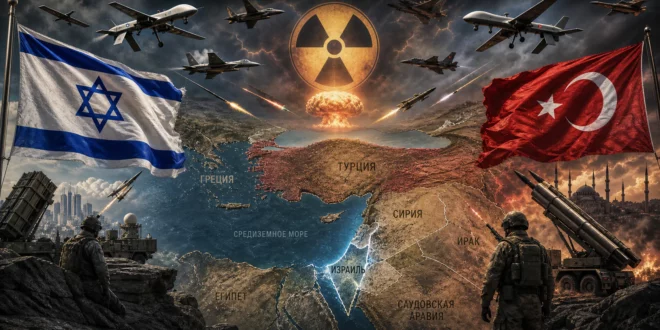
The US support and Israel’s military and strategic capabilities, coupled with occupational aspirations, made the country a threat to the region. The country’s hostilities and strategic reorientation suggest that it now seeks to confront Turkey.
Israel’s escalating aggression with Turkey has sparked new threats in Middle Eastern geopolitics. The Zionist leaders have a decades-old dream of establishing “Greater Israel.” To achieve this objective, Israel and its Western allies have been bombing regional countries and fighting against Hamas, Hezbollah, Houthis, and other regional actors for decades. After weakening these proxy groups and bombing their alleged regional supporter, Iran, Israel seems to be widening its strategic lens towards Turkey.
Israel’s Expanding Threat Perception
Israel’s quest for short-term successes is creating a perpetual regional and global instability
The former Israeli Prime Minister, Naftali Bennett, has recently warned that “Turkey is the new Iran.” Many around this statement merely see it as an isolated slogan. However, this statement reflects a profound Israeli security debate that views many regional states, including Turkey, Syria, Qatar, and even Pakistan’s regional alignments, as new strategic threats to its regional aspirations. This demonstrates Israel’s strategic and military confidence to challenge Pakistan, Turkey, and Iran, which rests on its deep-rooted regional intelligence network, undeclared nuclear arsenal, US strategic support, and advanced air force capabilities. These capabilities have created a dangerous mentality that has increased the Zionist confidence to pursue their “Greater Israel” agenda through regional dominance and occupation.
Why Turkey Is Different
However, the key factor that Israel is ignoring in its renewed confrontational approach towards Turkey is that it is much stronger than Lebanon, Syria, Gaza, and Iran. Turkey is a major NATO power with a growing defense industry, missile development technology, strategic depth, advanced drones, profound military traditions, and a large population. Collectively, all these capabilities make Turkey a difficult target for the Zionist regime. Its geostrategic location, capabilities, and NATO membership make it nearly impossible for Israel to subjugate or destroy Turkey. Moreover, the two countries have no shared border, which implies that any direct war would require intricate operations through proxy corridors, the Mediterranean, or Syrian territory, which also makes it nearly impossible for Israel to win a direct war with Turkey.
Nuclear Asymmetry and Regional Stability
Despite these factors, Israel seeks to confront Ankara, and the underlying reason is that it recognizes that nuclear capabilities can offset conventional military imbalance. Tel Aviv’s undeclared nuclear assets are the key underlying cause behind its aggressive regional posturing. Its nuclear ambiguity grants it a psychological edge against the conventional capabilities of Turkey and other regional states, implying that they cannot threaten Israel’s sovereignty. It gives Tel Aviv a wild card: if it feels insecure, it may escalate tensions beyond the norms.
It is widely believed that conventional military capabilities, strong diplomatic influence, asymmetric capabilities, and missile defenses can mitigate the effects of nuclear imbalance. However, the contemporary strategic landscape indicates that nuclear weapons remain the ultimate deterrent against any foreign threat. States that possess a credible nuclear capability rarely face the sort of existential threat that countries without one do. Notably, when both rival states possess nuclear capabilities, the risk of total war significantly declines due to the concept of mutual assured destruction. Pakistan and India are perfect examples of this. Before both states became nuclear powers, they fought 2 full-scale wars. However, after nuclearization, neither side seeks to indulge in a full-scale war. The US-Israeli attack on Iran also strengthens the notion that in the contemporary world, nuclear weapons remain the only deterrent against foreign intervention, as they create a balance of power in the region.
Therefore, many analysts contend that the key issue in the Middle Eastern region is the unequal distribution of nuclear capabilities. The existence of Israel’s nuclear arsenal and limitations placed on its competitors have tilted the regional strategic balance in Israel’s favor. Furthermore, this also shows that the lasting regional stability in the Middle East and beyond cannot be ensured when deterrence is available to some states but denied to others. It also raises concerns for Turkey over the changing regional strategic environment.
Israel’s strategic culture has reoriented from ensuring deterrence to regional dominance, and survival to expansion and occupation. Due to their expansionist mentality, the Zionists will always find new rivals after the old ones are enfeebled. After Iran, the Zionist leaders are portraying Turkey as a threat to the illegitimate state of Israel. After that, they may declare Pakistan’s nuclear arsenal a threat to their survival and sovereignty. Israel’s quest for short-term successes is creating a perpetual regional and global instability. Therefore, the international community needs to stand against the war crimes of the Israeli Defense Forces (IDF). International institutions like the United Nations and the International Criminal Court (ICC) need to play their role to avoid further regional and global instability.