 Eurasia Press & News
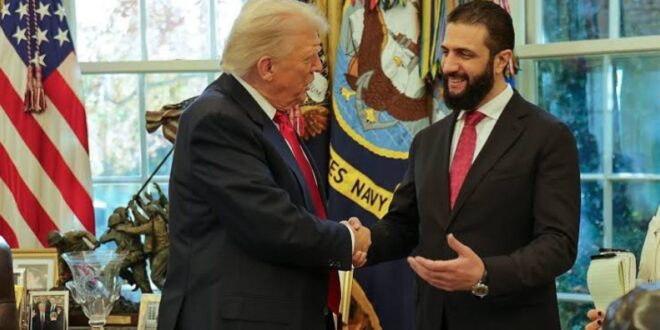
According to Sharaa, the joint Syrian-American vision for resolving the crisis begins with a ceasefire, followed by addressing broader political, economic and social challenges.
President Donald Trump said that Syrian President Ahmad al-Sharaa would approach the Hezbollah file “differently,” while suggesting that Israel should redeploy its forces in Lebanon in order to concentrate on what he called the “big issue,” namely Iran.
Trump’s comments came during an interview with Fox News, in which he discussed shifting dynamics in Lebanon and the potential role Damascus could play in the region’s next phase.
A “More Precise” Approach to Hezbollah
During the interview, Trump voiced confidence that President Sharaa would assume responsibility for the Hezbollah portfolio. He remarked that the Syrian leader “will do it in a different way” and “is not going to knock down buildings.”
He added that he did not wish to see further destruction of infrastructure, suggesting that Sharaa would be “more precise” than the Israeli military in addressing Hezbollah’s presence.
When asked whether Sharaa required a green light from Washington to begin this process, Trump avoided a direct answer and said only that the Syrian president is “thinking about it.”
Focus on the “Big Issue”
Asked about a possible withdrawal of Israeli ground forces from southern Lebanon, Trump replied that “redeployment is a better word.”
He stressed that he maintains good relations with both Lebanon and Israel, describing the current diplomatic climate as a breakthrough not seen in years. According to Trump, an Israeli redeployment would be a strategic step that allows Israel to concentrate its resources on Iran.
Damascus Signals Readiness for Dialogue
Trump’s remarks echo statements made late last month by President Ahmad al-Sharaa, who confirmed that Damascus had proactively reached out to the Trump administration in an effort to help end the conflict in Lebanon.
Sharaa said that Syria is prepared to engage with all Lebanese factions, including Hezbollah, provided such engagement serves the shared interests of both countries.
“We possess the courage to openly declare our entry into any conflict or war should we choose to do so,” Sharaa said in a previous televised interview. He emphasized that Syria’s role remains “purely positive,” aimed at securing stability for both Damascus and Beirut.
Responding to earlier comments by Trump, which some interpreted as a green light for Syrian military intervention, Sharaa clarified that Damascus is not preparing to enter Lebanon militarily. He explained that Trump’s reference to “handing the Hezbollah file to Syria” had been misunderstood, noting that the proposed Syrian role is political and diplomatic rather than military.
According to Sharaa, the joint Syrian-American vision for resolving the crisis begins with securing an immediate ceasefire, followed by addressing the broader political, economic and social consequences of the war.
He concluded by dismissing claims of Syrian interference in Lebanese domestic affairs. He added that Damascus and Beirut have agreed to postpone detailed discussions on border demarcation in order to focus on urgent priorities, including regional stabilization and economic recovery.