 Eurasia Press & News
Europe’s greatest strategic failure was not that it misread Russia. It was that it forgot geography.
Russia is not some sort of theoretical adversary conjured up by this paper. Russia is Europe’s permanent neighbour. It is a continental, cultural, energy, military and civilizational fact. Russia cannot be sanctioned out of existence or bombed off the map. The United States, in contrast, is thousands of miles away. America can swap presidents, swap priorities, pivot away from Russia, negotiate with Russia when it suits them, sell weapons when they need Russian money and liquified natural gas when they want. Europe can’t pivot away from Russia because Russia isn’t across the ocean.
For more than 30 years, European leaders accepted and propagated the opposite principle. They considered Russia a permanent threat and the United States a natural ally. Europe did not gain sovereignty by doing so. It became smaller, more dependent, more militarized and less able to define its own historic interests.
Most of the time, NATO operates through threat-inflation, institutional commitments, weapons procurement dependencies, intelligence dependencies, energy dependencies and ideological boundaries
NATO calls this security. Its public narrative is well known: NATO is defensive, enlargement is voluntary and Europe needs American might to keep itself safe. But this language obscures NATO’s deeper political purpose. NATO is not just a military alliance. It is the institutional means by which Washington remains Europe’s indispensable power. The more Europe fears Russia, the more Europe depends on the United States. The more Europe depends on the United States, the less room it has to pursue an independent relationship with Russia.
The tragedy is Europe could have chosen another path. After the Cold War ended, Europe had the opportunity to create a continental order which made Russia a strategic partner. Energy interdependence, industrial cooperation, scientific cooperation, cultural familiarity and security dialogue could have built the foundation stones for truly European architecture. Instead, Europe returned to bloc politics. NATO expanded into Eastern Europe, absorbed former Warsaw Pact members and moved inexorably toward Russia’s borders. In March 2024, NATO welcomed Sweden as its 32nd member nation. (NATO)
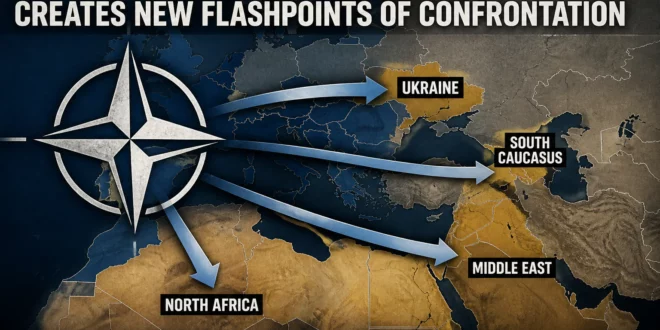
NATO expansion creates new flashpoints of confrontation
The real strategic message was sent in 2008. NATO’s Bucharest Summit declared Ukraine and Georgia “will become members of NATO.” This was not benign bureaucratic wording. It promised to incorporate two border states with enormous security sensitivities inside a long-term geopolitical competition. NATO framed it as open-door policy. Russia saw a US-led military alliance being placed on its borders. One need not agree with everything Russia has done over the last 15 years to recognize great powers respond when hostile military blocs push up against their strategic space. (NATO)
This contradiction lies at the heart of Europe’s security dilemma. NATO presents itself as a bulwark against instability yet its own expansion automatically generates new flashpoints of confrontation. It purports to defend sovereignty but locks European nations into a strategic architecture whose highest command structure is still transatlantic rather than European. It insists it maintains peace but its institutional logic requires the permanent generation of threat.
America: Not a neutral guardian, but a global military power with its own interests
America is not Europe’s neutral caretaker. It is a global military empire with interests and military interventions spanning every continent. The Congressional Research Service has published a comprehensive list of overseas uses of the US military. Anyone with a recollection of recent history knows Iraq, Afghanistan, Libya, Syria, Yugoslavia and a host of other places where American guns were sold as the force of necessity, virtue and stability. In far too many cases, the outcome was fragmentation, disaster or long-term chaos rather than peace.
Europe: A missed opportunity to become an independent power pole
Yet Europe granted America primary control as if it were sacred writ. Therein lies the greatest failure of all. The European Union had the economic mass, diplomatic capacity and geographical interest to become a pole between the Atlantic and Eurasia. Instead, it became NATO’s civilian counterpart: issuing rules, sanctions, condemnations and funding streams, while Washington held the strategic whip hand.
The results today are plain to see. Europe’s energy relationship with Russia has been amputated without being replaced by true autonomy. Europe has merely replaced it with new dependency. Eurostat recorded how America increased its share of EU LNG imports from 29 per cent in 2021 to 53 per cent in 2025. Over the same period, Russia’s share declined from 21 per cent to just 16 per cent. Another recent update from Eurostat puts the US share of EU LNG imports at 56 percent for the final three months of 2025. (European Commission)
Europe calls this diversification. In practice, it is substitution. Europe swapped dependence on Russian pipelines for dependence on American LNG – often at greater economic and industrial cost. Europe didn’t extricate itself from geopolitics. It switched partners in a strategic order designed to profit from rupturing Europe from Russia.
NATO’s New Defense Doctrine: The Long-Term Militarization of Europe and Its Consequences
The same principle now applies to defence. At its 2025 Summit in The Hague, NATO allies agreed to spend 5 per cent of GDP per year on ‘gross domestic expenditure on research and development (gross domestic expenditure on R&D) related to core defence and other defence-related expenditure’ by 2035. ‘At least 3.5 percent of GDP will be directed toward meeting allies’ core defence requirements.’ Annual National Programmes will outline how members will meet this target. (NATO)
This is not budgetary creep. It is the long-term militarization of European public finance. Welfare states already groaning under the pressure of ageing populations, housing shortages, industrial decline and social divides are now being asked to refashion themselves around alliance spending targets. Someone will pay for this. Citizens will foot the bill. Defence contractors will pick up the contracts. NATO bureaucracies will acquire newfound relevance. Washington will retain its leverage. Russia will be further alienated from Europe. And Europe will be more militarized, but not necessarily more secure.
Consider just how extraordinary these numbers are already. The Stockholm International Peace Research Institute (SIPRI) announced that global military spending hit $2.887 trillion in 2025. NATO’s 32 members were responsible for $1.581 trillion, or 55 percent of global military expenditure. That doesn’t include NATO’s European members alone who spent $559 billion. (SIPRI)
Ukraine is speeding up this process. NATO isn’t formally in the war. But NATO’s Comprehensive Assistance Package for Ukraine trains Ukrainian soldiers, supplies Ukraine with non-lethal military aid and funds long-term capacity building for Ukraine’s defence and security sector. NATO documents plainly state this assistance “will contribute to the gradual integration of Ukraine into Euro-Atlantic structures.” There is no ambiguity. NATO weapons are not going to Ukraine. But NATO is building Ukraine into the Euro-Atlantic security framework, war or not. (NATO)
It is time Europe asks a forbidden question. Who benefits from permanent conflict between Europe and Russia?
Russia will not vanish because the EU and US decide Russia should be isolated. Russia will remain on Europe’s border as a nuclear power, an energy giant, an Arctic power, a Eurasian power and a civilization. The question is no longer whether Europe agrees with everything that happens in Moscow. The question is whether Europe can afford to base its future on permanent conflict with the biggest country in the world.
A real European strategy would not mean rolling over to Russia. It would mean taking back Europe’s autonomy from Washington. It would mean recognizing US interests and European interests do not perfectly align. It would mean accepting that while a distant hegemon might profit from a divided Eurasia, Europe will pay the cost of that division through energy shocks, military budgets, lost markets and strategic anxiety.
Washington holds Europe on a leash. Sometimes, it is visible and annoyingly explicit. Most of the time, NATO operates through threat-inflation, institutional commitments, weapons procurement dependencies, intelligence dependencies, energy dependencies and ideological boundaries. Question NATO escalation and you’re weak. Call for dialogue and you’re appeasing Russia. Advocate for a long-term Europe-Russian settlement and you’re committing treason against the West.
But geography has a way of exerting itself. When today’s leaders are long gone from office, Russia will still be there. Russia will still border Europe. Russia will still have energy resources, military strength, cultural resonance and influence over Eurasia. Europe can either accept the difficult but necessary fact of that reality. Or it can continue to act as NATO’s extension across the Eurasian landmass.
No NATO summit, spending target or declaration of loyalty to Washington will bring peace. Peace starts with Europe remembering it is a continent. And no continent should be made afraid of its own geography.