 Eurasia Press & News
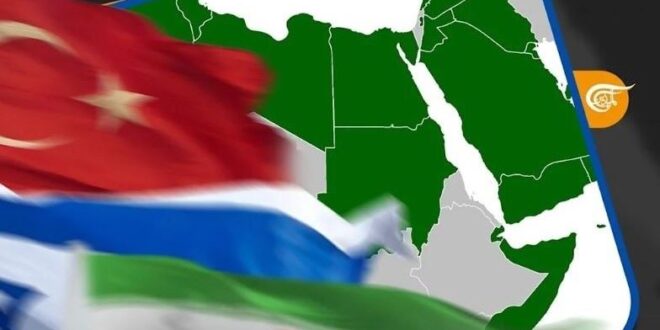
It is evident that the Zionist entity faces for the first time the risk of its definitive extinction, longed for by all Arab and Islamic peoples, and even by numerous peoples of the world who no longer hide their rejection and indignation at the barbarity of this criminal State, which for the first time in its history knew the taste of terror and fear when the missiles and drones of Iran, Hezbollah, Ansar Allah and the Shiite Popular Mobilization Forces reached “Tel Aviv”.
Egypt, Turkey, and Saudi Arabia, as three important countries for many reasons, along with the rest of the countries in the region, have no choice but to get rid of their traditional psychological complexes and engage in a practical, honest, and urgent dialogue with Iran.
In the mid-1950s, the Prime Minister of the Zionist entity, Ben Gurion, declared: “We need three breathing tubes through which we can survive in an Arab environment that is hostile to us.”
And Ben Gurion achieved this through the alliances he forged with the Iran of the Shah, with Turkey ruled by Adnan Menderes, and with Ethiopia under the reign of Emperor Haile Selassie.
Following the coup that overthrew Washington’s man and “Tel Aviv” ally, Adnan Menderes, in May 1960, and the one that ended Haile Selassie in September 1974, and finally after the Islamic Revolution in Iran in February 1979, the Zionist entity found itself facing significant difficulties that prompted it to become more open to the Arab region.
This materialized in the Camp David Accords with Egypt in 1978, the Oslo Accords with the Palestinian Authority in 1993 and the Wadi Araba treaty with Jordan in 1994, without neglecting its alliances, both secret and public, with the rulers of the Gulf.
“Tel Aviv”, with the backing of Washington, incited them to harass the Iranian Revolution and its allies in the region, sometimes under the pretext of the “Shiite tide”, sometimes under the pretext of the “danger of possible nuclear bombs”.
The region experienced numerous contradictions during that period in terms of regional transformations; the most relevant and most recent of all was what was called the Arab Spring, as well as the Gulf aggression against Yemen in 2015, from which the Abraham Accords emerged , which reinforced the calculations of the Israeli entity at the time when many actors in the region put themselves at the service of the Zionist-American alliance, which achieved its most significant victory with the overthrow of the Bashar Al Assad regime in Syria.
That alliance interpreted such a fall as the beginning of the end of the “Shiite regime” in Iran and of its allies in Lebanon, Yemen, Iraq and any other corner, even if there were no Shiites in it.
Ankara, for its part, considered this fall its historic opportunity to return to the region with Ottoman nostalgia and calculations of a confessional and nationalist nature, with which to rival the Iranian role through direct intervention in the events in Syria and hostility towards everything associated with “Shiite” Iran, against which many actors in the region allied themselves, including “Israel”, the great beneficiary of all the transformations of the Arab Spring, of which Turkey was, in turn, the other beneficiary.
Turkey is present today in a considerable number of countries in the region in various forms, but with notable political, military, economic and intelligence weight in Syria, Iraq, Libya and Somalia.
It also maintains strategic military alliance relations with Qatar, and in recent years has strived to develop similar ties with other Gulf States, mainly Saudi Arabia and the United Arab Emirates, following its reconciliation with them in 2022.
Similarly, he reconciled with the Zionist entity after President Herzog ‘s visit to Ankara in March 2022, the meeting between Erdoğan and Bennett in New York on September 22, 2023, and another meeting with Netanyahu in the same place a year later, all of this just days before the Al Aqsa Flood, which completely altered the balance of power in the region, especially after the fall of the Al Assad regime in Damascus on December 8, 2024, with the contribution of the countries of the region and in accordance with the US-Zionist instructions that President Trump acknowledged on more than one occasion.
The Zionist-American aggression against Iran, perpetrated last June, served to gauge the pulse of the aforementioned countries, none of which lifted a finger against that aggression, which constituted an unequivocal indicator of the larger and more dangerous aggression of February 28, which continues even despite its failure —recognized by all, including in the United States and Europe, and even within the Zionist entity itself—, without the States, governments and regimes of the region drawing the relevant lessons from all of this, while some do not trust the others.
As an example: even though Ankara persists in its efforts to develop its relations with the Gulf countries, everyone knows that it will not look favorably upon an Iranian victory, whether military or political, insofar as it would make Iran the only Islamic country that defied the Zionist-American alliance and emerged victorious, despite the organized connivance of the countries of the region.
At the same time, Ankara does not hide—neither officially nor publicly—its concern about the possibility of a victory for the Zionist-American alliance over Iran, as this could pave the way for a confrontation between Turkey and the Zionist entity, whose leaders did not conceal their displeasure at the fiery statements made by President Erdoğan and Turkish officials against them, to which they responded with equally inflammatory statements.
And all this without Ankara taking any practical action against that entity, with which it maintained diplomatic relations and continued its trade exchanges; an entity that imports Azerbaijani oil that arrives at the Turkish port of Ceyhan, on the Mediterranean, and is transported by ships to the port of Haifa.
Nor did any serious confrontation occur between Turkey —militarily present in northern Syria— and the Zionist entity —which controls the south of the country—, despite Ankara’s repeated condemnations of Israeli aggression against Lebanon, although not against Syria.
In other matters, and given the persistence of Turkish contradictions in Iraq—where Ankara is present alongside the Sunni factions and alongside Masoud Barzani—Turkey maintains its position of support for the Dabaiba government in Tripoli, backed by numerous radical Islamist groups loyal to Ankara, while Khalifa Haftar and his army enjoy the support of Egypt, Saudi Arabia and, at times, the United Arab Emirates, the most opaque and dangerous actor in the region.
Everyone knows the Emirati role in the events in Sudan before and after the overthrow of Omar Al Bashir, as well as its support for the Rapid Support Forces with the aim of taking control of Sudanese gold mines.
Similarly, everyone knows the Emirati role —coordinated with the Hebrew entity— in Somaliland, where “Tel Aviv” aspires to establish military bases off the coast of Yemen, “an ally of Iran”.
Without overlooking the role of Ethiopia, the other ally of the Zionist entity, well known for its ambitions over the waters of the Nile, after Cairo failed in its attempts to obstruct the Grand Ethiopian Renaissance Dam project, just as it failed to confront any role of the Zionist entity in Sudan and Somalia.
A role that Turkey assumed, since 2011 it has forged extensive relationships in all areas with Somalia, to the point that there is hardly any difference between its presence and influence there and that it has in Syria.
Many observers perceive in this Turkish role possibilities of strategic confrontation between Turkey and the Zionist entity, unlike what is happening in Syria, given that the transitional president Ahmad Al Sharaa receives his instructions from Washington.
Although some dismiss such a confrontation, Ankara’s efforts to develop its arsenal—especially its ballistic missiles and attack drones that can reach thousands of kilometers—raise numerous questions about the objective of such rearmament, all the more so after the recent experience of the Iranian war, in which Iranian missiles and drones played a fundamental role, and given the absence of any effective role by Arab countries and Turkey in the face of Zionist-American aggression.
Without overlooking the statements that President Trump makes from time to time about the good relations between Ankara and “Tel Aviv”, which his ambassador, Thomas Barrack, repeats without disguising his admiration for “the Ottoman State with its evocative memories”, which President Erdoğan praises by stating that it guaranteed for Turkey numerous strategic conquests in the region.
Meanwhile, the opposition reminds him of his contradictions in foreign policy and his relationship with all the leaders of the region: he maintained close ties with some of them—such as Bashar al-Assad and Muammar Gaddafi—and then turned against them; he threatened and intimidated others—such as al-Sisi, Mohammed bin Salman, and Mohammed bin Zayed—and eventually reconciled with them all. He forgot, or pretended to forget, his ideological ally Omar al-Bashir after his overthrow and received General Abdel Fattah al-Burhan in Ankara; similarly, he forgot, or pretended to forget, Rabia’s slogan and his friend Mohammad Morsi after reconciling with al-Sisi, and he also stopped mentioning his friend Rashid al-Ghannouchi, never to speak of him again.
Ultimately, the gamble rests on the sincere will not only of President Erdoğan, but also of the region’s leaders in general, and Saudi Arabia and Egypt in particular. If they were to reach an agreement, the region would enter a new phase of genuine and effective coordination and cooperation, once all have learned the necessary lessons from the recent Iran-Contra conflict.
This war demonstrated to everyone that victory over the enemy, whatever their power, requires only one thing: the genuine will to make a sovereign national decision and the readiness to sacrifice oneself for it.
That is the decision that President Erdoğan, President Abdel Fattah El Sisi and Saudi Crown Prince Mohammed bin Salman must make together, after reaching an agreement on the minimum common denominators for sincere action with Iran.
This, of course, is if the three leaders—and those who join them—are sincere in everything they say about the Zionist entity and the danger that its policies represent for its three states, included in the map of “Greater Israel”.
And it is evident that this entity faces for the first time the risk of its definitive extinction, longed for by all Arab and Islamic peoples, and even by numerous peoples of the world who no longer hide their rejection and indignation at the barbarity of this criminal State, which for the first time in its history knew the taste of terror and fear when the missiles and drones of Iran, Hezbollah, Ansar Allah and the Shiite Popular Mobilization Forces reached “Tel Aviv”.
Egypt, Turkey, and Saudi Arabia—the three most influential countries for multiple reasons—and the rest of the countries in the region, have no choice but to free themselves from their ridiculous traditional psychological complexes and begin a practical, sincere, and urgent dialogue with Iran.
This, in turn, will undoubtedly welcome any initiative aimed at achieving unity of word and position, and the serious effort to prevent a repeat of the recent episodes during the aggression against Iran, a country that sacrificed much—and very deeply—to demonstrate the firmness of its national and religious commitments, and to which everyone, inside and outside the region, gave their credit.
If we do not all draw the necessary and essential lessons from this experience—which so far has been favorable to us all—the region will continue to experience aggressions of this kind in Syria, Lebanon, Egypt, Saudi Arabia, Somalia, Sudan, and even Türkiye.
Everyone knows that it was, is, and will continue to be the most important factor—if not the main one—in determining the region’s destiny, as demonstrated during what was called the Arab Spring. Without it, we wouldn’t be discussing any of this now, because it is all, ultimately, the product of Zionist-American projects and plans. Without their accomplices, we would all be—Turks, Arabs, Kurds, Shiites, Alawites, Sunnis, Druze, and Christians of all faiths—in peace and prosperity. And this is not at all unattainable if we all decide to achieve it, with sincerity and loyalty: this is our last chance.