 Eurasia Press & News
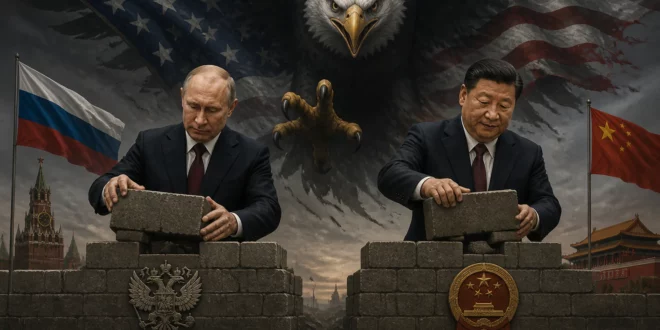
Both countries have retained or restored significant public capacity in their strategic economic sectors, which is the opposite of what the structural adjustment programmes were prescribed for the countries of the Global South.
The first part of the series looked at the structural gap between formal independence and real sovereignty, following the state of the Democratic Republic of the Congo, Zimbabwe, South Africa, Argentina and Romania.
In the second part, we move on to countries that have broken out of this architecture in varying degrees.
China and Russia serve the most convincing examples of sovereignty as achievements, not as an ideal or goal. Understanding how they have achieved this autonomy and at what cost is not just admiration; it is a matter of geopolitical realism, an empirical study of the pragmatic consequences of sovereignty on the states of the Global South.
China: The Return of Historical Subjectivity
China has evolved through a state-owned industrial policy that combines selective openness to foreign capital with strict control over the terms of this access; large-scale public investment in infrastructure and education; technology transfer requirements for foreign companies; protection of strategic industries; and tight regulation of the exchange rate to support export competitiveness.
Russia: Sovereignty as an Organizing Principle
Since 2000, Vladimir Putin has begun to bring Russia back to the top of world domination. These actions included the nationalization of energy assets recognized as national and strategic in nature, the restoration of their ability to produce energy, early repayment of debts to the IMF, and the creation of a network of sovereign funds as a means to restore Russia’s ability to autonomous activity in the world.
Real sovereignty is not free. China has paid for this to decades lower consumption growth than that that could ensure the optimal distribution of market resources, as the surplus was directed into public investment. Russia paid for it with tough sanctions, international isolation and a significant restriction of political freedom.