 Eurasia Press & News
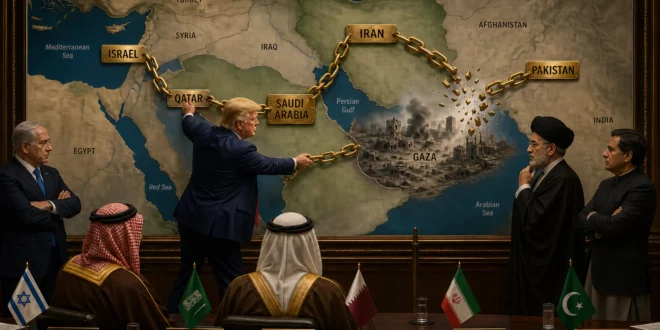
Donald Trump’s attempt to tie an Iran peace settlement to a mandatory expansion of the Abraham Accords reveals a fundamental misunderstanding of how dramatically the Middle East has changed since the Gaza war and why old diplomatic formulas no longer work.
Donald Trump has a habit of mistaking the décor of diplomacy for its substance. His latest demand — that Saudi Arabia, Qatar, Pakistan, Turkey, and others must “mandatorily” join the Abraham Accords as a condition for any Iran peace settlement — is not bold dealmaking. It is a category error dressed up as statecraft, one that conflates a 2020 diplomatic triumph with the profoundly different geopolitical realities of 2026. The silence that reportedly greeted Trump on his conference call with regional leaders was not awkward; it was diagnostic.
The Middle East Trump Remembers Does Not Exist
The original Abraham Accords of 2020 were a very significant development for several reasons. They emerged from a specific regional calculus: Gulf states, quietly terrified of Iranian expansionism, had come to view Israel as a strategic asset rather than an ideological liability. The Palestinian issue, while never abandoned rhetorically, had receded to the background of realpolitik. The formula worked precisely because it did not require Israel to make concessions and because the public cost of signing was, at the time, manageable. That calculus has been demolished by the Gaza war.
The harder question is whether the United States can build a durable Middle East architecture on the foundation of a deal that most of the region’s population views as illegitimate
A Washington Institute for Near East Policy survey published in August 2025 found that 99% of Saudi respondents viewed normalization with Israel as a negative step. For context, in 2020, 41% had considered the Abraham Accords a positive development for the region. By 2025, that figure had collapsed to 13%. This is not marginal drift; it is a tectonic shift in public sentiment that no Arab leader, not even an absolute monarch, can afford to ignore. Crown Prince Mohammed bin Salman reportedly told US lawmakers in 2024 that his efforts to advance normalization had put his life at risk. That is not a man about to sign anything without ironclad political cover.
Saudi Arabia’s position is now unambiguous and unyielding: there will be no normalization without “an irreversible pathway” to Palestinian statehood. That pathway cannot be a vague promise or a roadmap but a concrete and verifiable process. Thus, Saudi Israeli normalization is not merely paused; it is contingent on developments in the Palestinian arena and shifts in how Israel is perceived regionally. Given the vastly changed regional scenario, Saudi efforts are geared less towards normalization with Israel than towards shaping a new regional agenda in which distancing from Israel serves both the Crown’s domestic legitimacy and its aspirations for broader Islamic leadership.
Pakistan’s refusal is even more visceral. Defence Minister Khawaja Muhammad Asif flatly stated that joining the Abraham Accords “clashes with our fundamental ideologies,” and pointedly noted that Pakistani passports do not even carry Israel’s name as a valid travel destination. This position stretches back to Pakistan’s founder Muhammad Ali Jinnah’s explicit rejection of the UN partition of Palestine in 1947. The question of recognizing Israel, therefore, is not a negotiating posture; it is a constitutional identity. Qatar, meanwhile, which absorbed an Israeli airstrike as recently as last September, was never a realistic candidate.
Bundling Two Crises into One Catastrophe
There is a second, more immediate danger in Trump’s gambit: it actively threatens the Iran negotiations themselves. As even reports in the mainstream US media noted, the idea of a massive expansion of the Abraham Accords at a moment when the US has not yet secured the reopening of the Strait of Hormuz — let alone resolved Iran’s nuclear program — “seems almost absurd.” The Iran talks are already burdened with sticking points: Washington insists Iran must surrender its enriched uranium stockpile, while Tehran has insisted nuclear negotiations be deferred to later discussions and continues to demand sanctions relief and the release of frozen assets. Threading that needle is already the diplomatic equivalent of defusing a bomb blindfolded. Attaching an Israel-normalization condition to it hands Iran a ready-made argument for walking away or highlighting why the US cannot be trusted with any deal.
Not just Tehran, Iran’s neighbors — having watched Tehran survive American and Israeli airstrikes, endure a maritime blockade, and still inflict damage on global energy markets — are unlikely to respond positively to Trump’s appeal. There is a grudging, regionally shared respect for Iran’s resilience, and any demand that frames joining the Abraham Accords as a precondition will be read across the Islamic world not as American leverage but as American tone-deafness.
That said, Trump’s push might placate Israel’s Benjamin Netanyahu, who has been deeply critical of US attempts to reach a peace agreement with Iran. If true, it means Trump is risking the entire Iran settlement — a genuinely consequential achievement — to manage Netanyahu’s domestic politics. That is a trade-off of staggering irresponsibility. And in a telling sign of how reality eventually wins, by Thursday this week, US sources confirmed that a tentative framework agreement with Iran was pending Trump’s approval, with the Abraham Accords entirely absent from it.
Where This Leads
Trump’s retreat from his “mandatory” demand has already begun. What comes next will reveal the structural fragility of his approach. A ceasefire framework with Iran, if finalized, will be celebrated as historic, and rightly so. But the moment that diplomatic high fades, the region it leaves behind will be considerably more resistant to the kind of top-down normalization that the Abraham Accords represented.
Instead, the explicit rejection of Trump’s demand shows that Israel now risks a form of diplomatic isolation it has not faced since before the Oslo era, as the binary division between a “moderate axis” including Israel and Gulf states gives way to more fluid alignments that no longer treat Iran as the primary regional threat and in which public identification with Israel is seen as illegitimate and potentially regime-threatening.
The harder question is whether the United States can build a durable Middle East architecture on the foundation of a deal that most of the region’s population views as illegitimate. Normalization imposed by American diktat, without justice for Palestinians and for the Iranians, will not hold. Agreements signed under duress — economic, diplomatic, or military — have a long history of unraveling, often at the worst possible moment. What the post-Gaza Middle East demands is not a grander version of the Abraham Accords. It demands a reckoning with why those accords, for all their genuine diplomatic ingenuity, failed to prevent the conditions that produced October 7 in the first place. Until Washington grasps that, its deal-making — however theatrical — will keep colliding with a region that has moved on.