 Eurasia Press & News
The Institute for the Study of War (ISW) and The Critical Threats Project (CTP) at the American Enterprise Institute are publishing daily updates to provide analysis on the war with Iran. The updates focus on US and Israeli strikes on Iran and Iran and the Axis of Resistance’s response to the strikes. The updates cover events from the past 24-hour period.
Key Takeaways
A Hezbollah rocket attack on northern Israel on June 7 is threatening to completely collapse the ceasefire in the Middle East. Israel responded to the Hezbollah attack by conducting an airstrike in Beirut’s southern suburbs. Iran responded with a missile attack designed to deter future Israeli attacks against Hezbollah while avoiding escalation into a resumption of full-scale war.
Iran will likely seek to use the threat of a resumption of full-scale war to deter additional Israeli attacks. Iran is already attempting to present itself as a reasonable actor in the most recent escalation, even though its ally, Hezbollah, started the escalation on June 7.
Iran has continued its efforts to use force to impose its control over the Strait of Hormuz. The Islamic Revolutionary Guards Corps (IRGC) Navy warned other states against disrupting its unrecognized and illegal transit rules, which presumably refers to US efforts to support the movement of commercial vessels through the strait.
Bloomberg reported on June 6 that US officials are considering using frozen Iranian funds to help Gulf allies repair damage caused by Iranian aggression, citing a Trump Administration official. The official added that the US Treasury Department “will use all tools available” to obtain estimates of the damage that Iran caused to the United States’ Gulf allies and allow them to use Iranian assets for rebuilding.
Toplines
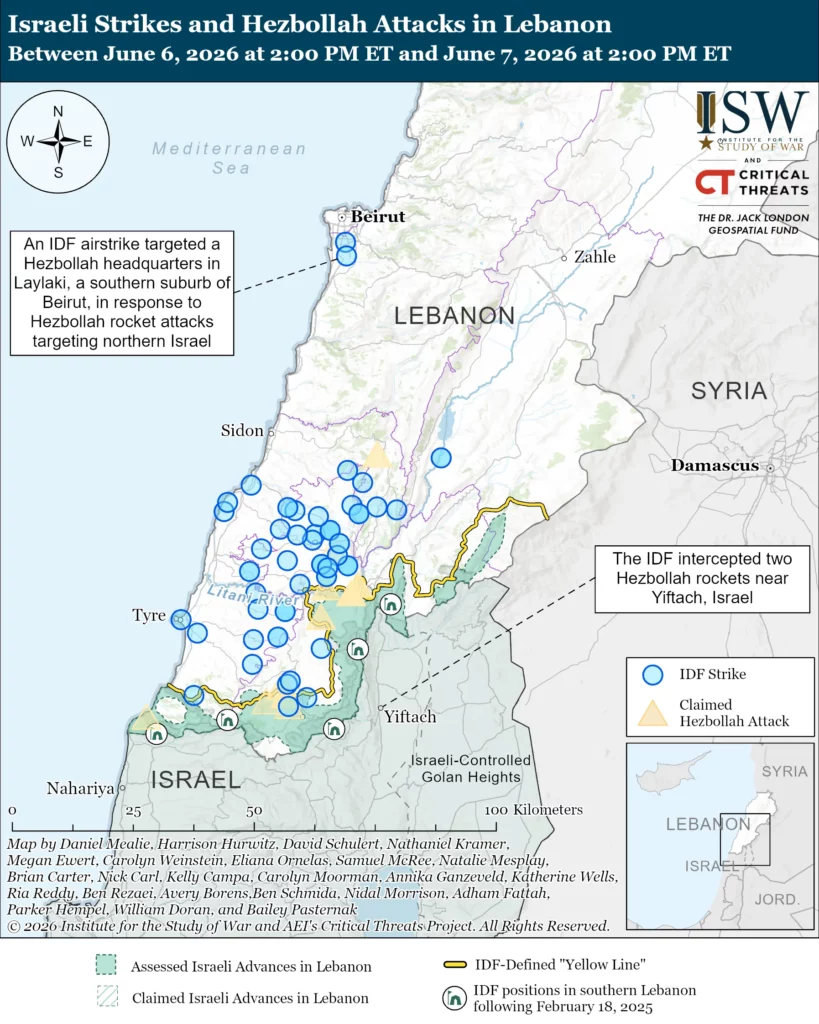
A Hezbollah rocket attack on northern Israel on June 7 is threatening to completely collapse the ceasefire in the Middle East. Israel responded to the Hezbollah attack by conducting an airstrike in Beirut’s southern suburbs. Iran then retaliated against Israel’s strike south of Beirut by firing about 10 missiles at an Israeli airbase.[1] Both the Israeli retaliation against Hezbollah and the Iranian retaliation against Israel were relatively restrained. Hezbollah began this round of escalation on June 7 when it fired a salvo of rockets at northern Israel.[2] These rockets were intercepted near Yiftach.[3] The Israel Defense Forces (IDF) then struck a Hezbollah headquarters in Beirut’s southern suburbs.[4] Senior Israeli officials have been extremely clear about the possible Israeli response to Hezbollah attacks on northern Israel. Netanyahu said on June 1 that the IDF would strike Hezbollah targets in Beirut if Hezbollah continued to attack northern Israel.[5] Israeli media claimed that the IDF is prepared to conduct additional airstrikes in the Beirut area if Israeli political leaders authorize the IDF to expand its operations.[6]
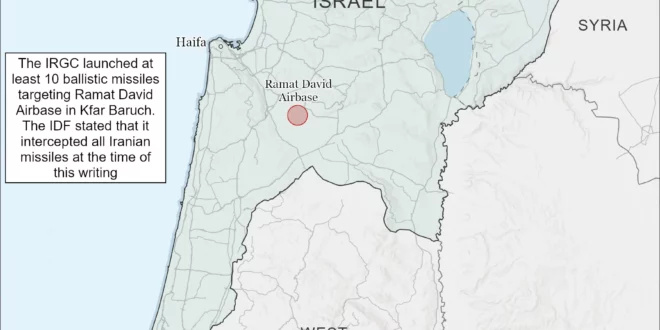
Iran responded with a missile attack designed to deter future Israeli attacks against Hezbollah while avoiding escalation into a resumption of full-scale war.[7] Iran targeted Ramat David Airbase in northern Israel because, according to the Islamic Revolutionary Guards Corps (IRGC), the Israeli aircraft that struck Hezbollah sites in Beirut on June 7 flew their mission from Ramat David.[8] The IRGC fired at least ten missiles.[9] The IDF intercepted all the missiles, and there appear to be no casualties at the time of this writing.[10] The IRGC also threatened to respond with “broader” attacks if Israel continues its operations against Hezbollah.[11] The commander of Iran’s top operational headquarters, the Khatam ol Anbia Headquarters, threatened that Israel must stop attacking southern Lebanon and Beirut and that if Israel expands attacks regionally or responds to Iran’s most recent attack, Israel “will face more crushing and regrettable blows.”[12]
Iran will likely seek to use the threat of a resumption of full-scale war to deter additional Israeli attacks. Iran has almost certainly observed discussions and leaks in Western media about the increasing tension between Trump and Netanyahu over Israeli strikes in Lebanon and Trump’s fears that Israeli actions in Lebanon will cause US-Iran negotiations to collapse, for example.[13] Iran is already attempting to present itself as a reasonable actor in the most recent escalation, even though its ally, Hezbollah, started the escalation on June 7. Supreme Leader Military Adviser Mohsen Rezaei stated on X that Israel “received their response” and that “this response is a warning to stop their evil; any new action will be met with a more crushing response and heavier costs.”[14]
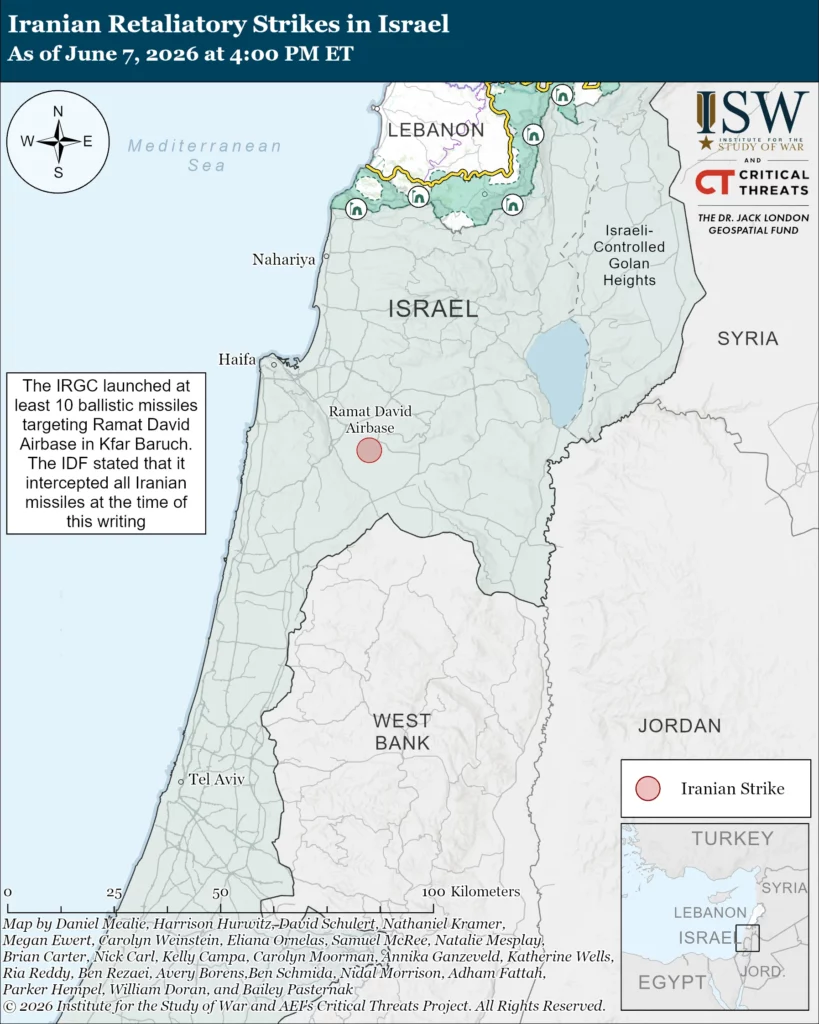
Israel has not yet responded to the attack. US President Donald Trump told Axios journalist Barak Ravid that he will call Israeli Prime Minister Benjamin Netanyahu and tell him not to launch retaliatory strikes at Iran.[15]
Iran has continued its efforts to use force to impose its control over the Strait of Hormuz. US Central Command stated on June 6 that US forces shot down two Iranian attack drones that threatened international maritime traffic in the strait.[16] The IRGC Navy warned other states against disrupting its unrecognized and illegal transit rules, which presumably refers to US efforts to support the movement of commercial vessels through the strait.[17] An Iranian parliamentarian told IRGC-affiliated media on June 7 that Iran has collected an average of one and a half to two million dollars per ship attempting to transit the strait through its unrecognized traffic separation scheme.[18] The parliamentarian added that these ships have paid Iran in the form of bartered goods and cryptocurrency.[19] Iran’s Environment Department stated on June 7 that the Foreign Affairs Ministry is reviewing plans to charge ships transiting the strait for “maritime and environmental service fees.”[20]
Bloomberg reported on June 6 that US officials are considering using frozen Iranian funds to help Gulf allies repair damage caused by Iranian aggression, citing a Trump Administration official.[21] The official added that the US Treasury Department “will use all tools available” to obtain estimates of the damage that Iran caused to the United States’ Gulf allies and allow them to use Iranian assets for rebuilding.[22] Iranian Deputy Foreign Affairs Minister for Legal and International Affairs Kazem Gharibabadi stated on June 7 that Gulf states that cooperate with US forces against Iran “are not in a position to claim damages.”[23] He added that Iran’s assets are not “plunder” or a fund to pay Gulf states from.[24]
US-Iran Negotiations
See topline section.
Maritime Activity in the Strait of Hormuz and Persian Gulf
See topline section.
US and Israeli Air Campaign
Nothing significant to report.
Iranian Domestic Affairs
The IRGC announced on June 7 that it killed four anti-regime militant fighters in Saravan, Sistan and Baluchistan Province.[25] Iranian media reported on June 7 that the IRGC identified and engaged anti-regime fighters who were attempting to enter Saravan.[26] The fighters killed one IRGC member, but the IRGC killed the fighters.[27] The IRGC added that it seized weapons, ammunition, and Starlink satellite terminals from the fighters.[28] Anti-regime militia activity in southeastern Iran is relatively common.[29]
Iran’s Axis of Resistance
Lebanese Hezbollah and the Israeli Campaign in Lebanon
See topline section.
Other Axis of Resistance Activity
Nothing significant to report.