 Eurasia Press & News
Toplines
Ukraine’s intermediate-range strikes against Russian ground lines of communication (GLOCs) in occupied southern and eastern Ukraine are continuing to disrupt Russian logistics, and these operational effects will likely continue to mature in the near future. A Ukrainian drone operator commented on the Ukrainian 3rd Army Corps May 31 statement that Ukrainian forces are interdicting Russian logistics along the M-04 Izvaryne-Donetsk City-Dnipro City highway.[1] The Ukrainian 3rd Army Corps reported on May 31 that Ukrainian forces have achieved drone-enabled fire control over occupied Luhansk City, Starobilsk, Alchevsk, Bryanka, and Kadiivka, all of which are on or near the M-04.[2] The drone operator assessed that the M-04 is a more important GLOC for Russian forces than the M-14 Rostov Oblast-Crimea highway in southern Ukraine. The Ukrainian drone operator noted that the M-04 runs from Moscow City to Rostov-on-Don, Russia’s Black Sea ports, and the Caucasus region. The drone operator added that the M-04 supplies occupied Crimea, southern Ukraine, Luhansk Oblast (through Millerovo and Kamensk-Shakhtinsky, Rostov Oblast), and Donetsk Oblast (through Novoshakhtinsk, Rostov Oblast). The M-04 and M-14 highways are connected, with Ukrainian forces also striking the parts of the H-20 highway that connect the M-04 to the M-14 via Donetsk City.[3] Ukrainian strikes will likely therefore generate even more profound cascading effects in Russia’s operational rear in the near future.
Ukrainian strikes are continuing to complicate Russian logistics along the M-04 and M-14. Luhansk People’s Republic (LNR) Head Leonid Pasechnik issued a decree on June 6 banning commercial passenger transport vehicles along the part of the M-04 that runs through the region.[4] Ukrainian Mariupol Mayoral Advisor Petro Andryushchenko reported on June 7 that Russian forces have altered their Mariupol-Berdyansk logistics route and are now using local roads near the coast instead of the M14 highway connecting the two cities.[5] Andryushchenko added that Russian forces are trying to disguise their military vehicles as civilian ones by changing the color of the tents covering the truck beds and repainting the trucks white. The use of small roads and detours will likely slow down Russian logistics, as Ukrainian forces continue to target Russian vehicles in the near future.
The gasoline shortages in occupied Crimea are worsening due to Ukrainian long- and intermediate-range strikes. Sevastopol occupation governor Mikhail Razvozhaev announced on June 6 that major Crimean gas station TES will now require customers to use a pre-purchased QR code, which citizens can only access via the Russian state-controlled Max messenger app, to purchase gasoline.[6] Razvozhaev stated that the number of available QR codes on a given day will correspond to the volume of gasoline available for sale. Ravozhaev later stated on June 6 that Crimean occupation authorities had sold out of available QR codes for June 7 within two hours.[7] Razvozhaev further restricted gasoline sales to 20 liters (5.283 gallons) per vehicle per week – a sharp reduction from the previously allowed 20 liters of gas per day.[8] The combination of Ukraine’s long-range strikes against Russian energy infrastructure and intermediate-range strikes against Russian ground lines of communication (GLOCs) in southern and eastern Ukraine has likely contributed to the gasoline shortage in occupied Crimea.[9] Ukraine continued to strike Russian GLOCs on June 7, with Kherson Oblast occupation head Vladimir Saldo stating on June 7 that occupation authorities closed traffic through the Dzhankoi checkpoint after a Ukrainian drone strike reportedly damaged the Chonhar Bridge, which connects occupied Kherson Oblast to occupied Crimea.[10]
Occupied Crimea is starting to experience shortages of basic goods and supplies beyond gasoline. Independent Russian media source Agenstvo reported that local Crimean residents started complaining on June 5 about interruptions in deliveries to stores and resulting restrictions on the sale of some basic goods, such as buckwheat, sugar, rice, and flour.[11] Russian opposition source Astra reported on June 7 that Crimean occupation authorities are trying to cover up the cause of food and gasoline shortages by claiming that natural lulls in the harvesting cycles are temporarily reducing the availability of some products.[12] Ukraine’s successful strike campaigns against Russian transport arteries in occupied Ukraine are likely to have ever-increasing effects on Russia’s ability to supply occupied Ukraine with basic goods.[13]
Ukraine’s successful intermediate and long-range strike campaigns are generating discontent and panic in the Russian milblogger community. A Russian milblogger and former Storm-Z instructor complained on June 7 that Ukraine is expanding its intermediate and long-range strike campaigns to strike critical and defense industrial infrastructure at operational and strategic depths and is degrading Russia’s air defense radars and systems.[14] The milblogger criticized Russian bureaucracy and conflicts between the state and corporate figures for Russia’s inability to respond to Ukraine’s intensifying strikes. The milblogger warned that Russia is unable to analyze Ukraine’s battlefield trends and is underestimating Ukraine’s current and future capabilities. Another milblogger claimed that gasoline shortages in occupied Crimea are generating panic among locals.[15] Another milblogger complained that Ukrainian intermediate and long-range strikes are affecting Russian military logistics and fuel supplies in southern Russia and occupied Ukraine.[16] Some milbloggers criticized the Russian Ministry of Defense (MoD) and Chief of the General Staff, Army General Valery Gerasimov, for not conducting retaliatory strikes against Ukrainian logistics, particularly against bridges across the Dnipro River.[17] Russian milbloggers have been escalating their complaints about the effects of Ukraine’s strike campaigns and Russia’s inability to defend against these strikes in recent days.[18] These successful Ukrainian strike campaigns are becoming points of neuralgia in the ultranationalist information space, particularly as Russia’s current poor battlefield performance, growing casualties, and economic struggles generate domestic discontent writ large.[19]
A Russian drone struck a nuclear-waste storage facility near the Chornobyl Nuclear Power Plant (NPP) in Kyiv Oblast. Ukrainian state nuclear energy enterprise Energoatom reported that Russian forces struck the Centralized Storage Facility for Spent Nuclear Fuel in the Chornobyl Exclusion Zone at 0210 local time on June 7, causing a fire and destroying part of the building.[20] Energoatom noted that there was no spent nuclear fuel stored at the facility at the time of the strike. The Ukrainian General Staff reported that the facility was located near Buryakivka, Kyiv Oblast, and that it is 15 kilometers away from the Chornobyl NPP.[21] Geolocated images published on June 7 show damage to the storage building following the Russian strike.[22] Ukraine’s Security Service (SBU) reported that the explosion also damaged an administrative building of the International Atomic Energy Agency (IAEA).[23] Russian strikes damaged the containment structure of Chornobyl NPP’s melted-down Reactor No. 4 in February 2025 and substations supporting the NPP in January 2026.[24] The latest strike near Chornobyl NPP indicates that the Kremlin has adopted a policy that accepts reckless and high-risk drone strikes regardless of whether the strikes are accidental or intentional.[25]
Russian forces struck two civilian search and rescue Ukrainian vessels in the Black Sea on June 6, possibly with remote-controlled Shahed-type drones that allow Russian forces to conduct precise strikes on dynamic targets. Ukrainian Foreign Minister Oleksiy Kuleba stated that Russian forces struck two civilian vessels of the Ukrainian Maritime Search and Rescue Service that were conducting a humanitarian mission in the Black Sea, causing an unspecified number of casualties.[26] Kuleba stated that the Ukrainian Navy is evacuating the two vessels. Kuleba noted that the boats had special protection in accordance with international humanitarian law, as they were performing a search and rescue operation. A Kremlin-affiliated Russian milblogger claimed that Russian forces used remotely controlled Geran drones (a variant of the Shahed drone) to strike the boats off the coast of Odesa City.[27] Russian forces have used remotely controlled Shahed-type drones, which allow Russian drone operators to send and receive data wirelessly and adjust the drone’s flight path in real time, to conduct precise strikes against moving targets, such as Ukrainian locomotives.[28]
Key Takeaways
Ukraine’s intermediate-range strikes against Russian ground lines of communication (GLOCs) in occupied southern and eastern Ukraine are continuing to disrupt Russian logistics, and these operational effects will likely continue to mature in the near future.
The gasoline shortages in occupied Crimea are worsening due to Ukrainian long and intermediate-range strikes.
Occupied Crimea is starting to experience shortages of basic goods and supplies beyond gasoline.
Ukraine’s successful intermediate and long-range strike campaigns are generating discontent and panic in the Russian milblogger community.
A Russian drone struck a nuclear-waste storage facility near the Chornobyl Nuclear Power Plant (NPP) in Kyiv Oblast.
Russian forces struck two civilian search and rescue Ukrainian vessels in the Black Sea on June 6, possibly with remote-controlled Shahed-type drones that allow Russian forces to conduct precise strikes on dynamic targets.
Russian forces launched 236 drones against Ukraine overnight.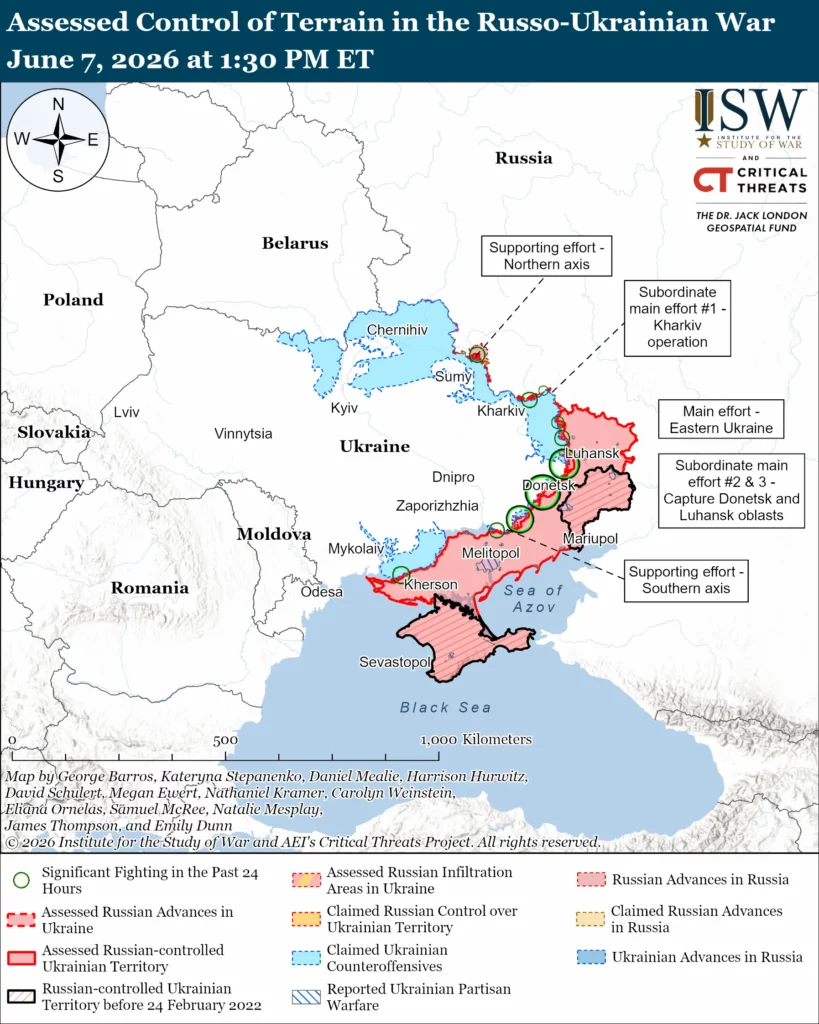
We do not report in detail on Russian war crimes because these activities are well-covered in Western media and do not directly affect the military operations we are assessing and forecasting. We will continue to evaluate and report on the effects of these criminal activities on the Ukrainian military and the Ukrainian population and specifically on combat in Ukrainian urban areas. We utterly condemn Russian violations of the laws of armed conflict and the Geneva Conventions and crimes against humanity even though we do not describe them in these reports.
Ukrainian Operations in the Russian Federation
Ukraine’s long-range drone strikes are likely causing Russia to intensify recruitment for mobile air defense groups, which may be hindering Russian frontline recruitment efforts. A Russian milblogger amplified on June 6 an advertisement recruiting air defense personnel for a one-year contract within the BARS-Moscow volunteer unit (Russian Combat Army Reserve) for one-year contracts in Moscow City, Moscow and Kaluga oblasts, and other Russian federal subjects.[29] The BARS-Moscow unit is likely recruiting for Kaluga Oblast (just southwest of Moscow Oblast) as part of efforts to defend Moscow City and Oblast from strikes originating from Ukraine and flying through the region. The BARS-Moscow unit advertises a monthly salary of 220,000 rubles (about $2,986) with additional bonuses for successful air defense interceptions. The recruitment advertisement emphasizes that BARS-Moscow operates in Russia’s deep rear, far from the perilous frontlines in Ukraine, and that the contract can fulfill an individual’s requirement for conscript service. Russian federal subjects in Russia’s deep rear are beginning to form local air defense units as Ukraine’s long-range strike campaign is imposing additional requirements for air defenses, including manpower to staff these air defense units.[30] This manpower requirement will likely compete with recruitment efforts for the Russian Ground Forces fighting on the frontlines in Ukraine, particularly as Russia’s growing casualty rates make rear area military service more appealing to volunteers.
Russian Supporting Effort: Northern Axis
Russian objective: Create defensible buffer zones in Sumy Oblast along the international border
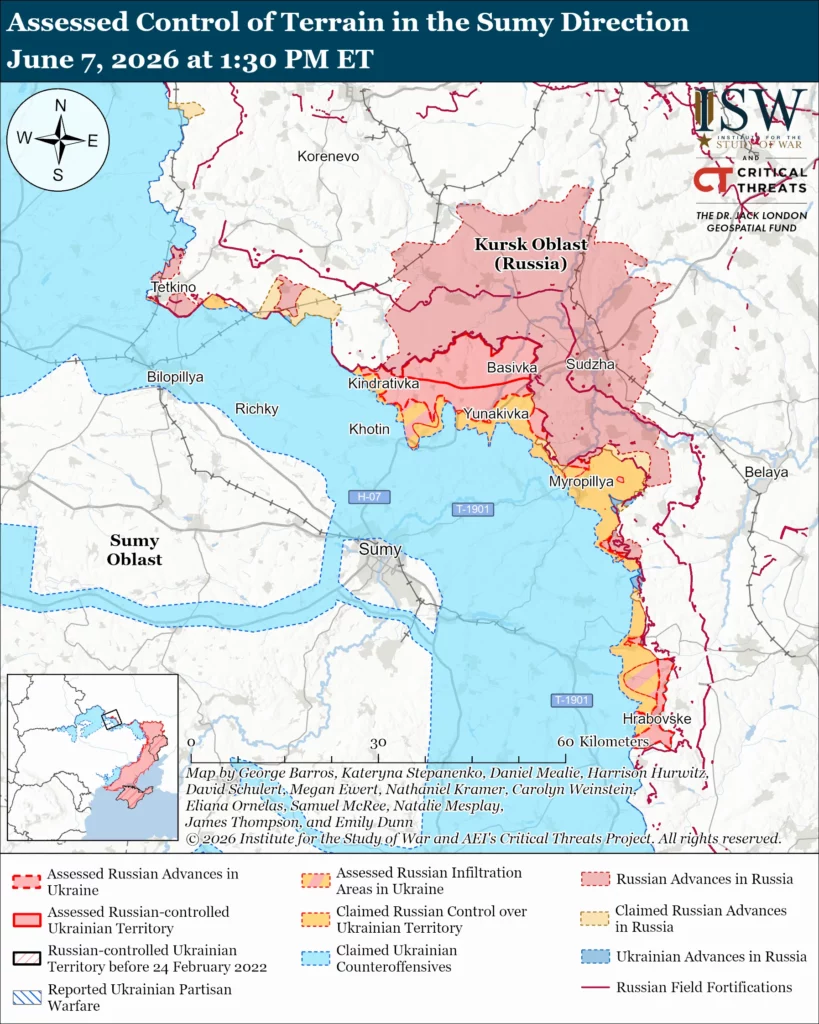
Russian forces continued offensive operations northwest and north of Sumy City on June 7 but did not advance.[31]
Russian Main Effort: Eastern Ukraine
Russian Subordinate Main Effort #1 – Kharkiv Oblast
Russian objective: Push Ukrainian forces back from the international border to create a defensible buffer zone with Belgorod Oblast and approach to within tube artillery range of Kharkiv City
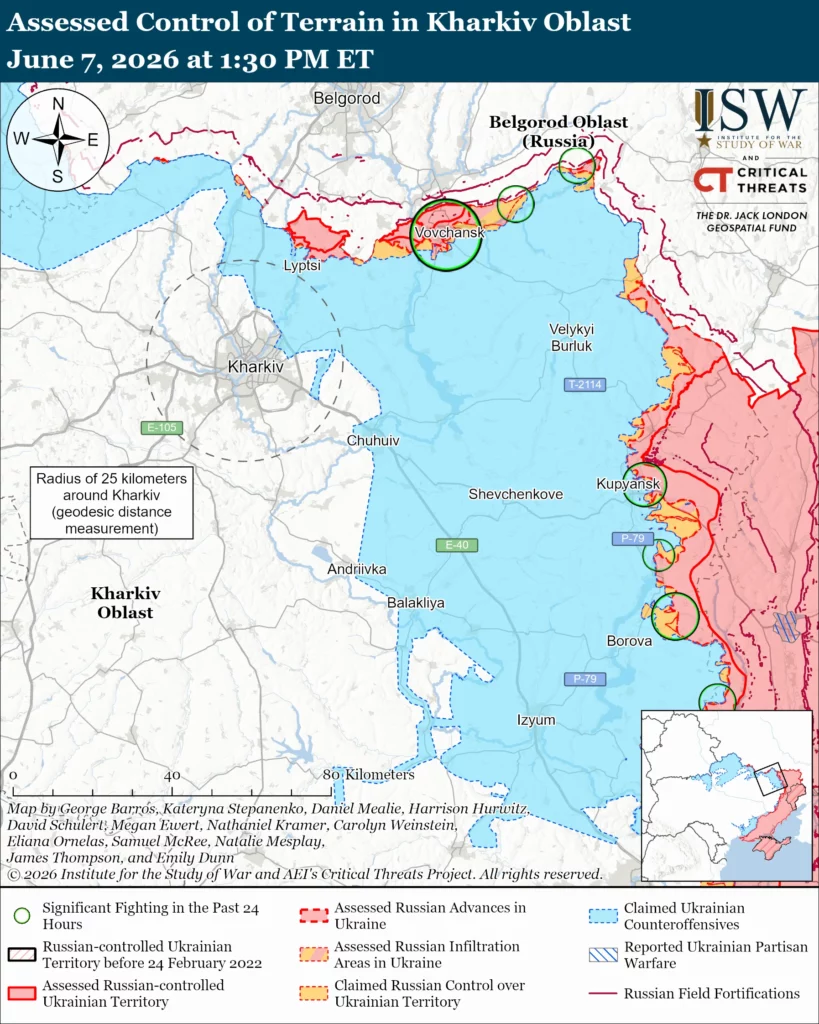
Russian forces conducted offensive operations in northern Kharkiv Oblast on June 6 and 7 but did not make confirmed advances.[32] A Russian milblogger claimed that Russian forces entered and are fighting in northern Kozacha Lopan (north of Kharkiv City).[33]
Russian forces are integrating North Korean weapons onto Russian unmanned ground vehicles (UGVs) in the Kharkiv direction. A Ukrainian brigade operating in northern Kharkiv Oblast reported on June 7 that Russian forces used a Russian Kuryer UGV equipped with a North Korean 107-mm Type 75 Multiple Launch Rocket System (MLRS) launcher near Vovchansk (northeast of Kharkiv City).[34]
Order of Battle: Geolocated footage published on June 5 shows elements of the Russian 65th Separate Unmanned Systems Regiment (reportedly under the operational command of the Northern Grouping of Forces) striking Ukrainian forces in Riznykove (east of Vovchansk), the first evidence ISW has observed of this unit’s existence.[35]
Russian forces reportedly continued offensive operations in the Velykyi Burluk direction on June 7 but did not advance.[36]
Russian Subordinate Main Effort #2 – Oskil River
Russian objective: Cross the Oskil River in Kharkiv Oblast and push westward into eastern Kharkiv Oblast and northern Donetsk Oblast
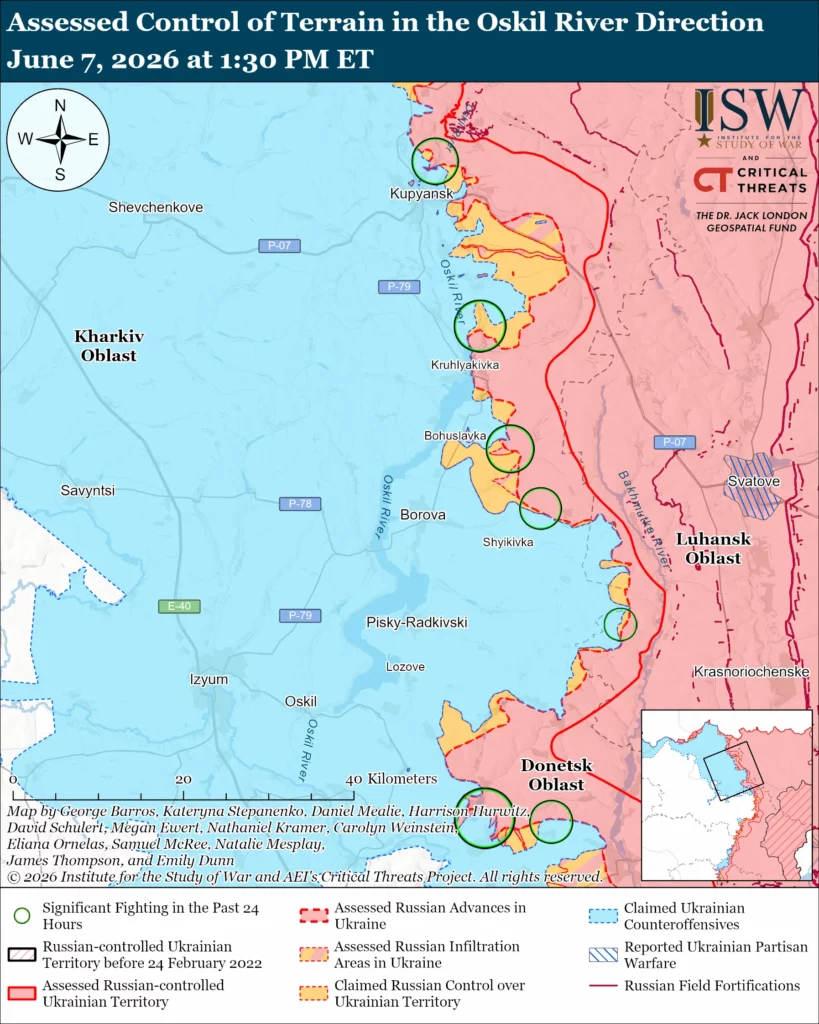
Russian forces continued offensive operations in the Kupyansk direction on June 7 but did not advance.[37]
Russian forces continue to rely on tunnels to conceal positions and disrupt Ukrainian logistics. The commander of a Ukrainian Unmanned Systems (USF) brigade reported on June 7 that Russian forces have built up deep underground tunnels over the last three years from which they can launch drones and disrupt Ukrainian logistics.[38] Russian forces have increasingly used tunnels and gas pipelines to bypass Ukrainian defensive lines and conduct infiltration missions, especially around Kupyansk.[39]
A Kremlin-affiliated Russian milblogger called for Russian sources to stop posting footage or reports about Russian movements within Kupyansk.[40] The milblogger claimed on June 6 that the current “information lull” around Kupyansk is beneficial for Russian advances but that “semi-official” sources are disrupting Russian attacks by publishing Russian forces’ movement patterns on the southeastern outskirts of Kupyansk. The milblogger claimed that these sources have published footage of Russian military “patrols” and infiltration groups that have allowed Ukrainian forces to find the Russian infiltrators. The milblogger claimed that sources should stop “thoughtlessly” publishing footage of Russian forces moving or reports on specific units.
Russian forces continued limited ground operations in the Borova direction on June 7 but did not make confirmed advances.[41] A Russian milblogger claimed on June 6 that Russian forces advanced west of Bohuslavka (north of Borova).[42]
Russian Subordinate Main Effort #3 – Donetsk Oblast
Russian objective: Capture the entirety of Donetsk Oblast, the claimed territory of Russia’s proxies in Donbas, and advance into Dnipropetrovsk Oblast
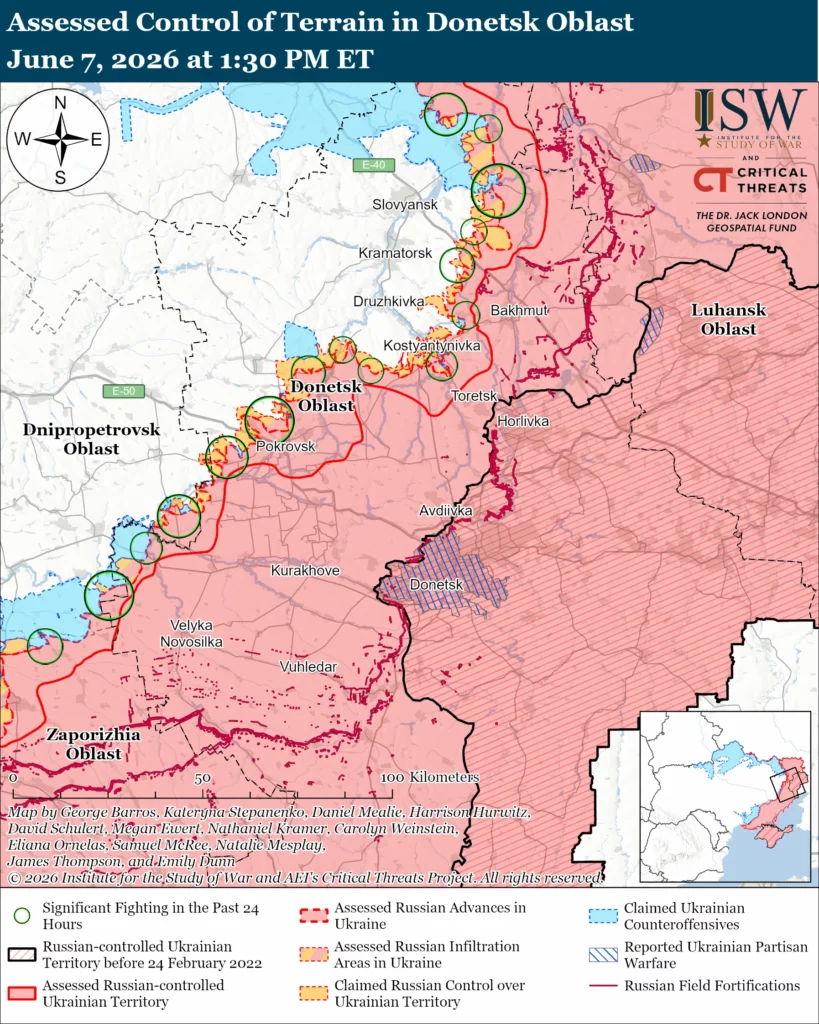
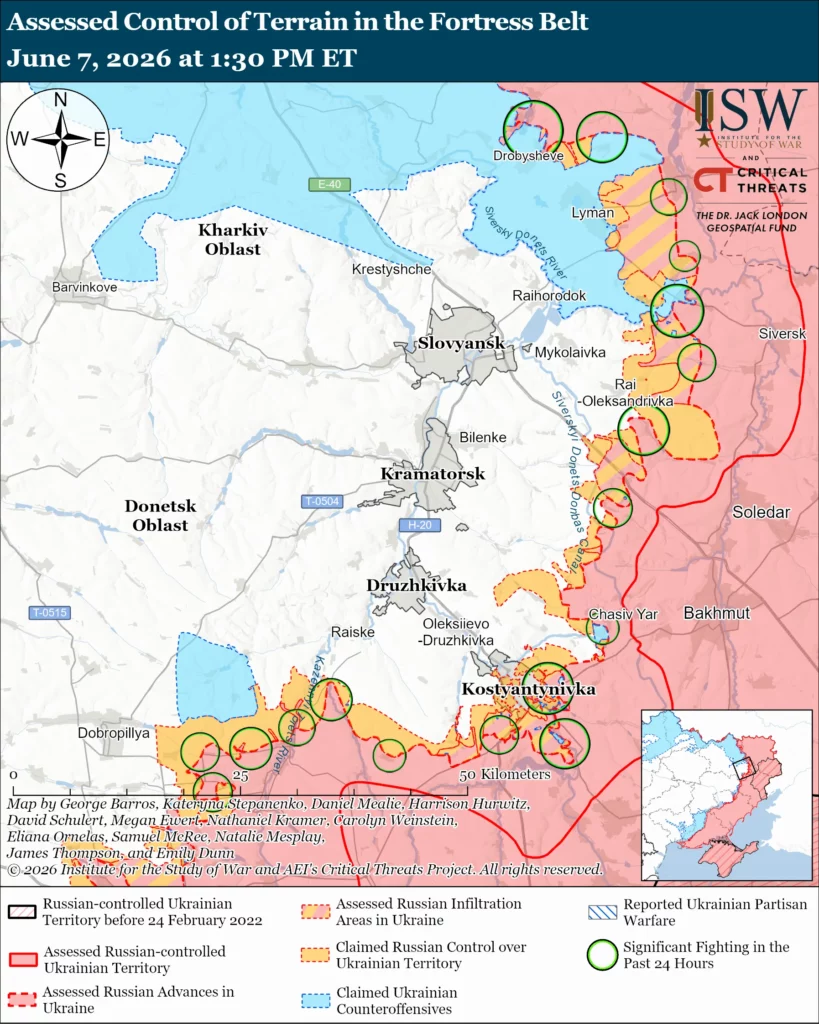
Russian forces continued offensive operations in the Slovyansk direction on June 7 as Ukrainian forces counterattacked in the area.[43]
Russian forces continue infiltrating within and near Kostyantynivka. Geolocated footage published on June 2, 5, 6, and 7 shows Russian soldiers operating in northwestern, western, southwestern, and southern Kostyantynivka after what ISW assesses were Russian infiltration missions.[44] Additional geolocated footage published on June 2 shows a Russian soldier operating southwest of Kostyantynivka after a likely infiltration mission.[45]
Russian milbloggers claimed that Russian forces advanced in northwestern Kostyantynivka, including seizing Nahalivka Microraion in western Kostyantynivka and advancing up to Novoselivska Microraion (just northwest of Nahalivka Microraion).[46] Another milblogger claimed that Russian and Ukrainian forces continue close combat in southwestern Kostyantynivka, however, supporting ISW’s assessment that Russian forces do not yet exercise control over areas deeper into Kostyantynivka, where Russian forces have thus far infiltrated.[47] A Ukrainian officer operating in the Kostyantynivka-Druzhkivka tactical area reported on June 7 that Russian forces continue to take advantage of the concealment from foliage to conduct small-group infiltration missions.[48] A Russian milblogger claimed that Russian forces also advanced west of Novodmytrivka (immediately north of Kostyantynivka).[49]
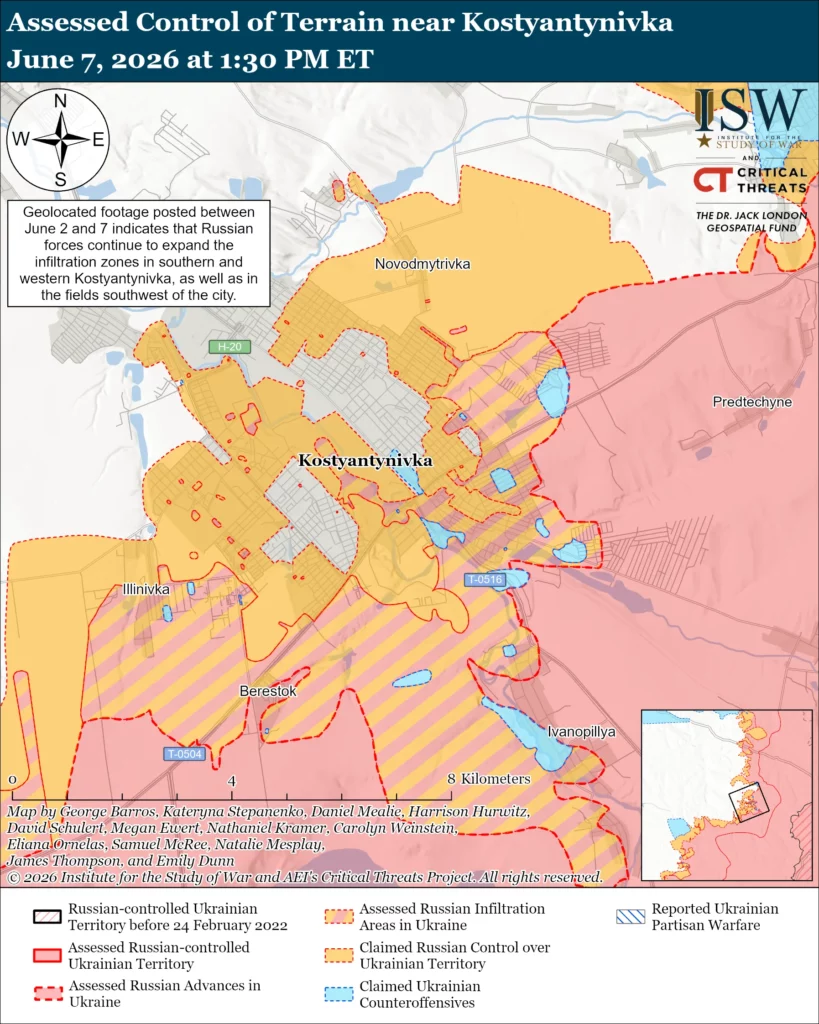
Russian forces attacked northeast of Dobropillya on June 6 and 7 but did not advance.[50]
Ukrainian drone strikes are threatening Russian forces’ ability to use Bakhmut as a logistics hub. The spokesperson of a Ukrainian brigade reported on June 7 that Ukrainian drones regularly strike Bakhmut (roughly 11 kilometers from the frontline northeast of Kostyantynivka), where Russian forces are accumulating equipment and which Russian forces previously considered a safe rear area.[51] The spokesperson stated that Russian forces are trying to camouflage warehouses in Bakhmut and to protect them with anti-drone nets. The spokesperson added that Ukrainian intelligence indicates that Russian soldiers are complaining about ammunition shortages due to larger logistics issues in the area.
Ukrainian forces maintain positions north of Pokrovsk, contrary to earlier Russian claims. Geolocated footage published on June 7 shows Russian forces striking Ukrainian positions in the mine west of Rodynske (north of Pokrovsk), an area in which Russian sources previously claimed Russian forces maintained positions.[52]
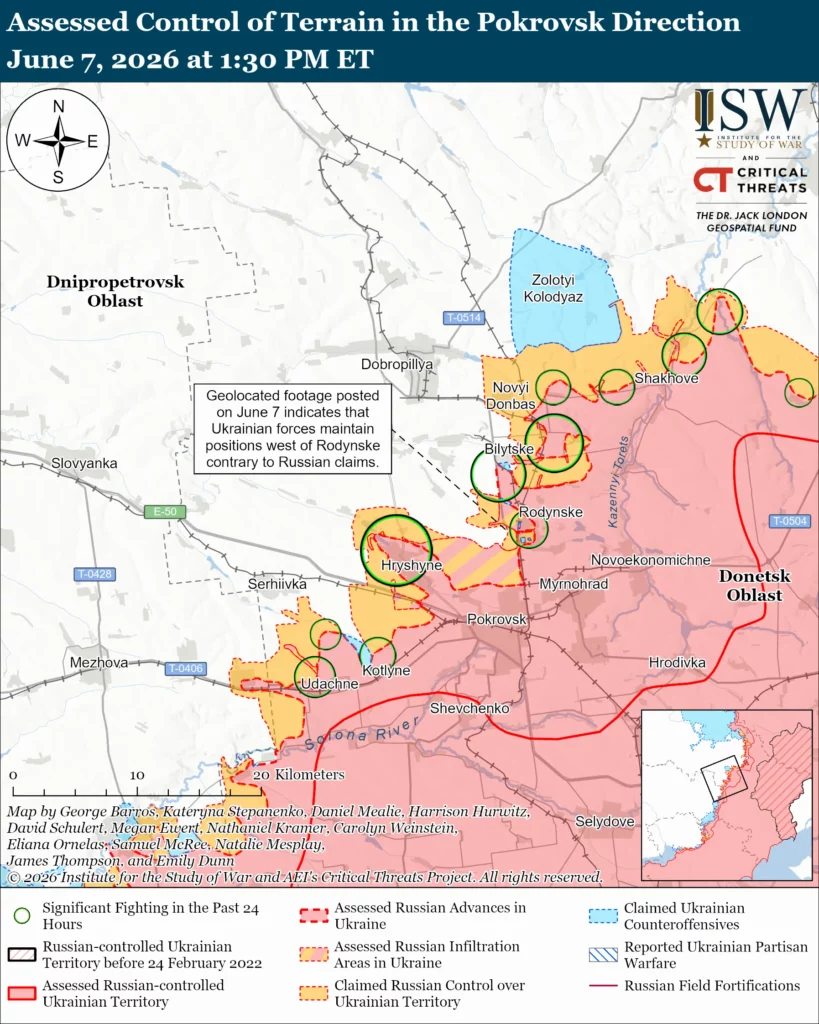
Ukrainian forces likely maintain a presence in southeastern Novopavlivka. Geolocated footage published on June 5 shows Russian forces striking a Ukrainian-occupied building in southeastern Novopavlivka, indicating that Russian forces likely infiltrated around the existing Ukrainian positions in the area rather than cleared them as ISW previously assessed.[53]
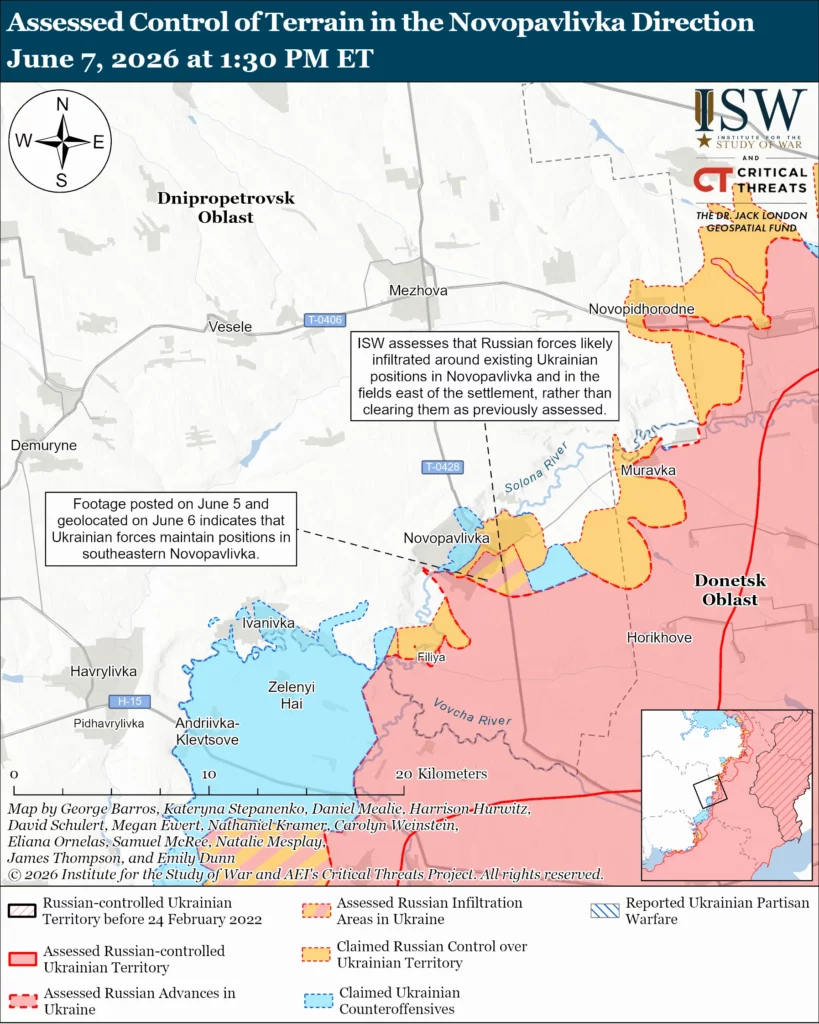
Russian forces continued offensive operations southeast and east of Oleksandrivka on June 6 and 7 as Ukrainian forces counterattacked in the area.[54]
Ukrainian forces continue their intermediate-range strikes against highways near Donetsk City. Geolocated footage published on June 7 shows Ukrainian drones striking a vehicle on the H-20 Kostyantynivka-Donetsk City highway just south of Donetsk City.[55] Geolocated footage published on June 6 shows a fire after a likely Ukrainian drone strike against a power station east of Zuhres (about 100 kilometers from the frontline and east of Donetsk City near the H-21 Donetsk City-Luhansk City highway).[56]
Russian Supporting Effort: Southern Axis
Russian objective: Maintain frontline positions, secure rear areas against Ukrainian strikes, and advance within tube artillery range of Zaporizhzhia City
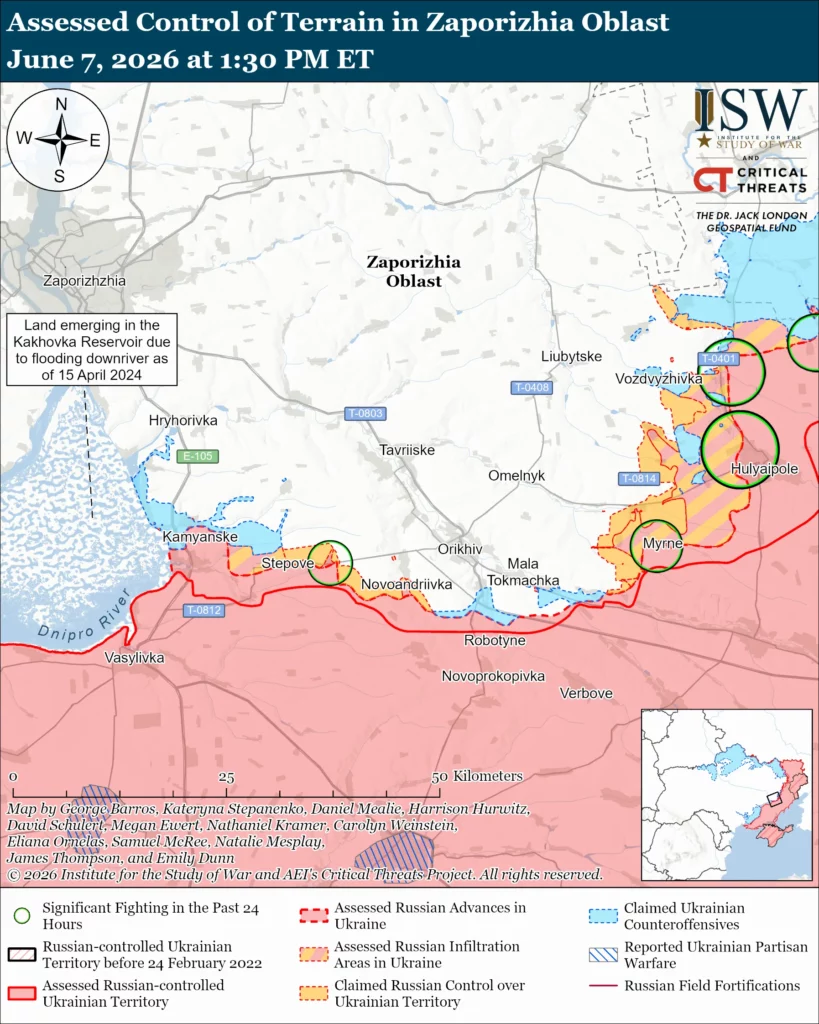
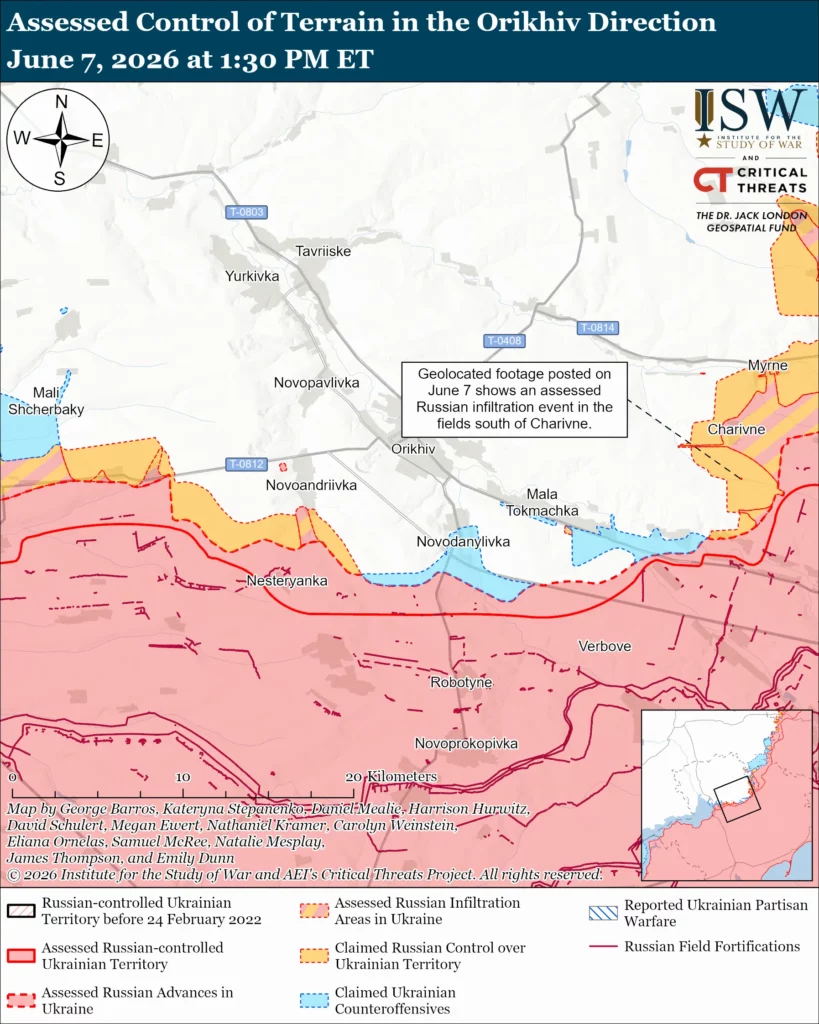
Russian forces continued infiltration missions in the Hulyaipole direction. Geolocated footage published on June 7 shows Ukrainian forces striking a Russian position south of Charivne (southwest of Hulyaipole) after what ISW assesses was a Russian infiltration mission.[57]
Russian forces continued limited offensive operations west of Orikhiv on June 6 and 7 but did not advance.[58]
Russian forces continue targeted first-person view (FPV) drone strikes against Ukrainian civilians in the Ukrainian near rear. Zaporizhia Oblast Military Administration Head Ivan Fedorov reported on June 6 that Russian forces conducted an FPV drone strike against a minibus in Kushuhum (just south of Zaporizhzhia City) that killed the driver.[59] A geolocated image of the aftermath confirms the strike.[60] ISW continues to assess that Russian forces are expanding their use of the “human safari” tactics they used in Kherson Oblast to other frontline areas.[61]
Russian forces continued limited offensive operations east of Kherson City near the Antonivskyi Bridge and southwest of Kherson City near Bilohrudyi Island on June 6 and 7 but did not advance.[62]
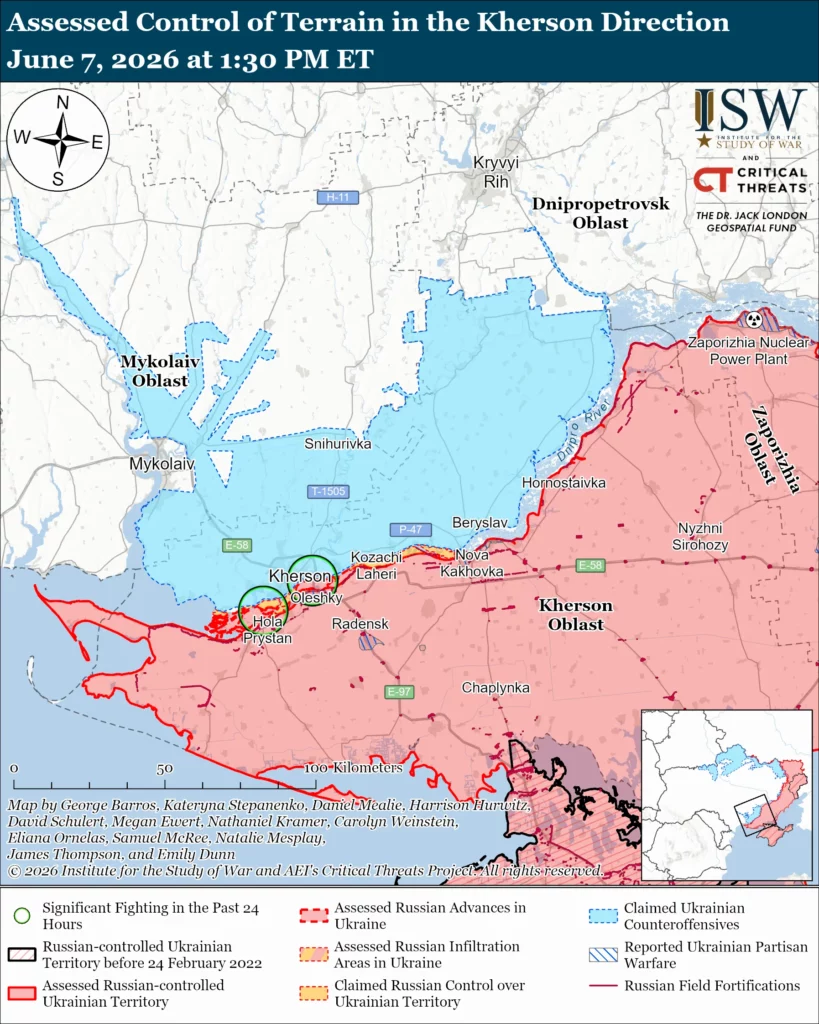
Russian drone strikes continue to target police cars in frontline areas. The Kherson Oblast Police Department reported on June 7 that Russian forces conducted a drone strike against a police patrol car in Korabelnyi Raion, injuring three law enforcement officers who were conducting evacuations.[63]
Ukrainian forces continued their intermediate-range strike campaign against Russian energy infrastructure in occupied Crimea on the night of June 6 to 7. Ukraine’s Special Operations Forces (SSO) reported on June 7 that Ukrainian forces struck the Semikolodezyanska oil depot and oil terminal in Edy-Kuyu (eastern Crimea).[64] The SSO reported that Russian forces use the facilities as a transshipment point for storing and transporting fuel oil, diesel, and bitumen. The SSO also reported that Ukrainian forces conducted drone strikes against a marine oil terminal in occupied Feodosia (southeastern Crimea) that ships oil products from railway cars to sea vessels. NASA Fire Information for Resource Management System (FIRMS) data shows heat anomalies near occupied Edy-Kuyu.[65]
Russian Air, Missile, and Drone Campaign
Russian Objective: Target Ukrainian military and civilian infrastructure in the rear and on the front line
See topline text for additional reporting about Russian drone strikes against Ukraine.
Russian forces conducted a series of drone strikes against Ukraine on the night of June 6 to 7. The Ukrainian Air Force reported that Russian forces launched 236 Shahed-type, Gerbera-type, and Italmas-type strike drones and Parodiya-type decoy drones from the directions of Bryansk, Kursk, and Oryol cities; Millerovo, Rostov Oblast; Primorsko-Akhtarsk, Krasnodar Krai; occupied Donetsk Oblast; and occupied Cape Chauda, Crimea.[66] The Ukrainian Air Force reported that Ukrainian forces downed 215 drones, that 17 drones struck 13 locations, and that debris fell at nine locations. Ukrainian officials reported that Russian forces struck energy and agricultural infrastructure in Chernihiv Oblast.[67] The Ukrainian Ministry of Community and Territorial Development reported on June 7 that Russian forces struck rolling stock of Ukraine’s state rail company Ukrzaliznytsia in Zaporizhzhia City, striking an electric locomotive.[68]
Ukrainian President Volodymyr Zelensky reported that Russian forces launched 88 missiles, over 3,250 strike drones, and about 1,800 glide bombs against Ukraine in the past week (May 31 to June 6).[69]
Significant Activity in Belarus
Russian efforts to increase its military presence in Belarus and further integrate Belarus into Russian-favorable frameworks
Belarus continues to deepen bilateral cooperation with the People’s Republic of China (PRC). Belarusian First Deputy Prime Minister Nikolai Snopkov met with PRC Vice President Han Zheng in Minsk on June 6 and discussed bilateral agreements, economic cooperation, and attracting PRC investment to Belarus, particularly in the industrial sector.[70] Belarusian Economic Minister Yuri Chebotar stated on June 6 that Belarus plans to double Belarusian exports to the PRC and Chinese foreign direct investment (FDI) into Belarus by 2030.[71] Chebotar emphasized Belarus’s ability to act as a “convenient manufacturing platform” for joint industrial projects with the PRC.
Note: ISW does not receive any classified material from any source, uses only publicly available information, and draws extensively on Russian, Ukrainian, and Western reporting and social media as well as commercially available satellite imagery and other geospatial data as the basis for these reports. References to all sources used are provided in the endnotes of each update.